
Suchen Sie nach Geburtssteinringen für Paare, und Sie werden in den ersten Suchergebnissen etwas Merkwürdiges feststellen: Das gleiche Zwei-Stein-Ringlayout wird auf einer Website als Partnerring und auf der nächsten als Mutterring verkauft. Esdomera baut eine ganze Kollektion um Geburtssteinringe für Paare und „personalisierte Stile, um Ihre Liebesgeschichte zu feiern“, während Jewlr Zwei-Stein-Designs als personalisierte Mutterringe vermarktet, Kays Konfigurator es Käufern ermöglicht, zwei bis vier Steine Familienmitgliedern zuzuweisen, und Marktplatzverkäufer nahezu identische Drei-Stein-Bänder als individuelle Mutter- und Familienringe anbieten. Das Metall, die Fassung und die Steinanzahl sind oft austauschbar. Was sich ändert, ist die Geschichte, die Sie jedem Stein zuweisen.
Diese einzige Erkenntnis erleichtert das Einkaufen erheblich. Bevor Sie ein Dutzend Produktseiten vergleichen, entscheiden Sie, wen jeder Stein repräsentiert, wie viele Steine Sie möchten und ob Sie einen Ring mit beiden Geburtssteinen oder zwei Ringe möchten, die sich gegenseitig ergänzen. Dieser Leitfaden behandelt diese Entscheidungen in der Reihenfolge ihrer tatsächlichen Bedeutung und zeigt dann, welche Awareness Avenue Ringe wirklich zu jedem Szenario passen – und wo unser Katalog bei der monatlichen Anpassung an seine Grenzen stößt, damit Sie mit realistischen Erwartungen einkaufen können.
Was „Geburtssteinringe für Paare“ in der Praxis bedeutet
Bei den Händlern, die für diese Phrase ranken, lassen sich Geburtssteinringe für Paare in drei erkennbare Formate einteilen. Wenn Sie wissen, welches Sie möchten, grenzen Sie das Feld schneller ein als jeder Filter.
1. Zwei Steine in einem Ring
Die klassische Paarkonfiguration: Ihr Geburtsstein und der Ihres Partners, Seite an Seite gefasst oder in einem Toi-et-Moi-Arrangement, bei dem die beiden Steine zueinander gebogen sind. Slate & Tell verkauft Toi-et-Moi-Geburtssteinringe in diesem Stil, und Olivia Jewelry vermarktet ein Duo-Design um die Idee von „zwei Geburtssteinen, ein Ring“. Käufer, die einen Geburtssteinring mit 2 Steinen suchen, finden dieses Format unter verschiedenen Namen – Toi-et-Moi, Duo oder einfach Zwei-Stein – je nach Händler. Ein Ring, der von einer Person getragen wird und beide Identitäten trägt – weshalb er gleichermaßen gut als Jubiläumsgeschenk, Versprechensring oder als Zwei-Geburtssteinring für Mütter mit zwei Kindern funktioniert.
2. Drei Steine in einem Ring
Drei-Stein-Designs erweitern die Geschichte. Für Paare repräsentiert der dritte Stein normalerweise ein Kind, einen gemeinsamen Meilenstein oder ein bedeutungsvolles Datum. ArtCarved listet Drei-Stein-Marquise-Geburtssteinringe in seinem Angebot an Mutter- und Familienringen auf, und Marktplatzverkäufer machen gute Geschäfte mit individuellen 3-Stein-Geburtssteinring-Angeboten, bei denen Käufer jeden Stein, seine Position und das Metall auswählen können. Dies ist auch das Format hinter Suchen nach Geburtssteinringen für Mütter mit 3 Steinen und einzigartigen Mutterringen mit 3 Steinen.
3. Ein passendes Paar, ein Stein pro Person
Die am häufigsten übersehene Option: zwei Ringe, jeder mit dem Geburtsstein des Trägers, in einem koordinierten Design oder Metall. Niemand muss Kompromisse bei der Steinfarbe eingehen, beide Partner tragen etwas Persönliches, und das Paar wirkt als Set, ohne identisch zu sein. Es umgeht auch die unangenehme Realität, dass einige Geburtsmonats-Paarungen in einer einzigen Fassung einfach nicht harmonieren.
Über allen drei Formaten liegt die Symbolik. Edelsteinführer wie die Geburtssteinübersicht von Gemsmagic beschreiben einzelne Steine als traditionell verbunden mit Eigenschaften wie Liebe, Schutz, Stärke und Glück und rahmen Geburtssteinschmuck als Symbol für Liebe und Verbundenheit. Das ist der emotionale Motor hinter dieser Kategorie: Die Steine sind keine Dekoration, sie sind eine Abkürzung für bestimmte Personen.
Zwei-Stein-Geburtssteinringe für Paare
Wenn Sie einen Ring möchten, der Sie beide hält, ist ein Zwei-Stein-Design der direkteste Weg. Es ist auch das Format mit der größten Designvielfalt – Steine können eben und nebeneinander sitzen, sich in einer Bypass-Fassung überlappen, in einem gemeinsamen Halo verschachtelt sein oder sich in einer Toi-et-Moi-Fassung gegenüberstehen.
Geburtsmonatsfarben kombinieren, die tatsächlich zusammenpassen
Zwei-Stein-Ringe leben oder sterben am Farbgleichgewicht. Traditionelle Geburtssteine geben Ihnen eine feste Palette, mit der Sie arbeiten können: Granat im Januar, Amethyst im Februar, Aquamarin im März, Diamant im April, Smaragd im Mai, Perle im Juni, Rubin im Juli, Peridot im August, Saphir im September, Opal im Oktober, Topas oder Citrin im November und Türkis oder Blauer Zirkon im Dezember. Einige Paarungen sind mühelos: Aquamarin mit Amethyst wirkt kühl und harmonisch, Granat mit Peridot ist kontrastreich und festlich, Saphir mit Citrin ist eine starke Warm-Kalt-Paarung.
Schwierigere Kombinationen sind in der Regel eine Sättigungs-Fehlpassung – ein blasser Aquamarin im März neben einem tiefen Rubin im Juli kann ungleichmäßig wirken, es sei denn, die Fassung gleicht sie aus. Zwei Lösungen funktionieren gut: Gleichen Sie die Steine in Größe und Schliff an, damit das Auge sie als Paar wahrnimmt, oder trennen Sie sie mit einem kleinen Akzentstein oder einem Metalldetail, damit der Kontrast beabsichtigt statt zufällig wirkt. Unser Leitfaden zu einem Geburtssteinring mit 2 Steinen behandelt die Paarungslogik ausführlicher, und der umfassendere Leitfaden 2 Geburtssteinschmuck behandelt dieselbe Idee bei Halsketten und Armbändern, falls ein Ring nicht das richtige Format ist.
Zwei-Geburtssteinringe in Gold und anderen Metallen
Ein Zwei-Geburtssteinring mit Goldfinish ist aus gutem Grund die am häufigsten nachgefragte Paarung: Gelbgold wärmt Steine über das gesamte Spektrum hinweg auf und kaschiert kleine Farbunterschiede besser als helles Weißmetall. Ihre praktischen Optionen sind Massivgold, Gold Vermeil (eine dicke Goldschicht über Sterlingsilber), vergoldete Basismetalle wie Edelstahl und Weißmetalle wie Sterlingsilber oder Platin. Massivgold kostet am meisten und hält am längsten ohne Nachbearbeitung; Vermeil und Vergoldung sehen am ersten Tag ähnlich aus, aber die Oberfläche nutzt sich mit der Zeit und Reibung ab, und die Rate hängt davon ab, wie Sie leben. Einige Modeschmuckmarken betonen die Wasserbeständigkeit und Anlaufbeständigkeit für vergoldete Stücke – Olivia Jewelry zum Beispiel bewirbt ihren Duo-Geburtssteinring als wasserdicht und anlauffrei –, aber das sind markenspezifische Behauptungen, die an bestimmte Konstruktionen gebunden sind, und keine allgemeine Eigenschaft von vergoldetem Schmuck.
Unterschiede in der Haltbarkeit, die Sie berücksichtigen sollten
Nicht alle Geburtssteine vertragen den täglichen Gebrauch auf die gleiche Weise. Saphir und Rubin gehören zu den härtesten Farbedelsteinen und widerstehen routinemäßigem Kontakt; Perle und Opal sind erheblich weicher und poröser, und beide sind anfällig für Stöße, Hitze und Haushaltschemikalien. Wenn der Monat eines Partners auf Perle oder Opal fällt, ziehen Sie eine schützende Fassung wie eine Lünette in Betracht, planen Sie, den Ring an der nicht-dominanten Hand zu tragen, oder fragen Sie, ob der Verkäufer einen härteren alternativen Stein für diesen Monat anbietet – viele Marken bieten sowohl traditionelle als auch moderne Optionen an.
Drei-Stein-Geburtssteinringe: Ein Kind, ein Datum oder eine Familie hinzufügen
Drei-Stein-Ringe sind der Punkt, an dem Partnerringe und Familienringe zusammenlaufen. Das Layout ist dasselbe, das Sie als Mutterring vermarktet sehen werden; was sich unterscheidet, ist, wen der dritte Stein darstellt.
Gängige Drei-Stein-Konfigurationen für Paare
Drei Anordnungen decken die meisten Wünsche ab. Zwei Partner plus ein Kind, wobei der Stein des Kindes zentriert ist, ist die beliebteste Lesart. Drei Kindersteine, getragen von einem Elternteil, verwandelt den Ring von einem Partnerstück in ein Familienstück. Und drei Meilensteinsteine – zum Beispiel die Monate, in denen Sie sich kennengelernt, geheiratet und Eltern geworden sind – verwandeln den Ring in eine Zeitleiste statt in ein Porträt.
Designüberlegungen werden bei drei Steinen anspruchsvoller. Die Betonung des Mittelsteins, ob das Band bequem mit einem Ehering gestapelt werden kann und wie viel Gesamtbreite über den Finger passt, sind allesamt wichtig. Unser spezieller Geburtssteinring-Kaufleitfaden mit 3 Steinen behandelt Steineanzahl, stapelbare versus traditionelle Bänder, Metalle und die Entscheidung zwischen Natur- und Synthesesteinen ausführlich, nutzen Sie ihn also als technische Ergänzung zu dieser Übersicht.
Custom-Made versus vorgefertigte Drei-Stein-Ringe
Sonderanfertigungen – einschließlich der vielen Optionen für individuelle 3-Stein-Geburtssteinringe auf Marktplätzen, die typischerweise in Silber, Gelbgold und Roségold angeboten werden – geben Ihnen die Kontrolle über Steinart, Steinreihenfolge und Metall. Dieselbe Logik gilt für personalisierte Geburtssteinringe für Paare mit Initialen, einem gemeinsamen Datum oder einer kurzen versteckten Botschaft im Inneren des Bandes. Wenn Sie eine Sonderanfertigung wählen, erhalten Sie fünf Antworten, bevor Sie bezahlen: Sind die Steine natürlich, im Labor gezüchtet oder synthetisch; welche Steinmaße haben sie; wie sind sie befestigt (Krappenfassung, Lünettenfassung, Kanalfassung); kann der Ring nach dem Einsetzen der Steine in der Größe geändert werden; und wie lange ist die Produktionszeit? Die Anfertigung von individuellen Mehrstein-Arbeiten braucht Zeit. Wenn der Ring an ein Jubiläum oder einen Geburtstag gebunden ist, bestätigen Sie die vollständige Produktions- und Lieferzeit schriftlich, anstatt eine Standardlieferung anzunehmen.
Einzigartige Drei-Stein-Mutterringe für Paare, die Eltern sind
Wenn Sie einzigartige Mutterringe mit 3 Steinen suchen und keine massenproduzierten Bänder, lohnt sich ein Blick auf das Handwerkersegment des Marktes. Handwoven Bands zum Beispiel verkauft handgeflochtene Wirbel-Mutterringe, die einzeln von einem Kunsthandwerker gefertigt und mit dem Geburtsstein jedes Kindes oder Enkelkindes besetzt sind – ein Beispiel dafür, wie handwerkliche Herstellung, nicht nur die Steinauswahl, zum Unterscheidungsmerkmal wird. Der Kompromiss bei handgefertigten Arbeiten sind in der Regel längere Lieferzeiten und weniger standardisierte Größen- oder Reparaturmöglichkeiten, also wägen Sie das gegen die Individualität ab, die Sie kaufen.
Awareness Avenue Auswahl für Paare: passende Sets und Einzelsteinringe
Hier ist die ehrliche Einschätzung. Die Partnerringe von Awareness Avenue sind designorientierte passende Sets, und unsere Edelsteinringe sind Feststein-Designs – wir bieten derzeit keinen Konfigurator an, der Steine nach Geburtsmonat austauscht, wie es spezialisierte Geburtssteinring-Anbieter tun. Wenn eine monatliche Anpassung für Sie unverzichtbar ist, kaufen Sie bei einer Marke, die darauf spezialisiert ist. Wenn Sie eigentlich ein bedeutungsvolles Paar Ringe möchten – mit Gravur, koordiniertem Design und einem Stein, der persönliche Bedeutung hat – sind dies die passenden Stücke, und der oben beschriebene Ansatz mit passenden Paaren ist der einfachste Weg, eine Geburtssteingeschichte damit zu erzählen.
Passende Diamant-Herz-Paarringe – das koordinierte Sie-und-Er-Set
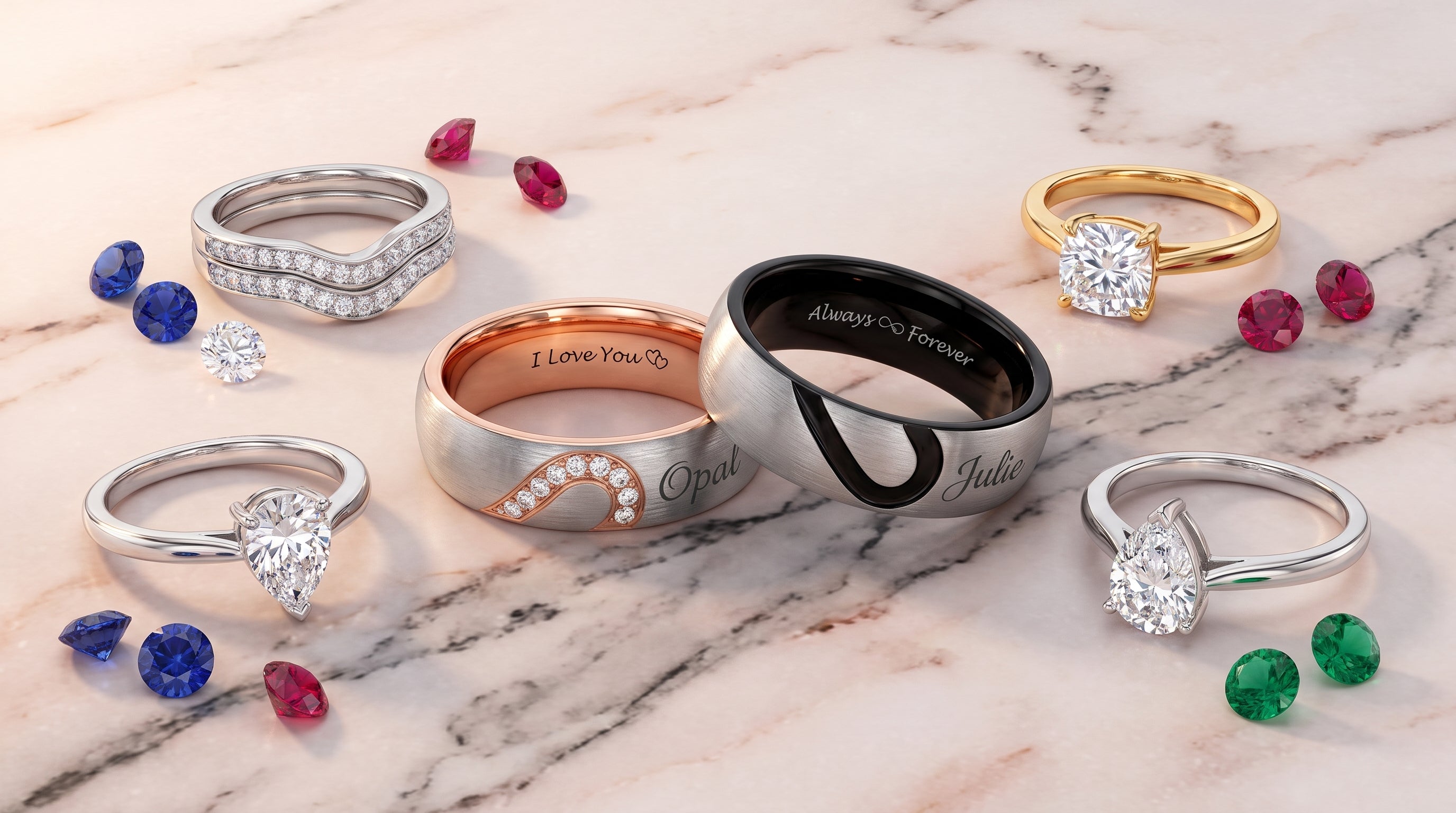
Die Passenden Diamant-Herz-Paarringe werden als Set von zwei verkauft, eines für ihn und eines für sie, die um ein Herzmotiv herum gebaut sind. Laut Produktbeschreibung verfügt der Herrenring über ein elegantes schwarz plattiertes Herzdetail, der Damenring ist mit im Labor gezüchteten Diamantsimulanten und hypoallergener 18K Roségold-Beschichtung akzentuiert, und beide sind aus massivem chirurgischem Edelstahl gefertigt. Eine personalisierte Gravur ist verfügbar, und jede Bestellung enthält eine Geschenkbox. Hier gibt es keine Geburtssteine – das Funkeln kommt von Diamantsimulanten – dies ist also die Wahl für Paare, die ein koordiniertes, gravierbares Paar wünschen und keine wörtlichen Monatssteine.
Gebogene Sets für Paare, die möchten, dass die Ringe optisch ineinandergreifen
Die Gebogenen Pavé-Paarringe und die Gebogenen Moissanit-Paarringe sind beide als Paare-Sets mit gebogenen Profilen aufgeführt, was eine nützliche Form ist, wenn einer der Partner bereits einen Verlobungsring trägt und ein Band wünscht, das bündig daran anliegt. Die Emaille-Kontrast-Paarringe verfolgen stattdessen einen Color-Blocking-Ansatz und verwenden Emaille anstelle von Steinen für den Kontrast zwischen den beiden Ringen. Überprüfen Sie vor der Bestellung jede Produktseite auf die aktuellen Stein-, Metall- und Größenangaben und durchsuchen Sie das gesamte Angebot an Paarringen-Sets, wenn Sie Profile direkt vergleichen möchten.
Einzelsteinringe für eine Eins-Stein-Paarung
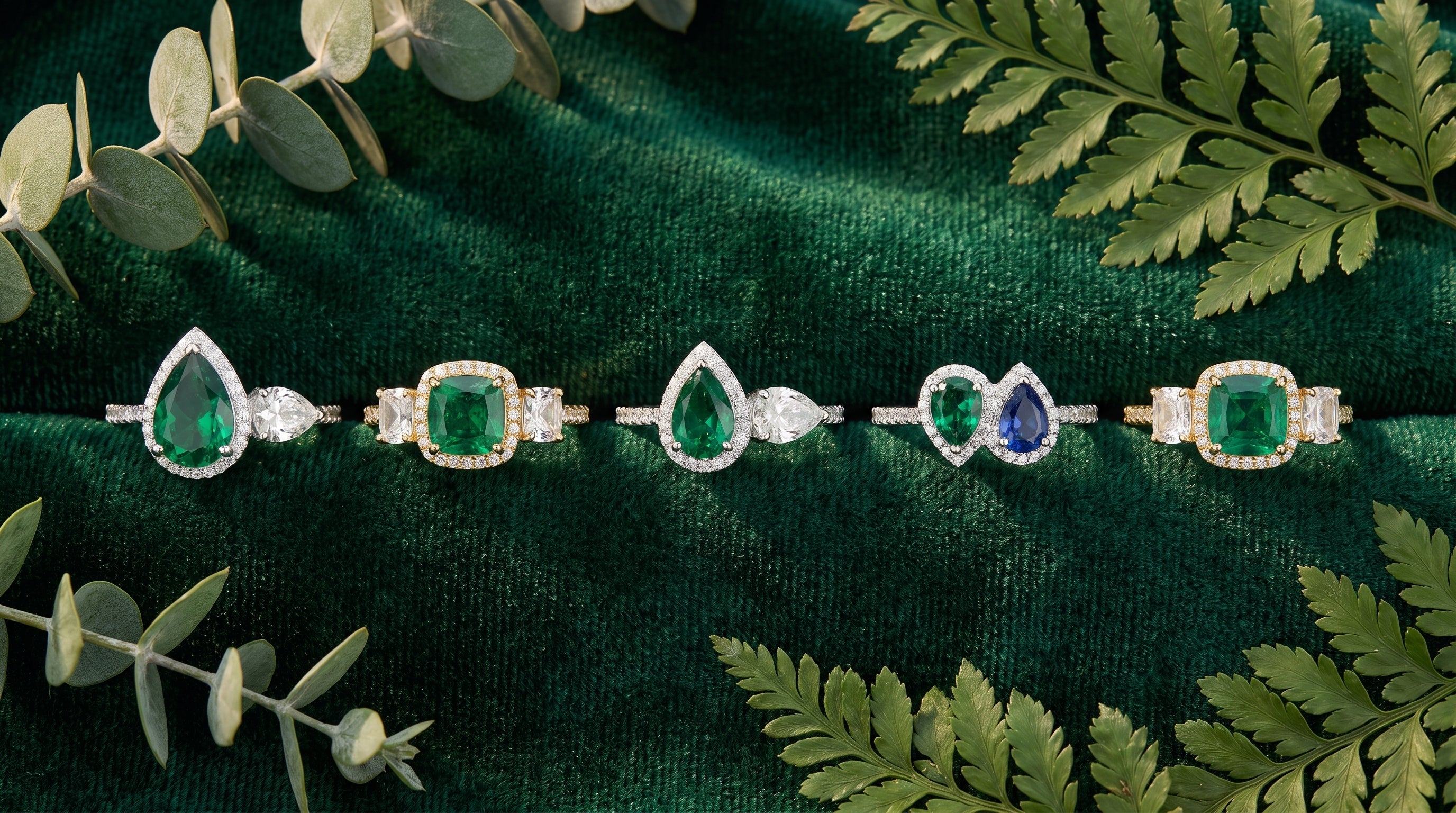
Hier können Sie echte Geburtssteinsymbolik aus unserem Katalog aufbauen. Der Grand Duchess Amethyst Ring ist ein lila Amethyst-Design – Amethyst ist der traditionelle Geburtsstein im Februar – und funktioniert als Statement-Stück für einen Februar-Partner. Für wärmeres Metall sind der Valerine Cushion Ring und der Azurina Cushion Ring beide 18K Gold Vermeil Kissenschliff-Designs, während der Marcella Pear Ring, der Calystara Pear und der Valerise Ring S925 Sterlingsilber-Designs sind. Kombinieren Sie zwei davon – einen pro Partner, farblich passend im Metall, damit sie als Set wirken – und Sie erhalten eine Zwei-Ring-Interpretation einer Geburtssteingeschichte für Paare. Da es sich um feste Designs und nicht um konfigurierbare Geburtssteinringe handelt, bestätigen Sie den Stein auf jeder Produktseite, anstatt einen bestimmten Monat anzunehmen. Sie können auch die Geburtssteinschmuck-Kollektion durchsuchen, um zu sehen, welche Steinfarben derzeit verfügbar sind.
Wie man sich entscheidet: ein kurzer Kaufrahmen
Klären Sie zuerst die Frage der Steinanzahl
Zwei Steine für Sie beide; drei, wenn Sie ein Kind oder einen dritten Meilenstein einschließen möchten. Wenn die Familie wachsen könnte, wählen Sie entweder ein Design, das Sie gerne so behalten würden, oder planen Sie ein stapelbares Band, das Sie später erweitern können, anstatt eines Rings, der neu angefertigt werden müsste. Stapelbarkeit ist einer der praktischen Gründe, warum Käufer von Drei-Stein-Ringen zu schmaleren Profilen tendieren.
Wählen Sie das Metall für die Hände, die es tragen werden
Passen Sie das Metall an den Lebensstil an, nicht nur an den Geschmack. Massivgold und Platin vertragen ständiges Tragen mit minimaler Pflege. Sterlingsilber ist erschwinglich und leicht nachzubearbeiten, läuft aber an und muss gereinigt werden. Vermeil und plattierter Edelstahl bieten einen Gold-Look zu geringeren Kosten, wobei zu beachten ist, dass die Oberflächenveredelung ein Verschleißteil ist. Wenn einer der Partner zuvor auf Schmuck reagiert hat, bevorzugen Sie Metalle mit höherer Reinheit oder explizit hypoallergene Konstruktionen und überprüfen Sie die Legierungsdetails auf der Produktseite.
Entscheiden Sie, wie Sie zur Herkunft der Steine stehen
Natürliche Edelsteine, im Labor gezüchtete Steine und Imitationen kommen in dieser Kategorie vor, manchmal zu ähnlich aussehenden Preispunkten. Im Labor gezüchtete und imitierte Steine können eine stärkere, konsistentere Farbe liefern – ein echter Vorteil bei Mehrsteinringen, bei denen Sie möchten, dass drei Steine ausgewogen aussehen –, während natürliche Steine den Reiz ihrer geologischen Herkunft und Variationen mit sich bringen. Keine Wahl ist von Natur aus besser; wichtig ist, dass die Beschreibung angibt, was Sie bekommen. Unser allgemeiner Kaufleitfaden für Geburtssteinringe behandelt diesen Kompromiss zusammen mit den Grundlagen von Metall und Fassung.
Einigen Sie sich auf ein Budget, bevor Sie stöbern
Paarringe bewegen sich in einer ungewöhnlich breiten Preisspanne, von handgefertigten Marktplatzstücken bis hin zu Goldschmuck aus Massivgold, was eine vereinbarte Obergrenze nützlicher macht als ein Ziel-Design. Der Leitfaden für Paarringe von Esdomera schlägt einen Rahmen vor – etwa ein bis drei Prozent des Jahreseinkommens für Paarringe zu reservieren – zusammen mit dem Rat, Qualität und Langlebigkeit über Größe oder Glanz zu stellen. Behandeln Sie dies als eine Heuristik eines Händlers und nicht als Regel, aber der grundlegende Punkt ist stichhaltig: Entscheiden Sie gemeinsam die Summe, dann kaufen Sie innerhalb dieses Rahmens, denn Personalisierungsoptionen können im Laufe des Prozesses stillschweigend Kosten verursachen.
Planen Sie den Zeitrahmen rückwärts vom Datum
Gravur, Steineinfassung und individuelle Mehrsteinbearbeitung verlängern die Produktionszeit, und eine Größenänderung nach Lieferung dauert länger. Wenn die Ringe für einen bestimmten Anlass bestimmt sind, arbeiten Sie rückwärts: Anlassdatum, Versandfenster, Produktionsfenster und ein Puffer für Größenumtausch. Das frühzeitige Messen beider Ringgrößen – idealerweise am Ende des Tages, wenn die Finger am größten sind – verhindert die häufigste Verzögerung nach der Lieferung.
Häufig gestellte Fragen
Sollten wir zwei Steine in einem Ring oder jeweils einen Stein kaufen?
Ein Ring mit zwei Steinen ist die stärkere symbolische Aussage und wird normalerweise von einem Partner getragen. Zwei Ringe mit jeweils einem Stein eignen sich für Paare, die beide etwas tragen möchten, sehr unterschiedlichen Geschmack haben oder deren Geburtssteine in einer einzigen Fassung kollidieren. Viele Paare tun beides im Laufe der Zeit: einen Zwei-Stein-Ring zum Jubiläum und dazu passende Einzelsteinringe für den Alltag.
Müssen Partnerringe exakt übereinstimmen?
Nein. Passende Sets wie das oben abgebildete Herz-Design machen die Paarung offensichtlich, aber die Wiederholung eines Elements – dasselbe Metall, dieselbe Bandbreite, dieselbe Steinform – reicht aus, um als Paar zu wirken, während jeder Ring seinem Träger gerecht wird. Gebogene und Emaille-Kontrast-Sets sind Beispiele für koordinierte, aber nicht identische Designs.
Kann ein Drei-Stein-Ring sowohl ein Partnerring als auch ein Mutterring sein?
Ja, und genau diese doppelte Lesart ist der Grund, warum dieselben Designs auf beide Arten vermarktet werden. Ein Ring mit den Steinen zweier Partner, die den Stein eines Kindes flankieren, funktioniert gleichzeitig als Partnerring und als Mutterring. Wenn Sie ihn eher familiär betonen möchten, zentrieren Sie den Stein des Kindes; wenn Sie ihn romantisch betonen möchten, lassen Sie die beiden Partnersteine dominieren und behandeln Sie den dritten als Akzent.
Was ist, wenn der Geburtsstein eines Partners uns nicht gefällt?
Mehrere Monate haben mehr als einen anerkannten Stein – insbesondere Juni, Oktober, November und Dezember – prüfen Sie also die Alternativen, bevor Sie Kompromisse eingehen. Wenn das nicht hilft, verwenden Sie einen Stein, der mit einem gemeinsamen Datum statt einem Geburtsmonat verbunden ist, oder wählen Sie für einen Partner einen farblosen Stein, damit die Farbe des anderen den Ring trägt.
Lohnt sich das Hinzufügen einer Gravur?
Gravuren sind die günstigste sinnvolle Personalisierung im Schmuckbereich und diejenige, die am ehesten Jahre später nochmals gelesen wird. Initialen, ein Datum oder ein kurzer Satz im Inneren des Bandes funktioniert bei fast jeder Breite. Bestätigen Sie Zeichenbegrenzungen und ob gravierte Artikel rückgabefähig sind, bevor Sie bestellen, da personalisierte Stücke häufig von Standardrücksendungen ausgeschlossen sind.
Die Kurzfassung
Geburtssteinringe für Paare lassen sich auf drei Formate und eine Entscheidung reduzieren. Wenn Sie beide Identitäten in einem einzigen Ring wünschen, suchen Sie nach Zwei-Stein- und Toi-et-Moi-Designs und achten Sie auf Farbbalance und Steinhärte. Wenn Ihre Geschichte ein Kind oder einen dritten Meilenstein umfasst, wählen Sie ein Drei-Stein-Design und lesen Sie unseren speziellen Drei-Stein-Leitfaden, bevor Sie sich für ein Layout entscheiden. Wenn keiner der Partner bei der Steinfarbe Kompromisse eingehen möchte – oder wenn Sie lieber ein koordiniertes Paar mit Gravur als ein konfigurierbares Mehrsteinband möchten –, stellen Sie das Set aus passenden Partnerringen oder zwei Einzelsteinringen im gleichen Metall zusammen.
Awareness Avenue befindet sich fest in der dritten Kategorie: designorientierte Paare-Sets wie die Matching Diamond Heart Couples Rings und Feststein-Edelsteinringe, die Sie pro Partner paaren können. Das ist eine bewusste Positionierung und keine Umgehung, und es klar zu sagen, ist besser, als Anpassungsmöglichkeiten zu implizieren, die wir nicht anbieten. Welchen Weg Sie auch immer wählen, schreiben Sie auf, wen jeder Stein darstellt, bevor Sie bestellen. Es ist das Detail, das den Ring in zwanzig Jahren erzählenswert macht, und das Detail, das die meisten Käufer zuletzt entscheiden.

Hinterlasse einen Kommentar
Diese Website ist durch hCaptcha geschützt und es gelten die allgemeinen Geschäftsbedingungen und Datenschutzbestimmungen von hCaptcha.