


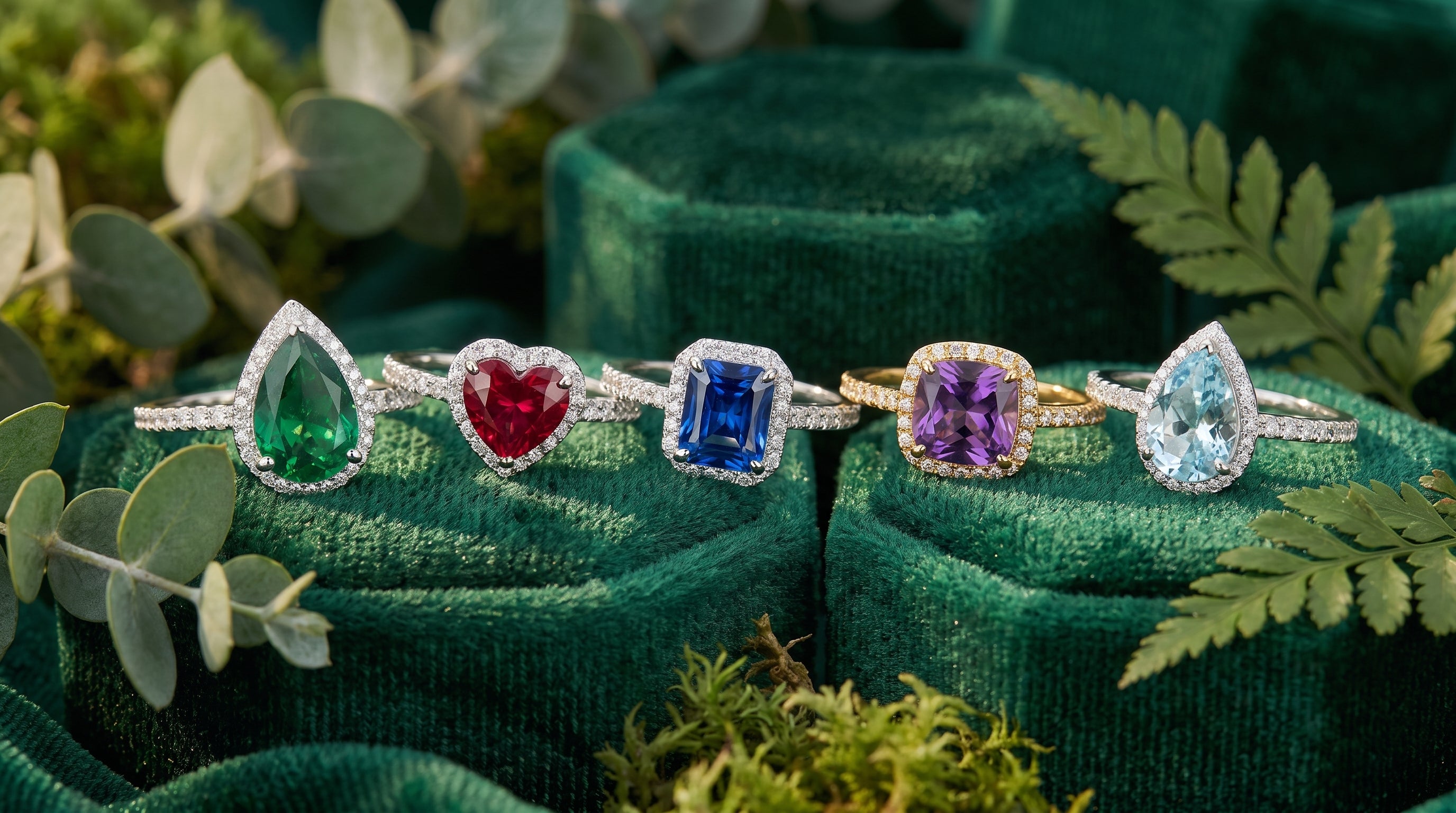
A five-stone family ring is a proportion problem as much as a sentimental one. Jewlr's Organic Leaf Five Stone Family Ring, for instance, sets its five stones as 2.5 mm rounds on a band measuring roughly 2.0–2.6 mm wide, with a maximum ring width of about 5.5 mm. Those numbers are the whole design brief in miniature: once you commit to five stones on one band, each stone has to shrink so the row stays wearable across a finger joint. Understanding that trade-off is what separates shoppers who love their five-stone ring from those who quietly stop wearing it.
This guide covers what five-stone birthstone rings actually are, which retailers document genuine five-stone configurations, how to spec stones, metal, and engraving, how five compares with two-, three-, four-, and six-stone alternatives, and what to expect from custom production timelines. It closes with an honest look at single-stone stacking — including where Awareness Avenue's own catalog does and does not fit this search.
What a Five-Stone Birthstone Ring Is (and Who Buys One)
Search for “birthstone rings 5 stones” and the results are almost entirely configurable mothers rings and family rings — not general birthstone jewelry. Jewlr, Kay, Zales, Ana Luisa, Mint & Lily, and specialist sites such as MothersFamilyRings.com all maintain product or category pages built specifically around a five-stone configuration, which tells you what the market assumes you want: a single band where five distinct stones stand for five people.
Jewelry education sources define the category consistently. A mother's ring is described as a personalized piece featuring gemstones that represent each child, typically their birth months, most often arranged in a simple row although more intricate patterns exist. Design guides describe the same three building blocks — birthstones, engravings, and metal choice — and treat stone count as the first decision, made by counting the children or grandchildren the ring will represent.
Who the five stones usually represent
In practice, five stones map onto several household shapes. The most literal is five children. Just as common are four children plus a partner, three children plus both parents, or a mix of children and grandchildren. Jewlr's five-stone mothers ring page frames the configuration broadly — children, grandchildren, or other loved ones — which is a useful signal that you are not obliged to use the stones in birth order or restrict them to immediate family.
Blended families, memorial stones for a lost family member, and stones for a pet all fit inside a five-stone band as long as you plan the color order before you order. Because the stones sit adjacent to one another, sequence is a permanent design decision, not a detail.
When five stones is aesthetic rather than literal
Not every buyer counts people. Mint & Lily's Five Stone Statement Ring, for example, is marketed as a statement birthstone piece rather than under mothers ring language, which reflects a second audience: people who simply want five colors across the finger. If that's you, the symbolic rules relax entirely — you can repeat a stone color, run a gradient, or pick five gems purely for how they read together in daylight.
Why five is a design ceiling for classic bands
Design guidance for mothers rings notes that classic band configurations typically hold one to five stones and suit everyday wear. That's a meaningful boundary. At five stones, a straight band is still slim enough to sit under a knuckle and beside other rings. Beyond five, designers generally have to widen the shank, stagger the stones, curve the band, or move to a cluster — which is exactly what six-stone family rings do.
Five-Stone Birthstone Rings and Mothers Rings Worth Comparing
The following options are drawn from retailers with documented five-stone (or five-stone-capable) products. Specifications below reflect what each brand states on its own pages; confirm current metals, stone options, and availability directly before ordering, since configurable jewelry catalogs change frequently.
| Ring | Stone count | Metals stated by the brand | What stands out |
|---|---|---|---|
| Jewlr — Organic Leaf Five Stone Family Ring | 5 (any birthstones) | Sterling silver; white, yellow, or rose gold | Published dimensions: five 2.5 mm round stones, band 2.0–2.6 mm, max width 5.5 mm |
| Ana Luisa — 5 Stone Birthstone Ring | 1–5, configurable | Gold vermeil or 10K solid gold | Modular stone count; made to order with a stated shipping window |
| Zales — Mother's Birthstone and Diamond Accent Wave Ring | 5 plus diamond accents | Not stated in available product data | Wave-shaped band rather than a straight row |
| Kay — Mother's Family Birthstone Asymmetric Contoured Ring | Up to 5 | Customer's choice of metal | Asymmetric contoured silhouette with interactive personalization |
| Mint & Lily — Five Stone Statement Ring | 5 | Not stated in available product data | Fashion-first statement design; brand claims the rings never tarnish |
| MothersFamilyRings.com — Five Stone Mothers Rings | 5 | Gold and platinum | An entire collection dedicated to the five-stone count, in precious metals |
| ArtCarved — Sophisticate (six-stone family ring) | 6 | Sterling silver; 10K, 14K, 18K white and yellow gold | Ten personalization options, simulated or genuine stones, text in four areas |
If you want published dimensions before you buy
Jewlr's Organic Leaf design is the most transparent of the group on physical specs, and those specs are worth borrowing as a benchmark. If a competing five-stone ring doesn't publish stone diameter and band width, ask. A 2.5 mm stone reads as a delicate accent; a ring that squeezes five larger stones into the same footprint will sit higher and catch on clothing more.
If you want flexibility on stone count
Ana Luisa's five-stone ring lets you choose anywhere from one to five stones within the same design, in gold vermeil or 10K solid gold. That modularity is genuinely useful for two situations: a family that isn't finished growing, and a gift where you're unsure whether the recipient wants a loud or quiet piece. It also lets you match budget to metal without abandoning the design.
If you want something other than a straight row
Zales' wave ring and Kay's asymmetric contoured ring both break the row. A curved or contoured band distributes five stones across a longer visual line, which can make each stone feel less crowded and can sit more comfortably against a wedding band. Jewlr's wider mothers ring assortment shows the same instinct at other counts — bypass settings and heart arrangements at three stones, marquise-with-round-accents and heart layouts at four.
If you want precious metal over plating
MothersFamilyRings.com's five-stone collection is presented in gold and platinum, and ArtCarved's six-stone Sophisticate spans sterling silver through 18K gold. If you expect the ring to be worn daily for decades and eventually handed down — mothers rings are frequently described as heirloom pieces — solid metal is the more conservative choice.
How to Spec a Five-Stone Ring: Stones, Metal, Setting, and Engraving
Published mothers ring design guidance sets out a four-step order of decisions, and it holds up well at five stones, where mistakes are more visible than they are at two or three.
1. Lock the stone count first — and think about growth
Count the people the ring will represent, then ask whether that number is stable. Design guidance specifically recommends choosing a style that can accommodate one or two additional stones later if the family is still growing, and notes that classic band structures make future additions easier than more sculptural designs. A five-stone ring built on a modular band gives you somewhere to go; a five-stone cluster usually does not.
2. Choose stones for meaning, then check color harmony
Start with traditional birthstones, then evaluate the five colors side by side before ordering. Color harmony is what makes a multi-stone ring wearable day to day, and five stones is where clashes become obvious — a run of blues and greens reads as a considered palette, while a scattered mix of red, orange, purple, and pale blue can look accidental. Two workable strategies: order stones by birth date and accept the palette you get, or group cool tones together and let a single warm stone act as a focal point. Many configurators show a live preview; use it.
3. Match metal to lifestyle, not just budget
Design guidance recommends selecting metal based on how the wearer lives, suggesting platinum or 14K gold for people who are active or work with their hands. Sterling silver and gold vermeil sit at a friendlier price point and are widely offered — Ana Luisa uses gold vermeil alongside 10K solid gold, and ArtCarved offers sterling silver alongside 10K, 14K, and 18K. Gold vermeil is a gold layer over a silver base, so plating thickness and wear behavior are worth confirming on the specific product page rather than assumed. Our guide to gold birthstone rings breaks down how karat choice interacts with stone color and setting.
4. Plan engraving before you commit
Engraving is treated as the final step for a reason: it is permanent, and character limits vary by design. Confirm the limit with the jeweler before you write out five names, and remember that a five-stone band has less flat surface than a wider six-stone design. ArtCarved's Sophisticate, by contrast, offers text personalization across four separate areas of the ring, which is the kind of capacity a longer inscription needs.
Simulated versus genuine stones
Some family rings let you choose between simulated and genuine stones — ArtCarved states this explicitly for the Sophisticate. The distinction affects price and, over time, appearance. If the brand doesn't say which it uses, ask directly rather than inferring from photography; a five-stone ring is not a piece you want to guess about.
Five Stones Versus Two, Three, Four, Six, Seven, and Eight
Retailers segment mothers rings by exact stone count for a reason: the design changes at every step. Jewlr maintains separate three-stone, four-stone, and five-plus-stone mothers ring categories; Kay lists a personalized four-stone birthstone family and mothers ring within its mothers ring range. Here's how the counts behave.
Two and three stones
Two-stone rings suit couples, a parent and one child, or a pair of siblings, and they leave room for a substantial stone size. Three-stone designs are where shape variation starts to appear — Jewlr's three-stone assortment includes bypass and heart arrangements rather than only a straight row. If your count is lower than five, start with our three-stone birthstone ring guide or the two-stone comparison.
Four stones
Four is the most common alternative for shoppers who arrive at five-stone searches and then recount. It keeps a slim band, and retailer assortments at this count include marquise stones with round accents and heart-shaped layouts — useful if you want something less conventional than a row. Our four-stone family ring guide covers layout and sizing at that count in detail.
Six stones and up
Six is where dedicated family ring designs take over from classic bands. ArtCarved's Sophisticate is explicitly a six-stone family ring with a princess-shaped main stone around 4 mm wide and ten personalization options, spanning sterling silver to 18K gold. The design complexity is the point: at six stones you generally need a wider or sculpted band to keep the stones proportionate.
For seven- and eight-stone mothers rings, be prepared to ask rather than browse. Dedicated seven- and eight-stone product pages did not appear in the current landscape we reviewed, even though several large retailers offer deep personalization. What is well supported is the underlying principle: as stone count rises, band width, stone size, and engraving capacity all become harder to balance, so custom or semi-custom work is the realistic route. Two practical workarounds are a two-row or stacked pair of bands (four stones plus four stones), or one wide band plus a companion ring — both of which keep individual stones large enough to read.
Single-Stone Alternatives and Stacking: Where Awareness Avenue Fits
To be direct: Awareness Avenue does not currently offer a five-stone mother's ring or any multi-stone birthstone band. Our birthstone jewelry collection is built around single-stone rings in S925 sterling silver and 18K gold vermeil. If your requirement is five birthstones on one band, the retailers listed above are the ones to shop.
That said, a meaningful number of people searching for five-stone rings end up choosing differently once they see how small each stone becomes. The stacking approach — one solitaire per person, worn together or across fingers — is the main alternative, and it has real advantages: each stone stays a proper focal size, you can add a ring when the family grows without redesigning anything, and the set can be split between everyday and occasion wear.

Building a five-person set from solitaires
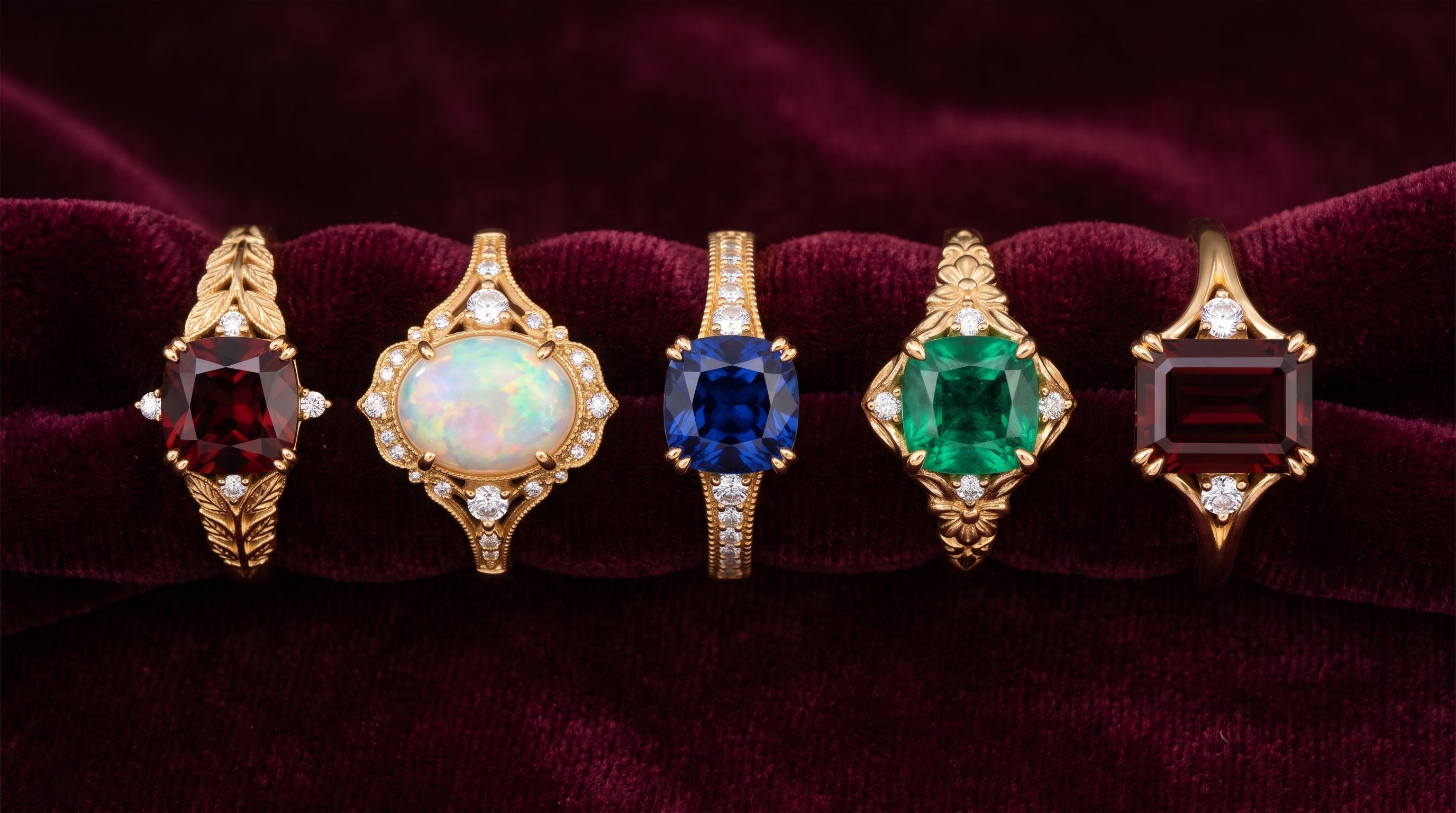
Two approaches work. Match the cut across every ring and let the stone colors do the differentiating — for example, all cushion cuts using The Valerine Cushion Ring, The Azurina Cushion Ring, and The Arisara Cushion Ring in 18K gold vermeil. Or vary the cut so each person's ring is individually recognizable: The Marcella Pear Ring and The Calystara Pear in pear, The Elianara Heart Ring in heart, The Azurea Radiant Ring and The Elianise Radiant Ring in radiant, plus The Valerise Ring or The Sylphide Ring as the anchor. All of these are sterling silver or 18K gold vermeil, and each carries one stone — not five.

A third pattern worth considering: buy one solitaire in the mother's own birthstone as the daily piece, and keep the family symbolism on a separate multi-stone piece such as a pendant. Our guide to birthstone rings for mothers compares that split against a single all-in-one band.
Sizing, Production Time, and Shipping for Multi-Stone Rings
Two operational issues cause most of the disappointment around custom birthstone rings: fit and lead time. Both are solvable if you plan.
Getting the size right
The paper-strip method is the standard at-home approach and appears in Awareness Avenue's own sizing guidance: cut a strip of paper or use a piece of string, wrap it around the finger you're sizing, slide it up over the knuckle to confirm the ring can actually pass, mark where the ends intersect, then measure that length against a ruler and match it to a size chart. To size someone else without asking, measure the inside diameter or circumference of a ring they already wear and compare that against the chart, which maps US, UK, AU, and CA sizes to millimeter diameters and circumferences.
One extra consideration for five-stone bands specifically: check the size at the end of the day, when fingers are largest, and remember that a wider band generally feels tighter than a thin one at the same nominal size.
Realistic lead times
Made-to-order jewelry is not next-day jewelry. Ana Luisa states that its five-stone birthstone ring is custom-made and gives a specific delivery window with free shipping. Smaller studios can take considerably longer: Little Sycamore's published FAQ notes that ready-to-ship orders leave in one to five business days, that raw stone rings made in silver need additional plating time when ordered in gold or rose gold with processing of three to six weeks, that mini momma rings and birthstone stackables ship in two to three weeks, and that fully custom mothers rings have no guaranteed ship date, usually take a couple of months, and cannot be rushed — with silver shipping sooner than gold or rose gold. The same FAQ notes that orders don't ship until every piece is ready, though customers can request a split shipment for ready-to-ship items.
Shipping speed is a separate clock. Little Sycamore describes standard USPS mail as typically around five days and Priority as around three, while explicitly noting those times are controlled by the postal service and can't be guaranteed. If the ring is for a birthday, Mother's Day, or a milestone, work backward from the event and add slack for both production and transit.
Verify policies before you order
Return and exchange terms vary widely and are frequently narrower for personalized items than for stock pieces. Little Sycamore's FAQ indicates refunds and exchanges are accepted on standard designs but doesn't publish full terms for custom work. Read the specific retailer's policy page before ordering an engraved or configured five-stone ring, and treat brand durability language — including tarnish claims such as Mint & Lily's “never tarnish” statement — as a marketing position rather than an independently tested result.
Frequently Asked Questions
Does a five-stone birthstone ring have to represent five children?
No. Retailers frame the five-stone configuration around children, grandchildren, or other loved ones, and plenty of buyers use it for a partner plus children, a parent plus siblings, or simply five colors they like. Stone count corresponds to whoever the wearer wants to include.
What happens if the family grows after I buy?
Choose a structure that anticipates it. Design guidance recommends selecting a style that can accommodate one or two additional stones later, and notes that classic band configurations make future additions more practical than sculptural or cluster designs. Alternatively, build the set from stackable single-stone rings so an addition means one new ring, not a rebuild.
Can I get seven or eight stones on one mother's ring?
Dedicated seven- and eight-stone product pages weren't visible in the current retail landscape we reviewed, so treat higher counts as a conversation with a jeweler rather than an off-the-shelf purchase. Six-stone family rings are clearly available — ArtCarved's Sophisticate is one — and they show how designs widen and add personalization areas as stone count rises.
How small will each stone be on a five-stone ring?
Smaller than you may expect. One documented example uses 2.5 mm round stones on a band 2.0–2.6 mm wide with a maximum ring width of 5.5 mm. If stone presence matters more to you than having everyone on one band, a stacked set of solitaires keeps each gem at a larger, more visible size.
Sterling silver, gold vermeil, or solid gold?
All three appear across five-stone offerings. Sterling silver and gold vermeil are the accessible tier; 10K to 18K gold and platinum are the heirloom tier, and design guidance leans toward platinum or 14K gold for hands-on daily wear. Confirm plating details on the product page for any vermeil piece rather than assuming a specific thickness or lifespan.
Where should I start if I'm still undecided on stone count?
Work through the fundamentals of stones, metals, and layout first — our birthstone ring buying guide covers the decision sequence — then commit to a count. Deciding the number last, after you've seen how palettes and proportions behave, tends to produce fewer regrets than deciding it first.

Leave a comment
This site is protected by hCaptcha and the hCaptcha Privacy Policy and Terms of Service apply.