


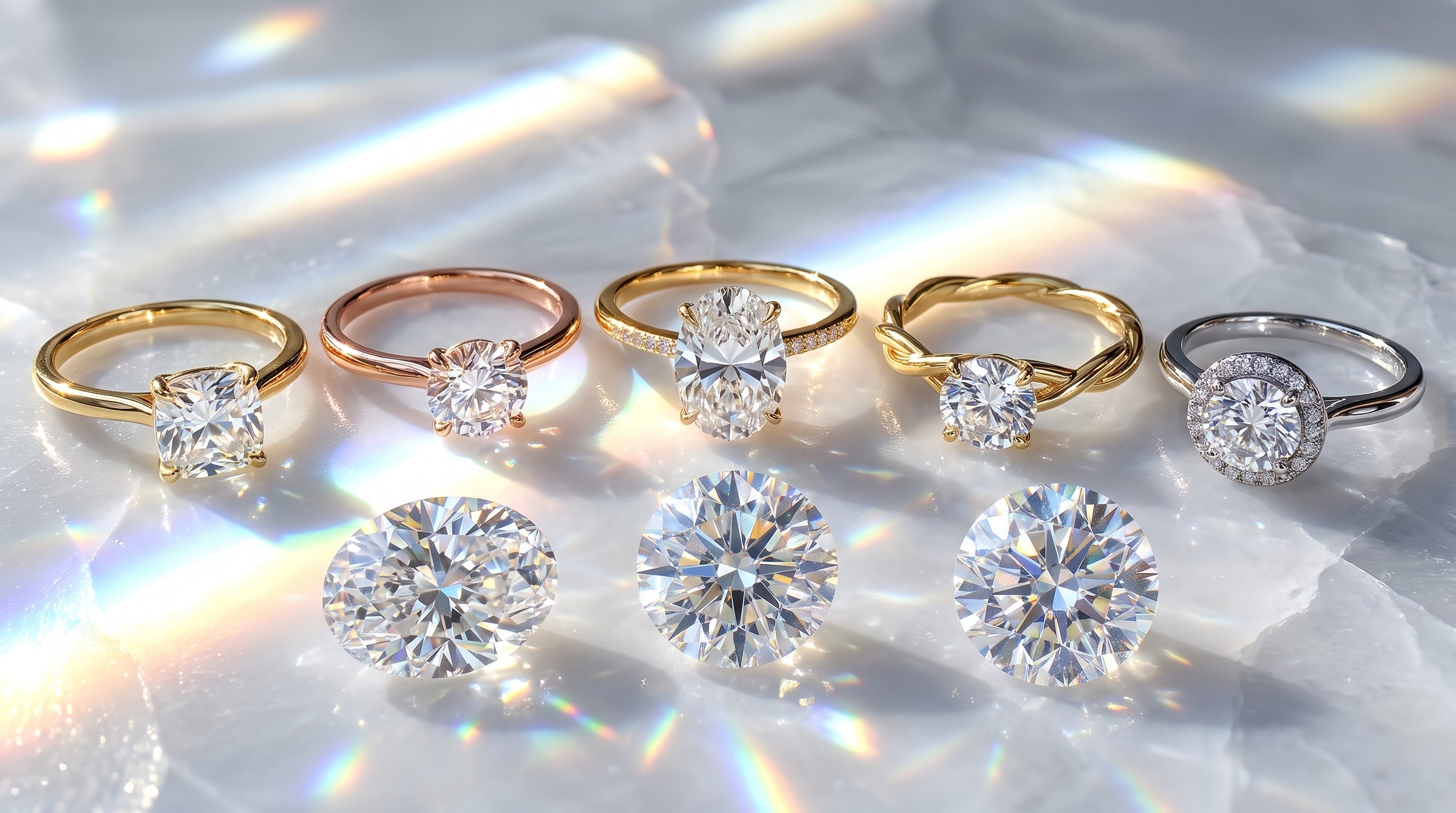
Here is the single sentence that resolves most of the confusion behind this search: all three stones are made in a laboratory, but only one of them is a diamond. Lab-grown diamond is crystallized carbon with the same crystal structure as a mined stone. Moissanite is silicon carbide, a different mineral entirely. Cubic zirconia is zirconium dioxide, engineered specifically to look like diamond without sharing anything chemically with it. "Lab-created" describes where a stone was made, not what it is — and shopping as though those two things are the same is how people end up disappointed six months after the proposal.
That distinction matters because the three materials behave differently under a decade of dishwashing, gym sessions, hand sanitizer and door frames. Below, each stone is treated on its own terms — composition, hardness, optical signature, cost structure, resale reality and symbolism — before the comparison is translated into actual buying scenarios. Awareness Avenue is a moissanite specialist, so that preference is stated up front rather than smuggled into a conclusion; where lab diamonds or cubic zirconia are genuinely the better answer, this guide says so.
What each stone actually is
Gemology draws a line that jewelry marketing frequently blurs. A synthetic or lab-grown diamond is a real diamond made by people. A simulant is any material that mimics diamond's appearance while being a different substance. Moissanite and cubic zirconia are simulants. Lab-grown diamond is not.
Lab-grown diamond: carbon, grown in a reactor
Lab-grown diamonds are pure crystallized carbon with the same atomic arrangement as diamonds formed in the earth's mantle. They are produced through High Pressure High Temperature (HPHT) or Chemical Vapor Deposition (CVD) processes that approximate the conditions under which natural diamonds grow, and the result is chemically, physically and optically indistinguishable from a mined diamond. They are graded on the same fundamental 4Cs — cut, color, clarity and carat — and under Federal Trade Commission guidance they are considered real diamonds. A trained jeweler generally cannot separate a lab diamond from a mined one by eye; it takes specialized equipment.
Moissanite: silicon carbide, and proud of it
Moissanite is silicon carbide (SiC). It was originally identified in tiny crystals recovered from a meteor crater, and natural moissanite is so vanishingly rare in the earth's crust that essentially all jewelry moissanite is lab-created. It is not a diamond, not a "lab diamond," and not a lesser grade of diamond. It is its own gemstone with its own optical fingerprint — which, as the next section shows, is arguably its most interesting feature rather than a defect.
One useful piece of context: the Gemological Institute of America has documented a case in which synthetic moissanite carrying fraudulent GIA inscriptions was submitted to its Johannesburg laboratory as diamond. That case matters for two reasons. It confirms that gem labs treat moissanite as a distinct material requiring spectroscopic and gemological analysis to identify, and it underlines why honest disclosure from a seller is worth more than any inscription on a girdle.
Cubic zirconia: zirconium dioxide, built to imitate
Cubic zirconia is the cubic crystalline form of zirconium dioxide (ZrO₂), typically stabilized with elements such as yttrium or calcium to hold that crystal structure. It contains no carbon at all. It was first researched for technical applications, including laser work, before it was adopted by the jewelry trade in the 1970s as an inexpensive diamond simulant. All jewelry-grade cubic zirconia is lab-made; there is no natural gem equivalent on the market.
Quick reference: the three materials side by side
| Property | Moissanite | Lab-grown diamond | Cubic zirconia |
|---|---|---|---|
| Composition | Silicon carbide (SiC) | Crystallized carbon | Zirconium dioxide (ZrO₂) |
| Is it a diamond? | No — separate gemstone | Yes — real diamond, lab origin | No — diamond simulant |
| Mohs hardness | Around 9.25 | 10 | Around 8 to 8.5 |
| Refractive index | Around 2.65 | Around 2.42 | Around 2.15 to 2.18 |
| Dispersion (fire) | Around 0.104 | Around 0.044 | Moderate, between the two |
| Refraction | Doubly refractive | Singly refractive | Singly refractive |
| Relative cost | Mid-range | Highest of the three | Lowest by a wide margin |
| Resale market | Limited, moderate | Exists, but weak versus mined | Effectively none |
Hardness and how each stone survives a decade of wear
The Mohs scale ranks resistance to scratching, and it is the single most predictive number for how a ring will look in year eight. Diamond, whether mined or lab-grown, sits at 10. Moissanite is consistently reported at approximately 9.25. Cubic zirconia lands around 8 to 8.5.
That looks like a narrow spread until you understand that the Mohs scale is ordinal, not linear. The gap between 8 and 10 in practice is the difference between a stone that accumulates visible surface wear within a few years and one that does not.
Lab diamond at 10: the durability benchmark
Hardness is a function of crystal structure and bonding, not origin, so a lab diamond and a mined diamond of comparable quality behave identically under abrasion. This is why lab diamonds are unambiguously suitable for daily-wear engagement rings and wedding bands. Diamonds are also tough enough to hold their faceted edges under normal conditions, although any diamond can chip if struck sharply along particular crystal directions — a fact that surprises people who have absorbed the marketing idea that diamonds are indestructible.
Moissanite at 9.25: the hardest non-diamond option in mainstream jewelry
Moissanite sits just below diamond and above essentially every other gemstone used in rings — sapphire, ruby, emerald, topaz. Practically, that means a well-set moissanite resists scratching through decades of everyday wear and retains its clarity and sparkle rather than dulling. Retailers and educational sources routinely describe it as the hardest non-diamond gemstone and cite that hardness as the core reason it belongs in fine jewelry rather than in the fashion category. For an engagement ring you intend to wear without removing, this is the practical threshold that matters.
Cubic zirconia at 8 to 8.5: bright now, tired later
Eight on the Mohs scale is respectable in gem terms — it is comparable to topaz. But roughly a full Mohs unit below moissanite has real consequences in a ring worn every day. Cubic zirconia scratches more readily, and the accumulation of micro-abrasions across the table and crown produces a worn, slightly cloudy look. Charles & Colvard, among others, notes that many cubic zirconia stones need replacement after roughly two to three years of regular wear, particularly in exposed settings where the stone takes the brunt of daily contact.
Cleaning does not fully reverse this. Diamond and moissanite respond well to mild detergent or ultrasonic cleaning and hold their polish. Cubic zirconia readily accumulates film from soaps and lotions, and once the surface carries micro-scratches, no cleaning routine restores the original brilliance. One additional technical difference worth knowing: cubic zirconia is a thermal insulator while diamond is a thermal conductor, which is precisely why handheld diamond testers can flag cubic zirconia instantly — and why they cannot reliably separate moissanite from diamond without a dedicated moissanite tester.
Optics: three genuinely different kinds of sparkle
People often assume the three stones look the same and differ only in price. They do not. The numbers behind their optical behavior explain what you will actually notice across a dinner table.
Refractive index and where the light goes
Refractive index governs how strongly a stone bends and returns light. Diamond sits around 2.42. Moissanite is higher, around 2.65. Cubic zirconia is lower than both, around 2.15 to 2.18.
The consequence: moissanite returns more light overall than diamond of the same cut quality, which reads as extra brightness. Cubic zirconia, with the lowest refractive index of the three, reflects more light near its surface and shows less depth — the quality often described as looking "glassy" rather than deep.
Dispersion and the rainbow question
Dispersion is the splitting of white light into spectral colors — the "fire" in a stone. Diamond measures around 0.044. Moissanite measures around 0.104, more than double. Cubic zirconia sits in an intermediate range.
This is the most visually consequential difference in the entire comparison. A diamond, lab-grown or mined, delivers a balanced mix: predominantly crisp white flashes with restrained colored flashes. Moissanite throws considerably more colored fire, and in larger stones under direct or bright light, those rainbow flashes are pronounced enough that an attentive observer can tell the stone is not a diamond.
Whether that is a flaw or a feature is genuinely a matter of taste, and this guide will not pretend otherwise. Some people want the classic, quiet diamond look and find heavy dispersion distracting. Others specifically want the extra color and consider a diamond's fire underwhelming by comparison. Before committing, it is worth seeing both in daylight and in restaurant lighting; our breakdown of what you actually see in moissanite versus lab diamond sparkle goes deeper on how these differences read in real rooms rather than in studio photography.
Double refraction and color
Moissanite is doubly refractive, meaning light entering the stone splits into two rays. Under magnification this can show as doubled facet junction lines, which is one of the diagnostic clues gemologists use. Diamond and cubic zirconia are singly refractive. At normal viewing distance, double refraction is not something you notice; it contributes to the overall liveliness rather than announcing itself.
On color: lab-grown diamonds are graded on the standard D-to-Z scale, so you select color precisely. Moissanite is typically sold as colorless or near-colorless, though larger stones can display a faint warmth or tint under certain lighting, particularly when placed beside a high-color diamond. Premium moissanite growers invest specifically in refining processes to minimize this. Cubic zirconia is easily produced perfectly colorless because color is fully controllable in synthesis — ironically, its color performance is the one area where it competes without compromise.
Price, long-term cost, and the resale conversation
Initial price, cost of ownership and resale value are three separate questions, and conflating them is where most buying decisions go wrong.
Where each stone sits on price
Lab-grown diamonds are the most expensive of the three. Retailer estimates commonly place them 30 to 40 percent below comparable natural diamonds for equivalent cut, color, clarity and carat, though some analyses report substantially wider gaps depending on market conditions. Either way, a lab diamond is still meaningfully more expensive than moissanite and dramatically more expensive than cubic zirconia.
Moissanite occupies the middle. Comparative tables from the International Gem Society show that at any given budget, moissanite delivers a notably larger stone than diamond — one analysis illustrates roughly a seven-millimeter moissanite against approximately half-carat diamonds at the same spend. Per-carat figures reported across moissanite retailers vary considerably by size, cut and quality grade, but the directional pattern is consistent across every source: significantly more face-up size and brightness per dollar than any diamond.
Cubic zirconia is in a different category altogether. Reported figures include raw material at roughly a dollar per carat, better-quality cut stones in the region of twenty to forty dollars per carat, and complete rings selling for tens to a couple of hundred dollars. These are indicative rather than universal, and pricing shifts by vendor and over time — treat them as orders of magnitude, not quotes. For a full treatment of the numbers, see our dedicated moissanite versus lab diamond price breakdown.
Cost per year of attractive wear
This is the metric almost no comparison article uses, and it changes the picture for cubic zirconia. If a cubic zirconia center stone needs replacing after two to three years of regular wear because of scratching and clouding, the cheap purchase price is not a one-time cost — it is a recurring one, plus the labor of resetting and the inconvenience of a ring that periodically looks worse than it did.
Moissanite's higher entry price buys decades of stable appearance. Across a fifteen-year horizon, the arithmetic favors moissanite over serial cubic zirconia replacement for any ring worn daily. Where cubic zirconia genuinely wins is occasional wear: a statement cocktail ring, a travel duplicate of a valuable piece, a costume item for a specific look. In those roles, its limitations barely register.
Resale: the honest version
None of these three stones is an investment, and buying jewelry as an asset is a strategy that disappoints far more people than it rewards.
Lab-grown diamonds are real diamonds but do not hold value the way mined diamonds do, because supply can be scaled with production capacity and they lack the rarity narrative that drives the secondary market. Some analyses put lab diamond resale losses in the range of 50 to 70 percent, with wide variation by stone and market. Natural diamonds are more often described as holding or appreciating in value on the strength of rarity, though even mined diamond resale outcomes are highly variable and frequently disappointing relative to retail price.
Moissanite's resale position is moderate. It is a durable gemstone with ongoing demand and it does not degrade, so a moissanite ring remains a wearable, giftable, resettable piece indefinitely. But there is no standardized secondary market infrastructure comparable to diamond, so do not expect to recover a meaningful percentage.
Cubic zirconia has essentially no resale value in conventional jewelry markets. It functions as a consumable fashion material.
The practical takeaway: if resale genuinely drives your decision, none of these three is the right answer and you should be looking at mined diamonds with clear eyes about their resale variability too. If the ring is a personal symbol you intend to wear rather than liquidate, resale is a distraction and you should optimize for durability, appearance and budget instead.
Ethics and symbolism: what is documented and what is marketing
This is the area where comparison content tends to get loosest, so it is worth separating the defensible from the aspirational.
What can be said with confidence
Lab-grown diamonds and lab-created moissanite both avoid traditional diamond mining. That is a factual, structural difference, and it sidesteps the mining-related environmental disruption and supply-chain risks documented in parts of the diamond industry. This is the substantive basis for the conflict-free positioning that lab-grown brands and moissanite brands both use.
What deserves more caution
"Lab-created" does not automatically mean low-impact. Growing diamonds requires sustained energy input across reactors running for extended periods, and the resulting carbon footprint depends heavily on the energy source powering the facility — a point that even lab-diamond-friendly sources acknowledge. Moissanite production footprints are rarely quantified in publicly available literature; most claims rest on the absence of mining rather than on life-cycle analysis. Cubic zirconia is occasionally described as having "minimal environmental impact" because it is synthesized, but that assertion typically appears without supporting evidence.
The honest position: lab origin removes specific, documented mining harms. It does not, on the evidence available, license blanket sustainability claims for any of the three. Anyone telling you a stone is definitively carbon-neutral should be showing you an audit, not an adjective.
Symbolism, and whether a non-diamond "counts"
This concern is real and worth addressing directly rather than dismissing. Some jewelry advisers argue that natural diamonds carry a specific romance of rarity and deep time — formed over billions of years — and that a lab-grown diamond, though visually identical, cannot replicate that narrative. By that logic, simulants sit further still from tradition.
The counter-position, held by a growing share of couples, is that the stone communicates the values of the people choosing it: financial pragmatism, a preference for spending on a home or a wedding rather than a center stone, an interest in unusual color, or simple indifference to a convention invented largely by twentieth-century advertising. Both positions are internally coherent. What matters is that the two people involved actually agree, because the failure mode is not choosing moissanite — it is one partner assuming diamond while the other quietly economizes. If you are working through the objections people raise about this in practice, our answers to the most common moissanite versus lab diamond objections covers the social-perception questions in more depth.
Which stone fits which situation
Technical data only helps once it is mapped to a specific circumstance. Here is where each material genuinely wins.
Everyday engagement rings
Both lab-grown diamond and moissanite clear the durability bar comfortably. The decision comes down to three questions.
First, does the word "diamond" itself matter to the wearer? If the answer is an unqualified yes, buy a lab diamond and stop optimizing. A stone that a partner privately wishes were something else is a bad purchase at any price.
Second, how much does size matter relative to budget? At a fixed spend, moissanite delivers substantially more face-up size. If the priority is presence on the hand, moissanite is the more efficient route by a wide margin — a two-carat oval like The Opaline or the larger five-carat Opaline reaches proportions that most diamond budgets cannot.
Third, do you like heavy fire? If rainbow flash appeals, moissanite is not a compromise version of diamond; it is a different and arguably more dramatic optical experience. If you want restraint, note that step cuts such as an emerald cut moderate dispersion by trading small facets for long, mirror-like planes — which is exactly why an emerald-cut design like The Adelina Rae reads more subdued than a brilliant-cut round of the same material.
Cubic zirconia is generally not the right choice for a ring meant to be worn daily for decades, on durability grounds alone. The exception is a genuine placeholder — a stone used for the proposal while the real ring is designed, or during a period when the budget simply is not there. That is a legitimate use, and it should be an explicit shared decision rather than a secret.
Men's rings and gender-neutral designs
Men's bands often see harder physical use — tools, weights, steering wheels, keyboards. Comparison content rarely addresses this, but the gemology transfers directly: the 10 and 9.25 hardness figures that make lab diamond and moissanite appropriate for daily-wear engagement rings apply equally to a man's band. Cubic zirconia is the weakest fit here, because the exact conditions that accelerate its surface wear are the ones men's rings encounter most.
Setting design matters more than stone choice in this context. Lower-profile settings with the stone protected by metal on the sides will outlast a high solitaire prong setting in rough use, regardless of what the stone is made of. For a fuller discussion of stone selection in masculine designs, see our guides to one-carat men's rings and real diamonds versus moissanite in men's earrings.
Colored stones
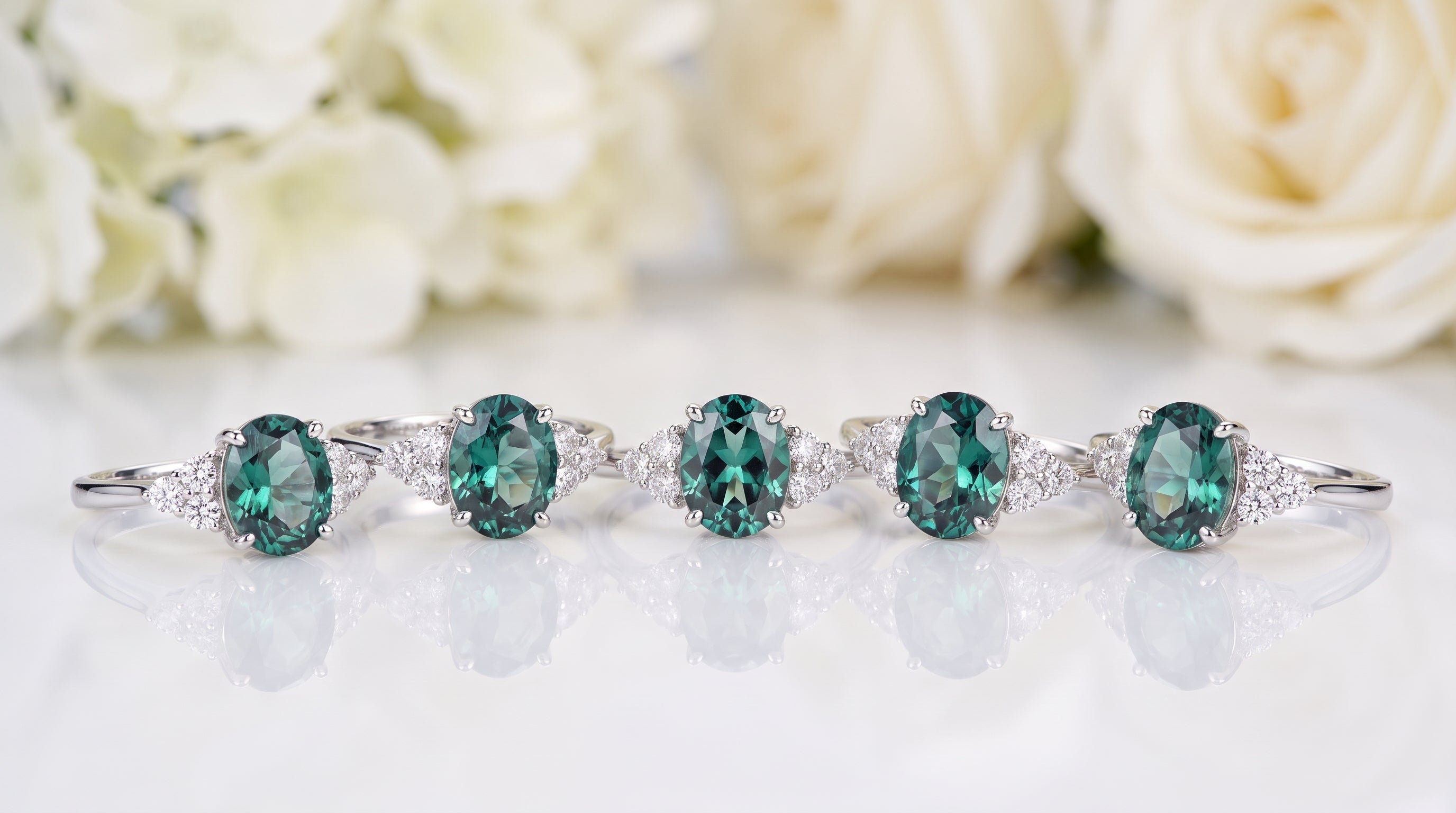
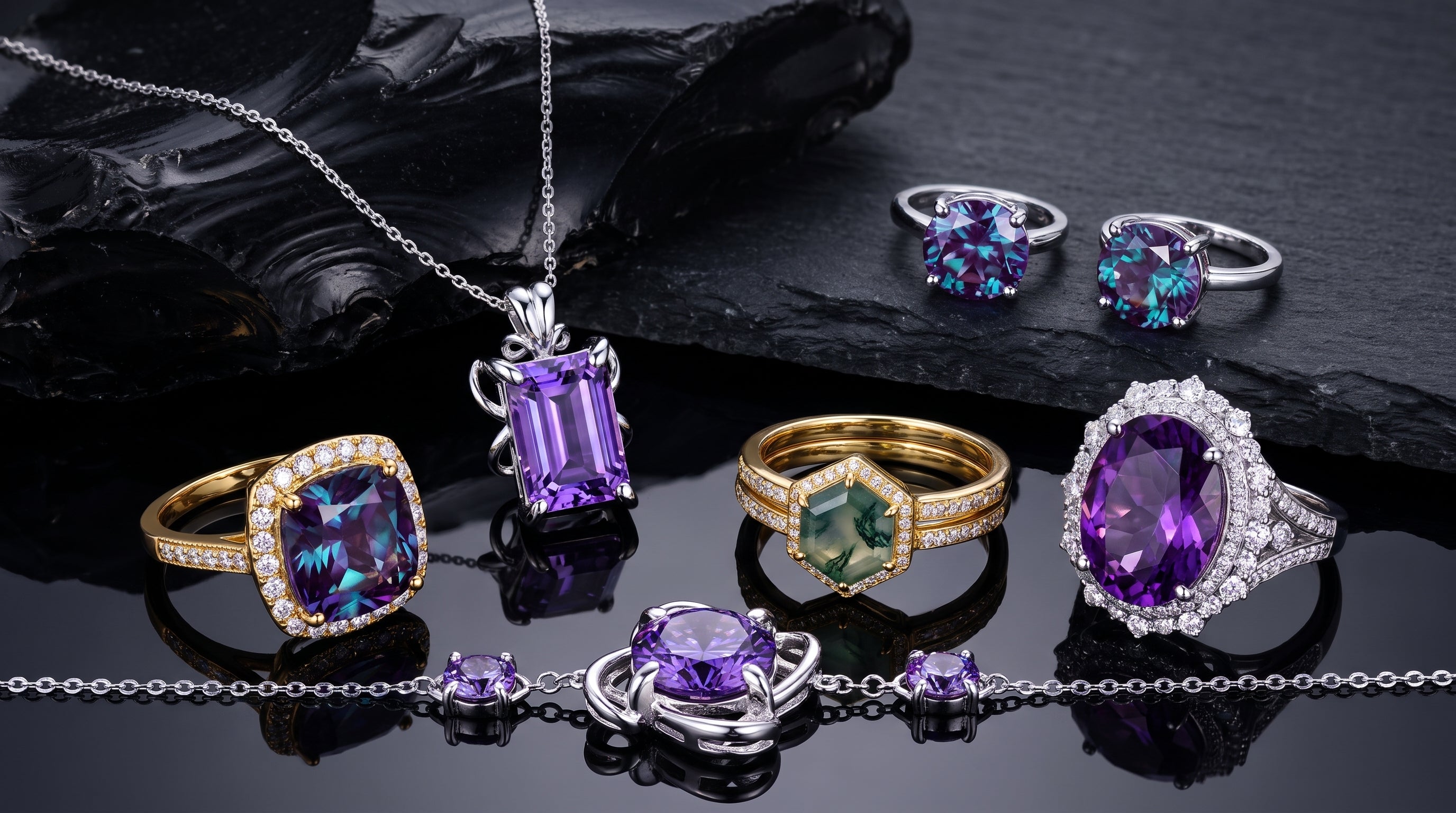
This is where the three-way comparison shifts meaningfully in moissanite's favor, and where most competing articles go silent. Colored diamonds — blue, pink, and their relatives — occupy a price tier far above colorless stones. Moissanite offers colored options at a fraction of that positioning while retaining the same 9.25 hardness, meaning a blue or pink center stone can realistically be an everyday ring rather than an occasional-wear luxury. Pieces like The Eveline in blue and The Camilla in pink illustrate the range. Cubic zirconia is also easily produced in color, but the same wear limitations apply.
Fashion and occasional-wear jewelry
Cubic zirconia's case is strongest here, and it is a real case. For a large statement ring worn a handful of times a year, a travel piece that stands in for something valuable, or a costume look tied to a specific outfit, cubic zirconia delivers a bright, colorless stone at a cost that makes experimentation painless. Its short attractive lifespan is not a problem when the wear hours are low.
Tight budgets with long time horizons
If you want a ring that still looks right in fifteen years but the budget is genuinely constrained, moissanite is the strongest fit among the three. It clears the durability threshold, delivers visible size, and does not require replacement. Designs such as The Celestine, the Twisted Band one-carat round, or The Luna and its rose gold version show how far the material stretches a budget. The full range sits in our moissanite engagement ring collection.
Common misconceptions worth clearing up
"Moissanite is a type of lab-grown diamond"
It is not, and this is the error that most damages purchase decisions. Moissanite is silicon carbide; lab diamond is carbon. Both are grown in laboratories, which is the entire source of the confusion. If a seller describes moissanite as a lab diamond, treat it as a signal about that seller rather than about the stone.
"Lab-grown diamonds are just fancy cubic zirconia"
Also wrong, in the opposite direction. Lab-grown diamonds are chemically, physically and optically identical to mined diamonds and are graded on the same scales. Cubic zirconia shares neither composition nor hardness nor optical behavior with diamond. Multiple ranking guides open by stating this explicitly, which tells you how often the mistake is made.
"Anything lab-created is fake"
Origin and authenticity are different axes. A lab-grown diamond is a real diamond. Moissanite is a real gemstone — a genuinely rare mineral in nature, made accessible by synthesis. Cubic zirconia is a real material too; it is simply a simulant with a specific role and specific limits. "Fake" is the wrong vocabulary for all three. Misrepresentation is the actual problem, which is what the GIA fraudulent-inscription case illustrates.
"Moissanite holds its value like diamond"
It does not, and no honest moissanite seller should imply otherwise. Moissanite's advantage is cost-to-appearance and durability, not resale. Anyone framing moissanite as a store of value is overreaching.
"Cubic zirconia can never be used in bridal jewelry"
Overstated in the other direction. Cubic zirconia is hard enough for everyday wear in some contexts, and some educational sources describe it as an appropriate diamond substitute in bridal pieces. The real objection is not that it cannot be worn — it is that its attractive lifespan is measured in a few years rather than decades, which conflicts with what most people want from a ring symbolizing permanence.
How to make the decision
Work through these in order and the answer usually resolves itself.
Start with the word, not the stone. Decide whether "diamond" is a requirement. If it is non-negotiable for either partner, choose a lab-grown diamond. Every subsequent trade-off is downstream of this.
Then set the wear profile. Daily wear for decades rules out cubic zirconia as a center stone. Occasional wear keeps it firmly in play and makes it the most sensible use of money.
Then decide what you want the sparkle to say. Restrained white brilliance points to diamond. Bold, colorful fire points to moissanite. Neither is correct; they are different aesthetics. Look at both in person, in ordinary light.
Then apply the budget honestly. Fix your number first, then ask which stone gives the best result at that number given the answers above. Do not stretch the budget to buy a smaller stone in a more prestigious material unless the material itself is what you want.
Finally, ignore resale unless you are certain you will sell. Most people never do. Optimizing a ring you will wear for a lifetime around a transaction that will probably never happen is how buyers end up with something they like less than the alternative they rejected.
For a compact side-by-side reference you can revisit while shopping, our stone-selection guide covering the same three materials distills the comparison into a shorter format.
The bottom line
Lab-grown diamond is the right answer when diamond identity matters, when you want the classic optical signature, and when the budget supports it. It is a real diamond with a real diamond's durability at a discount to mined stones, and its weaker resale position is only a drawback if you were planning to sell.
Cubic zirconia is the right answer for occasional wear, costume pieces, travel stand-ins and genuine short-term placeholders. It is bright, cheap and colorless. It is not built for a decade on a hand that never takes it off.
Moissanite is the right answer for the largest group of people running this search: those who want a stone that survives daily wear for decades, delivers meaningful size for the money, and offers a sparkle that is different from diamond rather than a diluted version of it. Awareness Avenue specializes in moissanite and that shapes what is on our shelves — but the case for it rests on the same published gemological figures that make lab diamond a strong choice and cubic zirconia a limited one: 9.25 on the Mohs scale, a refractive index of roughly 2.65, and dispersion around 0.104.
If moissanite is where you land, the moissanite ring collection spans classic solitaires, emerald cuts, twisted bands and colored center stones. If you land somewhere else, you now have the numbers to buy that stone with confidence too.

Leave a comment
This site is protected by hCaptcha and the hCaptcha Privacy Policy and Terms of Service apply.