


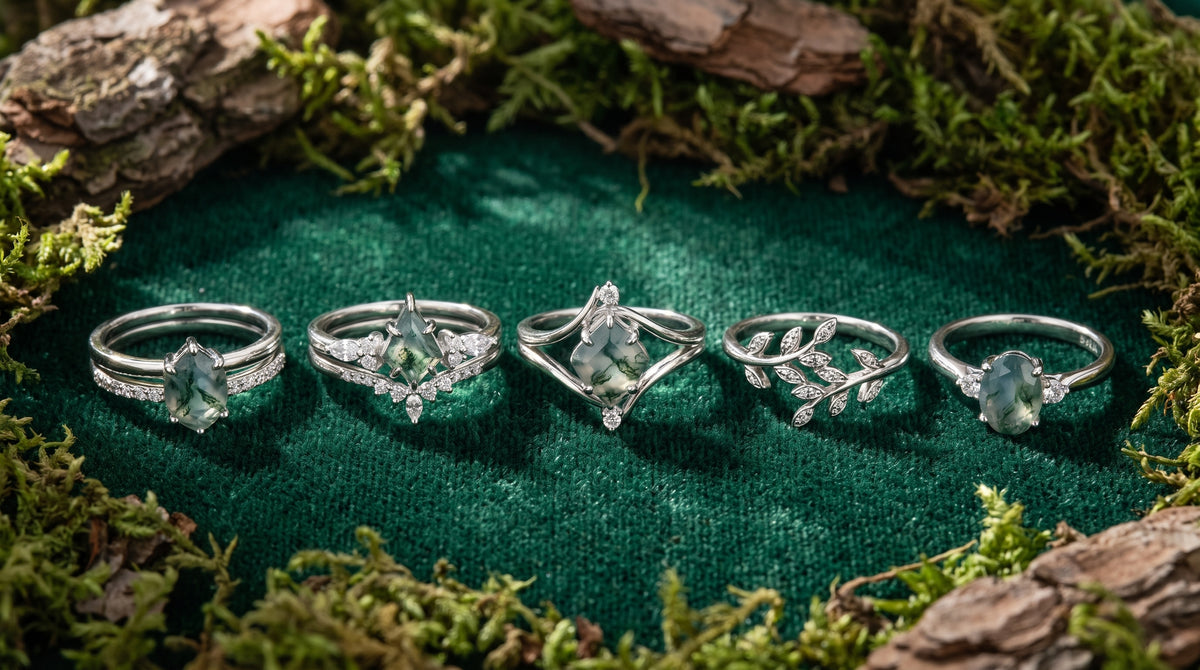
Search for a moss agate engagement ring in silver and you walk straight into a disagreement that most product pages never mention. On one side, marketplace listings routinely label S925 sterling silver moss agate rings as engagement and promise rings, leaning on romantic copy about vines, leaves, and everlasting love. On the other side, the small number of jewelers who actually compare metals for moss agate rank sterling silver last of the three main precious metals for daily wear, rating its protection level as fair and its maintenance demands as high, while placing platinum first and 14K gold second.
Both things can be true at once, and the gap between them is exactly where buying decisions get made. This guide works through the evidence rather than the marketing: what moss agate is as a material, what its hardness rating does and does not promise, how sterling silver behaves as a setting metal for a moderately tough stone, which settings and cuts meaningfully reduce risk, how to evaluate the stone itself, and how to match the ring to the commitment you are making — whether that is an engagement, a promise, or a stacking set you plan to wear a few days a week.
What Moss Agate Actually Is — and What 6.5–7 on the Mohs Scale Means
A chalcedony, not a banded agate
Jewelry educators and specialist retailers consistently classify moss agate as a variety of chalcedony, which is a microcrystalline form of quartz, rather than a true banded agate. Its signature feature is dendritic, plant-like inclusions that read as moss, branches, or miniature landscapes suspended in a semi-translucent base. Those patterns are internal to the stone rather than printed or applied to the surface, which is why no two stones are identical and why photography of a specific piece matters more than a generic product shot.
Hardness is one number; toughness is the other half
Multiple guides — including ones citing Gemological Institute of America data for chalcedony — report moss agate at 6.5 to 7 on the Mohs hardness scale. Practically, that means it is harder than window glass and a steel nail, but it is not in the same tier as sapphire or diamond, and it can be abraded by harder materials, including the quartz-bearing dust that shows up in everyday environments.
Hardness only describes resistance to scratching. Toughness — resistance to chipping and fracture — is the second axis, and it is where moss agate becomes more complicated. Chalcedony's microcrystalline structure generally helps toughness, but at least one published durability analysis argues that microscopic fissures around dendritic inclusions can act as stress concentrators, making thin edges and exposed corners more vulnerable than the hardness number alone implies.
Two credible camps on daily engagement wear
The sources do not agree, and it would be dishonest to pretend otherwise:
- The moderate-to-positive view: Several jewelry education sites describe moss agate as moderately durable and well suited to everyday wear when it is protected by bezel, low-profile, or halo settings and paired with sensible habits, particularly for office routines and less physically demanding lifestyles.
- The cautious view: One jeweler-published durability article concludes that moss agate is not a straightforward engagement-ring stone without caveats, citing its own wear-test cohort in which 68% of moss agate rings showed visible edge nicks or surface abrasion after six months of normal wear, with surface dulling, edge chipping, and setting loosening documented over twelve months. That figure comes from a single brand's proprietary study rather than peer-reviewed testing, so treat it as a directional warning, not a settled statistic.
The honest synthesis: moss agate is neither fragile nor bulletproof. It rewards protective design and mindful wear, and it punishes rough hands, hard knocks, and set-and-forget expectations. If you want a stone you never think about, this is not that stone — and if you want the closest thing to worry-free among alternative gems, you will likely be comparing moss agate against harder options rather than against other agates.
Sterling Silver vs. Gold and Platinum for a Moss Agate Setting
Only a handful of published guides compare metals specifically for moss agate rings, and the one detailed comparison in the current research reaches a clear conclusion.
| Metal | Protection level | Daily-wear suitability | Maintenance | Best fit |
|---|---|---|---|---|
| Platinum | Highest | Excellent | Low | "Forever" rings, active lifestyles |
| 14K gold | Great | Very good | Moderate | Balanced everyday engagement wear |
| Sterling silver | Fair | Limited | High | Occasional wear, fashion pieces, protective settings |
What "fair protection" means in practice
Sterling silver is the softest of the three, so a prong or a thin gallery deforms more readily than the same geometry in 14K gold or platinum. On a stone that already depends on its setting for edge protection, a bent prong or a slightly opened bezel lip is not just cosmetic — it is the difference between the metal absorbing a knock and the stone absorbing it. Silver also tarnishes, which means periodic polishing becomes part of ownership rather than an occasional chore, and polishing around a gemstone needs a gentle touch.
None of that makes silver a bad metal. It makes silver a metal with a maintenance contract attached. Seller copy describing S925 as "high quality" or "not easy to break and fade" is marketing language, not test data, and no source in this research offers independent laboratory evidence on how sterling silver settings perform specifically under long-term moss agate engagement wear.
When sterling silver is genuinely the right call
Silver makes sense when the cool, white-metal tone is the look you actually want against soft green and gray dendrites; when the ring will be worn mindfully rather than through workouts, gardening, and dishwashing; when you want a lower-commitment ring for a promise or a proposal while a permanent piece is commissioned later; or when you want a stacking set without stretching the budget across multiple gold bands. The aesthetic argument matters too: silver's neutral coolness tends to let the stone's interior landscape carry the ring, where warm metals push the green toward a different mood entirely.
When to step up to gold or platinum
If the ring is meant to be worn continuously for decades, if the wearer works with their hands, or if the expectation is minimal upkeep, the comparative guidance points toward 14K gold as the balanced choice and platinum as the most protective. If you are weighing that trade-off, our evidence-based guide to moss agate engagement rings in gold covers how the warmer metals change both the maintenance profile and the way the inclusions read.
Settings That Do the Heavy Lifting in a Soft Metal
Bezel, low profile, and halo
Across durability guides, the same three design strategies come up: a bezel that wraps and shields the stone's girdle, a low profile that reduces snagging and lever-arm impacts, and a halo that places harder accent stones or a metal frame around the vulnerable perimeter. In sterling silver these choices matter more, not less, because the metal contributes less inherent rigidity. A generous bezel wall in silver is doing real structural work; four thin prongs are doing considerably less.
Cabochon vs. faceted
Cabochon cuts — smooth, domed, no sharp edges — are repeatedly recommended for durability, partly because a curved surface distributes contact and partly because micro-scratches blend into a polished dome rather than announcing themselves along a facet junction. Faceted moss agate adds liveliness and a more conventional engagement-ring silhouette, but every facet edge and pointed corner is a place where a chip can start. Kite, marquise, and pear shapes are beautiful for exactly the reason they need protection: their points are the thinnest material in the stone. If you love a pointed cut, insist on metal coverage at the tips.
Shank and gallery
A slightly wider or thicker shank gives a soft metal more structure to resist bending out of round, which in turn keeps the setting geometry — and therefore the stone's protection — intact. This is design logic rather than a tested claim, but it is consistent with why silver is advised toward protective, substantial settings rather than delicate, airy ones.
Judging the Stone: Quality and Authenticity Before You Check Out
Pattern legibility at ring scale
Quality guidance for moss agate focuses on how the inclusions read at the sizes actually used in rings. Look for distinct, well-defined branch or moss structures with balanced distribution and visible negative space, ideally still legible at roughly 6–8 mm. Patterns that collapse into a single dark mass tend to look muddy once set, and overly uniform or crowded inclusions lose the sense of depth that makes the stone worth choosing in the first place.
Translucency and light behavior
A clear to semi-translucent quartz base lets light pass behind the dendrites so they appear to float in layers rather than sit flat. Heavy milkiness flattens that effect, though some buyers deliberately prefer a softer, foggier look. Ask for photos in daylight and in shade; moss agate changes character dramatically between the two.
Cut, polish, and structural integrity
A good cut enhances the internal pattern rather than slicing through it awkwardly. Check for an even polish without dull patches, and be wary of very thin profiles, visible internal voids, or shatter-line style fractures running through the stone — these are the features most likely to turn into a problem in a ring you wear.
Real, dyed, or glass: a practical checklist
- Inclusion character: Natural moss agate inclusions are irregular, randomly distributed, and blur softly into the surrounding chalcedony. Overly vivid, uniform green with sharply drawn, almost illustrated patterns is a flag for dye.
- Weight and temperature: Natural stone has noticeable density and feels cool to the touch; lightweight, quickly warming material suggests glass or plastic.
- Light transmission: Expect semi-transparency with hazy, uneven zones — not perfect clarity and not evidence of obvious filling.
- Magnification: Bubbles indicate glass. Mechanically regular, repeating patterns indicate manufacture.
- Hardness check: At 6.5–7 Mohs, moss agate should scratch glass without damage to itself — only ever attempt this on an inconspicuous area, and preferably on loose material rather than a finished ring.
- Professional appraisal: If doubt remains, an appraiser can confirm identity and flag treatments.
Since silver-set rings often attract more price-sensitive shoppers, the risk of encountering dyed or imitation material is worth taking seriously. Ask any seller directly whether the stones are dyed or otherwise treated, and treat a vague answer as an answer.
Meaning: What Moss Agate Is Said to Symbolize
A large share of moss agate content is written around symbolism, and it is a genuine part of why people choose the stone. Publishers in this space describe moss agate as a "stone of new beginnings," associating it with growth, abundance, emotional balance, and unconditional love, and they often recount its historical nickname as the gardener's or farmer's stone, once buried in fields in hopes of a good harvest. The green, branching patterns are commonly read as a metaphor for a relationship that keeps growing, with patience and renewal built into the image.
These are interpretive and spiritual associations offered by jewelers and gemstone writers, not demonstrated effects. Presented honestly, they are still meaningful: choosing a stone whose imagery matches how you think about a partnership is a legitimate reason to buy it. Pairing that imagery with sterling silver's quiet, cool finish tends to produce an understated, nature-forward look rather than an overtly luxurious one — which, for many buyers of alternative engagement rings, is precisely the point.
Engagement, Promise, or Full Set? Matching the Ring to the Moment
As an engagement ring
Viable, with conditions: a protective setting, a stone with sound structure, a realistic wear pattern, and an acceptance that silver requires more upkeep than gold or platinum. If the ring will be worn every day for decades without removal, the comparative metal guidance argues for a harder metal or, at minimum, a bezel-heavy silver design and a habit of taking the ring off for physical tasks.
As a promise ring
This is where sterling silver and moss agate align most comfortably with published guidance, since silver is explicitly framed as better suited to occasional and fashion wear. A promise ring is typically worn with more flexibility and less exposure than a 24/7 engagement ring. Our roundup of moss agate promise ring options covers styles built for that use case.
As a ring set
Sets solve two problems at once: a contoured or shadow band closes the gap beside a pointed stone and adds metal coverage near the most vulnerable edges, and buying the pair together avoids a mismatched band later. If you are comparing stacked configurations, see our guide to moss agate engagement ring sets, and for fit and profile questions when adding a band to an existing ring, our guide on pairing an engagement ring with a wedding band walks through the geometry.
Sterling Silver Moss Agate Rings at Awareness Avenue
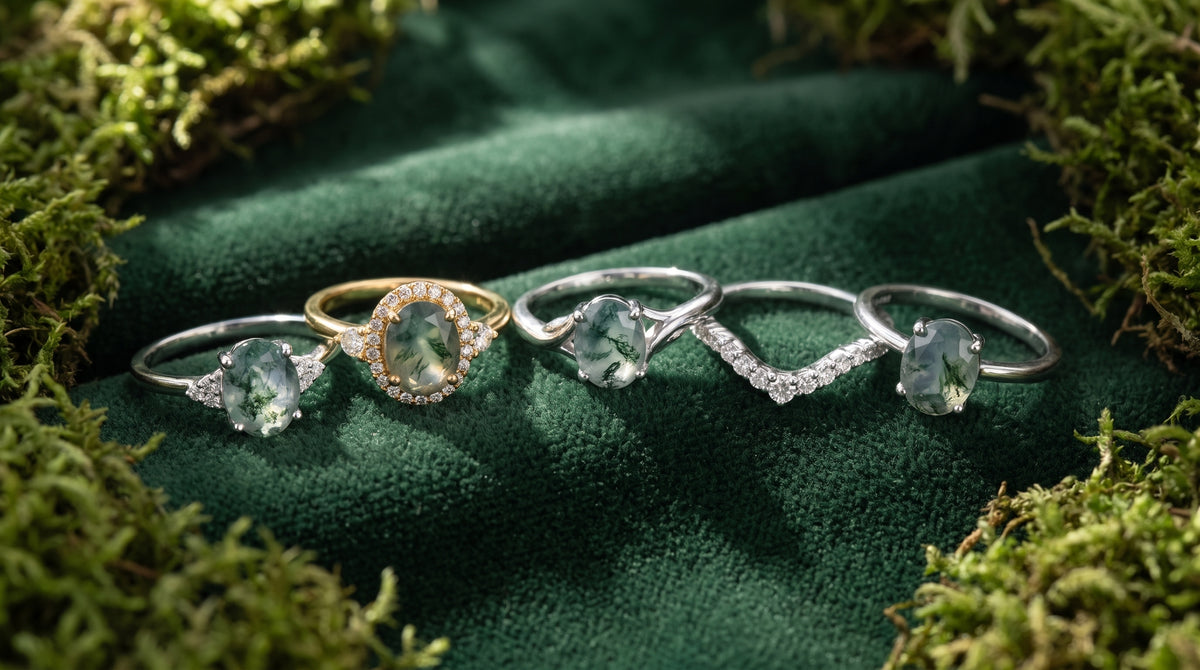
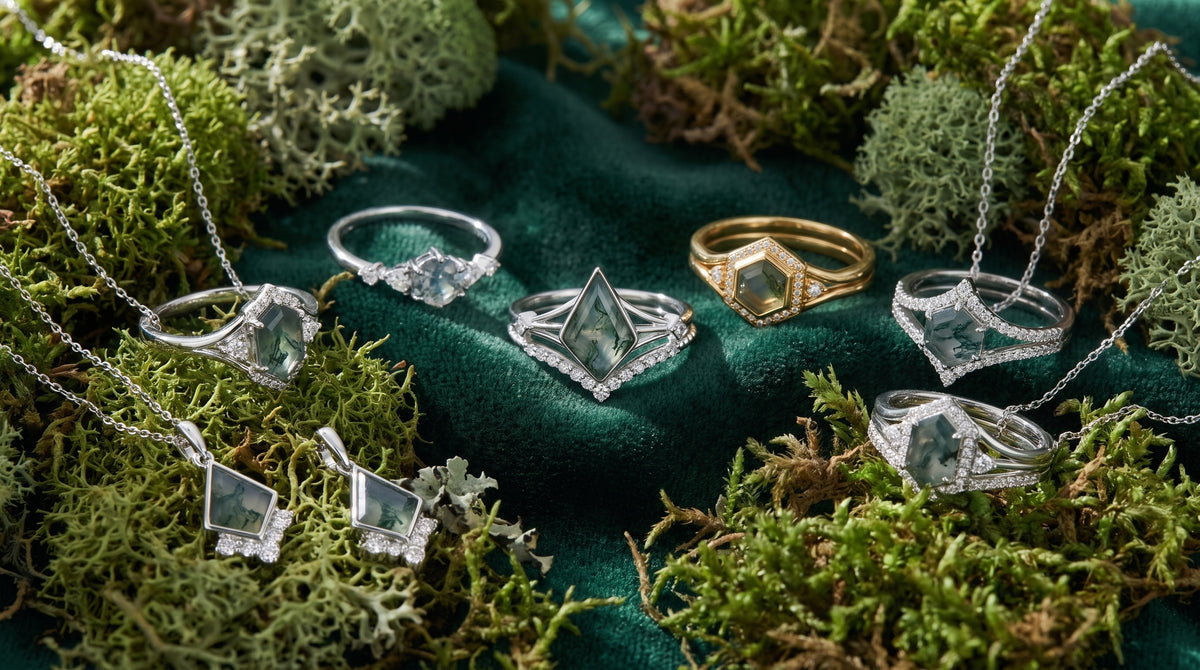
The pieces below are natural moss agate set in S925 sterling silver. Use the criteria above — setting coverage, cut profile, pattern legibility — to judge which suits your wear pattern, and view the full range in the moss agate rings collection.
- Natural Moss Agate Duo Band Ring Set — a two-band configuration for buyers who want the center stone flanked and supported from the outset.
- Natural Moss Agate V Cut Solitaire Ring Set — a solitaire paired with a V-shaped band, a useful pairing when the center stone has a pointed silhouette.
- Natural Moss Agate Leaf Design Ring — a botanical band treatment that leans into the stone's dendritic imagery.
- Natural Moss Agate Oval Solitaire Ring — an oval outline with no sharp corners, which is generally the friendlier geometry for a moderately tough stone.
- Natural Moss Agate Cushion Cut Ring — a cushion shape with softened corners in a halo-style design.
- Natural Moss Agate Kite Cut Ring — a bolder, pointed cut; check tip coverage carefully if you wear rings through hands-on days.
- Natural Moss Agate Ring — a channel-set band design that keeps accents recessed into the metal.
If you want the moss agate look without ring-level wear exposure, the Celtic Knot Natural Moss Agate Pendant and Natural Moss Agate Barrel Cut Dangle Earrings take far less abuse than anything worn on a hand.
Care Routine for a Silver Moss Agate Ring
Care advice is one of the most consistent areas across the published guides, which makes it reliable:
- Clean with warm water, mild soap, and a soft brush, then dry thoroughly.
- Avoid ultrasonic and steam cleaners; vibration and heat can aggravate microfractures and may interact badly with any dye treatment.
- Remove the ring for gardening, workouts, dishwashing, cleaning products, and anything involving grit or impact.
- Store it separately from harder stones such as diamonds, which will scratch moss agate on contact.
- Keep it away from thermal shock, strong acids, and prolonged direct sunlight — UV exposure is flagged as a particular concern for dyed material.
- Have prongs and bezel edges checked periodically; in a softer metal, setting security is the maintenance item most worth monitoring.
Questions Worth Asking Before You Buy
Is the stone dyed or treated?
This affects both appearance stability and care. Dyed specimens are the ones most often singled out as sensitive to heat, chemicals, and prolonged UV.
What kind of setting is it, exactly?
"Bezel," "half-bezel," and "prong" have very different protection profiles, especially in silver. Ask for close-up images of the stone's edge where it meets metal.
Can it be resized, and can the stone be replaced?
Because moss agate is unique to each stone, replacement is rarely like-for-like. Confirm what a seller can and cannot do before you commit, and confirm resizing options in writing rather than assuming.
Does the wear pattern match the metal?
This is the decisive question. A silver moss agate ring worn thoughtfully — removed for physical tasks, cleaned gently, checked occasionally — is a reasonable engagement or promise ring. A silver moss agate ring expected to survive continuous, unremoved, hands-on wear for decades is asking more of both the stone and the metal than the available evidence supports.
Choose the version of the ring that matches the life it will actually live, and the combination of a nature-formed stone and a quiet white metal holds up as a deliberate choice rather than a compromise.

Leave a comment
This site is protected by hCaptcha and the hCaptcha Privacy Policy and Terms of Service apply.