


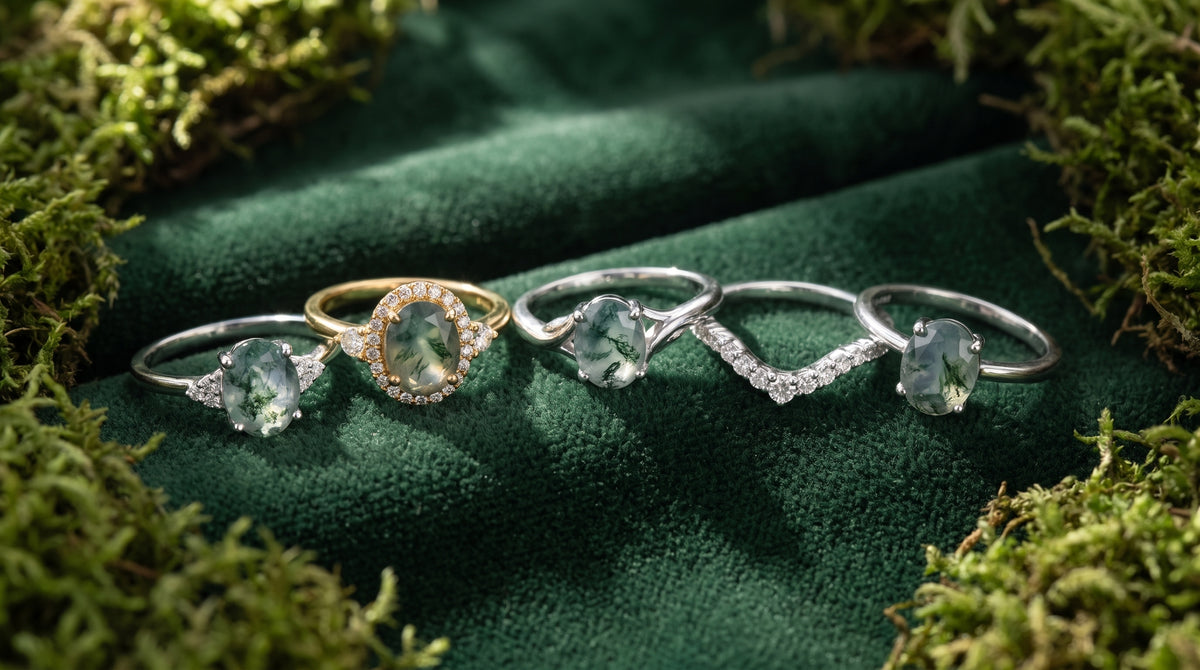
An oval moss agate center stone is asked to do two things that pull against each other. Its elongated face is the largest canvas in bridal jewelry for showing off dendritic, moss-like inclusions — but the same elongation creates two narrower ends where curvature tightens and stress concentrates during setting and daily knocks. Understanding that single trade-off explains most of the good advice about oval moss agate engagement rings: why protective settings keep appearing in jeweler guidance, why stone thickness matters more than carat weight, and why two stones of identical size can look completely different on the hand.
This guide works through what moss agate actually is, how to evaluate an oval stone before you commit, what durability really means for a quartz-family gem worn every day, and where the symbolism comes from. Where the available sources disagree — and on care advice, they do — that is flagged rather than smoothed over.
What Moss Agate Is — and Why It Isn't Technically an Agate
A chalcedony, not a banded agate
Moss agate is a variety of chalcedony: a microcrystalline (cryptocrystalline) form of quartz composed primarily of silicon dioxide, SiO₂. Chalcedony is built from extremely fine intergrowths of quartz and moganite, giving it a dense, compact structure quite different from macrocrystalline quartz varieties such as amethyst or citrine.
Strictly speaking, true agate is defined by concentric banding of chalcedony layers. Moss agate usually lacks that banding entirely, presenting instead a relatively uniform translucent-to-milky base interrupted by dark branching inclusions. For that reason some mineralogists prefer the term dendritic chalcedony. The gem trade has grouped it with agates for a very long time, and the name persists in both retail and metaphysical contexts — so "what is moss agate" has two correct answers depending on whether you are speaking commercially or mineralogically.
Where the "moss" comes from
The green, brown, and black filaments are inorganic. There is no plant matter inside the stone. They are most commonly oxides of manganese or iron that precipitated in branching forms within the silica; in some specimens showing green filaments, minerals such as chlorite or hornblende are cited instead. Crucially, these are three-dimensional structures sealed at varying depths inside the quartz, not surface staining — which is exactly what makes them stay put when you rotate the stone under a light.
The fractal look of those branches is associated with diffusion-limited aggregation, the same class of physical process behind frost patterns and lightning traces: mineral solutions migrating along pressure gradients through micro-channels deposit in branching forms. Moss agate generally forms in or beside volcanic rocks, where silica-rich fluids fill cavities and fissures; much of the material on the market is recovered as fragments weathered out of volcanic formations and found in stream beds or exposed outcrops.
Where it comes from
Commonly cited sources include India, Brazil, Uruguay, central Europe, and the western United States, with additional occurrences reported across North America. Moss agate is comparatively widespread next to rarer colored gemstones. Specific mine-level production figures are not systematically documented in the general gemological literature, so treat any precise supply or rarity claim with skepticism.
Why Oval Is the Most Popular Cut for Moss Agate
Elongation gives the dendrites room to read
In a faceted diamond, the cut is doing optical work — returning light. In moss agate, the cut is doing curatorial work: it frames a picture. An oval outline stretches the dendritic branches horizontally across the finger, which is why so many oval stones read as treetops, riverbanks, or windblown ferns. A round or square of the same carat weight compresses that same pattern into a tighter frame, and the composition can lose its sense of landscape.
Oval also carries conventional bridal associations. Editorial coverage routinely describes oval moss agate as the most traditionally bridal and vintage-leaning of the shapes, bridging the classic solitaire silhouette with an unconventional stone. That is an aesthetic judgment rather than measured consumer data — but it is a fair description of how the shape behaves visually, and it explains why oval sits comfortably next to nature-inspired bands, leaf motifs, and organic metalwork.
The trade-off: two narrower ends
The oval's tapered ends are where curvature tightens, and they can act as stress concentrators during setting and under impact. This is not a reason to avoid ovals; it is a reason to care about two specifics. First, adequate "belly" — depth behind the face of the stone — so the gem resists cracking when a setter applies pressure and when the ring meets a door frame. Second, a mounting that cradles those ends rather than leaving them exposed. Round and cushion outlines arguably have a marginal geometric advantage here because of their more uniform curvature, but no systematic fracture-rate data by shape exists in the published guidance; setting protection and stone soundness matter far more than outline alone.
How to Judge an Oval Moss Agate Stone Before You Buy
Translucency and depth
Ring-quality moss agate is typically semi-transparent rather than opaque. A clear or lightly clouded base lets light penetrate so the moss appears to float in foreground and background planes — the layered effect that makes the stone look like a scene rather than a printed pattern. Heavy cloudiness flattens the image and can make the ring look dull in ordinary indoor light.
Contrast and legibility at 6–8 mm
This is the criterion most buyers skip. Product photography is usually backlit, and almost any moss agate looks spectacular with a lamp behind it. An engagement ring, however, is seen face-up, at arm's length, in kitchen light and daylight. Ask for or look for images shot on the hand without backlighting. Strong stones have a pale or near-colorless base, clearly contrasting green or dark dendrites, a discernible focal area, and visible negative space. Weak stones go gray, yellowed, or low-contrast, and the pattern collapses into an indistinct dark mass once it is reduced to a 6–8 mm oval.
Structural integrity
Look for the absence of shatter lines, hollow pockets (vugs), and open pits. Fine internal veils are normal in chalcedony; large voids or fractures that reach the surface are not, because they can propagate under stress and they read as holes rather than moss. The polish should be smooth and even, with no scratched or under-finished areas that could become wear initiation points. Jewelers working with this material consistently reject thin, vuggy, or fracture-prone rough for ring use for exactly these reasons.
Authenticity: real moss agate versus imitations
Because moss agate is visually distinctive and not a high-cost gem, imitations circulate. The two most common are dyed opaque stones (jasper, serpentine, and similar) and resin pieces with printed or engineered patterns. Several practical tells exist:
- Depth behavior. Genuine dendrites sit at fixed depths inside the stone and do not shift position relative to the surface as you rotate it. Printed or surface-applied patterns can show slight parallax movement and look flat.
- Edge quality. Natural dendritic growth has feathered, fractal terminations. Dye that has crept along fissures tends to produce unnaturally sharp, outline-like edges and pools of concentrated color in cracks.
- Base transparency. Fully opaque, uniformly colored material relying entirely on surface pattern is suspect.
- Repetition. Two "stones" with identical patterns indicate engineered replication, not natural variation. Under magnification, resin imitations often show scattered bubbles.
- Hue. Neon or improbably bright colors are unlikely from natural iron or manganese oxides.
Hardness tests (moss agate should scratch glass) are sometimes suggested, but they risk damaging finished jewelry and shouldn't be attempted on a mounted ring. Solvent tests for water-soluble dye are for loose rough, not set stones. For anything valuable, microscopic examination and refractive index measurement by a qualified gemologist remain the reliable route.
Durability: Hardness Is Only Half the Story
The numbers
Moss agate sits at roughly 6.5 to 7 on the Mohs scale — the same territory as amethyst and citrine. In practice this means it will scratch glass (about 5.5) and typically resists scratching from materials below its own hardness, while remaining vulnerable to harder materials: topaz, sapphire, and diamond. Airborne dust containing quartz particles is also in this range, which is why any stone around 7 gradually acquires fine surface abrasion over years of hard wear.
Toughness and fracture behavior
Hardness only measures resistance to scratching. For a ring, toughness — resistance to chipping and breaking — matters at least as much. Chalcedony's compact microcrystalline structure gives it no pronounced cleavage direction; it breaks with conchoidal (curved) fracture and is generally described as having good toughness. That is a meaningful advantage over gems that split readily along cleavage planes. Chalcedony is also non-porous and chemically stable, with good resistance to household acids, UV light, and thermal shock compared with more delicate materials such as opal, and it does not require the oiling that fractured emerald often does.
The honest summary: moss agate offers moderate-to-good durability for an engagement ring when the stone is well chosen, well cut, and protectively set. It is not diamond or sapphire, and it can be scratched or chipped by rough treatment. Individual stones with surface-reaching fractures or large inclusions sitting in high-stress zones near prongs will always be more vulnerable than the hardness number alone suggests.
What wear reports do and don't tell you
Several retailers publish encouraging anecdotes — clients wearing moss agate rings daily for years without visible damage, and in one case a self-reported client survey in which the large majority saw no chips or cracks after two or more years of full-time wear. These are brand-specific, self-reported observations from single sources rather than independent testing, and they should not be read as a general durability statistic for all moss agate rings. What they reasonably support is a modest conclusion: with sensible design and care, multi-year daily wear is realistic for many wearers.
Choosing a Setting: Solitaire, Halo, or Ring Set
Solitaire
A solitaire puts the whole visual weight on the pattern, which is the right choice when the stone has a strong composition and good contrast. Look for a low profile — a stone sitting close to the band snags less and takes fewer side impacts than a high-domed mount. Awareness Avenue's Natural Moss Agate Oval Solitaire Ring in S925 sterling silver follows this classic bridal outline, while the oval moss agate ring with diamond accents adds sparkle along the shoulders without crowding the center stone. If you want to compare the solitaire approach against other center-stone options generally, our guide to solitaire engagement rings covers the silhouette in more depth.
Halo
A halo does two jobs at once. Visually, a ring of small stones raises the perceived size of the center and frames a pattern that might otherwise read as soft-edged. Structurally, the surrounding metal and stones shield the vulnerable oval tips from lateral contact. The Natural Moss Agate Oval Halo Ring in sterling silver and the Natural Moss Agate Halo Oval Ring in 18K gold vermeil both take this route; warm metal tends to amplify the green and brown tones in the dendrites, which is worth considering if your stone leans olive rather than near-black.
Ring sets and curved bands
Ovals are unusually friendly to contour bands, because a curved band can trace the stone's long edge and nest flush against it. That matters practically as well as aesthetically: a well-fitted curved band reduces the gap where a wedding band would otherwise rock and rub against the center setting. The Natural Moss Agate Oval Cut Curved Band Ring Set is built for that pairing, and the V-cut solitaire ring set takes a more angular approach to the same idea. If stacking is your priority, our guide to moss agate engagement ring sets goes further into band curvature and fit.
If you're not sure oval is the shape
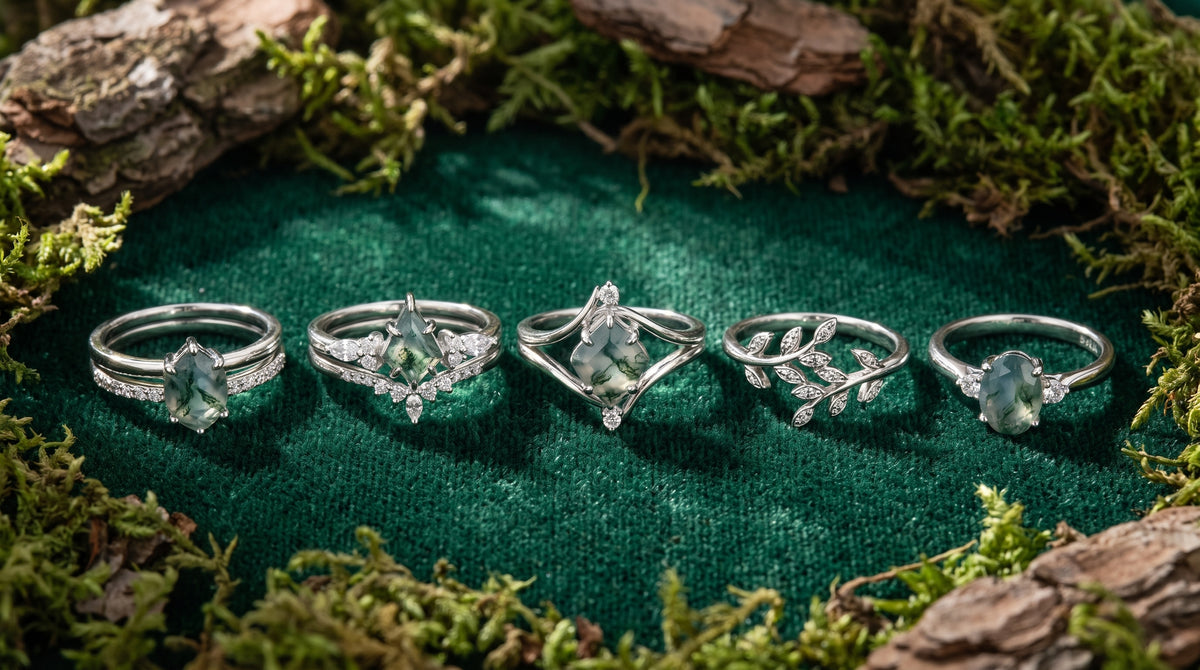
Cushion outlines keep a softly squared, vintage-leaning frame and have gentler corners; hexagons read modern and architectural and suit abstract, geometric dendrite patterns. Awareness Avenue's cushion-cut moss agate halo ring and hexagon moss agate ring set in 18K gold vermeil illustrate both alternatives, and freeform designs like the Organic Flow moss agate ring lean fully into the stone's irregularity. Browse the full range in the moss agate rings collection or narrow to oval designs. For the broader stone-versus-stone decision, the complete moss agate engagement ring buyer's guide is the better starting point.
Moss Agate Meaning: Folklore, Chakras, and Commitment
Everything in this section is cultural tradition and belief, not measurable gemology. It matters commercially and personally, but it should be read as symbolism rather than fact.
Agricultural folklore
Moss agate has long been tied to agriculture, fertility, and abundance. Medieval European and English folk practice reportedly associated it with crop success, with farmers said to carry small pieces at planting or place stones in fields at the start of the growing season. Some accounts describe tribal priests using it as a healing stone and warriors carrying it as a talisman of strength. Guides referencing symbolic history also link it to Demeter, the Greek goddess of harvest and renewal. Claims about its use in specific Native American ceremonies appear in retail writing without detailed ethnographic sourcing and should be treated as secondary reports rather than established anthropology.
Chakra and modern crystal traditions
In contemporary crystal practice, the moss agate spiritual meaning centers on the Heart (Anahata) and Root (Muladhara) chakras — emotional connection paired with grounding. It is often called a gardener's stone and framed as supporting gradual prosperity, gratitude, and emotional balance rather than sudden change, with a slow, stabilizing character compared with higher-intensity stones. Some metaphysical sources add claims about sociability, new friendships, or environmental cleansing. None of this has been demonstrated in controlled study; it reflects belief systems and subjective experience.
What that means on an engagement or promise ring
Translated into bridal terms, the moss agate engagement ring meaning most couples cite is growth: roots and branches as a metaphor for a relationship that is cultivated rather than completed, and a stone whose pattern is unrepeatable as a stand-in for a specific partnership. Because each specimen is genuinely one of a kind, that symbolism has a literal basis rather than being purely marketing language. The same themes — beginnings, patience, organic unfolding — are why moss agate appears so often in pre-engagement jewelry; our moss agate promise ring guide covers those lighter, more minimal designs, and pieces such as The Nimue Moss Agate Ring sit comfortably in that territory.
Care and Cleaning Without the Contradictions
Routine cleaning
Warm water, mild soap, a soft brush, a thorough rinse, and gentle drying with a soft cloth covers nearly all routine cleaning. Moss agate's non-porous, chemically stable nature means it doesn't need special treatments or ongoing maintenance the way oiled emerald or hydrated opal does. Avoid bleach and strong acids — partly for the stone, largely for the metal and any accent stones.
Ultrasonics: why caution wins
Published advice genuinely conflicts here. Some sources warn against ultrasonic cleaning for moss agate; others group it with durable quartz-family stones and call it generally safe. With no systematic testing to settle the question, and with an engagement ring combining a natural stone, accent stones, and fine metalwork of varying vulnerability, the conservative position is the sensible default: clean by hand at home, and let a jeweler decide whether machine cleaning is appropriate for your specific piece.
Wear habits and storage
Remove the ring for heavy manual work, gardening, weight training, and anything involving repetitive hard impact — as much to protect prongs and band as the stone. Store it separately from harder gems such as diamonds and sapphires, which will abrade a 6.5–7 stone if they share a compartment. Have prongs, bezels, and the stone itself inspected professionally every year or two, since metal fatigue and unnoticed micro-damage are usually what precede a lost or chipped stone.
Frequently Asked Questions
Is moss agate durable enough for an everyday engagement ring?
For most wearers, yes, with conditions. At 6.5–7 Mohs with good toughness and no cleavage planes, it handles normal daily life when the stone is sound, the setting is protective, and the ring comes off for rough activity. It will not match diamond or sapphire for scratch resistance, and over many years of hard wear you may see softening of the polish.
Is moss agate a real gemstone?
Yes. It is a naturally occurring variety of chalcedony within the quartz family. The organic-looking inclusions are mineral dendrites, not embedded plants — which is precisely why buyers sometimes assume genuine material must be fake.
Why do two oval moss agate rings of the same size look so different?
Because there is no grading system for pattern. Base translucency, dendrite color, density, distribution, and contrast vary enormously from stone to stone, and each of those variables changes how the ring reads face-up. This is why you should evaluate the actual stone images for the piece you are buying rather than a generic product rendering.
Does metal color change how the stone looks?
It changes the frame rather than the stone. Cooler white metals such as sterling silver emphasize the contrast between a pale base and dark dendrites; warm yellow tones tend to bring out green and brown notes. If you're weighing warm metals specifically, see our guide to moss agate engagement rings in gold.
What should I ask a seller before ordering?
Ask for face-up photos in natural light without backlighting, confirmation of the stone's dimensions, whether the piece ships with the exact stone shown, and what the setting style is at the oval's tips. Metal composition, sizing, and any policies should be confirmed directly on the product page, since those details vary by piece.
The Short Version
Choose the stone before you choose the ring. An oval moss agate succeeds or fails on translucency, contrast, and pattern legibility at the size you'll actually wear — not on carat weight and not on how it looks backlit. Once you have a stone that reads clearly face-up and shows no surface-reaching fractures or open vugs, put it in a setting that protects those two narrow ends, keep it away from harder gems in storage, take it off for rough work, and clean it by hand. Do that, and a gem that formed as silica filled a volcanic cavity and manganese branched through it becomes a piece of jewelry you can reasonably wear every day — carrying, if you like, several centuries of associations with growth, harvest, and patience.

Leave a comment
This site is protected by hCaptcha and the hCaptcha Privacy Policy and Terms of Service apply.