


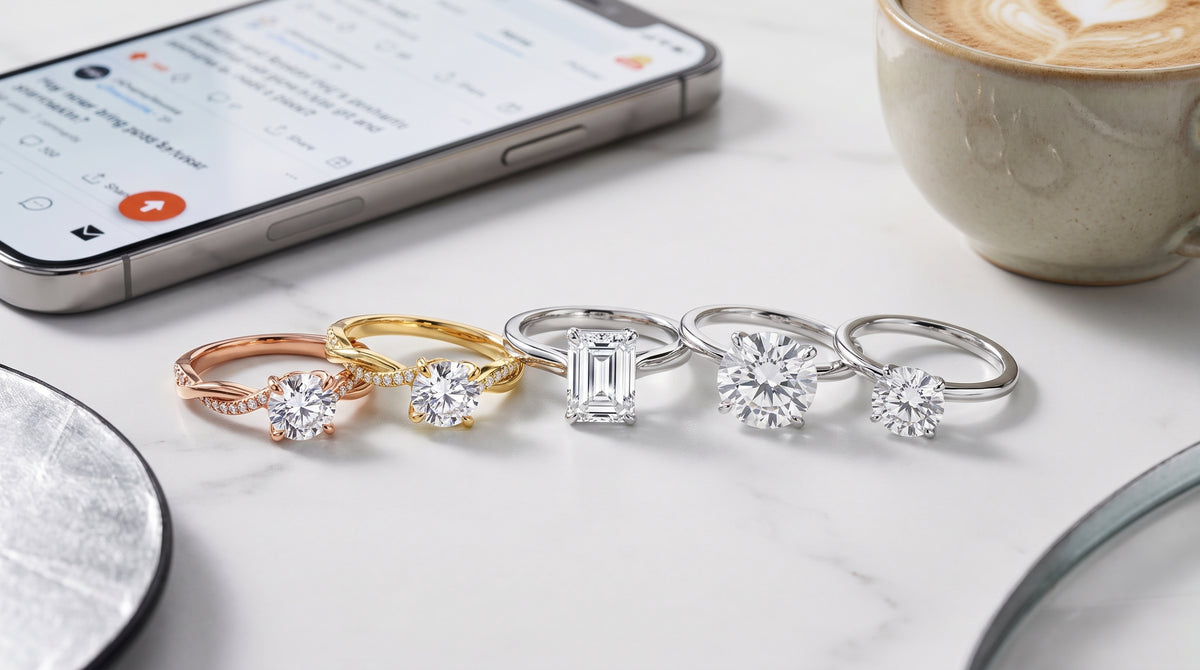
Open almost any affordable jewelry thread on Reddit and the same three artifacts show up: a macro photo of a chain that has gone dull around the clasp, a side-by-side of a product listing next to the duller item that actually arrived, and an argument about whether a mall chain is charging rent-and-marketing money for a ring that isn't worth it. That last argument isn't hypothetical — the jewelry review site The Carat Cut rates Kay jewelry around 4.1 overall yet explicitly advises readers not to buy engagement rings there, arguing that store overhead and marketing get baked into the price [14]. Meanwhile the wedding blog Life Line Wedding, drawing on personal experience and Reddit forums, comes down on Kay's side against Zales and notes the chain lists more than 3,600 engagement rings online [15]. Same brand, opposite verdicts, both citing Reddit.
That contradiction is the whole reason the phrase affordable jewelry reddit exists as a search. You aren't looking for a list of cheap jewelry online; you're looking for a way to tell which cheap thing survives daily wear and which seller answers the email when it doesn't. This piece takes the objections raised in those threads one at a time, answers each with the checkpoints that jewelry communities and reviewers actually use, and is transparent about where our own moissanite rings fit — and where they don't.
Why "reddit" Gets Added to an Affordable Jewelry Search
Adding a community name to a shopping query converts it from transactional to investigational [2][12][13]. You already know affordable jewelry stores exist. What you want is a filter: which of the best cheap jewelry websites hold up, and which ones look great in studio lighting and terrible after six weeks.
The guides that summarize these discussions keep pointing to the same handful of communities, each with a distinct job [2][3][13]:
- r/jewelry — identification, quality critique, and "is this worth it?" threads with close-up photos.
- r/frugal — timing and tactics: clearance, sale events, and stretching a jewelry budget.
- r/ThriftStoreHauls and r/Vintage — secondhand finds, and how to tell solid gold from plate before you pay.
- r/FashionReps and r/QualityRepJewelry — dupes and lookalikes, with brands such as JoomJume and Lark & Ro discussed in roughly the $50–$150 band [3].
What people take from these spaces isn't one perfect brand name. It's a habit of inspecting before buying, and of treating a seller's claim as a hypothesis rather than a fact. Below, that habit is turned into answers.
The Objections, One by One
"It'll tarnish in a few months anyway"
This is the single most common complaint, and it's fair. Jewel Meter's review of Studs earrings is a clean example: pieces averaging about $40 that feel good and look good at first, yet show tarnishing within roughly six to twelve months of daily wear [1]. That is not a scandal — it's what thin plating over a base metal does once it meets sweat, perfume, and friction.
The useful response is to stop treating "tarnish" as a brand trait and start treating it as a materials question. The checkpoint most often cited in these discussions is plating thickness: gold plating of roughly 1–2 microns wears far longer than the flash plating used on the cheapest pieces [3]. If a listing marketed as waterproof anti tarnish jewelry affordable doesn't state the base metal and the plating thickness, the claim is branding rather than a specification.
The second half of the answer is behavioral. Jewelry care guidance repeated across Reddit summaries and mainstream fashion coverage converges on the same short list: keep pieces dry, take them off in water of any kind, rinse and dry immediately after chlorine or saltwater contact, clean with mild soap and a soft cloth rather than harsh chemicals, and store in a dry, airtight container [4][11]. Reddit users also flag a subtler one — remove plated pieces before applying lotion, heavily scented soaps, or cleaning products, because those contact the finish more aggressively than water does [4]. If you want the deeper materials breakdown, we cover it in our guide to cheap good quality jewelry.
"The photos never match what arrives"
Also fair, and it applies to brands at every price. Third-party review platforms are the fastest place to test this before you order: read the one- and two-star reviews first and sort for the word "photo" or "picture" [16][17]. If mismatch complaints cluster around one product type rather than appearing randomly, that's a signal about a specific supplier, not about the whole store.
Practical mitigations that cost nothing: look for listings that show the piece on a hand or neck rather than only on white seamless; check whether the brand publishes customer photos; and read the return window before checkout rather than after. Several affordable jewelry comparison tables treat the return window as a headline attribute for exactly this reason — alongside average price range, material transparency, hypoallergenic options, and shipping speed [8].
"Cheap pieces break — the clasp goes first"
The hardware is where budget manufacturing shows up earliest. The quality checklist circulated in these communities is genuinely useful here, and it takes about fifteen seconds per piece [3]:
- Weight. A piece with some heft usually means denser metal or a solid rather than hollow build. Suspiciously light often means thin or hollow.
- Clasps. Lobster or box closures over flimsy spring rings. This is the most common failure point on necklaces and bracelets.
- Enamel and finish. Smooth, evenly filled color with no pooling or pinholes.
- Beading and detail. Uniform, consistently spaced detailing suggests a careful setter rather than a rushed one.
- Return policy. A seller confident in the build gives you room to inspect it at home.
For necklaces specifically, chain construction and clasp choice do more for perceived value than carat count ever will — something we get into in our roundup of affordable necklaces that actually look expensive.
"My skin reacts to anything under $50"
Skin sensitivity is treated as a first-class filter in affordable jewelry comparisons, where "hypoallergenic options" sits next to price and shipping as a deciding attribute [8]. The honest answer is that no one can promise your skin's response from a product page. What you can do is insist on material transparency: a seller that names the base metal, the alloy, and the plating is giving you the information you need to make the call, and a seller that only says "premium metal" is not [2][3].
If you know you react to a particular metal, the transparency test becomes the buying test. Ask support directly and treat a vague answer as an answer. Higher-quality metals and thicker plating generally sit better on reactive skin than low-grade base metals with flash coatings, which is one reason the same few brands keep surfacing in these threads.
"Is this store even legit, and will support ghost me?"
This is the objection that separates the community-vetting search from a generic one, and it deserves a straight answer rather than a reassurance.
Use third-party review platforms as your primary evidence and read them qualitatively. Look at the shape of the feedback, not just the average: are complaints about design and craftsmanship, or about logistics? Logistics problems are usually fixable and often seasonal; repeated craftsmanship complaints are structural. Also check whether the brand replies to negative reviews, and how.
Applying that standard to ourselves: Awareness Avenue's Trustpilot profile has shown an average around 4.1 across roughly a thousand reviews [16][17]. The positive pattern is consistent — reviewers describe the designs as striking, the pieces as well crafted, and the support team as fast to help with sizing changes and order modifications [16]. The negative pattern is also consistent, and worth stating plainly: some customers have reported deliveries taking longer than expected, gaps in proactive communication about order status, occasional pieces that didn't match the online images, and confusion over paperwork details [16][17]. Review scores and counts move over time, so check the live profile rather than taking this paragraph as current. The point isn't that we're flawless; it's that the same reading method you'd apply to any brand from a Reddit thread should be applied here too.
"Affordable and ethical can't both be true"
Ethics comes up constantly in these threads, usually attached to specific names. Mejuri and Aurate get cited for craftsmanship and ethical production at prices above fast fashion but below traditional fine jewelry [2]. Brilliant Earth is referenced for sourcing commitments, particularly around engagement rings and lab-grown stones, and Blue Nile for transparent pricing [12]. Ana Luisa jewelry gets described by the review site ClothedUp as a "green" brand founded in 2019, selling gold hoops and layered necklaces in roughly the $40–$60 range, and judged legitimate at that price [6].
Two caveats that Reddit users tend to apply and marketing pages tend to skip. First, a third-party blog calling a brand "green" is an interpretation of that brand's own marketing, not an audit — if the specifics matter to you, read the brand's sourcing page and look for verifiable detail rather than adjectives [6]. Second, secondhand is the ethics option that costs less rather than more: thrift stores, estate sales, and garage sales genuinely turn up solid gold and silver pieces at prices below new plated jewelry, which is why thrift hauls are a Reddit staple [5][13].
"Mall chains overcharge, but online-only brands feel risky"
This is the real trade-off, and neither side wins outright. The Kay Jewelers split captured above is the clearest illustration: one reviewer scores the brand respectably while warning off engagement-ring buyers over price-to-quality [14]; another prefers Kay to its nearest competitor and points to a catalog of thousands of rings [15]. Physical stores let you try things on and give you a counter to walk back to; they also carry costs that show up on the tag. Online-only brands cut overhead and often pass on the difference; they also mean you're buying from photographs.
The mitigation is procedural rather than emotional: buy online only from sellers whose return terms you have actually read, pay with a method that gives you recourse, and photograph the piece on arrival before wearing it. Our walkthrough on how to buy jewelry online goes through this sequence step by step.
How to Read a Reddit Recommendation Without Getting Burned
Community advice is only as good as your reading of it. A few habits that materially improve the signal:
Search the brand name, then read whole threads
Top comments are often the funniest, not the most informed. The useful detail — how long the piece lasted, whether support replied, what the metal actually was — usually sits three replies deep [2][13].
Weight photo evidence above adjectives
A post with a worn-in photo after a year of daily wear is worth ten enthusiastic first-impression comments. "I love it, arrived yesterday" tells you about packaging, not durability.
Check the date and the wear context
A recommendation from a while back may describe a supplier the brand no longer uses. And "never tarnished" from someone who wears a piece twice a month is not the same claim as from someone who showers in it.
Cross-check against a third-party review platform
Community sentiment plus aggregated reviews is a much stronger read than either alone [16][17]. Where the two disagree, look for the reason — usually a shipping period, a product line, or a policy change.
Separate the categories
Advice about $30 plated hoops does not transfer to a ring you intend to wear every day for decades. The failure modes, the price sensitivity, and the acceptable risk are all different.
The Affordable Jewelry Map: Where These Threads Actually Send People
Roundups summarizing these discussions consistently point to a handful of channels rather than one answer [2][3][5][12][13]:
- Independent makers on Etsy — unique designs, direct contact with the maker, variable consistency. Ask about metals before ordering [2].
- Mainstream fashion retailers — ASOS, Madewell, Forever 21, H&M, and BaubleBar come up for trend pieces at accessible prices, frequently on sale [2]. Treat most of it as seasonal rather than heirloom.
- Outlet and clearance sites — Nordstrom Rack and Overstock are named for discounted inventory [2]; Kay Outlet markets itself in the same affordable lane [9].
- Secondhand — thrift stores, estate sales, garage sales. The best value-per-dollar on real metal, at the cost of hunting time and a learning curve on authentication [5][13].
- Rental and subscription — services like Rocksbox let people wear pieces before committing, which defuses buyer's remorse in the trend category [2].
- Specialist online brands — including moissanite and lab-grown stone sellers, where the savings come from the stone choice rather than from cutting corners on the setting [12].
Most people end up mixing channels: secondhand or fast fashion for volume and trends, one or two considered purchases for the pieces that need to last.
Where Moissanite Engagement Rings Fit — and Where They Don't
Engagement rings are the point where "affordable" stops meaning "disposable." This is also where the broad affordable jewelry conversation splits off into a narrower one about stones, and where alternatives to mined diamonds — lab-grown stones and moissanite — enter the discussion as the main lever on price [12][14][15]. Moissanite is sold as a lower-cost alternative to diamond with high brilliance; the practical consequence is that the same budget buys a visibly larger or more elaborate setting.
Being clear about scope: our catalog is moissanite rings, which means it answers one slice of the affordable jewelry question, not all of it. If you came here for everyday hoops, layering chains, or high quality affordable jewelry brands across categories, the map above is the more useful section and we'd rather say so.
What to look at on any moissanite ring page
Apply the same checklist you'd apply to a $40 pair of earrings, adjusted for the stakes: named metal for the band, stated stone size and cut, setting type, sizing and return terms, and clear photography on a hand rather than only on a prop. Ask support the questions the page doesn't answer — a brand's responsiveness pre-purchase is a decent proxy for its responsiveness post-purchase.
Designs that illustrate the trade-offs
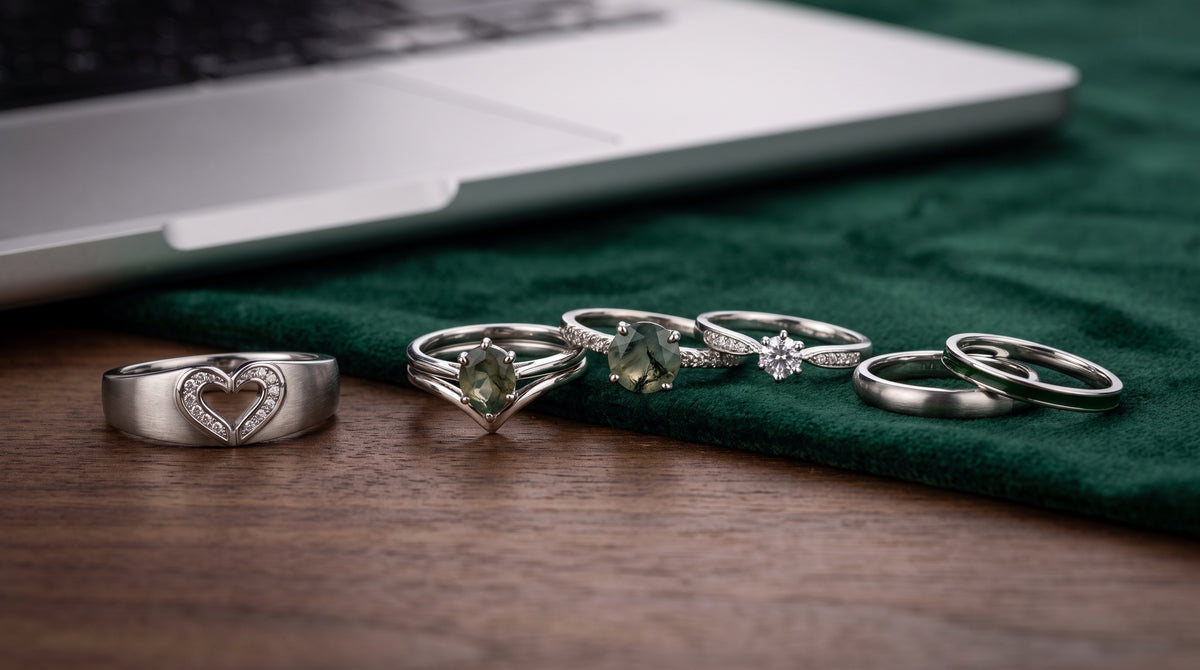
Within our own range, the design decisions map to different priorities. The Celestine is built explicitly around the affordable engagement ring brief, and also exists in a solid gold version for buyers who want the band material to be the long-term investment. Twisted-band silhouettes such as the Twisted Band Gold Moissanite Ring put the visual interest into the metalwork rather than into stone size, which is a reasonable choice if you dislike a high-profile setting. Step cuts like The Bella Jewel 1CT emerald cut read as understated at a given carat weight, while larger emerald and oval cuts trade that restraint for presence. The full range sits in our affordable engagement rings collection.
What we won't claim, because the evidence to support it isn't in front of you: that any of these is the best value on the market, that they're endorsed by any subreddit, or that they're immune to the wear and care realities described earlier. Read the metal specification on the product page, read the care notes, and compare against the other specialists people mention in these conversations.
A Pre-Purchase Checklist You Can Use on Any Seller
- Is the base metal named? If not, assume the cheapest plausible option.
- Is plating thickness stated? Roughly 1–2 microns is the threshold worth looking for on plated pieces [3].
- What closes it? Lobster or box clasp beats a thin spring ring [3].
- Does it have heft? Weight is a usable proxy for solid versus hollow construction [3].
- How long is the return window, and who pays return shipping? Read this before checkout [8].
- What do the negative reviews cluster around? Logistics complaints and craftsmanship complaints mean different things [16][17].
- Does support answer a specific technical question? Ask one before you buy.
- Is there a care instruction? A seller that tells you to keep it dry and store it properly is being straight with you about the material [4][11].
Frequently Asked Questions
Is waterproof, anti-tarnish jewelry real or marketing?
It's a spectrum, not a binary. Brands do sell everyday pieces marketed as tarnish-free, and better base metals with thicker plating genuinely last longer [3]. But the care advice that circulates in these communities is unanimous for a reason: rinse and dry after chlorine or saltwater, avoid harsh chemicals, take pieces off before lotion and cleaning products, and store dry and airtight [4][11]. "Waterproof" in a product name is a durability claim, not a permission slip.
How cheap is too cheap?
There isn't a universal number, but there is a pattern. Around the $40 mark you can get pieces that look and feel good initially and still show tarnish within six to twelve months of daily wear — that's documented for at least one popular earring brand [1]. Around $40–$60, brands like Ana Luisa are described by reviewers as offering legitimate fine jewelry [6]. Below that, judge by the checklist rather than by price.
Should I buy an engagement ring from a mall chain or online?
The published opinions genuinely conflict, including among people citing Reddit [14][15]. Mall chains offer in-person fitting, immediate recourse, and enormous selection; critics argue their overhead inflates prices relative to quality [14]. Online specialists usually offer more stone for the money and require you to trust photographs and a return policy. Decide based on which risk you'd rather manage, then verify the specific seller with third-party reviews.
Is secondhand actually better value than new budget jewelry?
Frequently, yes — thrift stores, estate sales, and garage sales turn up real gold and silver at prices competitive with new plated pieces [5]. The cost is time and the risk of misidentification, which is exactly why thrift-focused communities spend so much effort on how to tell plate from solid [5][13].
The Short Version
The reason people search for affordable jewelry with "reddit" attached is that they want the failure modes disclosed up front. So here they are: thin plating tarnishes, weak clasps fail, studio photos flatter, sensitive skin reacts to low-grade alloys, and no seller — including this one — has a perfect delivery record. What separates a good affordable purchase from a bad one isn't the price tag; it's whether the seller told you what the piece is made of, gave you a return window long enough to inspect it, and answered when you wrote. Use the checklist, read the whole thread, check the reviews yourself, and buy the piece whose specifications you could repeat out loud.

Leave a comment
This site is protected by hCaptcha and the hCaptcha Privacy Policy and Terms of Service apply.