


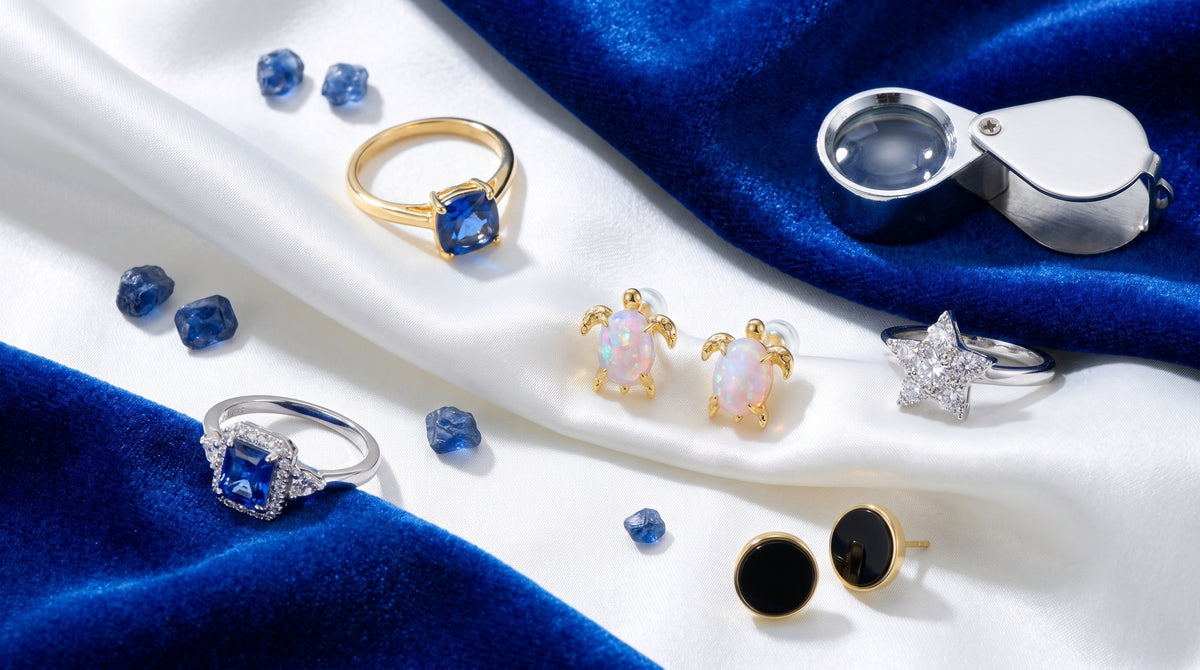
Put the stone under a bright lamp with a 10x loupe and tilt it slowly through the light. If you see a scatter of perfectly round, transparent spheres suspended inside the gem, stop there — you are almost certainly looking at glass or plastic, not sapphire. That single observation resolves more "is my sapphire ring real?" questions than every other test combined, because round gas bubbles are a signature of molten material cooling in a mold, and they are highly unlikely to appear inside corundum, whether that corundum grew underground or in a laboratory.
The frustrating part is what happens when you don't see bubbles. At that point the internet hands you a pile of contradictory home tests, retailer marketing, and a vocabulary problem: "genuine," "natural," "created," "synthetic," and "simulant" are used loosely by sellers and interchangeably by shoppers, even though they mean four different things. This guide takes the objections one at a time — the ring you already own, the ring you're about to buy, the lab-grown question, the durability question, and the color question — and separates what is gemological fact from what is trade-reported marketing.
What "Real" Actually Means When You're Talking About Sapphire
Most arguments about sapphire authenticity happen because two people are using "real" to mean two different things. It helps to split the word into three separate layers, each answered by a different kind of evidence.
Layer one: the material
Sapphire is a variety of the mineral corundum, composed primarily of aluminum oxide, with trace elements producing its color. Corundum sits at 9 on the Mohs hardness scale, directly behind diamond at 10, and it has no cleavage planes. Those properties are the material definition of a sapphire. A stone either is corundum or it isn't — and if it isn't, it's a simulant: glass, plastic, or a look-alike synthetic such as yttrium aluminum garnet (YAG) that mimics the color without sharing the chemistry.
This is the layer most people mean when they ask "is it real?" and it's also the layer that basic screening can partly address, because simulants tend to betray themselves through bubbles, softness, and heat behavior.
Layer two: the origin
A stone can be unambiguously corundum and still have been grown in a laboratory over hours rather than underground over geological time. Gemological education sources are consistent on this point: lab-grown sapphires are chemically and physically the same material as natural sapphires, with the same atomic structure, hardness, and optical properties, and gemological laboratories identify both as corundum. The difference is growth history — which is recorded on a report as natural or synthetic, never blurred.
Origin is where value, rarity, and a lot of emotional weight live. It is also the layer that no home test can settle.
Layer three: the treatment
Heat treatment to improve color is standard practice in the commercial sapphire trade — trade-oriented sources describe it as extremely common and consider it stable and accepted. A heat-treated natural sapphire is still unequivocally a natural sapphire. Untreated stones, particularly from prestige origins, are documented and valued separately precisely because they are less common. Treatment status is disclosed on laboratory reports, not deduced by eye.
So: a lab-grown sapphire is real corundum but not a natural stone. A heat-treated Ceylon sapphire is a natural stone that has been enhanced. A blue glass cabochon is neither. Knowing which of those three you are holding — or buying — is the whole task.
At-Home Tests: What They Catch, What They Miss
Consumer guides repeat a familiar set of checks. They are worth doing, but only if you understand their ceiling: they screen for obvious simulants. None of them can distinguish a natural sapphire from a lab-grown one.
The bubble check (the most useful one)
Under a loupe or microscope in strong light, look for round, gas-like bubbles. Consumer authenticity guides agree that tiny spherical bubbles trapped in the stone point strongly to glass or plastic rather than corundum. Tilt the ring through several angles — bubbles are sometimes only visible from one direction. The caveat matters as much as the test: the absence of bubbles proves nothing on its own, because plenty of simulants are cast cleanly.
The breath-fog test (and why the published numbers disagree)
Fog the stone with your breath and time how long the mist takes to clear. One widely read how-to guide says the fog on a real sapphire should fade within about one to two seconds; a retailer's ring-specific guide sets the threshold at roughly four seconds. That discrepancy is the most honest thing you can learn about this test. It depends on room humidity, stone temperature, surface oils, and how hard you exhaled. Treat a slow-clearing fog as a prompt to look closer, not as a verdict.
The temperature test
Gemstones are relatively poor conductors of heat and tend to feel cool against the skin, while glass imitations often feel warmer. Hold the ring against your cheek or wrist for a few seconds. Again: indicative, not conclusive, and easily confounded by a ring that has been sitting in a warm pocket or under a display light.
Inclusions under magnification
Natural sapphires commonly contain internal features formed during geological growth — rutile "silk," needles, fingerprint-like patterns, and small crystals. Their presence suggests natural formation and rules out most molded glass. But some fine natural sapphires are exceptionally clean, and lab-grown stones have their own internal signatures, such as curved growth striae from flame-fusion production or residual flux inclusions from flux growth. Telling those apart from natural features is a trained gemologist's job with a microscope, not a task for a loupe on a kitchen table.
The scratch test you should skip
Hardness testing sounds decisive and isn't. Lab-grown sapphire is corundum, so it is just as hard as natural sapphire and will pass any scratch test a natural stone passes. Meanwhile you risk damaging the stone, the setting, or whatever you drag it across. There is no scenario in which scratching an engagement ring produces information worth the damage.
The color myth worth discarding
One popular guide suggests that a stone flashing colors other than blue may not be a real sapphire. That framing is misleading. Corundum occurs in a wide range of colors; by trade convention, red corundum is called ruby and essentially everything else — blue, pink, yellow, green, teal, colorless, particolored — is sapphire. Teal sapphires are frequently described as a blend of blue and green with a hint of yellow. A green sapphire is not a failed blue sapphire, and a stone showing a secondary hue is behaving exactly as corundum often does.
Certificates and Gemologists: The Only Definitive Answer
Once you move past "is it glass?" and into "is it natural?", the answer stops being observational and starts being documentary.
Which laboratories the trade relies on
Trade and educational sources point to the same short list of reports when origin and treatment need to be established: GIA, GRS, Gübelin, and SSEF. A report from a reputable laboratory will state explicitly whether a stone is natural or synthetic and will disclose treatments. Equally important for your peace of mind: no credible laboratory will certify a lab-grown sapphire as natural. The categories are not negotiable on a report the way they sometimes are in a product description.
When a report is worth requesting
Certification costs time and money, and it is not issued for every stone in every price bracket. Some engagement ring buying guides recommend insisting on a GIA colored stone report for center sapphires above roughly three-quarters of a carat. A sensible rule of thumb: the more the origin story affects what you're paying — untreated, specific geographic origin, larger size, vintage provenance — the more a report is doing real work rather than decorating the box. For a small accent stone in a fashion ring, disclosure from the seller is usually the practical standard.
No paperwork does not mean fake
This is where a lot of unnecessary panic starts. Plenty of genuine sapphires, especially modest and lab-grown ones, are sold without reports simply because certification would cost more than it adds. The absence of a certificate doesn't make a stone a simulant; it just limits what anyone — including you — can honestly claim about its origin and rarity. If a seller is making origin, treatment, or investment claims without documentation, that's the red flag, not the missing paper itself.
"But Is a Lab-Created Sapphire a Real Sapphire?"
Yes, at the material layer. Multiple gemological and retail education sources state the same thing: lab-created sapphire is aluminum oxide corundum with the same chemical, physical, and optical properties as natural sapphire, and it is identified as corundum by gemological laboratories. "Synthetic" describes how the crystal formed, not whether the crystal is genuine. A synthetic sapphire is real sapphire; a sapphire-colored glass is not.
How lab sapphire is grown
The flame-fusion (Verneuil) process, developed in 1902, melts aluminum oxide powder in a flame so it crystallizes onto a rotating rod, producing corundum in a matter of hours. Flux and hydrothermal growth take longer and more closely mimic natural crystallization, generally yielding stones with fewer stress markers. Each method leaves characteristic traces — curved striae, flux residue, particular reactions under ultraviolet light — which is how laboratories separate them from natural material.
What you gain and what you give up
You gain consistency and accessibility: retailer and trade guides consistently report that lab-created sapphires cost substantially less per carat than natural stones of comparable appearance, and they deliver the same 9 on the Mohs scale and the same everyday wearability. You give up geological rarity and the origin-linked value that collectors and the upper end of the market pay for. Neither trade-off is objectively correct. What matters is that the stone is disclosed accurately, so that your decision is yours rather than a seller's omission. If you're weighing this alongside other engineered stones, our comparison of lab-grown and moissanite alternatives covers similar ground for colorless center stones.
Questions That Protect You at the Point of Purchase
If you are still shopping, authenticity is cheaper to establish before checkout than after. These are the questions that produce clean, quotable answers.
Ask about the stone, not about the ring
- "Is this stone natural corundum or lab-created corundum?" Insist on one of those two phrases in writing.
- "Has it been heat treated or otherwise enhanced, and how do you know?"
- "Is there a laboratory report, and from which laboratory?"
- "If there's no report, will you state natural or lab-created origin on the receipt?"
- "What are the carat weight and measurements of the center stone?"
Read the listing language literally
Sellers rarely lie outright; they lean on ambiguity. "Genuine sapphire" can be truthful for a lab-grown stone. "Created sapphire" and "lab sapphire" mean synthetic corundum. "Sapphire-colored," "sapphire blue," "sapphire crystal," or "sapphire glass" usually describe color or a watch face material, not the gemstone. If a description never uses the word "natural" and never uses the word "created," that silence is the answer you're looking for — ask directly.
Vintage and antique rings
Sapphire has a long presence in period jewelry — Victorian, Edwardian, and Art Deco pieces appear regularly in antique collections, including the cornflower-blue sapphire-and-diamond cluster style made famous by royal engagement rings. Period dealers often rely on in-house gemologists, but that isn't universal, and a hundred-year-old setting can hold a replaced stone. For vintage buys, ask specifically whether the center stone is believed original to the mounting, whether it has been tested, and what the return window is if an independent gemologist disagrees. Our guide to judging color, cut, and treatment in sapphire engagement rings walks through what to examine once authenticity is settled.
The Durability Objection: Is Sapphire Tough Enough for Daily Wear?
This is the second-most common hesitation after authenticity, and the evidence is reassuring. At 9 on the Mohs scale, sapphire is highly resistant to scratching — behind diamond, but ahead of most colored stones used in rings, including emerald, aquamarine, and opal. Just as importantly, corundum has no cleavage planes, so it doesn't have the built-in directions of weakness that make some gems prone to splitting along a plane. Buying guides routinely describe sapphire as one of the strongest mainstream choices for a ring worn every day.
Two honest caveats. First, hardness measures scratch resistance, not indestructibility; a hard stone can still chip if struck at an exposed edge. Second, cut quality and internal inclusions matter — a stone with a fracture reaching the surface is more vulnerable regardless of its species. Protective settings (bezels, low-profile prongs, recessed shoulders) and removing the ring for heavy manual work do more for longevity than any gemstone choice. The same logic applies to men's sapphire rings, where wider bands and harder daily use make setting depth the deciding factor.
The Color Objection: Blue, Teal, Green, and Gold Settings
Once a stone's authenticity is established, color becomes a values question rather than a technical one, and it's worth naming the symbolism for what it is: cultural tradition, not gemology.
Blue
Blue sapphire carries the deepest historical associations — loyalty, faithfulness, wisdom, sincerity, and peace recur across jewelry writing and older cultural traditions, and royal engagement rings have kept it visible in the modern imagination. In a yellow or rose gold setting, warm metal tends to soften a strongly saturated blue; white metals push it cooler and more vivid. Our guide to choosing the stone, karat, and color for a sapphire ring in gold covers those interactions in more detail.
Teal
Teal sapphires are described by jewelers as a blend of blue and green with a hint of yellow, producing ocean-like tones, and they are positioned as a deliberately non-traditional choice associated with clarity and individuality. They photograph differently under daylight and indoor light, so view one in both before committing.
Green
Green sapphire content leans heavily on metaphysical associations — compassion, calm, trust, growth. Those are interpretive traditions rather than measurable properties, and they're perfectly valid reasons to choose a stone as long as they're not mistaken for gemological claims. Materially, a green sapphire is the same corundum, with the same 9 hardness, as a blue one.
If the Stone Turns Out Not to Be Sapphire
Suppose the loupe shows bubbles, or a gemologist confirms that a ring sold as natural is actually synthetic or a simulant. A reasonable sequence: get a written opinion from an independent gemologist who isn't selling you a replacement; gather your original receipt, listing screenshots, and any correspondence where the seller described the stone; contact the seller with the specific discrepancy rather than a general accusation; and check the return, dispute, or payment-provider windows that apply to your purchase. Nothing here is legal advice, and outcomes depend entirely on the seller's policies and where you bought — but documentation before confrontation is what makes the conversation productive.
If the ring is an heirloom rather than a recent purchase, consider whether identification changes anything that actually matters to you. A synthetic corundum set in a grandmother's mounting decades ago was a real, intentional, fully legitimate gemstone choice at the time, and it's still corundum today.
Quick Answers
Can a jeweler tell if a sapphire is real just by looking?
An experienced jeweler can usually rule out obvious glass and plastic quickly. Separating natural from lab-grown corundum is a different task requiring magnification, spectroscopy, and training — and in borderline cases, a laboratory.
Do real sapphires have flaws?
Natural sapphires commonly contain inclusions such as silk, needles, and fingerprints. Some fine stones are very clean, so a flawless look is not automatically suspicious — but round gas bubbles are a different matter and point away from corundum entirely.
Is a heat-treated sapphire still real?
Yes. Heat treatment is standard and accepted in the trade, and a heat-treated natural sapphire is a natural sapphire. It should still be disclosed, because untreated stones are documented and priced differently.
Does a sapphire have to be blue to be real?
No. Corundum occurs in many colors; red corundum is called ruby, and the rest are sapphires, including teal, green, yellow, pink, and colorless.
How does this compare with verifying other colored stones?
The framework transfers. For gems where synthetics are widespread and visually convincing, the same three layers apply — material, origin, treatment — as our guide to buying a natural alexandrite and spotting a fake demonstrates with a very different mineral.
Defining "Real" on Your Own Terms
The most useful reframe for anyone searching whether a sapphire ring is real is this: the question has three answers, and you only need the ones that affect your decision. If you're checking a costume ring for glass, a loupe and ten minutes will do. If you're choosing between a lab-created and a natural stone, the material question is already settled — both are corundum — and what remains is a values and budget decision about rarity and origin. And if you're spending meaningfully on a center stone whose price depends on being natural, untreated, or from a particular source, the only evidence that carries weight is a report from a laboratory the trade recognizes.
Sellers who deal fairly will answer all of this in plain language and put it in writing. The ones who won't have told you something useful too.

Leave a comment
This site is protected by hCaptcha and the hCaptcha Privacy Policy and Terms of Service apply.