


Department stores have already answered the question for you: "affordable" bracelets are a shelf, not a feeling. Macy's and Zales both run permanent category pages built around a single threshold — bracelets under $50 — and the products inside them share an unmistakable recipe: thin chains, gold or silver plating over base metal, cubic zirconia, and tiny lab-grown diamond accents measured in fractions like 1/20 carat. Meanwhile, the brands most people type into a search bar alongside "affordable" — Pandora, pure-gold specialists — mostly live above that line, and only land near it during sale events or at the very entry of their range.
That gap is where buying mistakes happen. You can spend $45 and get a bracelet that looks like fine jewelry for one season, or spend $120 and get something that survives a decade of daily wear, and nothing on the product page tells you which is which. This guide maps the actual price tiers, explains what each one buys you in metal and construction, and gives you the clasp, hallmark, and sizing checks that separate a good-value bracelet from a cheap one.
What "affordable" actually means when you shop for bracelets
There is no industry definition, so use the retail architecture as your yardstick. Three bands cover almost everything a budget shopper will encounter, and each band is defined less by brand than by how much precious metal is physically in the piece.
Tier one: under $50 — plating, crystal, and accent stones
This is the mass-market gifting tier. Looking at how Macy's and Zales stock their under-$50 bracelet pages, the designs cluster into predictable families: gold-plated and silver-plated bangles and bolo sliders, cubic zirconia tennis bracelets, stainless steel curb, anchor, and foxtail chains, and sterling silver station bracelets finished with 14k or 18k gold plate and set with small lab-grown diamond or cultured pearl accents.
The economics are straightforward. These pieces keep costs down by minimizing the weight of solid precious metal and the size of the stones, substituting a microscopically thin gold layer or a durable non-precious metal underneath. That is not a flaw — it is the only way to deliver a tennis-bracelet look for the price of a lunch out — but it does set expectations. A plated finish is a surface, and surfaces wear.
Tier two: roughly $50 to $150 — solid sterling silver and branded sale pricing
Move up a band and you start buying substance instead of surface. This is where solid sterling silver chains, better clasps, and heavier link counts appear, and it is also where branded bracelets become reachable. Pandora's sterling silver Moments snake-chain and clasp bracelets are listed at the low three figures at full price on brand and retailer pages, and promotional pricing at Pandora's own sale sections and at department-store clearance is typically what brings them toward the $80 to $100 range. Treat any price you read — here or on a retail page — as a snapshot and verify it before checkout.
Tier three: $150 and up — where solid gold begins
Above $150 you are usually choosing between an elaborate branded set, a diamond-accented plated piece, or the very lightest solid gold chains. Solid 14k and 18k gold bracelets with real heft generally sit well beyond this line, and Pandora's own gold and lab-grown diamond bracelets run from the mid hundreds into the thousands depending on carat weight and style. If a solid gold bracelet is the end goal rather than a stopgap, it is worth understanding the karat trade-offs first — our guides to 14k gold bracelets for women and 14k gold bracelets for men cover how weight, link style, and karat interact with price.
Where your money actually goes: metals that keep a bracelet affordable
Price is mostly a function of metal. Knowing the four options below lets you read any product page in about ten seconds.
Sterling silver
Sterling silver is the workhorse of affordable jewelry: classic, genuinely lustrous, and far cheaper per gram than gold. Jewelry guides consistently describe it as a durable everyday choice with one maintenance requirement — it dulls over time and benefits from occasional polishing. For a bracelet that will be worn constantly, solid sterling usually outperforms a plated piece at a similar price because there is no finish to wear through.
Stainless steel and titanium
Stainless steel appears throughout the under-$50 chain selections at national jewelers for a reason: it is strong, holds a polish, and resists corrosion without any precious-metal content. Titanium is the lightweight, highly corrosion-resistant option often recommended for active lifestyles. Neither carries resale value, but for a bracelet that goes to the gym, the kitchen sink, and the office, that is rarely the point.
Gold-plated vs. gold-filled vs. solid gold
This is the single most misunderstood distinction in budget jewelry. Gold plating is a very thin gold layer — a fraction of a percent of the item's metal content — deposited over a base metal; it delivers the look inexpensively but can wear off with friction, which makes it best suited to fashion pieces and occasional wear. Gold-filled construction bonds a far thicker layer, typically around 5 to 10 percent of the total metal content, to a base core, and it holds up substantially better for daily wear. Solid gold is alloyed throughout: 14k is 58.3 percent pure gold mixed with metals such as copper and silver, and 18k is 75 percent pure gold with a richer color and a higher price.
Practical rule: for a bracelet worn daily, pay for solid sterling silver, stainless steel, or gold-filled before you pay for plating. For a statement piece worn to events, plating is a rational way to buy a look.
Stones: cubic zirconia, crystal, and lab-grown diamond accents
Under $50, sparkle comes from cubic zirconia, crystal elements, or very small lab-grown diamonds set in stations. Lab-grown accents in this tier are genuinely diamond, but the carat weights are small by design — fractions of a carat spread across several stations — which is exactly how a sterling-and-plate bracelet can carry real diamonds and still sell under $50. Check carat weight, not the word "diamond," when comparing two similar pieces.
Pandora bracelets, charms, and the math of buying in pieces
Pandora dominates searches around affordable bracelets without actually competing in the under-$50 band. Its relevance is structural: the charm system changes how the cost is distributed rather than how big it is. Whether you are comparing pandora bracelets charms one at a time or looking at pandora bracelets for women as complete starter sets, the math stays the same — price scales with metal and stone content, not with the brand name alone.
How the charm system spreads cost over time
You buy a base bracelet, then add charms indefinitely. Individual charms — what most shoppers are really searching for as pandora bracelets charms — are listed at major retailers across a wide range depending on material and licensing, with sterling silver and Murano glass charms at the lower end and gold-plated, lab-grown diamond, and licensed character charms running considerably higher. The budgeting advantage is real: a sterling silver base bracelet plus one or two charms is an achievable gift, and the recipient's next birthday has a built-in answer. The disadvantage is equally real: the finished bracelet most people picture, loaded with charms, represents a cumulative spend far above any single purchase.
Starter sets and pandora bracelets engraved options
Pandora's starter bracelet sets bundle a bracelet with one or more charms, including engravable heart designs and zodiac, birthday, and mother-and-daughter themes. For anyone specifically searching for pandora bracelets engraved, these sets are the most direct route, with the simplest engravable options sitting at the lower end of the set range and multi-charm or licensed sets climbing considerably higher. Bundled sets are positioned as gifts, so they are the pages worth checking first around major gifting occasions.
Pandora bracelets gold
Pandora bracelets gold styles — solid 14k gold and gold with lab-grown diamonds, including bangles, bezel chains, and tennis bracelets — are a separate conversation from affordability. These are priced from the mid hundreds into the thousands, with the largest tennis bracelets carrying several carats of lab-grown stones. They are best understood as the brand's fine-jewelry tier, not as a budget option that happens to be gold.
How to shop pandora bracelets sale events without regret
Sale pricing is the mechanism that brings branded bracelets into reach, and it comes with conditions. Brand sale sections and department-store clearance pages frequently label discounted pieces as final sale, which commonly means limited or no returns, and discontinued designs can be out of stock in the size you need. Three habits help: confirm the current price on the brand's official page before buying elsewhere, compare the same model across retailers since discounts differ, and read the return policy before committing — sizing mistakes are expensive when the item cannot go back.
24k gold bracelets for women's and 24k gold bracelets for men: pure, but not affordable
Searches for affordable bracelets overlap with searches for 24k gold bracelets for women's and 24k gold bracelets for men more than they should, so it is worth being blunt: pure gold is not a budget category.
What 24k actually is
24k gold is approximately 99.9 percent pure. That purity gives it a deep, saturated yellow color and immunity to tarnish, and it is why pure gold carries ceremonial and investment significance in many cultures. On specialist 24k retail collections, the overwhelming majority of bracelets — chains, bangles, and cuffs for both women and men — are listed above the $900 mark, with heavier cuffs and mariner chains reaching into five figures. Only a small number of the lightest chains fall into lower bands.
Why jewelers steer daily wear toward 14k and 18k
Purity and durability move in opposite directions. Because 24k gold contains no hardening alloys, it is exceptionally soft and malleable, which makes it prone to scratches, dents, and deformation — particularly at stress points like clasp tongues and chain links, and particularly on a bracelet, which takes more impact than any other category of jewelry. The standard guidance is that 24k is best reserved for ceremonial, symbolic, and heirloom wear, and that 14k or 18k gold is the better choice for a bracelet worn every day, because the copper and silver in the alloy add the hardness that pure gold lacks.
If you still want pure gold
Buy it for the right reasons — purity, cultural meaning, or metal value — and plan to wear it selectively rather than through workouts, manual tasks, and sleep. If you are weighing the trade-off, our comparison of 24k gold bracelets versus 14k and 18k for everyday wear goes deeper on how each karat behaves over years of wear.
How to judge quality at a low price: clasps, finishing, and hallmarks
Affordable does not have to mean poorly made, but at lower price points the finishing is where corners get cut. These checks take minutes and catch most problems.
Know your clasps
Clasp type tells you a lot about a bracelet's intended use. A spring ring is the small sprung circle you open by drawing back a tiny tab with a fingernail — inexpensive and common on light chains, but fiddly one-handed. A lobster claw works on the same principle with a larger hinged lever and generally gives a more secure, easier-to-operate closure on heavier bracelets. Box clasps slide a folded tongue into a box until it clicks, giving a seamless look, and safety box clasps add a hinged bar over the top — the standard on tennis bracelets, where a failure means losing every stone at once. Hinged closures are built into rigid bangles, and fish hook clasps, used on some delicate pearl bracelets, require sliding a hook through a latch and pressing it flush.
If the bracelet is expensive to lose or will be worn daily, prefer a lobster claw or a safety box clasp over a bare spring ring.
A five-minute inspection when the box arrives
Work under neutral light. Open and close the clasp half a dozen times: it should click cleanly and show no play or wobble when shut. Run the chain through your fingers and look for jump rings that are open rather than fully closed, thin sections at high-stress points, and rough tool marks or sharp edges that will snag fabric. Check color consistency across the whole piece, especially near solder joints and inside corners, where a mismatch suggests inconsistent plating or finishing. On stone-set pieces, confirm the settings are even and that nothing rattles.
Reading hallmarks and asking for paperwork
Genuine gold pieces carry karat markings such as 10K, 14K, 18K, 22K, or 24K, or parts-per-thousand stamps — 585 for 14k, 750 for 18k, 916 for 22k — usually on the clasp, an inner surface, or a back plate. Be cautious with marks that are unclear, placed in odd locations, or look freshly re-stamped. For higher-value purchases, ask for an invoice that lists karat, weight, and a full item description, plus any certificates for gemstones; some sellers and assay offices can also perform non-destructive XRF testing to confirm alloy composition. For plated and gold-filled items, the honest signal is the product description itself — a seller who clearly states "gold-plated" or "gold-filled" is giving you the information you need.
Sizing: the most common reason an affordable bracelet gets returned
Measuring the wrist
Pandora's official size guidance is a useful general method: wrap a tape measure tightly around the broadest part of the wrist, then add 2 cm to get the bracelet size for most chain styles. Its most popular size is 19 cm. If you land between sizes, size down for a snug fit and up for a looser one. When buying for someone else, an existing bracelet they already wear can be measured end to end instead — just remember that a well-worn bracelet may have stretched.
Bangles and charm allowance
Rigid bangles follow different math: add only 1 cm to the wrist measurement, since there is no drape. If charms will be added to a bangle, go one size larger than the wrist measurement to leave room for the extra bulk.
Bracelets change with wear
A new chain bracelet often feels stiff and tight at first and softens as it is worn. Pandora notes that a frequently worn bracelet typically grows about 1 cm over the first year, with the exact amount depending on how often it is worn and how many charms hang from it. A charm bracelet that looks sparse on day one also sits closer to the wrist as charms accumulate — worth factoring in before sizing up out of caution.
Meaning is the cheapest upgrade: heart and infinity designs
Current trend reporting in the jewelry space points in two directions that both favor budget shoppers: silver-toned metals and stacked, layered wrists are prominent, and symbolic jewelry — knots, talismans, and pieces with personal meaning — is a defining theme. Both are achievable without gold. A stack of three silver-tone bracelets reads as intentional styling, not as a compromise, and a design that says something specific to the wearer carries weight that carat count cannot buy.
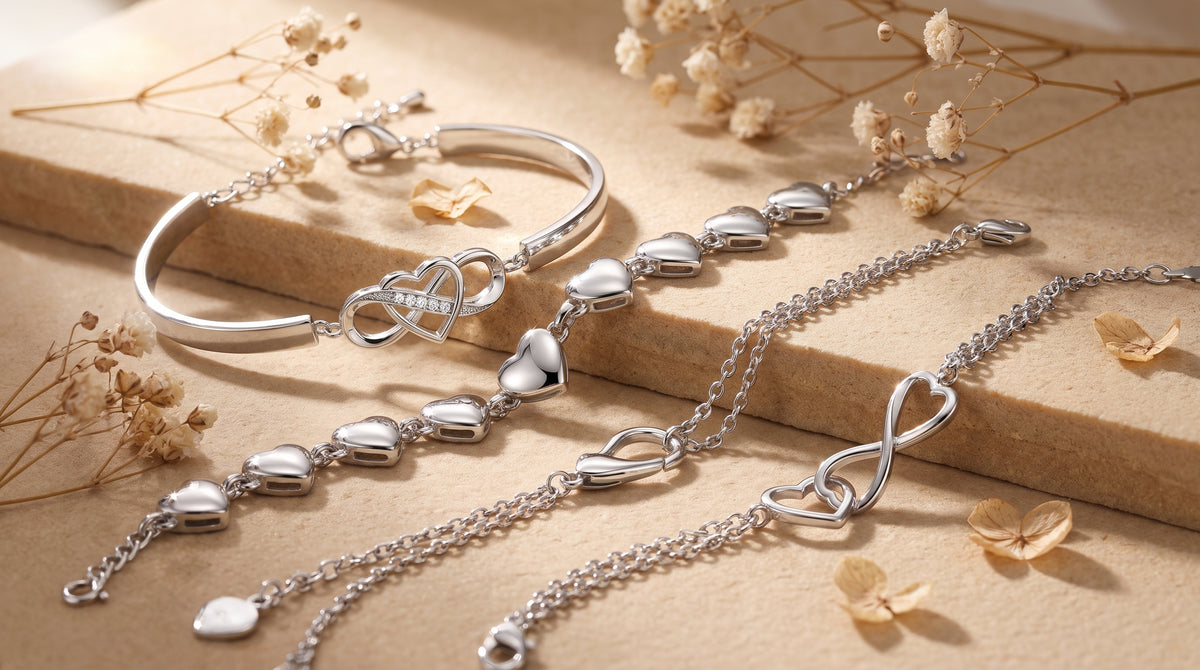
That is the logic behind the heart and infinity designs in our heart bracelets range. The Infinity Heart Bracelet and Linked Hearts Bracelet use the two most legible symbols in gift jewelry; the Petite Heart Link Chain Bracelet is a lighter option that stacks well with other chains; and the Althea Heart Bracelet - S925 Sterling Silver is another heart-motif design worth comparing alongside it. For relationship-specific gifting, the "You Are Also My Daughter-In-Heart" Infinity Heart Bracelet carries its message in the design itself. Check each product page for current pricing, exact materials, and measurements before ordering, and browse the full bracelets collection or the jewelry under $100 edit if you are shopping to a fixed ceiling. For a style-by-style breakdown aimed specifically at women's designs, see our guide to affordable bracelets for women.
Quick answers
What is a realistic budget for a bracelet that lasts?
If daily wear is the goal, the $50 to $150 band is the most reliable value: it generally buys solid sterling silver, stainless steel, or gold-filled construction and a better clasp, rather than a plated surface over base metal.
Will a gold-plated bracelet wear off?
Plating is a very thin gold layer over a base metal and can wear through with friction over time, which is why it is better suited to occasional and fashion wear. Gold-filled pieces bond a far thicker gold layer and hold up considerably better for everyday use.
Are Pandora bracelets affordable?
Relative to fine jewelry, the sterling silver and plated styles are accessible — especially during sale events — but they do not compete with the under-$50 department-store tier at full price. The brand's gold and lab-grown diamond bracelets are firmly in the fine-jewelry range.
Can I wear a 24k gold bracelet every day?
It is generally not recommended. Pure gold is soft enough to scratch, dent, and deform at clasps and links under normal daily stress, which is why 14k and 18k are the standard recommendations for everyday bracelets.
What size bracelet should I buy as a gift?
Measure the recipient's wrist tightly at its broadest point and add about 2 cm for a chain bracelet, or 1 cm for a bangle. If you cannot measure, 19 cm is the most commonly chosen chain size, and you can measure an existing bracelet end to end as a cross-check.
The short version: decide your ceiling first, then let the metal — not the marketing — tell you what that money is actually buying. Under $50, expect plating, crystal, and small accent stones, and buy the design you love. Between $50 and $150, buy solid metal and a secure clasp. Above that, you are buying gold content, and the karat you choose matters more than the brand stamped inside the clasp.

Leave a comment
This site is protected by hCaptcha and the hCaptcha Privacy Policy and Terms of Service apply.