


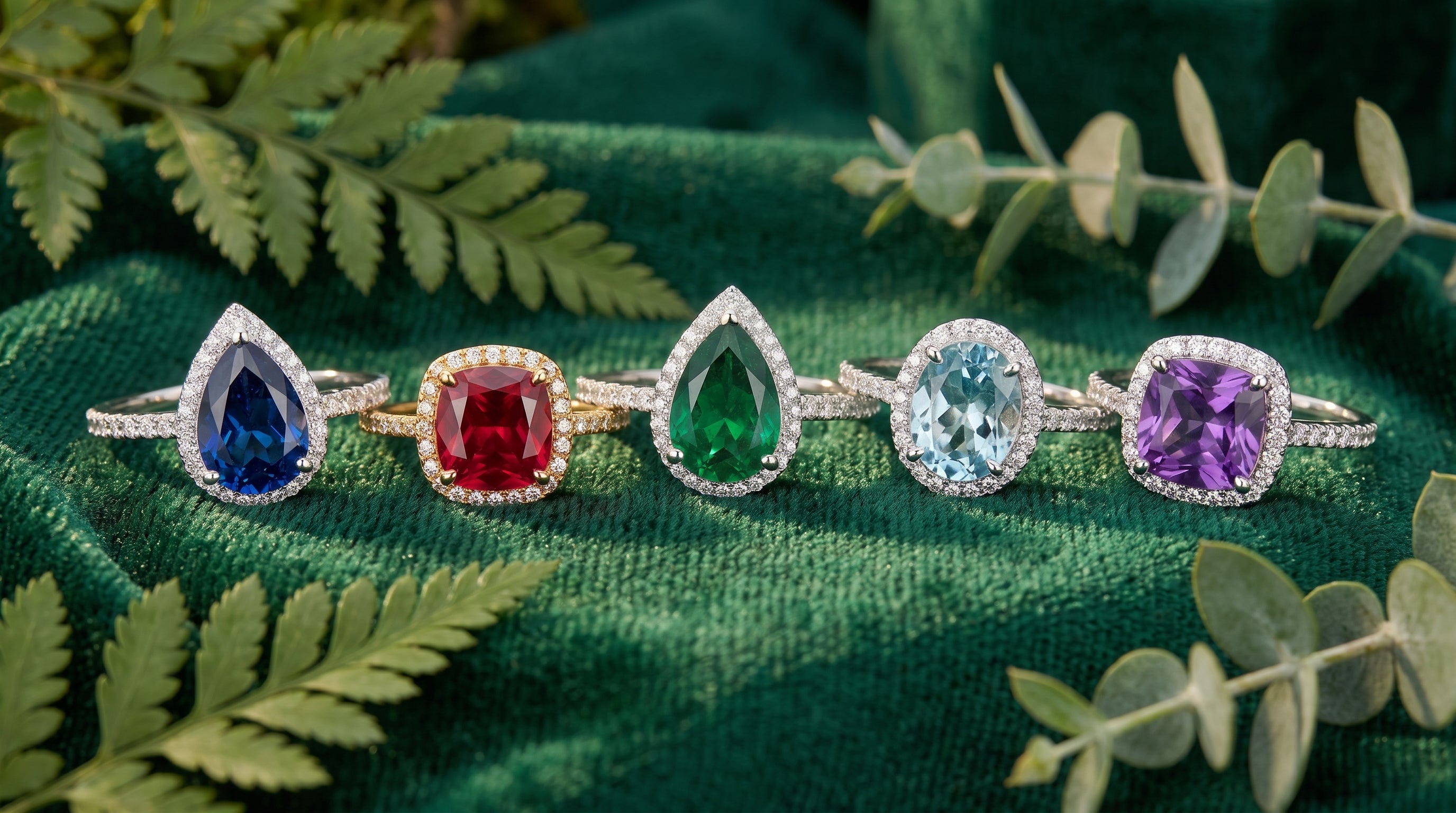
The hardest part of buying a birthstone ring is rarely the month. It is discovering that the month you thought was settled has more than one accepted stone. October can be tourmaline or opal. December is listed variously as blue zircon, blue topaz, or tanzanite, with turquoise and lapis lazuli as the older assignments. November is split between traditional topaz and modern citrine. Two reputable jewelers can publish two different "official" charts, and both are defensible, because birthstone lists are conventions that evolved through trade and tradition rather than a single ruling standard.
That ambiguity is actually good news. It means a birthstone ring is a design decision as much as a symbolic one, and you have permission to optimize for color, durability, and how the ring will be worn. This guide gives you a working framework: how to read the charts, how hardness should govern your setting, how to pair stones with metal, how 2-, 3-, and 4-stone architectures behave in practice, and what to ask before you pay for anything described as "natural."
What actually counts as a birthstone ring
The working definition used across buying guides is deliberately broad: a birthstone ring is any ring containing at least one gemstone associated with a birth month, most often given for a birthday or an anniversary. Nothing in that definition dictates metal, setting style, stone count, or who wears it. That is why the category stretches from a single-stone solitaire worn as a personal signature to a four-stone family ring, a stacked set of slim bands, or a pair of matching rings holding two partners' stones.
It also means there is no rule requiring anyone to wear only their own month's gem. Buyers routinely choose stones for color, meaning, or family connection instead: a mother wearing her children's stones, a couple wearing each other's, or someone simply preferring the depth of amethyst to the lighter shades of their assigned stone. Treat the chart as a starting point, not a constraint.
The birthstone chart: modern, traditional, and where retailers disagree
The most complete reference in general circulation lists modern and traditional assignments side by side. Simplified, it looks like this:
| Month | Modern | Traditional |
|---|---|---|
| January | Garnet | Garnet |
| February | Amethyst | Amethyst |
| March | Aquamarine | Bloodstone |
| April | Diamond | Diamond |
| May | Emerald | Emerald |
| June | Pearl | Pearl |
| July | Ruby | Ruby |
| August | Peridot, spinel | Sardonyx |
| September | Sapphire | Sapphire |
| October | Tourmaline | Opal |
| November | Golden topaz, citrine | Topaz |
| December | Blue zircon, blue topaz, tanzanite | Turquoise, lapis lazuli |
Why the lists you see while shopping vary
Retailers usually compress this into one stone per month for merchandising clarity, and they do not all compress it the same way. One well-known buying guide assigns opal to October, topaz to November, and zircon to December. A major online retailer's mother's ring education page assigns opal to October, citrine to November, and topaz to December. Neither is wrong; each reflects a different convention and a different inventory.
The practical consequence: if you are ordering a multi-stone ring for family members, confirm in writing which stone the seller will set for each month before you approve the order. A December stone rendered as blue topaz rather than tanzanite changes both the color balance of the ring and its cost profile.
A five-filter framework for choosing one ring
Most guides hand you a list of considerations without telling you what to do when they conflict. Run your shortlist through these five filters in order, and let earlier filters override later ones.
1. Symbolism: which meaning do you want on the hand?
Birthstone lore is where the emotional value sits, and it is worth choosing deliberately. Topaz is traditionally associated with love, affection, friendship, and peaceful communication, and in older accounts with balance, honesty, and inner strength. Citrine is linked to prosperity, positivity, creativity, and confidence. Amethyst is often chosen as a center stone for its reputed calming associations, with children's stones set around it. Treat all of this as tradition and lore rather than tested effect, and choose the story you actually want to tell.
2. Durability: how will the ring be worn?
This filter should overrule aesthetics for any ring intended for daily wear. Hardness on the Mohs scale is the usual shorthand: diamond, ruby, and sapphire sit at the top of the range (roughly 9 to 10) and tolerate the knocks that rings inevitably take. Topaz is around 8 and durable with care, though it has distinct cleavage and can chip if struck hard in the wrong direction. Citrine, a quartz, is around 7 with good toughness and is generally considered suitable for everyday wear. Garnet and peridot are intermediate and work in most settings with reasonable care. Opal and pearl are softer and more sensitive to chemicals and heat, which is why guides steer them toward earrings and pendants unless the ring setting is genuinely protective.
3. Setting: buy the setting the stone needs
Prong settings lift the stone and let in the most light, which flatters transparent gems but leaves girdle edges exposed. Bezel settings ring the stone in metal and shield those edges, which is the standard recommendation for softer or cleavage-prone stones you still want in a ring. Channel and bar settings hold several stones in a row and suit multi-stone family designs. If you want a soft stone in a ring you wear constantly, the bezel is not a style preference; it is the risk mitigation.
4. Metal: color harmony and wear behavior
Conventional pairing advice is straightforward and works: cool-toned stones such as amethyst, sapphire, and aquamarine read cleanly against white gold, platinum, or sterling silver, while warm gems such as garnet, ruby, citrine, and topaz gain depth against yellow or rose gold. Diamonds and pearls pair with any metal. Beyond color, metal construction affects longevity. Solid gold and platinum wear as one material; plated constructions such as gold vermeil pair a sterling silver base with a thicker layer of gold and can show wear at high-friction points sooner than solid metal, particularly on a ring worn every day.
5. Budget: set it per stone, not per ring
Cost in this category is driven mostly by which stone you chose and whether it is natural, lab-grown, or simulated. Within a single month, quality tiers can span an enormous range: rare imperial topaz is priced very differently from ordinary golden topaz, and citrine is widely regarded as one of the more affordable options. Deeper, more saturated citrine typically carries a premium over pale, highly transparent material, though the shade you genuinely prefer matters more than the shade the market rewards. Published price ranges in retailer guides are self-reported and change constantly, so use them as orientation rather than benchmarks.
Gold, silver, or vermeil for a birthstone ring
Metal is the decision buyers most often regret, because it is the part of the ring that touches skin, water, and soap thousands of times a year.
- Sterling silver (S925): a bright, cool metal that suits blues, purples, and greens, and the usual entry point for personalized and multi-stone family rings. It tarnishes and needs periodic polishing.
- Gold vermeil: a sterling silver core with a substantial gold layer. It delivers the warmth of gold against garnet, citrine, or ruby-red stones at a lower cost than solid gold, with the trade-off that the surface layer is finite. Awareness Avenue's Valerine Cushion Ring and Azurina Cushion Ring are described as 18K gold vermeil over solid S925 sterling silver, which is the construction to look for when you want gold color on a silver base.
- Solid gold and platinum: the choice when the ring is meant to be worn daily for decades or handed down. Both carry higher cost and, in the case of platinum, more heft.
Honest caveat: there is no independent long-term wear data in circulation comparing vermeil to solid gold, or simulated stones to natural ones, over five or ten years of daily use. Anyone who quotes you a precise lifespan is estimating. What you can do is match construction to intended wear: vermeil and silver for rings you rotate, solid metal for the one you never take off.
Multi-stone rings: 2, 3, and 4 stones for mothers and families
Once more than one person is represented in a ring, layout becomes the real design problem. The traditional approach for a mother's ring sets each child's birthstone in birth order, left to right. Modern approaches loosen that: repeating patterns, deliberate light-to-dark gradients, or a featured center stone (often the mother's, or an amethyst chosen for its associations) surrounded by smaller accent stones.
Two stones
Two-stone rings are the most versatile format, because they read as a couple, as two children, or as parent-and-child depending on framing. Symmetry matters here: stones of similar size and saturation balance better than a bold stone paired with a pale one. If one month's stone is much lighter, a shared metal accent or a neutral spacer can settle the composition. Our companion guide to two-stone birthstone jewelry works through pairing logic across rings, necklaces, and bracelets.
Three stones
Three stones invite a hierarchy: center-plus-flanks, or an even trio. Three matched sizes read as equal siblings; a raised center reads as one person emphasized. Color order deserves a moment of thought, because a saturated stone in the center will visually shrink the outer two. For layout options and setting styles specific to this count, see our dedicated guide to three-stone birthstone rings.
Four stones and beyond
Four-stone family rings are a standard format across specialty family-ring makers, typically as a row, a cluster, or a crossover band. Two practical notes from design-focused guidance: when the number of family stones does not fill the design, neutral stones such as diamond or white topaz can be used as spacers, and some retailers automatically substitute white accent stones when a buyer selects fewer birthstone types than the setting holds. Confirm what happens to empty positions before ordering. Larger families sometimes use repeating sequences instead of one stone per person, which keeps a wide band visually coherent.
Stackable rings for growing families
The strongest argument for stacking is that a single fixed multi-stone ring cannot grow. Stacked bands can: one slim ring per child, added over time, worn together or apart, and mixable across metals. It is a particularly sensible route for a first-time mother, and it sidesteps the awkward question of resetting a finished ring later. A slim design such as the Iridiana Stack Ring illustrates the format. If you are weighing a stacked set against a single continuous band, our comparison of eternity bands and stackable rings covers how each behaves in daily wear.
One sizing note for stacks and wide multi-stone bands: wider bands and multi-ring stacks fit more snugly than a single slim band at the same nominal size, so size against the actual construction rather than an old measurement.
Birthstone rings for couples
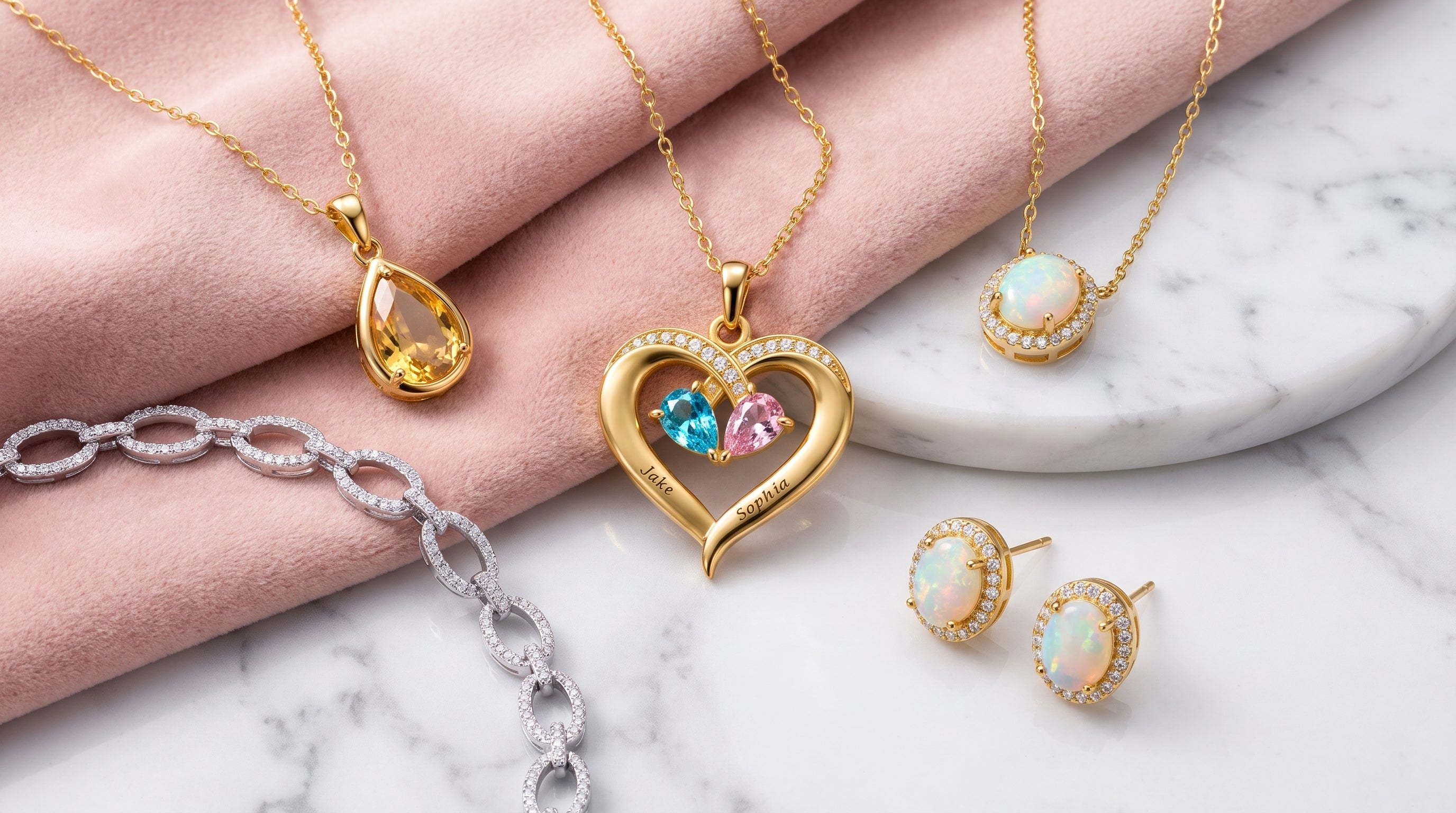
Couples' birthstone rings follow different rules from family rings. The two stones are usually given equal prominence rather than arranged hierarchically, often in symmetrical settings, heart motifs, or intertwined bands, and engraving with names or a date is common. Because the pieces are symbolic rather than heirloom-focused, simulated stones are widely used in this segment, which keeps color consistent between two rings that need to match.
Three questions settle most couples' purchases: do both partners want a matched pair or two individual rings that echo each other; will both rings be worn daily, which pushes you toward harder stones and protective settings; and does one partner's month have two accepted stones, which lets you tune the color pairing without abandoning accuracy. A pair of single-stone rings in the same setting family — for example two cushion solitaires such as the Nyara Cushion Solitaire — often works better than one ring holding both stones, because each person keeps a wearable piece.
November birthstone rings: topaz or citrine
November is the month buyers most often need help with, because both stones are legitimate and they behave differently.
Topaz, the traditional stone
Golden topaz ranges from soft yellow to rich honey, with rare imperial topaz showing fiery reddish-orange. It sits around 8 on the Mohs scale, which is durable enough for everyday wear, but it has distinct cleavage planes and can chip or split under a hard, badly angled knock. For a topaz ring in constant use, favor a bezel or otherwise protective setting, store it away from harder stones such as sapphire and diamond, and skip ultrasonic and steam cleaning.
Citrine, the modern stone
Citrine is a quartz spanning pale lemon to deep honeyed golden-orange, around 7 on the Mohs scale with good toughness, and it is generally described as well suited to daily wear. It is also typically the more affordable of the two. Keep it away from prolonged heat and constant direct sunlight, which can affect color, and avoid steam cleaning.
How to choose between them
If the ring will be worn on a working hand, citrine's toughness and lower replacement cost are the pragmatic pick. If you want the traditional stone, a deeper honey tone, or the possibility of imperial topaz, accept the extra caution topaz requires and buy the setting to match. In a family ring, you can use both: topaz for one November family member and citrine for another, which is a rare case where the chart's ambiguity becomes a design feature. Both stones read warmest against yellow or rose gold.
Be aware that yellow and golden gems are commonly color-enhanced through treatments such as heating. Published consumer guides acknowledge this in general terms but rarely specify how prevalent each treatment is, so ask the seller for a direct answer rather than assuming untreated material.
Natural, lab-grown, or simulated: getting a straight answer
This is where the most avoidable disappointment happens. Three categories are sold side by side, sometimes with similar language:
- Natural: mined material, variable in color and clarity, priced by quality factors and rarity, and frequently treated.
- Lab-grown: the same material grown rather than mined, usually more consistent and lower cost. Lab-created white sapphire, for example, is commonly used as an accent stone in personalized family rings.
- Simulated: a different material chosen to imitate a gem's appearance. Awareness Avenue's Valerine Cushion Ring, for instance, is described as featuring a color-calibrated simulated garnet for January — a deliberate choice that delivers consistent color, and one the brand states plainly.
None of these is inherently the right answer; the failure mode is not knowing which you bought. Practical steps: ask the seller to state in writing whether each stone is natural, lab-grown, or simulated; ask whether it has been treated and how; and for higher-value natural stones, ask for a grading report from a recognized gemological laboratory. A report is external documentation, which is a different category of evidence from a product description.
It is worth naming a limitation of the wider information landscape here: nearly all published birthstone guidance, including price ranges and durability reassurances, is authored by retailers and brands rather than independent laboratories or consumer testing bodies. Broadly accepted gemological facts such as Mohs hardness are reliable. Claims about how a specific product will perform over a decade are not verified, and should be read as vendor representation.
Care that actually keeps a birthstone ring wearable
- Clean most stones in warm water with a little mild soap and a soft brush or cloth, then dry gently.
- Avoid harsh household cleaners entirely, and avoid ultrasonic and steam cleaning for topaz. Skip steam for citrine. Treat opal and pearl as the most chemical-sensitive stones in the category.
- Store rings separately, in pouches or a partitioned box, so harder stones cannot scratch softer ones. Diamond and sapphire will win every contact with topaz.
- Have settings checked periodically by a jeweler so prongs stay tight and stones stay seated. This matters most on multi-stone family rings, where a single loose prong risks losing one person's stone.
- Remove rings for cleaning products, chlorinated water, gym sessions, and gardening. Impact, not wear, is what usually damages a colored stone.
Putting it together: a short pre-purchase checklist
- Confirm the exact stone for each month the seller will set, especially for March, October, November, and December.
- Decide wear frequency first, then let hardness and setting style follow from it.
- Choose metal for both color harmony and construction: solid metal for daily wear, vermeil or silver for rotation.
- For multi-stone designs, lock the layout — birth order, gradient, or center-plus-accents — and decide what fills unused positions.
- If the family may grow, favor a stackable approach over a fixed row of stones.
- Get stone origin and treatment in writing, and request a lab report for higher-value natural stones.
- Size against the real construction, allowing for wide bands and stacks.
If you are shopping single-stone designs rather than commissioning a multi-stone family ring, the format is easy to build around: a warm-toned January garnet in gold vermeil, an amethyst statement piece such as the Grand Duchess Amethyst Ring, an opal design like the Majesty Oval Opal Ring for October (worn with the extra care opal needs), or a May emerald pear such as the Valerise Ring in sterling silver. Our guide to May birthstone rings goes deeper on green-stone options, and the full birthstone jewelry collection is organized by month if you would rather start from a date than a design.
The rings people keep wearing are the ones where symbolism and construction agree. Pick the stone that means something, then buy the setting and metal that let it survive being worn.

Leave a comment
This site is protected by hCaptcha and the hCaptcha Privacy Policy and Terms of Service apply.