


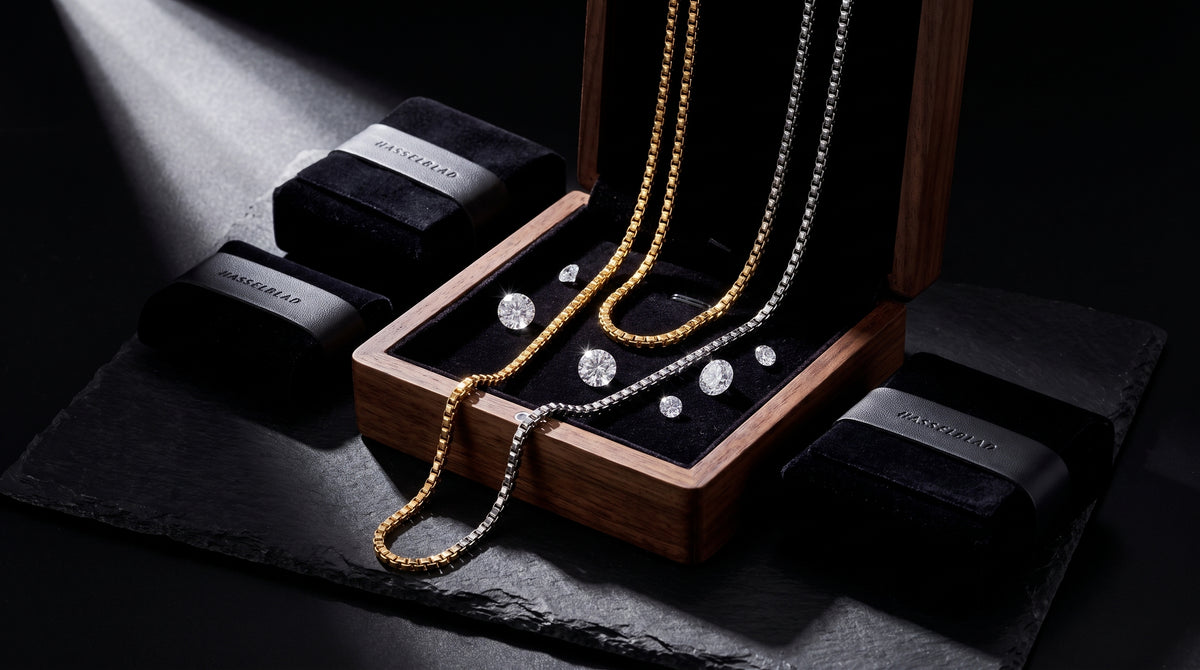
A 24-inch, 3.2 mm curb chain in 14K white gold weighs roughly 28 grams, and according to JewelTrendPro's men's jewelry storage guide, a single kink in a chain like that can irreversibly stretch the links. That one detail explains why shopping for a men's jewelry box by compartment count alone tends to disappoint. A box with 27 tidy little wells can still be the wrong box if your heaviest, most-worn piece is a chain that needs to lie flat or hang supported rather than get coiled into a square compartment.
The retail landscape doesn't make this easy. Brand sites, department stores, and marketplace listings describe men's jewelry boxes in terms of finishes, drawer counts, and hard shells, while genuinely technical storage guidance lives almost entirely outside the product pages. This guide sits in between: it uses what box makers and retailers actually publish about their products, plus published care protocols, to build a buying process you can run in about twenty minutes.
Start with what the box is actually holding
A men's jewelry box is rarely used only for jewelry. Packaging supplier Richpkg, which catalogs men's boxes by usage, describes them as containers for cufflinks, tie bars, bracelets, smart watch straps, keys, AirPods, and small keepsakes. MarqART frames its men's boxes similarly, listing bracelets, cufflinks, rings, keys, wallets, and tools among the things men put in them. In other words, the category is closer to a structured valet than a jewelry case, and the box that works for you depends heavily on which of those items dominate.
Do the inventory before you browse
Write down four numbers before you look at a single product photo:
- Chains and necklaces — count them and note their lengths. Anything past 22 inches needs real length to lie flat or a hook to hang from. If you're unsure what you own, our men's chain necklace size chart covers how lengths and millimeter widths translate into actual bulk.
- Watches — count them, and separate mechanical from quartz or smart watches, because they have different storage needs.
- Rings — count them. Ring rolls are the single feature most often over- or under-supplied relative to what men actually own.
- Small flat items — cufflinks, tie bars, collar stays, spare straps, a pocket knife, keys.
JewelTrendPro's guide offers a useful anchor point here: it suggests a 9" × 6" × 3" box with eight adjustable compartments as a sensible size for a man who owns roughly five to twelve pieces. If your count lands well above that, you're shopping for a multi-drawer or multi-level box, not a single-tray case.
Sizing: match dimensions to your dresser, not to the photo
Product photography flattens scale badly. Published dimensions are the only reliable comparison, and the three common formats separate cleanly by size.
Dresser-top boxes
Richpkg puts typical dresser-top men's boxes between roughly 8" × 6" × 2" and 12" × 8" × 3", which it describes as substantial enough for rings, watches, and cufflinks without swallowing the whole dresser surface. It cites a box around 12.5" wide as offering ample room for multiple items while still sitting cleanly beside cologne and a wallet. At the larger, multi-level end, Antorini's big jewellery box in white glamour measures 30 × 20 × 13 cm (roughly 11.8" × 7.9" × 5.1"), with a bottom-floor drawer sized for chains, bracelets, and watches and a top drawer divided into smaller compartments for pendants, rings, and cufflinks.
The practical test: measure the free rectangle on your dresser, subtract a couple of inches on each side so the lid can open without hitting a wall or mirror, and treat that as your ceiling.
Compact cufflink and accessory cases
Richpkg lists compact cufflink cases in the range of about 7" × 5" × 2" to 9" × 6" × 2.5". These live in a drawer or on a shelf and are built around small flat items. Cufflinks Depot, which specializes in this niche, positions its cufflink case boxes precisely around the problem of pairs going missing — which is what happens when cufflinks share an open tray with everything else.
Travel cases and rolls
Travel formats run smaller and harder. Richpkg cites travel-friendly cases at approximately 7" × 4" × 1.5" or in cylindrical roll formats. ProCase's men's travel jewelry case is described as holding three watches, one pair of sunglasses, an accessories slot, and five necklaces on hooks, with an EVA hard shell against drops and pressure plus a soft inner lining to reduce scratching. At the most compact end, ModGents' Vault ring box is a matte black travel ring case with a padded interior and two cushioned ring compartments.
Chains: the hardest thing to store well
Most men's boxes were designed around cufflinks and rings first. Chains were added later, and it shows. Only a minority of listings describe chain-specific architecture — Antorini's dedicated bottom drawer for chains, bracelets, and watches is one; ProCase's five necklace hooks are another.
How chains should be laid down
JewelTrendPro's protocol is specific: never toss a chain loose. Lay it flat, fasten the clasp, loop it once, secure it with a twist-tie made from archival paper, and store it in a rigid pouch or hang it vertically on a padded hook. The reasoning is mechanical rather than cosmetic — supported links don't develop the localized kink that stretches a chain permanently.
What that means when you're comparing boxes
Translate the protocol into features you can verify from a product page:
- A long, flat compartment or drawer that comfortably fits your longest chain once it is clasped and looped once, rather than forcing it into a small square well. That is why Antorini's approach of giving chains their own drawer rather than a divided tray makes sense for longer pieces.
- Padded hooks or a vertical hanging section, the feature ProCase supplies for necklaces in travel format.
- A soft, non-shedding lining under the chain rather than bare wood or hard plastic.
- Separation between chains. WOLF states the principle plainly on its jewelry storage pages, where its guidance on women's jewelry storage notes that the best storage uses individual compartments for each item to prevent scratching, metal transfer, and tangling — a design logic that applies equally to men's pieces. Two chains sharing one well will tangle eventually.
If your collection leans toward layered or mixed-length looks, the geometry matters even more; our guide to men's necklace styles walks through how chain widths and lengths stack, which is the same variable that determines how much flat storage you need.
Watches, rings, and cufflinks: the compartment math
Counting slots honestly
Large boxes publish their counts. The WOLF Heritage large jewelry box, as listed on Amazon, is described with 27 compartments, 26 ring rolls, a glass mirror, and a lock and key, plus two included travel cases that carry their own compartments, 21 earring holes, ring rolls, and necklace hooks. That's an unusually high-capacity configuration, and it's worth reading as a ceiling rather than a target — a man with four rings and two chains does not need 26 ring rolls, and the unused wells simply take up dresser real estate.
Mechanical watches want different treatment
JewelTrendPro separates watch types. For mechanical watches worn less than twice a week, it points to wind-and-store boxes set to roughly 800–1,200 rotations per day. For quartz and smart watches, it advises keeping them away from magnetic sources such as speakers and refrigerator doors. For general storage it suggests removing bands and resting watches face-down on microfiber. WOLF's own product range reflects this split, listing watch boxes and watch winder cases as categories distinct from jewelry boxes.
One frequently reported friction point: watch cushions and cuffs don't fit every watch. Among the customer reviews aggregated on Trustpilot for WOLF — 558 reviews in total, 546 of them submitted in the preceding twelve months — most reviewers report positive experiences and praise quality, craftsmanship, materials, and customer service, while some describe problems including incomplete shipments, items reported out of stock only after ordering, products arriving broken, and watch cuffs that did not fit certain watches. Those are customer reports rather than independent testing, but the fit issue is a concrete reminder to check cushion diameter against a heavy or large-cased watch before buying.
Rings and small flat items
Ring rolls hold rings upright and separated; cushioned compartments like the two in ModGents' Vault do the same job in a travel footprint. For cufflinks and tie bars, a shallow divided tray beats a deep well every time, because depth just lets pairs migrate.
Materials, linings, and what "archival" actually means
Wood and finish
Wood dominates the men's category. Mele's men's range alone lists finishes including Antique Walnut, Bamboo, Burlwood Oak, Cherry, Dark Walnut, Java, Mahogany, Mocha, Oak, Oceanside Grey, Walnut, and White-Ivory-Wood. Antorini's large box is inlaid wood in ivory and brown and is described as handmade in Italy. Finish is genuinely a decision factor — a box that clashes with your bedroom ends up in a closet, which defeats the purpose — but finish tells you nothing about what's happening to your metal inside.
Linings, by metal
This is where the care literature adds information the product pages don't. JewelTrendPro recommends anti-tarnish flannel pouches for gold, microfiber-lined trays kept separate for platinum, and tarnish-inhibiting silver cloth for oxidized silver. It specifically warns against felt for platinum, because felt can shed fibers that embed in platinum's grain, and against plastic wrap for oxidized silver, because it traps moisture. It also suggests pouch sizes of about 3" × 4" for most rings and small pendants and 5" × 7" for multi-link chains or oversized signet rings, and recommends segregating pieces by metal family rather than mixing them in one tray.
Practical takeaway: a box's dividers are only half the system. Pouches inside the compartments do the metal-specific work, and they're cheap relative to the box.
The archival benchmark
JewelTrendPro describes the industry benchmark as a GIA-recommended archival jewelry box built from acid-free, lignin-free fiberboard with removable, velveteen-lined dividers. That's presented as expert guidance in a care guide, not as a certification you'll find printed on consumer boxes — none of the retail listings surveyed claim archival compliance. Treat it as a standard to evaluate against: does the box use a soft, non-shedding lining? Are dividers removable so you can reconfigure as your collection changes? Is the interior free of strong chemical odor when it arrives?
Safes, humidity, and the environment around the box
If you're storing a box inside a safe, the safe becomes part of the storage system. JewelTrendPro argues that only safes with climate control — 40–50% relative humidity and a maximum temperature of 65°F — and non-reactive linings are appropriate for jewelry, warning that standard home safes can trap moisture and off-gas acidic vapors from insulation foam. Its suggested mitigation is adding silica gel canisters and checking them monthly. The same guide recommends rotating pieces weekly so stored items aren't left indefinitely under UV exposure, and cleaning jewelry after contact with sweat, saltwater, or lotions before it goes back in the box.
None of this requires a laboratory. A desiccant pack, a monthly glance, and a habit of wiping a chain down before it goes away covers most of it.
A buying checklist you can run in twenty minutes
- Count chains, watches, rings, and small flat items. Note chain lengths.
- Measure the space on your dresser or in your drawer; subtract clearance for the lid.
- Pick a format: dresser-top (roughly 8" × 6" × 2" to 12" × 8" × 3" per Richpkg's ranges), compact case, or travel case — or a dresser-top box plus a small travel case, which is the most common real-world pairing.
- Verify chain support: a flat drawer long enough for your longest chain, padded hooks, or both.
- Verify watch fit: compare cushion size against your largest watch case; check whether you need a winder rather than a static box for a mechanical piece.
- Check the lining and dividers: soft, non-shedding, ideally removable.
- Add pouches sized to your pieces and separated by metal family.
- Read the seller's policies on returns and any warranty directly on the retailer's or brand's page before ordering — the surveyed listings don't publish standardized terms, and the customer feedback on fulfillment issues makes this worth two minutes.
Common questions
Does a men's jewelry box need a lock?
Some large boxes include one — the WOLF Heritage listing specifies a lock and key alongside its mirror and compartments. A lock deters casual access but isn't a substitute for a safe. If security is the primary driver, the storage question shifts to the safe's climate conditions, which JewelTrendPro treats as the real risk factor for stored metal.
Is wood better than a hard-shell case?
They solve different problems. Wood dresser-top boxes prioritize capacity, organization, and looks; hard shells like ProCase's EVA construction prioritize impact and pressure resistance in a bag. Most men who travel with jewelry end up owning one of each rather than compromising on a single box.
Can one box hold chains and watches together?
Yes, if it's designed for it. Antorini's two-base layout explicitly dedicates the lower drawer to chains, bracelets, and watches while reserving the upper drawer's small compartments for pendants, rings, and cufflinks. The failure mode to avoid is a single open tray where a watch case rests against a chain — that's exactly the scratching and metal transfer WOLF's compartment philosophy is written against.
Do I need a separate box per metal?
Not necessarily a separate box, but JewelTrendPro does recommend segregating by metal family, which is achievable with pouches and dividers inside one box. It also suggests labeling pouches with archival tape noting metal type, karat, and acquisition date — genuinely useful if you own pieces you intend to pass down.
Storing pieces that are meant to be passed on
Worth stating plainly: Awareness Avenue makes chains, pendants, and gift bundles — not jewelry boxes. If you arrived here looking for a box, the buying criteria above are the useful part of this page, and the boxes themselves come from specialists like the brands and retailers referenced throughout.
Where this guide does connect back to what we make is on the other side of the transaction. The chains most likely to get stored badly are the ones worn most and thought about least: a daily gold chain like the Boxed In Chain in gold, or a heavier everyday piece such as the Boxer Chain in stainless steel. Both belong flat or hung, clasped, and separated from watch cases — not dropped into a nightstand drawer. The same applies to keepsake pieces given across generations; if you're choosing storage for a chain that came with a message attached, the flat-drawer-and-pouch approach is what keeps it looking the way it did the day it was given. You can see the range of pieces this applies to across our men's jewelry collection, and if you're assembling several items at once, our guide to men's jewelry sets covers how pieces work together — which also determines how many compartments you'll eventually need.
For broader context on metals, finishes, and how different men's pieces age with wear, the definitive guide to men's jewelry covers the materials side in more depth.
The short version
Buy for your inventory, not for the compartment count on the box with the best photograph. Count your chains and measure your dresser first. Confirm the box gives chains a flat run or a hook, gives watches a cushion that actually fits, and gives rings dedicated rolls. Favor soft, non-shedding linings and removable dividers. Add pouches sized to your pieces and keep metals separated. Then, if the box lives in a safe, pay attention to humidity — because as the care literature makes clear, the most expensive failure isn't a scratch. It's a stretched chain that can't be un-stretched.

Leave a comment
This site is protected by hCaptcha and the hCaptcha Privacy Policy and Terms of Service apply.