


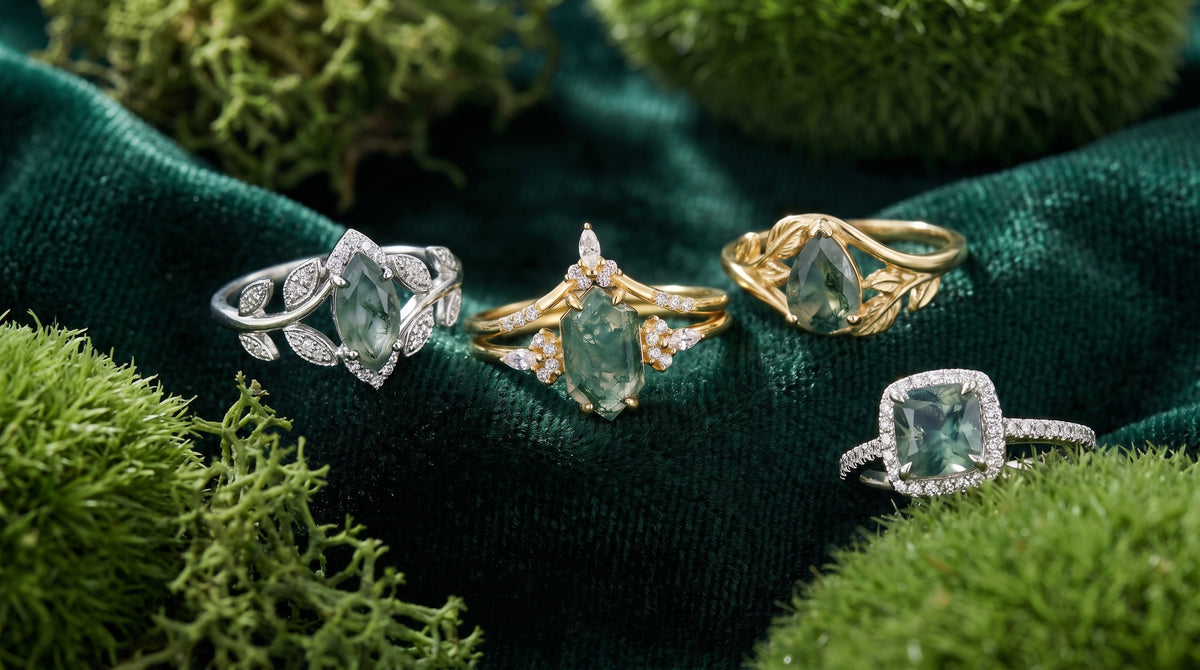
The "moss" in moss agate is not moss. Encyclopaedia Britannica and GeologyIn both describe those ferny green plumes as inorganic dendrites — primarily manganese and iron oxides — that formed inside a clear-to-milky chalcedony host, a microcrystalline variety of quartz, usually in fractures of volcanic rock that later weathered out. Nothing organic is trapped in the stone, so there is nothing inside it to decay, dry out, or discolor with age. That one fact reframes the whole purchase: when you shop for a moss agate engagement ring in gold, you are not managing a fragile botanical curiosity, you are managing a quartz-family gemstone that sits at 6.5–7 on the Mohs scale and whose real weak point is edge chipping under impact, not fading.
Once that is clear, the gold decisions stop being purely aesthetic. Metal color changes how the green reads against the milky matrix; karat affects how the setting holds up; bezel versus prong changes how exposed the stone's edges are; and solid gold versus 18K gold vermeil changes what you own and how you care for it. This guide works through each of those in order, flags where published jeweler evidence actually conflicts, and ends with the questions worth asking before you check out.
What Moss Agate Actually Is (And What It Is Not)
Moss agate is a chalcedony — microcrystalline quartz — with dark dendritic inclusions that branch like ferns, trees, or lichen. Britannica describes the base as grayish to milky-white quartz carrying dark inclusions of manganese and iron oxides; GeologyIn and Wikipedia describe the same structure, noting the green, brown, and black tones are produced by those metallic oxides rather than by plant matter. The jeweler blog Calithien adds that in some specimens the filaments are green hornblende or chlorite rather than iron or manganese oxide, which helps explain the range from soft sage wisps to dense near-black forests.
It is usually not a "true" agate — and that is fine
Several sources (GeologyIn, Wikipedia, Calithien, AC Silver) make the same technical point: most geologists reserve the word agate for banded chalcedony, and moss agate generally has no concentric banding. It is sold and universally known as an agate in the gem trade, and it is chemically the same family, but strictly speaking it is dendritic chalcedony. This is terminology, not a question of authenticity. Moss agate is a genuine, naturally occurring gemstone; the naming quirk is worth knowing only so you are not thrown if a seller or a forum post raises it.
Why no two stones match — and what that means when ordering
Because the dendrites grew unpredictably as mineral-rich fluids infiltrated fractures, every cut stone is a different landscape. AC Silver notes that a single stone can carry multiple tones of green and often resembles a painted scene, which is why moss agate is sometimes called landscape agate. Juyoyo and other jeweler guides make the same point in commercial terms: no two moss agate engagement rings are identical.
Practically, this means photography on any product page — ours included — shows a representative stone, not the exact stone you will receive. If pattern density matters to you (some people want airy, misty green; others want a dense canopy), say so when you order and ask whether the seller can share photos of available stones. There is no formal grading system for moss agate the way there is for diamonds; the informal selection criteria used across the trade are pattern clarity, color saturation, and translucency.
A note on dyed stones
Britannica and GeologyIn both record that some agates are dyed to enhance color. If a stone's green looks unusually uniform or neon rather than varied and mineral, it is reasonable to ask the seller directly whether the material is natural or color-enhanced. Dyed material is also the category where published warnings about fading under prolonged UV exposure are most often aimed.
Durability: What 6.5–7 On The Mohs Scale Really Buys You
Calithien, AC Silver, Jeweltrendpro, CustomMade, and MollyJewelryUS all put moss agate at 6.5–7 on the Mohs hardness scale — the same band as amethyst, citrine, and other chalcedonies. That is well above everyday plastics and most metals it will brush against, but meaningfully below sapphire (9) and diamond (10).
Hardness and toughness are two different problems
Hardness predicts scratch resistance. Toughness predicts resistance to chipping and cracking under impact, and this is where moss agate needs more caution than its Mohs number suggests. A Jeweltrendpro durability article argues that internal microfractures and inclusion boundaries make real-world edge resilience lower than the hardness figure implies; the site reports its own wear testing in which a clear majority of moss agate rings showed visible edge nicks or surface abrasion after six months of normal wear, with a minority developing small chips along the stone's edges, versus far lower rates for sapphire and diamond. Treat that as the publisher's own reported data rather than independent laboratory consensus — but treat the direction of the finding as credible, because it matches what every other guide implies through its care advice.
There is also a genuine contradiction in the published material worth naming. One Jeweltrendpro guide describes moss agate as highly stable and unaffected by UV, heat, or mild acids; another article on the same site warns about thermal shock, strong acids, and UV-driven fading in dyed specimens. The most reasonable reading is that stability is specimen-dependent: undyed, structurally sound material behaves very differently from heavily fractured or color-treated material. Ask about treatment status, and avoid sudden temperature changes regardless.
Also worth knowing: household dust contains quartz
Several care guides make the point that ordinary airborne grit includes quartz particles of comparable hardness to moss agate. That is why wiping a dusty stone hard with a dry cloth is a slow way to dull the polish, and why rinsing before wiping is the better habit.
Settings that actually reduce risk
Jeweltrendpro recommends full bezel settings — a continuous metal rim around the stone — specifically because they shield the vulnerable edges, and favors low-profile or flush mounts for round, oval, and cabochon stones. MollyJewelryUS makes the same structural argument when comparing moss agate to diamond: moss agate needs more protective settings. Prongs are not disqualified, and they let more light through a translucent stone, but a high-set prong design puts the girdle out where door frames and countertops live, and it needs more frequent inspection.
A practical hierarchy for daily-wear engagement rings: full bezel > partial bezel or geometric frame > low-profile prongs with a halo of accent stones absorbing knocks > high solitaire prongs. Halo designs help in two ways — the surrounding metal and pavé sit slightly proud of the center stone, and the visual sparkle compensates for chalcedony's soft, non-brilliant character. Our halo oval moss agate ring in 18K gold vermeil and the kite cut geometric frame ring set are examples of that frame-first approach.
Lifestyle fit, stated honestly
Juyoyo puts it plainly: moss agate scratches and chips more easily than diamond, and suits couples who value uniqueness and are willing to care for the ring — not people with very hands-on, high-impact routines. CustomMade and MollyJewelryUS reach the same conclusion with the same mitigation: take the ring off for rough work. If you climb, lift weights, work with tools, garden seriously, or handle cleaning chemicals daily, either commit to a removal habit with a dedicated dish by the sink, or consider moss agate for a right-hand ring, a promise ring, or a stacking piece, and choose a harder stone for the everyday engagement ring.
Choosing Your Gold: Color, Karat, And Solid Gold Versus Vermeil
Yellow, rose, or white
GemsMagic recommends 14K or 18K rose gold to warm and enhance moss agate's greens, yellow gold for a vintage, romantic register, and platinum or white gold for a clean modern contrast. In practice the mechanism is simple color theory against a semi-translucent stone:
- Yellow gold sits opposite green on the warm/cool axis and makes the dendrites read deeper and more forest-like. It flatters milky, cloudier matrices and is the natural choice for antique-inspired designs.
- Rose gold adds a pink cast that lifts both the green and the creamy background; it is the softest, most contemporary look. If you are weighing that specifically, our rose gold moss agate ring guide goes deeper into tone pairing.
- White gold gives a cool frame that emphasizes pattern edges and translucency — best when the stone has a crisp, high-contrast landscape you want read clearly. Note that white gold is typically rhodium plated and that plating is renewed periodically, which is an ongoing maintenance item.
Karat: a strength and color trade-off
This is standard jewelry-industry knowledge rather than a moss-agate-specific finding: higher karat means more pure gold, richer color, and a softer alloy; 14K is harder and more resistant to deformation, while 18K is purer and warmer but more easily marked. For a bezel that must hold a medium-hardness stone securely through years of wear, both work, but 18K bezels and prongs benefit from slightly more frequent inspection. Jeweltrendpro's engagement-ring guide favors 14K or 18K gold over platinum for moss agate, arguing that platinum's density can accentuate minor surface wear on the stone — a jeweler's opinion rather than a quantified mechanical study, but a reasonable one. For a broader look at purity trade-offs, see our 18K gold engagement ring buying guide.
Solid gold versus 18K gold vermeil
This is the single most consequential line item on any "gold" moss agate ring listing, and it is easy to misread.
Solid gold means the metal is gold alloy throughout. The color cannot wear off, because there is no surface layer to lose. It is the choice if you want a ring that can be resized, repaired, refinished, and worn continuously for decades. Our moss agate leaf design ring in solid gold and moss agate ring in solid gold sit in that category, alongside the rest of our solid gold pieces.
18K gold vermeil is a gold layer over a sterling silver base — a real precious metal underneath, not brass or plated base metal. It delivers the gold aesthetic at a different position in the market and is widely used by contemporary jewelers. The trade-off is that the gold surface is a layer, so it responds to abrasion, chemicals, and constant friction over time; vermeil rewards the same removal-before-chores habit that the moss agate itself already asks for. Our hexagon moss agate ring set in 18K gold vermeil and kite cut moss agate ring set in 18K gold vermeil are examples.
Neither is "better" in the abstract. The honest framing is: if this ring is intended to be worn every day indefinitely and never taken off for long, solid gold is the lower-friction long-term choice. If you want the gold look with a more elaborate design, or you are buying a promise ring or a stacked set you will rotate, vermeil is a legitimate option — provided you know exactly what you are buying. Check each product page for the specific metal, karat, and stone details before ordering rather than relying on a category name.
Cut, Silhouette, And Ring Sets: Matching Design To Gold
The cuts you will actually see
Moss agate is usually cut to show the landscape, not to chase brilliance, so faceted geometric shapes and smooth cabochons dominate the market rather than the brilliant cuts used for diamonds.
- Hexagon and kite: angular, modern, and strongly associated with nature-inspired and alternative bridal design. Their straight edges pair naturally with frames and bezels, which is useful given moss agate's edge vulnerability.
- Cushion: rounded corners, a softer and more classic outline, and fewer sharp points to catch — a sensible default for daily wear.
- Oval: elongates the finger and gives the dendrites a wide canvas; works especially well inside a halo.
- Leaf and organic motifs: the design echoes the stone's botanical illusion. In yellow or rose gold, leaf shoulders read as vintage; in white metal they read cooler and more graphic. Our cushion cut leaf design ring shows the silhouette in sterling silver if you want to compare the metal effect directly.
Single ring, or a set?
Ring sets pair the moss agate centerpiece with a contoured or accent band designed to sit flush against it. Two practical advantages: the second band physically braces the center ring and reduces rocking and rubbing, and you avoid the common problem of hunting later for a wedding band that fits an unusual stone outline — a real issue with hexagon and kite shapes. If you are comparing formats, our moss agate engagement ring set guide breaks down how the pairings work.
A separate route is an antique or estate piece — vintage moss agate rings set in gold genuinely exist in the secondary market, and condition assessment becomes the main issue: check for existing chips, worn bezels, and thinned shanks. Our vintage moss agate engagement ring guide covers what to inspect.
Engagement ring, promise ring, or something else
The same design can serve different commitments. Bolder center stones, halos, pavé shoulders, and coordinated sets are the features people most often associate with engagement; simpler solitaires and slimmer bands often serve as promise rings or anniversary pieces. Choose based on prominence and how the ring will be worn rather than on the label. You can browse the full range in our moss agate rings collection.
Meaning: What Moss Agate Is Said To Symbolize
Symbolism is a major reason people choose this stone, and it deserves accurate framing. In metaphysical and folk traditions, moss agate is widely called the gardener's stone and is linked to growth, abundance, fertility, renewal, and connection to nature; Calithien and Gemstonist both associate it with the heart chakra and with emotional healing. MollyJewelryUS interprets the green dendrites as emblems of abundance and stability and describes moss agate rings as symbols of ever-growing love, while Trendolla frames them around love, peace, and harmony. Some jeweler pages also recount that farmers in ancient Greece wore moss agate for good harvests, that medieval warriors carried it for endurance, and that it was admired in Victorian jewelry.
These are traditions and marketing narratives, not documented scientific or primary-source history — the historical anecdotes circulate widely without cited sources. That does not make them worthless. If the idea of a stone whose pattern grew slowly and unrepeatably inside rock speaks to how you think about a relationship, that is a legitimate reason to choose it. It simply should not be presented to you as verified fact, and the stone's beauty stands on its own for buyers who feel nothing about chakras.
How this compares to diamond symbolism
MollyJewelryUS frames the contrast well: diamond value is standardized through the 4Cs, where clarity and color differences invisible to the naked eye command premiums, whereas moss agate is valued for inclusions that a diamond grader would penalize. Jeweler guides including CustomMade and Juyoyo consistently describe moss agate as far less expensive than a diamond of comparable size — specific figures vary by retailer, design, and stone quality, so treat any quoted range as illustrative rather than a market rate. The useful takeaway is allocation: with moss agate, a larger share of the budget goes into metal quality, setting craftsmanship, and design rather than into the stone itself. That is precisely why the solid gold versus vermeil question matters so much here.
Care And Maintenance For A Gold Moss Agate Ring
Routine cleaning
MollyJewelryUS's care guide recommends lukewarm water with a drop of mild, non-detergent soap, a soak of roughly five to ten minutes, gentle work with a soft toothbrush, a thorough rinse, and patting dry with a soft cloth. Jeweltrendpro suggests a similar routine on a weekly cadence with a soft nylon brush. AC Silver's advice for moss agate is consistent: warm soapy water, nothing harsh.
What to avoid
- Ultrasonic and steam cleaners — repeatedly flagged as a risk for inclusion-rich stones with potential microfractures.
- Hot water, or any rapid temperature change, because of thermal shock concerns.
- Ammonia, bleach, alcohol, vinegar, and commercial jewelry dips, which can etch the surface or dull the polish.
- Abrasive pastes and vigorous dry rubbing.
- Swimming, household cleaning, and applying perfume or lotion while wearing the ring.
Storage and professional checks
Store the ring separately from harder stones — a diamond band in the same pouch will scratch moss agate. Care guides recommend having a jeweler check the prongs or bezel periodically and lightly re-polish the stone if the surface begins to look dull; this is normal for a medium-hardness gem and is not a sign of a defective stone. For vermeil, minimize exposure to friction, chemicals, and abrasive cleaning entirely, and clean with a soft cloth and mild soapy water only.
A Practical Checklist Before You Buy
- Confirm the metal precisely. Solid gold or 18K gold vermeil? What karat? Product pages, not category headings, are the source of truth.
- Confirm the setting type. Full bezel, partial frame, halo, or prongs — and how high the stone sits relative to the band.
- Ask about the stone. Natural or color-enhanced? Can the seller show the actual stone, given that patterns vary?
- Match the design to your hands. Be honest about impact exposure at work, in the gym, and around the house.
- Decide on the band now. Angular cuts are much easier to pair when the matching band is bought as a set.
- Check resizing and repair implications. Eternity-style and pavé bands and plated finishes behave differently from plain solid gold shanks.
- Plan the care routine. A ring dish by the kitchen sink prevents more damage than any product feature.
Is moss agate strong enough for an engagement ring?
For most wearers, yes — with conditions. At 6.5–7 Mohs it resists everyday scratching reasonably well, but its toughness is only fair, so a protective setting, a low profile, and a habit of removing it for rough tasks matter more than they would with sapphire or diamond. Jeweler guides broadly endorse it for engagement use while explicitly attaching these caveats, and so do we.
Does yellow or rose gold suit moss agate better?
Both work; they do different jobs. Yellow gold deepens the greens and leans vintage; rose gold softens and modernizes; white gold sharpens pattern definition. Look at the specific stone: dense, dark landscapes often gain from white metal contrast, while paler, mistier stones usually come alive against warm gold.
Will the pattern fade over time?
The dendrites are mineral, not organic, so there is nothing inside the stone to wither. The documented concerns are surface polish loss from abrasion and, for dyed material, potential fading under prolonged UV exposure — which is why treatment status is a fair question to ask before buying.
Moss agate in gold works best for people who want a ring that is visibly, permanently one of a kind and are willing to trade a little robustness for that. Decide the metal question honestly, insist on a setting that protects the stone's edges, and keep the cleaning routine mild, and the ring will carry its small forest well.

Leave a comment
This site is protected by hCaptcha and the hCaptcha Privacy Policy and Terms of Service apply.