


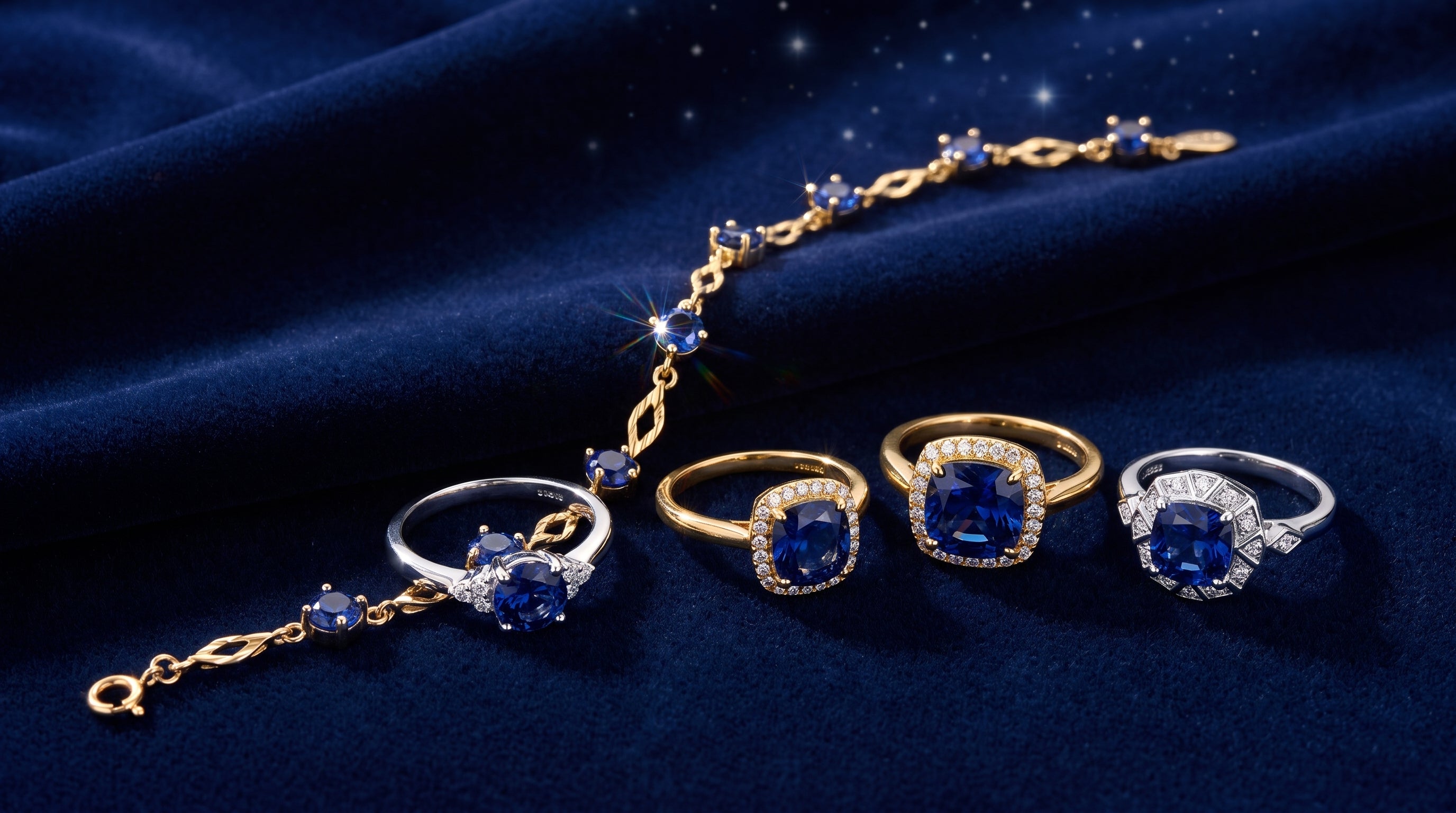
The Gemological Institute of America is unusually blunt about sapphire: color is the most important quality factor, and the most highly valued blue sapphires sit in a narrow band described as velvety blue to violetish blue, medium to medium-dark in tone, with saturation as strong as possible before the stone starts to look dark rather than bright. That single sentence reorders how a sapphire birthstone ring should be shopped. Carat weight and clarity grades tend to dominate product filters, but with sapphire the hue, tone, and cut are what your eye actually reads across a room. Everything else — metal, setting, stone origin — is a set of trade-offs you make around that.
This guide walks through those trade-offs in the order they matter: what September's birthstone tradition actually covers, how sapphire quality works in plain language, how to read the words "natural," "heated," "lab-grown," and "simulated" on a product page, which metal suits your wear pattern, and how to care for the ring afterward.
What a “sapphire birthstone ring” actually covers
Sapphire is widely recognized and marketed as the birthstone for September. Major jewelers treat it that way consistently: Kay Outlet groups its sapphire jewelry under the September birthstone heading, Tiffany & Co. curates a September birthstone collection built around sapphire, and jeweler education pages from Gabriel & Co. and Taylor & Hart both answer the question directly — yes, sapphire is September's stone, and has been recognized as such for decades.
Blue is iconic, but it is not the only option
Sapphire is a variety of corundum, and it occurs in far more colors than the deep blue most people picture. Tiffany's September edit includes blue, pink, and orange sapphires; Gabriel & Co. and Taylor & Hart both note yellow and the rare pink-orange padparadscha among the family. Any of these colors can legitimately celebrate a September birthday. If the person you are shopping for wears warm tones or dislikes blue, a pink or yellow sapphire ring is still a correct birthstone gift — it simply reads less traditionally.
The symbolism people actually buy into
Birthstone jewelry is bought for meaning as much as material. The associations attached to sapphire across the jewelry trade are consistent: loyalty, wisdom, protection, and truth. Gabriel & Co. describes historical beliefs that sapphires guided thoughts, protected travelers, and served as talismans of courage and spiritual purity, and notes that in medieval Europe clergy wore sapphires as symbols of heaven while royalty wore them to guard against envy and harm. Taylor & Hart adds the folkloric nickname "the traveller's protector" and links sapphire to wisdom, learning, and romantic connection.
These are traditional and folkloric meanings, not tested effects — worth saying plainly, because it is exactly the framing that makes a gift feel considered rather than superstitious. If the symbolic angle is what drew you in, our companion piece on sapphire engagement ring meaning, colors, and symbolism goes deeper on how those associations shift by hue.
Sapphire quality in plain language: color, clarity, cut, carat
Color: hue, tone, and saturation
Three variables sit inside the word "blue." Hue is the basic color and whether it leans violet. Tone is how light or dark the stone is. Saturation is how pure and intense that color reads. GIA's benchmark for the most valued blue sapphire combines a velvety blue to violetish-blue hue, medium to medium-dark tone, and strong to vivid saturation — intense, but not so dark that brightness disappears.
The practical consequence for budget: GIA notes that very dark colors such as navy or midnight blue, and weakly saturated colors such as grayish blue or straw yellow, are more affordable than vividly colored stones. That is useful information rather than a warning. A slightly darker or softer blue can be a deliberate choice if you prefer a moody, understated stone — just know what you are choosing and why the price differs.
Clarity: inclusions are normal
Blue sapphires commonly contain inclusions, and stones with extremely high clarity are rare and valuable. Price drops when inclusions are severe enough to threaten the stone's durability, but not every internal feature is a flaw. GIA points out that the fine silk-like rutile needles found in some Kashmir sapphires produce the velvety appearance those stones are famous for. Leibish's authenticity guide lists the same families of features — feather-like inclusions, silk rutile, color zoning, and fingerprint patterns — as the fingerprints gemologists use to confirm a natural stone.
Takeaway: if you are buying a natural sapphire and you see a few tiny internal marks under magnification, that is expected. A completely clean, flawless-looking natural stone at a low price deserves questions, not excitement.
Cut: the factor people under-weight
GIA describes cut as one of the most important influences on a sapphire's appearance. Cutters work around color zoning and pleochroism to even out color and keep light returning across the whole face of the stone, while preserving as much weight as possible. Gems that are cut poorly show uneven color or dead areas, are less marketable, and sell at a discount. Wild Fawn's engagement guide makes the same point from the wearer's side: sapphire's sparkle is subtler than a diamond's, so a well-cut stone in the right proportions is what makes it catch light convincingly.
If you have to compromise somewhere, compromise on carat before you compromise on cut.
Carat weight: what is realistic
Blue sapphires exist from a few points up to hundreds of carats, and GIA notes that large blue sapphires are more readily available than large rubies. Most commercial-quality blue sapphire, however, weighs less than 5.00 carats. For a birthstone ring worn as everyday jewelry rather than a statement engagement piece, a modest center stone with excellent color and cut will almost always look better than a bigger stone with muddy color.

Natural, treated, lab-grown, or simulated: decoding “real”
Two of the most common follow-up searches around this topic are some version of "is this sapphire ring natural" and "is this sapphire ring real." Those are actually two different questions, and product pages often blur them.
Treatment is the norm, not the exception
GIA states that a large proportion of sapphires on the market, in blue and fancy colors alike, have been treated to alter color — most often by heat, and in some cases by lattice diffusion. Lattice-diffused sapphire frequently shows vivid color but is less valuable than conventionally heated material. GIA's advice is direct: ask the jeweler what treatments a stone has undergone, and request a laboratory report when you are unsure. Treatment is not inherently a problem, but it affects value and, as you will see below, how the ring can safely be cleaned.
Natural vs lab-grown vs simulated
- Natural sapphire — corundum formed in the earth, typically carrying the inclusion types described above.
- Lab-grown (synthetic) sapphire — also corundum, and, as Leibish notes, just as hard as natural sapphire, which is why a scratch test alone cannot separate the two. It differs in internal growth structure and in value.
- Simulated stone — a look-alike engineered to imitate sapphire's color and brilliance. It is not corundum, and it should never be described as sapphire without the qualifier.
Checks you can do, and the one that settles it
Leibish's guide describes several practical indicators. Gas bubbles visible under a 10x loupe point to glass or another man-made imitation rather than sapphire. Real sapphire reflects light in the same color as the stone, while some glass imitations flash colors that do not match the body color. A scratch test works only in one direction — diamond at Mohs 10 can mark sapphire at Mohs 9, while softer materials cannot. And the breath test: fog should clear from a real sapphire in roughly one to two seconds, while slower clearing can suggest glass.
None of these are conclusive on their own. A report from a reputable gemological laboratory is the reliable answer, and it is the check GIA points buyers toward when treatment or identity is in question. If certified natural corundum is a non-negotiable for you, buy from a seller who supplies that documentation with the ring.
Choosing the metal: sterling silver, gold vermeil, or solid gold
Sapphire itself is unusually forgiving. Corundum ranks 9 on the Mohs hardness scale, has excellent toughness, and has no cleavage, meaning it resists both scratching and breaking when struck. GIA also notes that it is stable under normal wearing conditions and resistant to heat, light, and common chemicals. In practice, the setting metal — not the stone — is usually the limiting factor on a sapphire ring's lifespan.
Solid gold and platinum
When durability is the priority, platinum and 14K gold are generally the strongest choices, and Wild Fawn specifically recommends gold over silver for rings intended for constant wear because of its greater solidity. Blue sapphire also pairs cleanly with both white metals and yellow gold — white metals sharpen the blue and read crisper, yellow gold warms it and reads more vintage. If you are weighing tone against durability, our breakdown of silver rings vs gold rings covers the comparison in more detail, and our guide to birthstone rings in white gold deals with stone count and stacking specifically.
Sterling silver
Sterling silver is an affordable, versatile alloy with a distinctive cool color, and silver-set sapphire rings are a mainstream category — Helzberg lists silver sapphire engagement rings at accessible price points. The trade-offs, as Diamond Nexus outlines, are that sterling silver tarnishes over time and is softer than gold, so it can bend, scratch, and chip more easily. It suits frequent-but-not-relentless wear well, provided you clean and store it properly.
Gold vermeil
Gold vermeil is a construction rather than a solid metal: an 18K gold layer applied over a sterling silver base, as Mejuri describes its own vermeil pieces. It delivers a gold surface color over a silver core. Judge it as a finish — beautiful, warmer than silver, and a middle path between silver and solid gold — and treat it gently around abrasion.
Match metal to wear pattern
- Daily, never-removed wear (engagement-style): lean toward solid gold or platinum.
- Regular wear with sensible removal for cleaning, gym, and dishes: sterling silver or vermeil is reasonable, with routine care.
- Occasional, sentimental wear: metal choice becomes mostly an aesthetic and budget decision.
Style: engagement-grade versus everyday birthstone rings
Sapphire sits in two shopping worlds at once, and confusing them leads to bad purchases.
Engagement-style sapphire rings
Retailers like Brilliant Earth and The Natural Sapphire Company build sapphire engagement rings around handcrafted settings and larger center stones, often in white gold or platinum. Here, the priorities are secure setting, well-cut stone, verified stone identity and treatment, and a metal that can take decades of contact. Wild Fawn's position is worth repeating: among non-diamond options, sapphire's hardness makes it the strongest candidate for a ring worn every single day.
Everyday birthstone rings
Birthstone rings answer to a different brief: identity, gifting, and personal style. Kay Outlet, Tiffany & Co., Gabriel & Co., and Diamondere all present September sapphire pieces across rings, pendants, bracelets, and earrings, in a wider range of metals and colors than an engagement edit would allow. That flexibility is the point — the correct stone association matters more than engagement-grade specifications, and stackable or halo designs often suit a birthday gift better than a solitaire. If you are shopping birthstones across the family calendar, the same logic applies month to month, as in our roundup of May birthstone rings.
If a necklace suits better than a ring
Rings are the most searched sapphire birthstone format, but they are also the most size-dependent gift. Tiffany's September edit includes bezel-set sapphires on fine chains, and Gabriel & Co. covers sapphire jewelry across formats — a sapphire birthstone necklace removes sizing risk entirely and layers with whatever the recipient already wears.
Where Awareness Avenue fits — stated plainly
Our September birthstone pieces sit in the September birthstone simulated sapphire collection, and that naming is deliberate. These designs use engineered simulated stones chosen for consistent color and cut, not certified natural corundum. Our Azurea Radiant Ring in S925 sterling silver is marketed on exactly that basis — precision cut, museum-grade color, simulated perfection — because nature rarely delivers uniformity and we engineer it instead.
That is the honest dividing line for this guide. If your priority is a lab report confirming natural or lab-grown sapphire, buy from a jeweler who issues one. If your priority is a saturated blue September ring with clean color and a setting you can wear now, a simulated stone is a legitimate choice, and you should be told which one you are getting before you buy.

Matching a design to the brief above
- Straightforward September gift, silver tone: the September Sapphire Birthstone Ring in S925 sterling silver.
- Radiant-cut look: the Astris Radiant Ring in sterling silver, or the Azurea Radiant Ring in solid gold for a metal built for heavier daily wear.
- Cushion silhouette: the Arwenna Cushion Ring in sterling silver, the Arisara Cushion Ring in 18K gold vermeil for a gold surface over a silver core, or the Arisara Cushion Ring in solid gold.
- Something less traditional: the Azurae Crossover Ring in sterling silver.
- Beyond rings: browse the wider birthstone jewelry collection or our solid gold pieces.
Caring for a sapphire ring so it still looks new
Care depends more on the stone's treatment status than on the sapphire itself.
Cleaning rules from GIA
- Warm, soapy water is always safe.
- Ultrasonic and steam cleaners are usually safe for untreated, heat-treated, and lattice diffusion-treated sapphires.
- Fracture-filled, cavity-filled, or dyed stones should only be cleaned with a damp cloth — even mild acids such as lemon juice can damage them.
- Boric acid powder can etch the surface of even untreated sapphire, so keep it away entirely.
This is precisely why asking about treatment before you buy is practical rather than pedantic: it determines what you can do with the ring for the rest of its life.
Metal maintenance
Sterling silver tarnishes with exposure, so store it dry and away from open air when it is not being worn, clean it periodically, and remove it before abrasive tasks. Vermeil deserves the same handling, with extra care around friction that wears at surface finishes. Solid gold and platinum tolerate more, but no metal benefits from being worn through household chemicals.
A short pre-purchase checklist
- Decide the stone question first. Natural sapphire with a lab report, lab-grown corundum, or a simulated stone — these are different products at different prices, and the answer changes where you shop.
- Prioritize color and cut over carat. A medium-toned, vividly saturated, well-cut stone outperforms a larger dull one on the hand.
- Ask about treatment. Heat and lattice diffusion are common; fracture filling and dyeing change how you clean the ring forever.
- Match metal to how often it will be worn. Platinum and 14K gold for constant wear; sterling silver and vermeil for regular wear with care.
- Confirm sizing before gifting, or shift to a necklace format if you cannot.
- Do not assume blue. Pink, yellow, and orange sapphires all mark September, and may suit the wearer better.
A sapphire birthstone ring is one of the few gemstone purchases where the stone is tough enough to outlast almost any setting you put it in. Spend your attention on the two things that are hard to fix after purchase — the color you can see and the honesty of the stone description — and the rest of the decision becomes a matter of taste and budget.

Leave a comment
This site is protected by hCaptcha and the hCaptcha Privacy Policy and Terms of Service apply.