


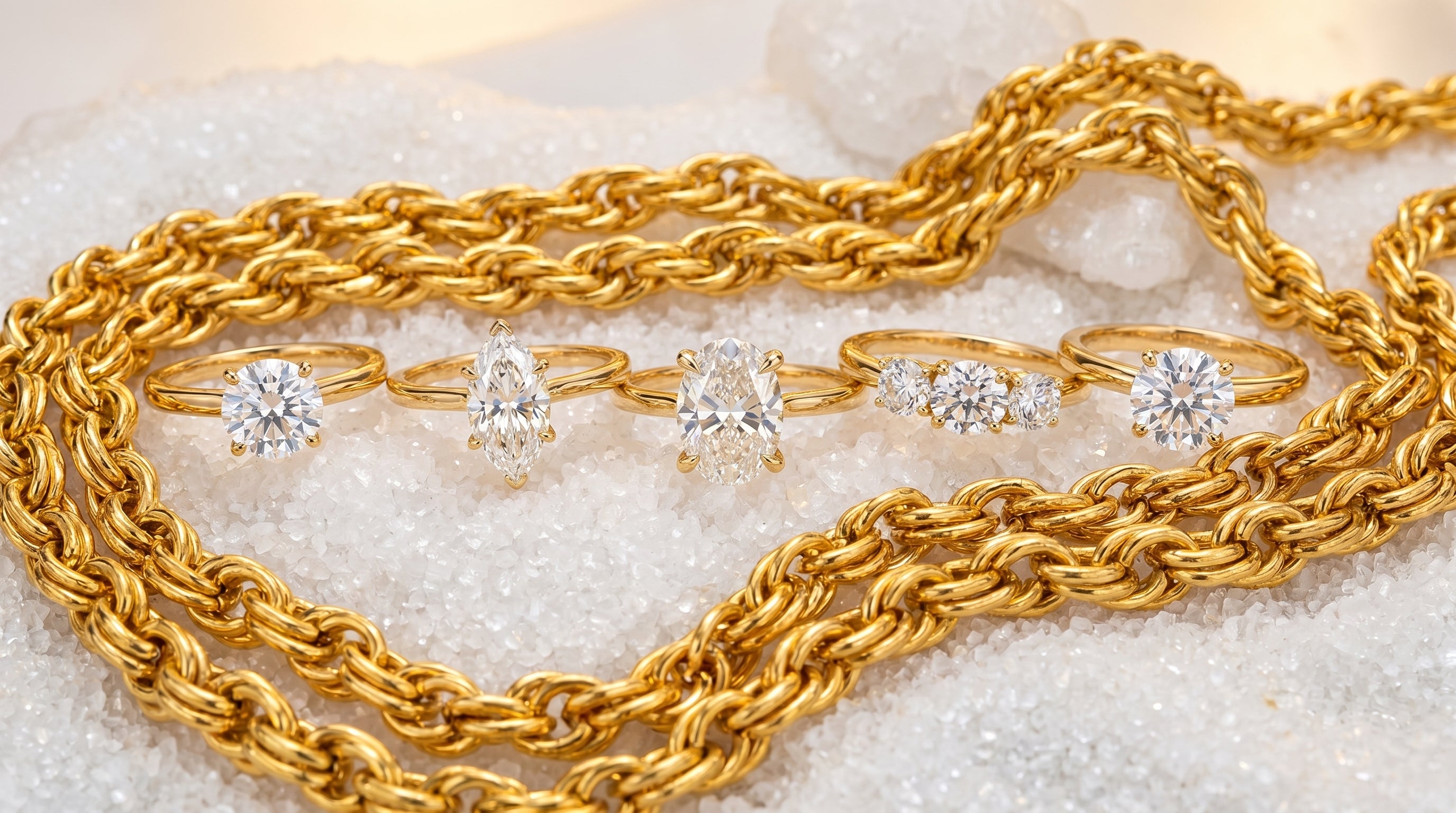
If you've been searching for the 24k pure gold chain price and landed here feeling more confused than when you started—you're not alone. Between fluctuating spot prices, hollow versus solid construction, and karat terminology that shifts by the retailer, buying pure gold is genuinely complicated. This guide cuts through all of it. We'll show you exactly what drives the cost in 2026, how 24k stacks up against 14k for real-world wear, and why over 250,000 customers have chosen a smarter path to everyday luxury.

Understanding the 24K Pure Gold Chain Price in 2026
The 24k pure gold chain price is calculated by multiplying the current global gold spot price per gram by the chain's total weight, then adding a premium for craftsmanship, brand reputation, and retail markup. In 2026, expect to pay significantly above the raw melt value for any finished piece.
Here's the thing—the karat system is simpler than most retailers make it sound. Gold purity is divided into 24 parts. Twenty-four karat gold represents 99.9% pure gold, with virtually no alloying metals present. That absolute purity is what sets the baseline cost for every piece you consider.
The fundamental pricing formula works like this: take the current gold spot price per gram, multiply it by the chain's total weight, and apply a purity factor of 0.999. Because a 24k solid gold chain is almost entirely pure metal, nearly every gram contributes to its raw gold value. But you'll never pay just the spot price. Manufacturers layer on premiums for the intricate labor of shaping such a soft metal, the complexity of the design, and the retail markup required to bring the piece to market.
In the 2026 market, those premiums vary wildly. A basic machine-made chain might carry a 20% to 30% premium over melt value. A hand-crafted designer piece? Fifty percent to 100% or more. This transparent relationship between raw material and finished product is actually one of pure gold's most appealing qualities—you can calculate the exact intrinsic value of the metal resting against your skin, which makes it uniquely attractive to investment-minded buyers.
24K Solid Gold Chain vs. 14K Solid Gold: The Ultimate Comparison
A 24k solid gold chain offers unmatched purity and investment value but scratches easily due to its softness. A 14k solid gold chain provides superior durability for daily wear, making it the preferred choice for active lifestyles while still retaining beautiful warmth and significant intrinsic value.
Pure gold's physical properties are a double-edged sword. Its exceptional malleability allows artisans to work it into intricate designs—but that same softness makes it highly susceptible to surface scratches, dents, and deformation during regular wear. A 24k solid gold chain lacks the structural reinforcement that harder alloying metals like copper, silver, or zinc provide.
This is exactly why jewelry experts recommend 14k gold for everyday wear. A gold rope chain 14k solid in construction offers the optimal balance: 58.3% pure gold for beautiful, lasting color, with the remaining alloy metals granting the strength to survive daily life. Want a piece you never have to take off? Fourteen karat is structurally superior. Full stop.
Density also plays a crucial role in how these chains feel. Pure gold has a density of 19.3 g/cm³, significantly higher than 14k gold's approximate 13 to 14 g/cm³. A 24k chain feels noticeably heavier than a 14k chain of identical dimensions—that satisfying heft is associated with luxury, though it drives the price up considerably.
| Feature | 24K Pure Gold | 14K Solid Gold |
|---|---|---|
| Gold Purity | 99.9% (24/24 parts) | 58.3% (14/24 parts) |
| Durability | Very soft; prone to scratching and bending | Highly durable; excellent for everyday wear |
| Color Profile | Intense, rich, warm buttery yellow | Classic, bright yellow (can also be rose or white) |
| Investment Value | High; closely tracks global gold spot prices | Moderate; retains value but lower melt price |
| Best Use Case | Special occasions, cultural events, investment | Daily wear, active lifestyles, layered styling |
If you're building a collection meant to last generations, understanding these metal dynamics is vital. For a deeper dive into how different gold purities affect your jewelry's lifespan, read our comprehensive guide on the Solid 18k Gold Chain: The 2026 Buyer's Complete Guide.
Popular Styles: The 24K Gold Chain Rope and Beyond
The 24k gold chain rope remains the most sought-after style for its classic, twisted aesthetic that maximizes light reflection. Because pure gold is so soft, the interwoven links of a rope design provide necessary structural integrity that delicate cable chains simply can't match.
Design preferences for high-karat gold reveal a fascinating intersection of aesthetics and engineering. Jewelers must carefully select link styles that can support their own weight without stretching over time. The 24k gold chain rope is a triumph of this thinking—the twisting, interwoven pattern creates a naturally supportive structure where links lean on one another, distributing tension evenly across the necklace. This makes the rope style far more resilient than a flat herringbone or thin snake chain, both of which can kink or snap if mishandled.

When shopping, you'll encounter a critical distinction: solid versus hollow construction. Hollow chains feature a thin gold shell surrounding an empty interior—they offer the visual appearance of a massive, heavy chain at a fraction of the cost. But hollow construction compromises durability badly. They dent and crush easily. In pure 24k gold, hollow construction is especially risky because the metal is already soft. A solid chain, while vastly more expensive, is the only way to ensure longevity.
Length dictates visual impact, too. Many buyers find that a 14k solid gold rope chain 20 inch length provides the perfect balance of visibility and comfort, resting right at the collarbone. In 24k gold, that same 20-inch length carries substantial physical weight—making it a true statement piece that commands attention the moment you walk into a room.
How to Spot Quality When Browsing a 24K Gold Chain for Sale
When evaluating a 24k gold chain for sale, always verify the weight in grams, check for official hallmarks like "999" or "24K," and perform a magnet test. Authentic pure gold is entirely non-magnetic, and reputable jewelers will always provide third-party certification for high-value pieces.
If you're browsing a 24k gold necklace for sale, arm yourself with the knowledge to authenticate your investment. Start with the hallmarks. Legitimate gold jewelry bears stamps indicating purity—for 24k gold, look for "24K", "24KT", or the European decimal mark "999" or "999.9". These stamps are usually located on the clasp or a small tag near the closure.
Stamps can be forged, though. That's where physical testing becomes necessary. The magnet test is a simple at-home check: gold is non-ferrous, meaning it isn't magnetic. If a chain is attracted to a strong neodymium magnet, it contains a significant amount of base metal hidden beneath gold plating. The small spring inside a clasp may react slightly, but the chain itself never should.
More sophisticated verification involves density testing, which calculates the specific gravity of the piece. Because pure gold is so dense, a genuine 24k chain displaces water differently than a fake made of lighter metals. Professional jewelers also use X-ray fluorescence (XRF) analyzers—non-destructive tools that provide an exact breakdown of the metal's elemental composition. Never hesitate to ask a retailer for XRF results or third-party certification from a recognized gemological laboratory.
For a complete breakdown of authentication techniques that protect your investment, explore our detailed article: How to Tell if Gold Jewelry is Real: Your Expert Guide to Authenticity & Lasting Value.
The Investment Value: Calculating the 24K Pure Gold Necklace Price
The 24k pure gold necklace price directly correlates with global commodities markets, making it a wearable investment. Unlike lower-karat alloys, 24k pieces retain up to 95% of their raw melt value on the secondary market, though you rarely recoup the initial retail craftsmanship premium.
Purchasing a 24k gold chain necklace is fundamentally different from buying fashion jewelry. You're acquiring a tangible asset tied to the global economy. Because 24k gold contains no non-precious alloy metals, its value moves in lockstep with the daily gold spot price—a feature that appeals to buyers who view fine jewelry as both adornment and financial security.
The resale dynamics of pure gold are favorable compared to lower purities. Reputable gold buyers and refiners typically offer 85% to 95% of the melt value for 24k gold. In contrast, 14k or 18k pieces fetch roughly 70% to 85% of their melt value, reflecting the additional labor and chemical processes required to separate pure gold from copper and silver alloys.
But here's where it gets interesting—you must manage expectations around the "premium over melt." If you buy a chain for $5,000 but the raw gold weight is only worth $3,500, you're paying a $1,500 craftsmanship premium. Sell that chain the next day, and a gold buyer offers you a percentage of the $3,500 melt value only. That premium vanishes on the secondary market unless the piece carries the name of a world-renowned luxury design house.
Brilliant Alternatives: Pairing Gold with Moissanite
While a pure gold chain makes a stunning statement, pairing durable 14k or 18k gold with brilliant moissanite creates the ultimate everyday luxury. Moissanite offers diamond-level fire and ethical origins, perfectly complementing the rich warmth of gold without the fragility of a 24k setting.
At Awareness Avenue, we hold a deep reverence for the beauty of gold. We understand the allure of that rich, buttery yellow hue. But our experience helping over 250,000 customers find their perfect piece has taught us that absolute purity isn't always practical. Rings, pendants, and delicate chains face constant friction, impacts, and exposure to the elements. This is why we champion 14k and 18k solid gold—as well as premium gold vermeil—as the ideal foundations for our brilliant moissanite stones.

Moissanite is a gemstone born from the stars—originally discovered in a meteorite crater, now ethically lab-created to GRA-certified standards. Its refractive index of 2.65 to 2.69 surpasses a natural diamond's 2.42, meaning it bends and shatters light into a more intense display of spectral color. That phenomenon—called fire—is measured by dispersion: moissanite scores 0.104, which is 2.4 times the dispersion of diamond at 0.044. Set a VVS-clarity moissanite against warm gold, and the rainbow fire that catches in direct sunlight is nothing short of breathtaking. And with a Mohs hardness of 9.25, it's built to last a lifetime.
Consider The Celestine Gold Promise Ring. The golden band provides a classic, romantic foundation that lets the center stone command the room. The durability of alloyed gold keeps the prongs rigid and secure—protecting the gemstone in a way that soft 24k gold simply couldn't guarantee.
For those who prefer elongated, elegant shapes, The Bella Jewel Marquise Cut Moissanite Ring offers a striking silhouette. The marquise cut maximizes carat weight, creating an illusion of greater size while flattering the finger. The gold setting warms the icy white flashes of the moissanite, creating a balanced, luxurious aesthetic that turns heads at every angle.

We also offer exceptional pieces in 18K Gold Vermeil—the visual richness of high-karat gold layered over a durable sterling silver core. The Celestara Teardrop - 18K Gold Vermeil and The Emera Pear - 18K Gold Vermeil deliver the intense color profile that gold purists love, combined with the structural integrity needed to hold complex multi-stone settings securely in place.
And if you're searching for a true showstopper, The Luna Moissanite Ring features a breathtaking 2-carat oval center stone. Watch how light dances through its facets and reflects off the golden band—it creates an aura of timeless elegance that no 24k setting could safely sustain. Browse our full Best Selling Moissanite Rings collection to see every option in one place.
Understanding the true cost of fine jewelry empowers you to make brilliant choices. To see how our stones compare to traditional mined options in terms of value, read our breakdown on Moissanite vs Diamond Price: What You're Really Paying For.
Frequently Asked Questions
Navigating the fine jewelry market raises countless questions about purity, pricing, and daily wear. Here are the most common questions we hear from customers looking to understand the true value and practical realities of owning pure twenty-four karat gold pieces in 2026.
Is a 24k pure gold chain good for everyday wear?
No. Twenty-four karat pure gold is too soft for continuous everyday wear. Because it lacks hardening alloy metals, it's highly susceptible to scratching, denting, and stretching. Activities like exercising, sleeping, or even heavy lifting can warp the links over time. For daily wear, 14k or 18k solid gold is the right choice for its superior durability and lasting structure.
Why does the 24k pure gold chain price fluctuate so much?
The price of 24k gold is directly tied to the global commodities market. Because it's 99.9% pure, its value rises and falls with the daily spot price of gold. Economic factors, inflation rates, and global market stability all influence that spot price, causing the retail cost of pure gold chains to shift accordingly—sometimes dramatically within a single week.
How can I tell if a 24k gold chain is hollow or solid?
The most reliable indicator is weight. A solid 24k gold chain feels exceptionally heavy for its size due to gold's high density of 19.3 g/cm³. Hollow chains feel surprisingly light by comparison. You can also inspect the links closely under a loupe—hollow chains often show microscopic seam lines where the gold tubing was fused together during manufacturing.
Does 24k gold tarnish or change color over time?
Pure 24k gold is a noble metal—it doesn't react with oxygen and will never rust, tarnish, or corrode. Its rich, warm yellow color is permanent. If a piece sold as 24k gold begins to tarnish or turn your skin green, it's either fake, heavily alloyed, or merely gold-plated over a base metal like copper.
Can I set gemstones or moissanite in 24k gold?
Jewelers strongly advise against it. The metal is too soft to create secure prongs or bezels—a slight impact bends a 24k prong, and you risk losing the stone entirely. This is why premium moissanite and diamond rings are almost exclusively set in 14k, 18k, or platinum, all of which provide the structural rigidity needed to protect your gemstone for decades.
Final Advice on Your Gold Jewelry Journey
Choosing the right gold jewelry means balancing your desire for absolute purity with the practical realities of daily wear. Whether you invest in a pure 24k chain or opt for durable 14k pieces paired with brilliant moissanite, prioritize authentic craftsmanship and verified materials above all else.
The allure of pure gold is undeniable. Its history, its weight, and its vibrant color have captivated humanity for millennia. Understanding the 24k pure gold chain price means recognizing that you're buying more than an accessory—you're acquiring a piece of the earth's most coveted element. But true luxury is also about wearability and peace of mind. You deserve jewelry that fits seamlessly into your life, pieces you wear with confidence without constantly worrying about damage or deformation.
And honestly? The most beautiful jewelry is the kind you actually wear. If you're drawn to the warmth of gold but demand the durability required for everyday elegance, we invite you to explore our curated selections—backed by a lifetime warranty, secure checkout, and 30-day returns. Browse our Solid Gold Pieces to find your perfect foundation, explore our Best Sellers to see what jewelry lovers are choosing in 2026, or view our complete Fine Jewelry Collection to find a piece that truly tells your story.

Leave a comment
This site is protected by hCaptcha and the hCaptcha Privacy Policy and Terms of Service apply.