


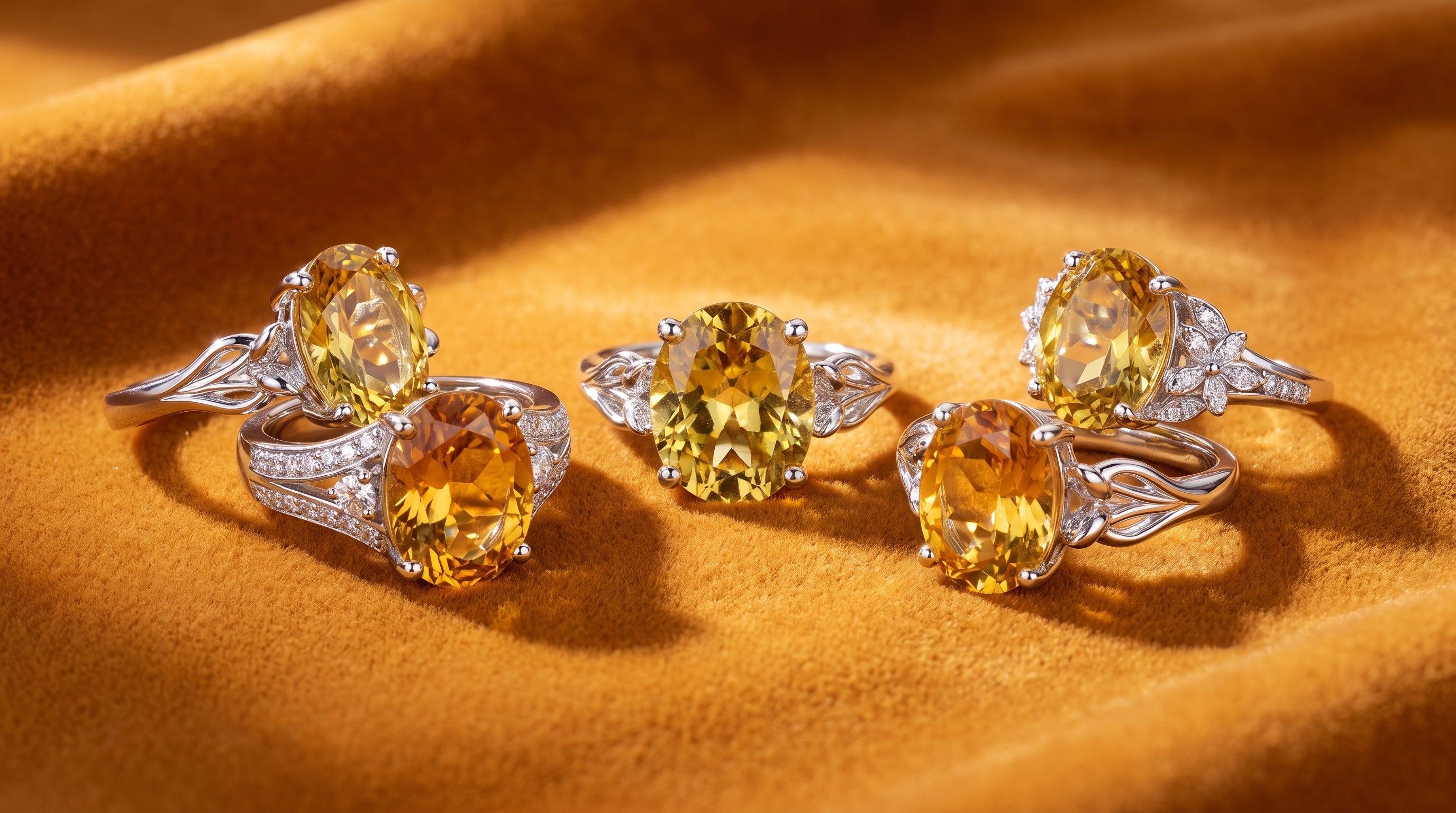
Search for November's birthstone and the first page of results will hand you two different answers. The Gemological Institute of America states plainly that people with November birthdays have two birthstones to choose from, topaz and citrine. Yet several major retailers — Jared and Kay Outlet among them — open with a single line: November's birthstone is citrine. Meanwhile jewelers such as Cape Cod Jewelers and Fink's merchandise topaz and citrine side by side in one November collection, and Brilliant Earth's guide splits the difference by naming topaz the traditional stone and citrine the modern one.
That disagreement is the single biggest source of hesitation for anyone shopping November birthstone rings. It's also easy to resolve. Both stones are legitimate, they behave differently on a hand, and they suit different wardrobes and lifestyles. What almost no page in this category does is translate that into ring-specific advice — because a ring takes knocks that a pendant never will. This guide does exactly that: identity first, then color, then durability and setting, then what's actually inside the stone you're buying.
November's Two Birthstones, and Why the Answers Conflict
Modern birthstone charts are not a single fixed document. Traditional lists were inherited from older European and folk traditions; modern lists were standardized later by the jewelry trade, partly to reflect availability and price. November is one of the months where the two lists diverge, which is why a topaz ring and a citrine ring are both correct.
Topaz: the traditional November stone
Topaz is the traditional November birthstone, historically prized in its warm golden-yellow color. GIA notes that topaz occurs in a wide range of colors, which is why you'll see blue, colorless, orange, and pink topaz sold under the same November heading. GemSelect describes topaz as a stone that has long symbolized affection and love, and one that older traditions credited with conferring strength; Brilliant Earth's guide adds associations with friendship, joy, generosity, and peaceful communication.
Citrine: the modern November stone
Citrine is the modern November birthstone — a yellow to golden-orange variety of quartz, popularized in jewelry particularly during the Art Deco era. Blue Nile describes it as a natural variety of quartz appearing in hues from pale yellow to brown, with jewelry examples running from light yellow to reddish orange. Its most quoted nickname is the "Merchant's Stone" (Blue Nile also calls it "the money stone"), tied to a long-standing belief that it attracts prosperity. GemSelect connects citrine's popularity partly to the scarcity of affordable gold-colored gems, and notes the frequent framing of citrine as a stone that channels the warmth of the sun — fitting, it argues, for the month of Thanksgiving.
What this actually means when you're buying
Nobody is going to challenge your birthstone credentials. If you want the older, more classical reference, choose topaz. If you want the stone most contemporary charts and store displays use, choose citrine. If you want both, note that GemSelect and GIA both treat the pair as jointly representing November, and a two-stone or stacked look is entirely consistent with the tradition. Both stones are also commonly listed as Sagittarius stones, which matters if the recipient's birthday falls after November 21.
Color First: Getting the Hue Right Before Anything Else
Color is the decision you'll live with daily, and it's where topaz and citrine genuinely differ. A ring sits at eye level in conversation, under kitchen light, against a keyboard — so the shade matters more than it does in a pendant that spends half its life under a collar.

Topaz: one name, many colors
Because topaz spans such a broad color range, "topaz ring" tells you very little on its own. Golden and sherry-toned topaz reads as the classic November stone. Blue topaz is by far the most visible topaz in retail today and is widely sold within November collections — GemSelect even frames a gift of blue topaz as a message of love and devotion. Blue topaz simply looks less like a birthstone and more like a color choice, which is a plus for anyone who dislikes yellow jewelry.
Citrine: yellow through golden orange
Citrine is a narrower, more predictable band: lemon, honey, amber, and at the deeper end a brownish or reddish orange. Pale lemon citrine looks bright and modern in white metals; honey and madeira tones look richer and read almost autumnal, which suits the month. If you're buying unseen, ask for a photo in daylight rather than under warm store lighting, since warm bulbs flatter every yellow stone.
Pairing stone color with the metal
Yellow gold amplifies both golden topaz and citrine, effectively extending the stone's color into the band — lovely if you want warmth, less useful if you want the stone to stand apart. White metals do the opposite: sterling silver, white gold, and platinum create contrast that makes a pale citrine or a golden topaz look more saturated. Blue topaz behaves like a cool stone and generally reads cleanest in white metals, though it also works against yellow gold for a deliberately high-contrast look. If you're weighing white metal options in particular, our guide to birthstone rings in white gold walks through stone count, setting, and stacking decisions in more detail.

Durability: What Mohs Hardness Does and Doesn't Tell You
This is the section most November birthstone jewelry pages skip, because they write about "jewelry" in general. Rings are the hardest-working category in a jewelry box. They meet door handles, gym equipment, granite counters, and car doors in a way earrings never do.
The numbers
Brilliant Earth lists topaz at 8 on the Mohs scale, describing it as relatively durable and suitable for everyday wear with care. Citrine, as a quartz, sits at 7 with good toughness, which the same source describes as durable and well suited to everyday wear. Both sit high enough on the scale for ring wear, but the gap matters: everyday grit and dust contain quartz particles at roughly hardness 7 — the same hardness as citrine — so a citrine can gradually dull at the facet edges over years, while topaz at 8 holds a clear edge on scratch resistance.
Hardness is not the whole story
Mohs hardness measures resistance to scratching, not resistance to breaking. A stone can be hard and still chip if it takes a sharp knock on an exposed edge or corner. That distinction matters for rings far more than for pendants, and it's the practical reason to think about setting style rather than relying on a hardness number alone. It's also why the care advice from gemological sources is more conservative for topaz than the number 8 might suggest: Brilliant Earth recommends warm soapy water and a soft brush for topaz and advises avoiding ultrasonic and steam cleaners, while noting that ultrasonic cleaning is generally safe for citrine, with steam still off the table.
Setting styles that protect a November stone
- Bezel: metal wraps the girdle of the stone, shielding the edges. The most protective option for daily wear, and it works beautifully with a warm honey citrine.
- Halo: surrounding accent stones sit slightly proud of the center stone and absorb some contact, while visually enlarging a modest topaz or citrine. You can browse halo designs to see how much presence a small center stone gains.
- Low-profile prongs: if you want the open light of a prong setting, choose a lower crown and heavier prongs rather than tall, delicate claws.
- Cabochon or step cuts: rounded cabochons have no exposed points at all; emerald and baguette cuts have corners that benefit from protective metal.
If you're deciding between a solitaire, a cluster, a band, or a stacking format, our breakdown of birthstone ring formats compared by stone count is a useful companion to this section.
Natural, Lab-Grown, or Simulated: Know What's in the Setting
"November birthstone ring" is a marketing label, not a materials disclosure, and the market is genuinely mixed. Three different things are sold under that heading:
- Natural topaz or citrine — mined stones of the species named on the birthstone chart.
- Lab-grown stones — chemically the same material, grown rather than mined. Little Sky Stone, for example, states that its November birthstone jewelry uses lab-grown citrine, which it describes as more sustainable and less expensive than natural citrine while looking just as beautiful.
- Simulated or man-made crystal in the right color — a different material chosen to evoke November's palette. For example, a november birthstone ring Pandora offers, like the Honey Eternity Circle Ring, is a sterling silver birthstone ring set with a honey-colored man-made crystal rather than topaz or citrine.
None of these is dishonest as long as it's disclosed, and none of them changes the symbolism. They do change price, hardness, and how the stone will age. A colored crystal will not perform like a Mohs 8 topaz over years of daily wear, which is worth knowing before you choose a ring to wear on the same finger every day.
At Awareness Avenue the distinction is kept explicit in the catalog. The natural topaz jewelry collection includes ring designs such as The Aethra Natural Topaz Ring, The Amabel Natural Topaz Ring, and The Azurella Natural Topaz Ring, while the November birthstone simulated topaz collection is labeled as simulated. On the citrine side, The Alysienne Citrine Ring and The Apollonia Citrine Ring carry the modern November stone. The explicitly month-branded piece, the November Topaz Birthstone Ring, is crafted in S925 sterling silver. Whatever brand you buy from, read the stone line on the product page rather than the collection title.
Meaning and Symbolism, Handled Honestly
November birthstone meaning is why many people buy these rings, and it deserves to be reported accurately rather than inflated. What follows is documented tradition and belief, not tested effect.
Topaz
Topaz is traditionally linked with affection and love. GemSelect describes it as a stone believed to offer strength and intelligence to the wearer, and frames blue topaz as a gift that communicates love and devotion. Brilliant Earth's guide associates topaz with love, affection, and friendship, and with promoting joy, generosity, and peaceful communication.
Citrine
Citrine's reputation is built around prosperity and optimism. Brilliant Earth notes its nickname as the "Merchant's Stone" and its reputed ability to attract wealth, along with the idea that it carries the power of the sun and encourages positivity and clarity. Jared's November page recounts older beliefs that citrine brought the power of the sun, comforted and energized the wearer, and warded off evil — which is why, it says, the ancients carried it.
The caveat worth stating out loud
These are cultural and historical associations recorded by jewelers and gem dealers. They are not medical or financial claims, and no source in this category offers clinical evidence for the health or wealth benefits sometimes attributed to either stone. Treat them as meaning you assign, not mechanism you buy. For a broader look at how birthstone symbolism developed across the calendar, see our complete guide to birthstone jewelry.
How to Choose Between a Topaz Ring and a Citrine Ring
Five questions usually settle it faster than browsing another hundred product photos.
- Does the wearer wear warm or cool tones? A wardrobe of camel, olive, and cream suits honey citrine or golden topaz. A wardrobe of navy, gray, and black often looks better with blue topaz or a pale lemon citrine in a white metal.
- Which meaning resonates? Love, affection, and strength point to topaz. Prosperity, optimism, and sunny energy point to citrine — a common choice for graduations, promotions, and new ventures.
- How rough is the wearer's day? For hands-on work, topaz's higher hardness plus a bezel setting is the more forgiving combination. Anyone who removes rings for chores can wear either happily.
- Yellow gold, white gold, or sterling silver? A november birthstone ring gold setting intensifies warm hues; sterling silver and white gold sharpen the contrast and usually cost less for the same stone size.
- Solo or stacked? A single sizeable stone reads as a statement; two slim bands — one topaz, one citrine — honor both of November's stones and are easier to wear with an existing wedding set.
If nothing is decisive, buy the color you can picture on your own hand tomorrow morning. Birthstone rings fail from disuse far more often than from damage.
Building a November Set Without Overdoing It
Most November collections are merchandised across categories — rings, necklaces, bracelets, earrings, and charms — and it's tempting to buy the matching set. A better rule is one focal piece and one quiet piece. If the ring is the statement, keep the november birthstone necklace to a small solitaire pendant and the november birthstone earrings to modest studs; Linjer's November birthstone studs, for example, use small 2.5 mm citrine stones in 14k recycled gold, which is the right scale for something worn beside a bolder ring.
A november birthstone bracelet is the flexible middle ground: a single birthstone station or a family-stone line reads well next to a solitaire ring without competing with it. Our guide to 14k gold birthstone bracelets covers how stone count and spacing affect the finished look, which applies equally to a November piece. And because November birthstone jewelry is often given for graduations, promotions, and anniversaries as well as birthdays, a set built one piece at a time over several occasions tends to be more meaningful than a matched set bought at once.
Care and Everyday Wear
Both November stones are low-maintenance, but the two have slightly different cleaning tolerances.
- Routine cleaning: warm water, a drop of mild dish soap, and a soft brush around the setting, then rinse and dry with a lint-free cloth. GemSelect describes this as the safest method for both topaz and citrine.
- Ultrasonic cleaners: generally safe for citrine; avoid for topaz.
- Steam cleaning: avoid for both.
- Heat and strong light: keep colored quartz out of prolonged direct sun and away from heat sources; store in a pouch or lined box rather than on a sunny windowsill.
- Storage: store separately from harder stones. Anything above Mohs 8 — sapphire, moissanite, diamond — will scratch citrine and topaz if pieces rub together in a drawer.
- Take it off for: cleaning products, chlorinated pools, gardening, and weight training. Chemicals attack the metal and the setting adhesive long before they trouble the stone.
- Check the setting: once or twice a year, hold the ring near your ear and tap it gently; a faint rattle means a loose stone that needs a jeweler before it becomes a lost stone.
November Birthstone Ring FAQs
Is November's birthstone topaz or citrine?
Both. GIA lists topaz and citrine as November's birthstones. Topaz is the traditional stone and citrine the modern one, which is why some retailers name only citrine while gemological sources and multi-stone jewelers present the pair together.
Is blue topaz a legitimate November birthstone?
Yes. Topaz occurs in a wide range of colors, and blue topaz is widely sold within November collections. The historical November association is with golden-yellow topaz, so if you want the most traditional november birthstone topaz look specifically, choose a golden or sherry tone.
Are the November birthstone rings sold by big brands real topaz?
Not always, and that isn't hidden — it's just easy to miss. For example, a november birthstone ring Pandora offers, like the Honey Eternity Circle Ring, is a sterling silver birthstone ring set with a honey-colored man-made crystal rather than natural topaz or citrine. Check the materials line on any product page for the words "topaz," "citrine," "lab-grown," "simulated," or "crystal" before assuming.
Can I wear a citrine ring every day?
Citrine is a quartz at Mohs 7 with good toughness, described by Brilliant Earth as durable and well suited to everyday wear. For a ring specifically, a protective setting and the habit of removing it for manual work will do more for its lifespan than the hardness number alone.
Is topaz or citrine suitable for an engagement ring?
Both are worn as engagement rings, and topaz's Mohs 8 gives it the advantage in scratch resistance. Neither matches diamond, sapphire, or moissanite for long-term wear on a ring worn 24 hours a day, so if the ring will never come off, favor topaz in a bezel or halo setting and plan on periodic professional checks.
Which metal is best for a November birthstone ring?
There's no single answer, only a color decision. Choosing a november birthstone ring gold setting intensifies warm hues for a monochrome glow; sterling silver and white gold create contrast that makes the stone appear more saturated. Sterling silver — like the S925 used in the November Topaz Birthstone Ring — lets you buy a larger stone for the same outlay, while gold holds its finish with less frequent polishing.
What size stone looks right on a hand?
For a solitaire worn daily, a center stone roughly as wide as the midline of the finger reads as intentional without catching on clothing. Halo designs let a smaller stone occupy the same visual footprint with less height off the finger, which is usually the more practical choice for a ring worn with gloves or a keyboard.
The Short Version
November genuinely has two birthstones, and the choice between them is aesthetic and personal rather than a matter of correctness. Topaz is the traditional stone — harder at Mohs 8, available in golden, blue, and other colors, and tied to affection, love, and strength. Citrine is the modern stone — Mohs 7 with good toughness, running from lemon to golden orange, and tied to prosperity and optimism. Pick the hue you'd wear on an ordinary Tuesday, choose a setting that shields the stone's edges, confirm whether the gem is natural, lab-grown, or simulated, and clean it with nothing more exotic than warm soapy water. Do that, and a November birthstone ring stays wearable long after the birthday it marked. To see both stones in one place, browse the full birthstone jewelry range.

Leave a comment
This site is protected by hCaptcha and the hCaptcha Privacy Policy and Terms of Service apply.