


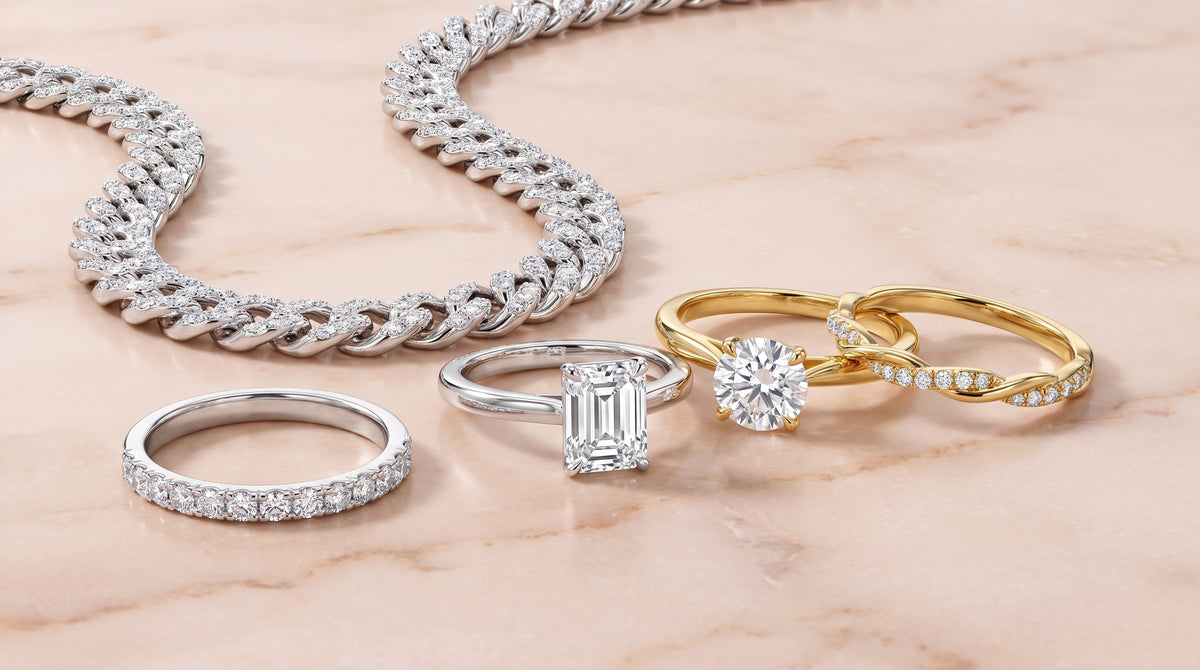
A gold-plated ring finished with typical fashion-grade flash plating can carry a gold layer around 0.17 microns thick. On a finger, at the knuckle, where the metal is rubbed against keys, steering wheels, and other rings all day, that layer can wear through in under eight weeks, according to a technical breakdown of plating standards from industry resource JewelTrendPro. Nothing was defective. Nothing was misdescribed, technically. The piece simply did exactly what 0.17 microns of gold does.
That single number explains most bad experiences with cheap jewelry better than any brand review can. The pieces that tarnished in days, turned a finger green, or lost their finish before the season ended were not badly made versions of good jewelry; they were a different product category wearing the same vocabulary. Once you can read the vocabulary, cheap good quality jewelry stops being a contradiction and becomes a shopping problem with a repeatable solution.
This guide handles the objections in order: it fails fast, it irritates my skin, "waterproof" is a lie, the stones are fake-looking, and I can't tell who to trust. It uses published material standards and gemstone data rather than adjectives, and it is honest about the limits of what any brand — including this one — can promise you without showing its paperwork.
Why "cheap" is the wrong number to optimize
The mistake most shoppers make is comparing purchase prices across categories that have wildly different lifespans. JewelTrendPro's comparison of gold vermeil against standard gold plating puts average daily-wear lifespan at roughly 12 to 36 months for properly made vermeil, 6 to 18 months for heavy gold plate, and only 2 to 6 months for standard plating — while vermeil typically costs around three to five times more than the plated equivalent. In other words, the more expensive option often buys three to five times the wear for three to five times the price, and it does so without the drawer full of dead pieces in between.
Reframed as cost per year of attractive wear, the cheapest-looking option is frequently the most expensive one. That reframe is the whole argument of this article. It also means "cheap good quality jewelry" is not a myth — it just requires you to spend your budget on the parts of a piece that decide how long it survives, and to accept trade-offs everywhere else.
What you can reasonably expect at a low price
You can realistically get: a genuine sterling silver base, a gemstone that resists scratching as well as anything short of diamond, clean finishing, and a design that reads as expensive. What you generally cannot get at a low price is heavy solid-gold weight, multi-decade plating on a high-friction ring, or resale value. Editorial roundups from Cosmopolitan, Marie Claire, Good Housekeeping, PureWow, Oprah Daily, Who What Wear, and Rank & Style converge on the same point: in the affordable tier, quality is decided by materials and disclosure, not by branding. Rank & Style's shopping heuristic is blunt — treat specific terms like "14k gold," "gold vermeil," and "sterling silver" as good signs, and treat "gold tone" or "metal blend" as a reason to slow down.
Objection 1: "It tarnishes or fades within weeks"
This objection is valid, well documented, and entirely predictable from the product description — if the description is specific enough to be read.
Gold vermeil is a legal standard, not a marketing word
In the United States and several other jurisdictions, gold vermeil has to meet three criteria: a sterling silver base of at least 92.5% pure silver, gold of a stated purity (commonly 14K or 18K), and a minimum gold thickness of 2.5 microns applied by electrolytic deposition. JewelTrendPro notes that vermeil in the 2.5 to 5.0 micron range can hold its luster for one to three years of daily wear and five years or more with occasional wear and sensible care. "Gold plated," by contrast, carries no legal minimum thickness and no requirement about the base metal — brass, copper, zinc alloy, and stainless steel are all fair game.
That is the entire difference between the ring that lasted a year and a half and the one that lasted six weeks. Same color. Same photograph. Roughly fifteen times the gold.
The base metal decides what happens after the gold wears
Every plated surface eventually thins somewhere. What matters is what is underneath. A sterling silver substrate stays a precious metal when it is exposed and behaves predictably; brass and copper bases are far more prone to visible discoloration and the green-skin effect that makes people swear off cheap jewelry entirely. This is why editors keep steering readers toward sterling-based pieces even when the visible finish is gold.
About "non tarnish jewelry"
Treat "non tarnish" as a marketing description, not a specification. It tells you nothing about micron thickness, base alloy, or gold karat, and there is no standard behind the phrase the way there is behind vermeil. If a listing says "non tarnish" but will not say what the metal is, you have learned something useful: the brand chose an adjective over a number. Ask for the number.
Match the material to the body part
Friction, not price, is the strongest predictor of failure. The same plating data shows earrings lasting three years or more because they barely rub against anything, while rings are the hardest category in the catalog. Practical consequence: put your money into rings and be more relaxed about earrings. A sterling or vermeil ring is worth the upgrade; a plated ring is best treated as a seasonal fashion item you are not emotionally attached to.
Objection 2: "Waterproof jewelry doesn't survive real water"
"Waterproof" and "water resistant" appear constantly in affordable jewelry marketing — brands in this space actively promote water resistance and skin-friendliness as selling points — but these words are not regulated the way vermeil thickness is. There is no published standard telling you how many showers a "waterproof" plated chain survives.
Notice what actual editorial care guidance says instead. Marie Claire's advice for keeping affordable jewelry looking good is to keep it dry and take it off before swimming, exercising, showering, and sleeping. That advice exists because moisture, chlorine, salt, sweat, sunscreen, and soap accelerate wear on plated finishes and dull the look of almost everything else.
How to buy "affordable waterproof jewelry" sensibly
- Prefer solid over plated for wet wear. A solid metal piece has no finish layer to lose. Sterling silver may develop tarnish, but tarnish is a surface film you can polish off — it is not the same failure mode as plating wearing through to a different metal.
- Ask for thickness, not adjectives. If a "waterproof" piece is plated, the only meaningful follow-up question is how many microns of gold and over what base.
- Be strictest with rings and bracelets. These take abrasion and immersion together, which is the worst combination for any coating.
- Rinse and dry after pools and the ocean. Even durable pieces look better longer with thirty seconds of care.
If you want jewelry you genuinely never take off, build that set deliberately rather than hoping a coating holds — our guide to building an everyday jewelry set you never have to remove walks through the material choices that survive that level of wear.
Objection 3: "A cheap stone will scratch, chip, or look fake"
This is where the biggest savings in jewelry are available, and where the fear is most out of step with the data. The stone, not the metal, is usually what makes traditional fine jewelry expensive — so the stone is where an affordable piece can gain the most without giving up performance.
The hardness numbers
Moissanite is lab-created silicon carbide and rates about 9.25 on the Mohs hardness scale. Diamond is 10. Sapphire — long considered a durable engagement stone — is 9. The everyday abrasive that quietly dulls jewelry is quartz in household dust, which sits well below all three. Analyses from Satéur, Odozi Akuchi, and Caratwire agree on the practical conclusion: at 9.25, ordinary life — typing, carrying bags, housework — does not scratch the stone. A diamond can scratch moissanite under controlled conditions, but that encounter is rare in daily wear, and the surface difference is generally imperceptible to a non-specialist over decades.
Toughness is a separate property from hardness. Diamond has cleavage planes, which are directions along which a sharp impact can split the stone. Moissanite lacks strong cleavage, which gives it a modest advantage in forgiving certain knocks. Both are considered robust for daily wear when they are set properly — and setting quality matters more than most shoppers assume.
Sparkle: different, not lesser
Moissanite has a refractive index around 2.65 versus diamond's 2.42, and fire dispersion around 0.104 versus diamond's 0.044 — roughly 2.4 times the rainbow flash. That is a genuine aesthetic difference, and it cuts both ways. Some people want that flash; others prefer diamond's whiter, more restrained brilliance and find moissanite "loud" in direct sun. Decide which look you actually like before you buy, ideally by seeing a stone in daylight and under warm indoor lighting. Well-cut moissanite does not cloud or yellow with age; the haziness people occasionally notice is a film of soap, lotion, or skin oil that cleans off.
The honest trade-off: resale
Moissanite is mass-produced with effectively unlimited supply, and Caratwire's buyer guidance is that it has essentially no resale market — you should buy it to wear and enjoy, not as an asset. The same analysis notes that diamonds, lab-grown and natural alike, also lose money on resale; diamond simply retains broader recognition and a more established secondary market. If your jewelry decision is being framed as an investment, that framing is shaky at almost every price point. Buy for wear, symbolism, and years of use, and the math for moissanite becomes very attractive: a stone that is dramatically cheaper per carat than a comparable natural diamond while sitting just below it on the hardness scale. If you're weighing that specific decision, our guide on where to buy moissanite engagement rings covers vendor evaluation in more depth, and our overview of moissanite jewelry basics explains cut and setting choices.
Objection 4: "I don't know where to buy — warehouse club, mall chain, or online brand?"
Searches like "places to buy jewelry near me," "kay jewelry near me," "costco jewelry," and "ana luisa jewelry" all reflect the same underlying uncertainty: which channel is least likely to burn me? The useful answer is that channel is a weaker predictor than disclosure. A warehouse club, a mall chain, a direct-to-consumer label, and an independent online brand can all sell excellent affordable pieces or disappointing ones. What separates them is whether they will tell you, in writing, what you are buying.
The same six questions, everywhere
- What exactly is the metal? You want "14K solid gold," "18K gold vermeil," or "925 sterling silver," not "gold tone" or "metal blend."
- If it's plated, how many microns and over what base? Vermeil's 2.5-micron floor over sterling is the benchmark to compare against.
- What is the stone, and is it lab-created? "Moissanite" and "lab-grown diamond" are specific; "diamond simulant" and "CZ" are different products with different hardness.
- What do the reviews say about aging? Rank & Style's advice is to hunt for customer photos and comments about color change and weight rather than reading only star ratings.
- What is the written return, repair, or warranty policy? Read it before checkout, not after. Affordable jewelry often has tighter policies than luxury fine jewelry, and "no questions asked" language means nothing unless the policy page says so.
- Does the seller answer specific questions specifically? Email and ask for micron thickness. A brand that knows its supply chain will answer with a number.
In person versus online
Shopping in person lets you judge weight, clasp quality, and how a stone behaves under different lighting — genuinely useful for evaluating sparkle preference. Shopping online usually gives you fuller written specifications and easier comparison, but puts more weight on policy pages and review patterns. If you're buying online, our walkthrough on how to buy jewelry online safely covers verification steps in detail. Either way, the materials checklist above travels with you.
What a materials-first budget actually looks like
Here is how to allocate a limited budget across categories, based on where each piece fails first.
Earrings: the easiest win
Because they experience almost no abrasion, plated earrings age far better than plated rings, and sterling or vermeil earrings can hold up for years. This is the category where you can spend least and still be happy longest.
Necklaces and pendants: check the chain, not just the pendant
Chains rub against collars and skin and carry the weight of the pendant. A sterling silver chain or a genuine vermeil chain is worth prioritizing over a heavier-looking pendant on a thin, unspecified chain. Clasp quality is the other common failure point and is rarely photographed well — ask.
Rings: spend here or accept a short life
Rings take the most abuse. If a ring is meant to be permanent or symbolic, the sensible order of preference is solid gold, then true vermeil over sterling, then sterling, with the stone chosen for hardness. A moissanite stone in a modest setting will typically outlast an ambitious-looking plated ring by years.
Men's chains: weight and base metal
For heavier chains, the base metal is doing structural work, not just carrying a finish. Sterling silver constructions are the pragmatic choice in the affordable tier for exactly that reason.
How Awareness Avenue pieces map onto this framework — and what we won't claim
Applying the checklist to our own catalog, the material categories discussed above appear in specific products by name. The Celestara Teardrop is made in 18K gold vermeil, the standard with the sterling silver base and 2.5-micron minimum described earlier. The Natural Moss Agate Teardrop Necklace and the Men's Iced Moissanite Cuban Link Chain are built in S925 sterling silver. The Bella Jewel 1CT Emerald Cut Moissanite Ring and The Celestine use moissanite, the 9.25-on-Mohs stone described above, and The Celestine is also offered in a solid gold version for buyers who want no finish layer at all. You can browse the broader rings and necklaces ranges and compare specifications the same way you would with any other seller.
Now the part most brand pages skip. Independent review platform Trustpilot lists Awareness Avenue at roughly 4.1 out of 5 across approximately a thousand reviews. Many of those reviewers describe the jewelry as beautiful and well made and praise customer service for handling exchanges and replacements promptly. Other reviewers report problems with delivery times, orders, and returns or refunds. The brand is recorded as responding to all negative reviews. That is a mixed, realistic picture, and you should read it yourself rather than take a summary's word for it — including ours.
Equally, there are things this article will not assert because the evidence to support them is not in hand: that any particular piece is hypoallergenic or nickel-free without a published alloy breakdown, that any specific shipping speed or return window applies, or that these products are the cheapest quality jewelry available anywhere. Those are claims that require documentation, and a brand asking you to trust it should hold itself to the standard it is recommending to you.
The short version you can shop with
Cheap good quality jewelry is a real category, but it is defined by specifications rather than by price tags. Buy metals that are named precisely — solid gold, 18K or 14K vermeil at 2.5 microns or more over sterling, or 925 sterling silver — and be skeptical of "gold tone," "metal blend," and unqualified "non tarnish" or "waterproof" claims. Choose gemstones on hardness: at 9.25 Mohs, moissanite handles daily wear, and its extra fire is a style choice you should make on purpose. Match material to friction, putting your budget into rings and relaxing about earrings. Read written policies before checkout and read review patterns for how pieces age, not just how they arrived.
Do that consistently and the outcome changes in a measurable way: instead of replacing a failing piece every few months, you own a small number of items that still look right years later. That is the only definition of "cheap" that survives contact with a jewelry box. If you want to extend this thinking across a whole wardrobe of pieces rather than one purchase, our guide to building a jewelry collection with lasting value applies the same materials-first logic over a longer horizon.

Leave a comment
This site is protected by hCaptcha and the hCaptcha Privacy Policy and Terms of Service apply.