


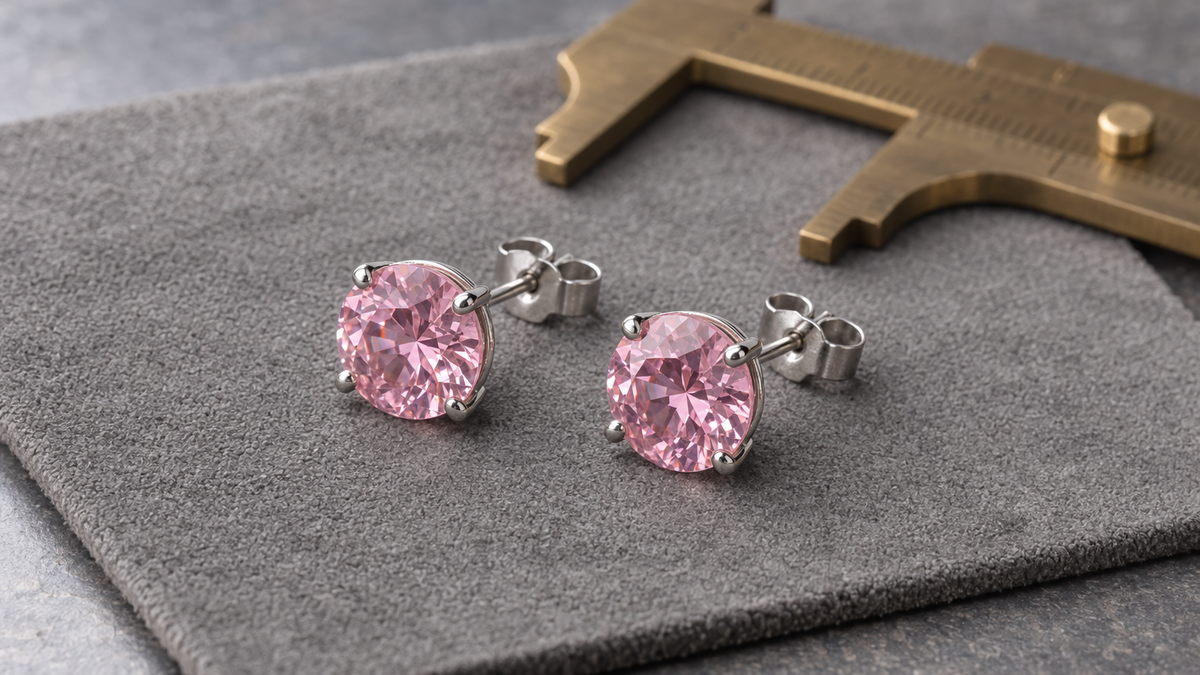
Two pairs of pink earrings can look nearly identical in a product photo, sit in the same color family, and cost wildly different amounts — because one contains a mined gemstone and the other contains a man-made look-alike. The information that separates them is not in the image. It is in the three or four words placed immediately before "pink tourmaline" in the product title and the stone line of the specification list. This guide is built around reading those words correctly, then checking the handful of specifications that actually determine how a pair looks and wears on your ear.
Everything below is sourced to gemological and regulatory references where evidence is required. Retailer listings are described as seller-stated and are used to show what complete disclosure looks like — they are examples, not endorsements, and specifications were drawn from those pages as observed on October 17, 2026.
The one word that changes what you are buying
A simulant is a material that imitates the appearance of a gem but has a different chemical composition, crystal structure, and different physical and optical properties; the Gemological Institute of America names synthetic cubic zirconia among common simulants and gives it a Mohs hardness of 8.5 (GIA, gem imitations). That is a different substance from mined tourmaline, which GIA ranks at 7 to 7.5 on the Mohs scale (GIA, tourmaline care and cleaning). Appearance similarity does not make two stones the same material.
US Federal Trade Commission jewelry guidance addresses this directly: when a gemstone name is used to describe a simulated or imitation product, the qualifying word must appear immediately before the gem name, with equal conspicuousness, so a buyer is not misled into thinking the stone was mined (16 CFR Part 23). The FTC has publicly reminded sellers that product descriptions must make the nature of the material clear rather than leaving it to inference (FTC business guidance).
One more phrase deserves caution. "Lab-grown pink tourmaline" sounds like a familiar category because it exists for diamonds, sapphires and emeralds. GIA reports that tourmaline has no laboratory-grown counterpart (GIA research summary), and FTC guidance permits "laboratory-grown" before a gem name only where the product has essentially the same optical, physical and chemical properties as that stone (16 CFR Part 23). If a listing offers "lab-created pink tourmaline," ask what the material actually is before assuming it is tourmaline.
Natural, treated, simulated: reading the stone line
Natural pink tourmaline
Listings that sell mined material state the stone identity in the stone line or the collection name. Dedicated collections such as Angara's pink tourmaline earrings category, a specialist catalog like Mineral Miners, and fine-jewelry pages including Celinni state the stone identity as part of the product description. If the identity appears only in a marketing paragraph and not in the specifications, ask the seller to confirm it in writing before ordering.
Natural does not mean untreated
Origin and treatment are two separate facts, and a stone can be fully natural while still having been enhanced. GIA identifies heating and irradiation as the two most important tourmaline treatments, and notes that pink tourmaline may be irradiated to increase its color saturation (GIA tourmaline care; GIA research summary). Treatment is not automatically a flaw — it is a disclosure to ask for at the item level, because it affects value and, in some cases, how the stone should be handled.
Simulated stones
When the stone line reads "simulated pink tourmaline," the honest reading is: this is a pink-colored stone chosen to resemble tourmaline, not tourmaline. That wording should survive everywhere — the title, the specification table, the cart and the invoice. Be equally careful about transferring material properties across products: if one listing names its simulant and another only says "simulated," you cannot assume both contain the same substance or share the same hardness.
Letter grades and acronyms
Terms such as "A5," "AAA" or "VVS" applied to colored stones or simulants are seller-side descriptions unless the listing names an independent laboratory and the method behind the scale. For tourmaline specifically, GIA states that it evaluates the stone but does not grade it; a Colored Stone Identification Report can establish what the material is and identify detectable treatments (GIA FAQ). So "GIA-graded tourmaline" is not a thing to look for — an identification report is.
Color, clarity, cut and pair matching
GIA describes color as tourmaline's most important quality factor, with clarity, cut and carat weight also contributing to appearance and value (GIA tourmaline buyer's guide). In practice that means you should judge a pink pair on how the color reads in neutral light — including whether the tone goes too dark in parts of the stone — before worrying about anything else.
Clarity expectations differ by variety. GIA notes that pink-to-red tourmaline often shows more visible inclusions than green-to-blue material (GIA, tourmaline). A few eye-visible inclusions in a pink stone are normal; what matters is whether an inclusion or fracture sits in a prominent position or reaches the surface in a way that affects the setting you have chosen. Do not expect, or pay a premium for, a promise of flawlessness.
On cut, GIA's advice is not to compromise: a well-cut tourmaline should reflect light back evenly across the entire gem, and poorly cut gems sell at a discount (GIA buyer's guide). Lighting choices in product photography affect how that reads, so ask for images or video in diffuse, neutral light where possible.
Two stones, one pair
Earrings are judged as a pair, so the two stones need to agree in color, face-up size and proportion. Natural material varies, so if a listing uses representative photography rather than images of the exact pair, confirm how matching is handled — especially for larger center stones, where a slight mismatch in tone can be apparent.
Millimeters beat carats for scale
Carat weight describes mass, not footprint; depth, cutting style and setting all change how large a stone looks on the ear. Strong listings give both. For orientation, seller-stated examples observed on October 17, 2026 include a 14K white gold halo pair with two 3.5 mm round pink tourmalines, 14 accent diamonds totaling 1/8 carat, prong setting and push backs; a 14K yellow gold drop with two 5 mm princess-cut tourmalines and pear-shaped rose quartz, 1 inch long and 2/5 inch wide, with screw backs; clover studs in 14K gold with round pink tourmalines totaling 0.20 carat, measuring about 1/4 inch with post backs; and, at the opposite end of the scale, an 18K white gold pair with ovals measuring 11.00 × 8.70 × 6.70 mm and roughly 8.47 carats total weight. Both of those last two listings are sold as pink tourmaline earrings; only the millimeter and carat figures tell you they are very different pieces of jewelry.
Studs, drops and hoops — and the backs that hold them
Category pages from the specialist and fine-jewelry sellers cited here cover studs, hoops and drops, with halo designs among the listed styles, in metals that include sterling silver and karat gold (Angara; Mineral Miners). Choose the silhouette around how you will wear them rather than around the stone alone.
Studs
Studs keep the stone flat against the lobe, so the same face of the stone is on view each time, which puts cut quality and color evenness in plain sight. A halo surrounds the center stone with accent stones, adding face-up size without a larger center stone — useful when millimeter dimensions are modest.
Drops
Drops hang below the lobe and move as you do. Length is the specification to check first: the seller-stated examples above run from roughly 1/4-inch studs to a 1-inch drop, and longer designs change how the earring interacts with collars and hair. Pair weight matters too; if it is not published, ask, especially for larger stones or elongated designs.
Hoops and beaded styles
Hoop and bead designs distribute stones around the ear rather than concentrating them in one face-up position. A seller-stated example observed on the same date is a pink tourmaline bead hoop with 10K yellow gold spacers, 5.50 carats total gemstone weight, a 7/8-inch length and snap-bar backs — a listing that usefully gives length, total weight and closure in one place.
Backs and closures
Closure type is a genuine decision criterion, not a footnote. Push backs are convenient; screw backs add resistance to accidental removal; leverbacks and snap bars enclose the wire. Push, screw, post, snap-bar and leverback styles all appear across the listings cited above. No closure can be promised to be loss-proof, and comfort is individual — post length and lobe thickness matter as much as the mechanism. If you prefer a flush back against the lobe, our guide to flat back earrings for adults explains how those fittings differ from conventional posts.
Metal and plating language, decoded
"Gold" and "silver" describe several materially different constructions, and US FTC jewelry guidance defines the key terms. Sterling silver denotes metal that is at least 925/1,000 pure silver. Vermeil describes a sterling silver base coated on significant surfaces with gold of at least 10 karat fineness and a minimum thickness equivalent to 2.5 microns of fine gold (16 CFR Part 23). Solid karat gold and platinum are different again, with fineness stated as a karat or parts-per-thousand figure.
Two reading tips follow from those definitions. First, rhodium plating is a surface finish applied over another metal; it is a separate disclosure from the base metal and is not covered by the FTC's vermeil definition, which concerns gold over sterling silver. If you see a finish described with the word "vermeil" alongside rhodium, read it as a rhodium surface finish and ask what the base metal is. Second, no plating thickness should be assumed from adjectives like "heavy" — thickness is a measurable figure, and without it, plating longevity cannot be estimated. The same reading discipline applies to colored-stone pieces generally, as covered in our emerald earrings buying guide.
Sensitive ears: what "hypoallergenic" does and does not tell you
The American Academy of Dermatology identifies earrings and earring backs as common sources of nickel exposure for people with nickel allergy and advises choosing suitable alternative metals (AAD, nickel allergy). "Hypoallergenic" on a product page does not by itself tell you the alloy composition or whether nickel release has been tested. If you react to jewelry, ask for the alloy breakdown of every component that touches skin — post, back, and any plating — and treat a general reassurance as a starting point for questions rather than an answer. No seller, including us, can promise that an individual will not react.
Care: natural tourmaline versus plated metals
For mined tourmaline, GIA recommends cleaning with warm, soapy water and does not recommend steam cleaners or ultrasonic machines; it also warns that high heat can alter the stone's color and that sudden temperature changes can cause fracturing (GIA tourmaline care and cleaning). That guidance is specific to natural tourmaline and does not transfer to a simulant or to a plated metal. When a pair combines a stone with a plated finish, ask the seller for the care instructions that apply to that exact construction rather than assuming the natural-tourmaline advice covers it.
On gifting: GIA lists tourmaline and opal as the October birthstones (GIA). If you are shopping birthstone jewelry more broadly, our September birthstone earrings guide uses the same label-first approach for sapphire and lapis lazuli.
Simulated pink tourmaline alternatives at Awareness Avenue (not natural tourmaline)
We list two pink October-birthstone-color earring designs, and they belong in a clearly separate section because they are not mined tourmaline. The specifications below are drawn from the current product listings as published, and availability and variant options are whatever the product page shows at the time you order; nothing here is an independent laboratory verification, and we are not repeating the marketing, grade, skin-suitability, durability or warranty language that appears in those descriptions as if it were verified fact.
The Alys Studs
The Alys Studs are round stud earrings. The listing identifies the stone as simulated pink tourmaline and names the material as A5 cubic zirconia, with a 6.5 mm round precision cut, a solid S925 sterling silver body, a finish the listing calls "Platinum Vermeil (Rhodium)" — read that as a rhodium surface finish rather than the gold-over-sterling construction the FTC defines as vermeil — and a double-notched post. The jewelry material option list runs S925 sterling silver, 14K white gold and 18K white gold; however, the seller states that 14K and 18K gold orders automatically upgrade the center and accent stones to VVS moissanite, meaning those variants do not contain the simulated pink tourmaline. Because the simulant is named for the silver variant, you can look up that material's general properties independently — GIA, for instance, gives cubic zirconia a Mohs hardness of 8.5 (GIA) — though a material property is not the same as a promise about how a finished earring will perform.
The Amarylla
The Amarylla is an emerald-cut drop earring set in solid 925 sterling silver with an 18K gold vermeil finish, offered in 18K gold vermeil, 14K yellow gold and 18K yellow gold. Its stone is labeled A5 simulated pink tourmaline for the vermeil option, but the seller states that 14K and 18K gold orders automatically upgrade the stones to VVS moissanite. Note the difference from the Alys: this label establishes that the base variant's stone is simulated but does not name a specific simulant material, so you should not assume it is the same substance as the Alys stone or carry across any hardness figure. If the exact material matters to your decision, ask before ordering.
How to think about these versus mined stones
A simulated stone can be the right choice when a particular look, price position or silhouette matters more to you than owning mined material — provided the listing says so plainly and you are not paying for the word "tourmaline" while receiving something else. It is the wrong choice if you want a natural gemstone, an identification report, or a stone whose treatment history can be documented. Our companion article on the pink tourmaline ring works through the same natural-versus-simulated distinction for ring settings, where stone exposure and daily knocks add another layer to the decision. You can also browse the October birthstone simulated pink tourmaline collection or the wider earrings collection to see current designs and live variant details.
Questions worth asking before you check out
Is "created pink tourmaline" real tourmaline?
Treat the phrase skeptically. GIA reports that tourmaline has no laboratory-grown counterpart (GIA), and FTC guidance restricts "laboratory-grown" to products with essentially the same optical, physical and chemical properties as the named stone (16 CFR Part 23). Ask for the material name.
How can I verify a natural stone?
An independent identification report is the mechanism. A GIA Colored Stone Identification Report can establish the material and identify detectable treatments, but it does not assign a quality grade to tourmaline (GIA FAQ). A seller-issued certificate is not the same document as a report from an independent laboratory; check which one is being offered.
Will the pair I receive look like the photo?
Ask whether the images show the exact pair or are representative of the design. For natural stones this matters most, because color and inclusion patterns vary from pair to pair.
Can pierced earrings be returned?
Return eligibility for pierced jewelry varies by retailer and can be subject to hygiene conditions, condition requirements, time limits and exclusions for customized or made-to-order items. Read the controlling policy for the specific seller and the specific item before ordering — for example Blue Nile's returns policy or Angara's return policy. Note that a warranty page is a different document: Brilliant Earth's warranty terms are published separately, and a warranty is not evidence of return eligibility, so read the seller's own returns page for that question. For our own orders, confirm the current terms on the Awareness Avenue FAQ and shipping and delivery pages before you buy, since terms can change.
What should the listing contain before I commit?
A complete pink tourmaline earring listing names the stone (natural, treated natural, or simulated with the material identified), gives millimeter dimensions for each center stone plus overall length and width, states total carat weight and whether it applies to the pair, specifies the base metal and any plating separately, names the setting and closure, and points to the applicable return and warranty terms. Where one of those is missing, ask rather than assume — and keep the seller's written answer with your order confirmation.
A short pre-checkout checklist
Before you buy any pair of pink tourmaline earrings, run these six checks in order. One: read the stone line and confirm whether the word "natural" or the word "simulated" appears, and what material follows it. Two: look for a treatment statement, remembering that natural and untreated are separate claims (GIA). Three: find the millimeter dimensions and overall length, not just the carat weight. Four: check the base metal and plating against the FTC definitions for sterling and vermeil (16 CFR Part 23). Five: identify the closure and, if you are sensitive to nickel, the alloy of every part touching skin (AAD). Six: read the actual return and warranty terms for the exact item, not the banner on the product page.
A shopper who does those six things will choose better than one who compares photographs, because the photographs are the one part of a pink tourmaline earring listing that cannot tell you what you are buying.

Leave a comment
This site is protected by hCaptcha and the hCaptcha Privacy Policy and Terms of Service apply.