


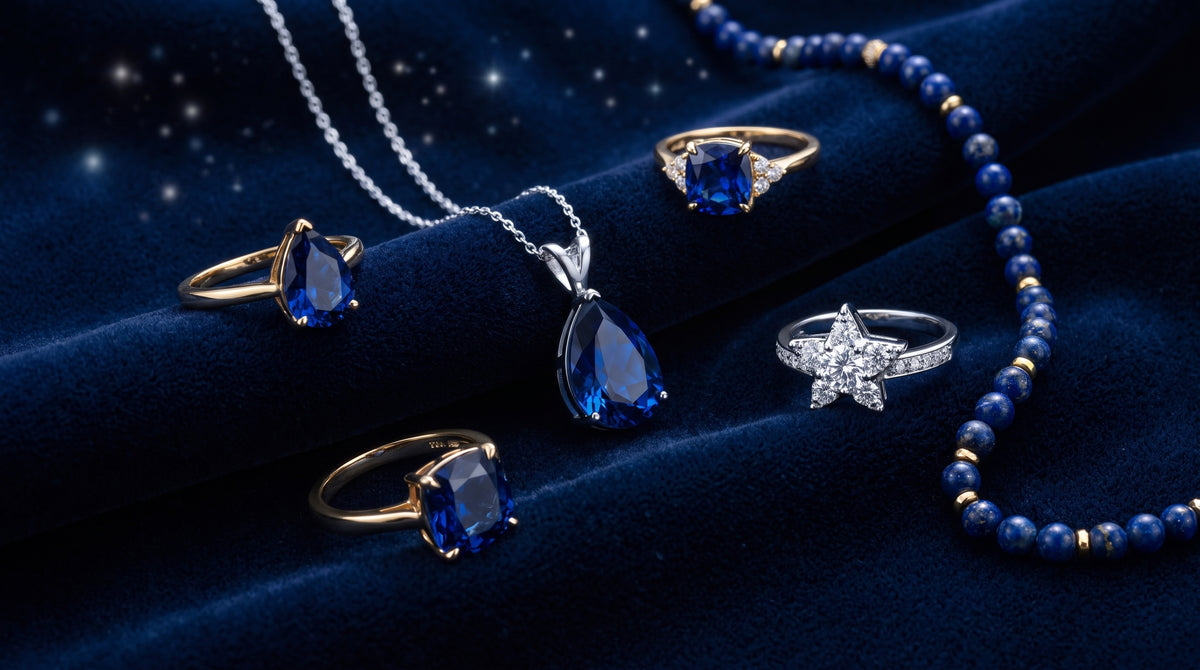
Four pieces can all be listed as "September birthstone jewelry" and hold four different stones: a natural sapphire, a lab-grown sapphire, a blue man-made crystal chosen only to match the month's color, or a slab of deep-blue lapis lazuli. They are not interchangeable. They differ in hardness, in how they photograph, in how they age on a wrist versus a neck, and in price by an order of magnitude. That is the real decision behind this search, and most category pages skip it.
This guide sorts the options the way a jeweler would: first the stone, then the format, then the metal, then the budget line and the care reality. Along the way it answers the question that sends so many shoppers here in the first place — whether September has one birthstone or two.
What Are the 2 Birthstones for September?
The short answer: sapphire is September's primary birthstone, and lapis lazuli is the widely recognized modern alternative. Both are blue. Only one of them is a precious gem.
Sapphire: the canonical September stone
Sapphire appears as September's stone on the trade birthstone charts used across the jewelry industry, and the Gemological Institute of America names sapphire outright as the September birthstone, a gem cherished for thousands of years. It has held that slot in every major list since the American jewelry trade standardized birthstones in 1912, which is why sapphire is the default expectation when someone hears "September birthstone."
Gemologically, sapphire is the blue variety of corundum; the red variety of the same mineral is ruby. Sapphire also occurs in a range of other colors — pink, yellow, and more — even though blue is the color tied to September in birthstone tradition. Traditionally it has symbolized sincerity, truth, faithfulness, and nobility, with long associations to royalty and romance, which is a large part of why sapphire engagement rings and anniversary pieces keep their appeal.
Lapis lazuli: the second September stone, and why it exists
Lapis lazuli's claim is not marketing invention. The Greek word sappheiros, the ancestor of the word "sapphire," originally referred to lapis lazuli, and older lapidary texts used the term loosely. That linguistic overlap is why lapis still travels with sapphire on many modern lists — the International Colored Gemstone Association's September page names the month's stone as "sapphire or lapis lazuli," and boutique collections routinely market the pair together for Virgo and Libra birthdays.
Lapis is not a single mineral but a rock, prized for its midnight-to-royal blue body color flecked with gold-toned pyrite. It is commonly sourced from Afghanistan, Chile, and Russia, and it carries its own set of traditional meanings: inner peace, clarity, intuition, and honest communication. If sapphire's story is loyalty and nobility, lapis lazuli's is self-expression and calm insight.
The stones you'll see mentioned but shouldn't count on
Carnelian, peridot, agate, and iolite all surface in niche or historical lists for September. They are interesting footnotes, not mainstream birthstone choices. If you're buying a gift and want the recipient to recognize the gesture instantly, stay with sapphire or lapis lazuli. For broader context on how multi-stone months work — June, October, November, and December each carry more than one option — our complete guide to birthstone jewelry maps the full calendar.
Sapphire vs. Lapis Lazuli: Durability, Look, and Who Each Suits
This is the fork that determines whether a piece gets worn daily for a decade or lives in a drawer after one scratch.
| Factor | Sapphire | Lapis lazuli |
|---|---|---|
| Mohs hardness | 9 — one of the hardest gems in common use | Roughly 5–6, and porous |
| Appearance | Transparent, faceted, bright blue with sparkle | Opaque, saturated blue with gold pyrite flecks |
| Best formats | Rings (including engagement), studs, pendants — anything worn daily | Pendants, earrings, statement rings worn with care |
| Traditional meaning | Truth, faithfulness, wisdom, nobility | Inner peace, clarity, communication, intuition |
| Typical cost position | Precious stone; the higher end of colored-gem pricing | Accessible; a far cheaper route to the same blue |
Practically: sapphire at hardness 9 resists scratching from most everyday contact, which is exactly why it dominates birthstone ring collections. Lapis, being softer and porous, is vulnerable to abrasion, impact, and household chemicals. That doesn't disqualify it from regular wear — plenty of people wear lapis constantly — but it belongs on a chain or in an earring more comfortably than on a knuckle that meets door handles and gym equipment.
Choose sapphire when the piece is a milestone, a ring, or something meant to survive decades. Choose lapis lazuli when the recipient prefers depth and texture over sparkle, when the budget is fixed, or when the gift is about calm and self-expression rather than heirloom permanence. If the gift is for a mother or grandmother with a September birthday, our sapphire birthstone gift guide for mom works through the same stone-first logic with gifting occasions in mind.
Choosing the Format: Necklaces, Earrings, Rings, Bracelets, and Charms
Large birthstone retailers present September in five formats — rings, earrings, necklaces, bracelets, and charms — because shoppers arrive without a fixed format in mind. Each one has a different failure mode.
September birthstone necklaces
The safest gift format, because there is no sizing risk and the stone sits away from impact. A single blue stone on a fine chain reads as intentional rather than novelty. Lapis suits this format especially well: our Odyssey Lapis Lazuli Necklace centers one polished natural lapis stone, while The Celestial Strand and The Azure Cascade spread the blue across a longer line for more visual movement. Check chain length against how the recipient layers — a pendant that lands at the same point as a necklace they already wear every day tends to get skipped.
September birthstone earrings
Earrings are the lowest-risk purchase for someone whose taste you only half know: no size, no resizing, and blue reads as a neutral against almost every wardrobe. Faceted blue studs are the conventional route; a geometric lapis design such as The Royal Hex Lapis Lazuli Earrings is the alternative for someone who owns enough sparkle already.
September birthstone rings
Rings demand the most from a stone and from your information. You need the ring size, and you want hardness on your side — which is the argument for sapphire (or a hard sapphire-look stone) over softer options in a piece worn daily. Lapis rings are a legitimate choice for occasional and styled wear; The Starscape Lapis Lazuli Ring is that kind of piece. If you want the September-blue mood in a more architectural silhouette, The Arisara Cushion Ring in 18K gold vermeil and The Orionis Star Ring in sterling silver show how cut and setting change the read — confirm the stone and color on each product page before choosing.
Bracelets and birthstone charms
Charm bracelets are where the brand-specific searches cluster, and it's worth knowing exactly what the mass-market charms contain. Pandora's September Birthstone Eternity Circle Dangle Charm is crafted in sterling silver with an openwork infinity braid, a central blue man-made crystal, and three clear cubic zirconia, measuring 4 mm deep, 12.4 mm high, and 10 mm wide. It is a well-made, gift-ready piece — but the blue stone is a man-made crystal, not sapphire. The same eternity circle design runs across the calendar; the December Birthstone Eternity Circle Charm, for example, measures 11.7 mm deep, 11 mm high, and 9.8 mm wide, which is why people so often buy a September and a December charm together for two family birth months. If you're building that kind of piece, see our guides to birthstone charms for bracelets and to two-birthstone jewelry for how to pair months without the bracelet looking accidental.
Metals and Settings That Flatter a Blue Stone
September birthstone jewelry is sold across yellow, white, and rose gold, sterling silver, platinum, and stainless steel, so the metal is a real choice rather than a default. Standard color guidance holds up: cool-toned stones — sapphire, aquamarine, blue topaz, tanzanite — look their sharpest in white gold or platinum, where the metal disappears and the blue takes over. Warm stones like garnet and citrine belong in yellow or rose gold, and pearls and diamonds work in any metal.
Two useful exceptions. First, lapis lazuli's gold pyrite flecks give it a genuine affinity for yellow gold and gold vermeil — a pairing that looks deliberate rather than mismatched. Second, and more important than any color theory: buy the metal the recipient actually wears. A beautiful gold pendant given to someone who wears only silver is an unworn pendant. Metal preference is as decisive as the birthstone itself, and it is the single most common reason a thoughtful birthstone gift stalls.
Budget, Authenticity, and How to Read the Material Line
Sapphire is a precious stone, so September sits in the mid-to-upper band of colored-gem pricing — less extreme than April's diamond or July's ruby, but meaningfully above the most affordable months. General birthstone buying guidance describes the tiers roughly like this, and it maps well onto September:
- Entry level: sterling silver settings with smaller genuine stones, or plated pieces set with created stones.
- The sweet spot for most birthday gifts: genuine gemstones in settings solid enough for regular wear.
- Higher tier: solid gold settings and better stone grades — pieces intended to last decades.
- Milestone territory: high-grade sapphires, diamond accents, and multi-stone family pieces in solid gold.
Natural, lab-grown, or simulated — three honest answers
Most colored stones are treated in some way, by heat, fracture filling, or irradiation. Treatments are standard industry practice rather than defects, but a reputable seller discloses them, so ask. Ask, too, whether a stone is natural or synthetic. Lab-grown sapphire is chemically identical to mined sapphire and costs dramatically less; both are legitimate choices as long as you know which one you're buying.
The genuine trap is the third category. A listing that says "September blue" rather than "natural sapphire" is describing a color, not a gemstone. That blue could be cubic zirconia, a man-made crystal, glass, or a simulant. None of that is dishonest in itself — color-matched jewelry is a huge and useful part of the market — but it should be labeled, and you should know it before you gift it. Read the material line, not the headline.
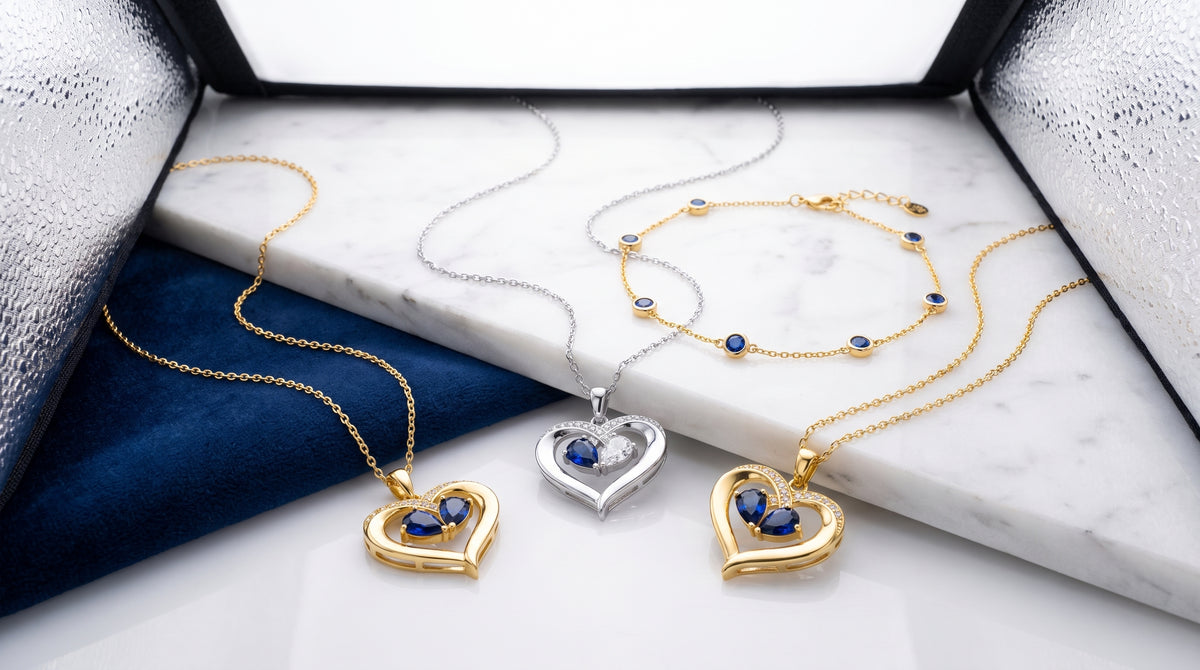
We label ours plainly: our September birthstone collection in simulated sapphire uses simulated stones for that deep September blue, not mined sapphire, and our lapis lazuli jewelry uses natural lapis. If you want brilliance in a September-adjacent format instead, our pear-cut designs lean on cut and light rather than gem tradition: The Thalyssa Pear Pendant is a pear-cut moissanite pendant set in S925 sterling silver, while The Mariselle Pear and The Azurise Pear carry the same teardrop silhouette in 18K gold vermeil — check each product page for the stone it is set with. None of these are birthstones; they are September birthday gifts chosen for sparkle.

Care, Longevity, and the Gifting Details People Forget
Sapphire's hardness of 9 makes it forgiving: gentle cleaning with mild soap and water, plus an occasional check that the stone is still tight in its setting, covers most of what it needs. It is the September option that tolerates a life of typing, cooking, and kids.
Lapis lazuli needs a different habit. Because it is softer and porous, keep it away from harsh detergents, perfumes, and ultrasonic or mechanical cleaning, and store it so harder stones can't scratch its surface. Wipe it with a soft dry cloth rather than soaking it. This is the same principle that applies to porous stones generally — opals and pearls, for instance, shouldn't live in a steamy bathroom or stay on in the shower. When you gift a softer stone, pass the care instruction along with the box; most damage to birthstone jewelry is a knowledge problem, not a quality problem.
Two logistics worth handling before you check out. Confirm the return or exchange window, because you are buying for someone else's taste and a generous return policy is worth more than a small discount. And if a piece is made to order, order early — a September birthday doesn't move, and custom work has a lead time. You can browse the full range by month in our birthstone jewelry collection or by format in necklaces.
September Birthstone Jewelry FAQ
Does September birthstone jewelry have to be blue?
Traditionally yes, because September's stone is blue sapphire. Sapphire itself occurs in many colors, so a pink or yellow sapphire is still a sapphire — but it won't read as "September" to most people. If the recipient dislikes blue, a non-blue sapphire is the most defensible compromise.
Is Pandora's September birthstone charm real sapphire?
No. Pandora's September Birthstone Eternity Circle Dangle Charm is sterling silver set with a blue man-made crystal and three clear cubic zirconia. It represents the birthstone color in a charm format; it is not a mined or lab-grown sapphire.
Can I wear a lapis lazuli ring every day?
You can, with awareness. At roughly 5–6 on the Mohs scale and porous, lapis scratches and stains more easily than sapphire. Remove it for cleaning, gardening, workouts, and anything involving chemicals. For genuinely unthinking daily wear, a sapphire or other hard stone is the better bet.
What's the difference between a simulated sapphire and a lab-grown sapphire?
A lab-grown sapphire has the same chemistry and properties as mined sapphire — it is sapphire, just made in a controlled environment, at a much lower cost. A simulated sapphire is a different material chosen to imitate sapphire's color and look. Both are legitimate purchases; only one is sapphire, and the listing should say which you're getting.
Which September format is safest as a surprise gift?
Earrings or a pendant. Neither requires a size, both suit layering, and blue stones sit comfortably with most existing jewelry. Save rings for situations where you know the size and the metal preference for certain.

Leave a comment
This site is protected by hCaptcha and the hCaptcha Privacy Policy and Terms of Service apply.