


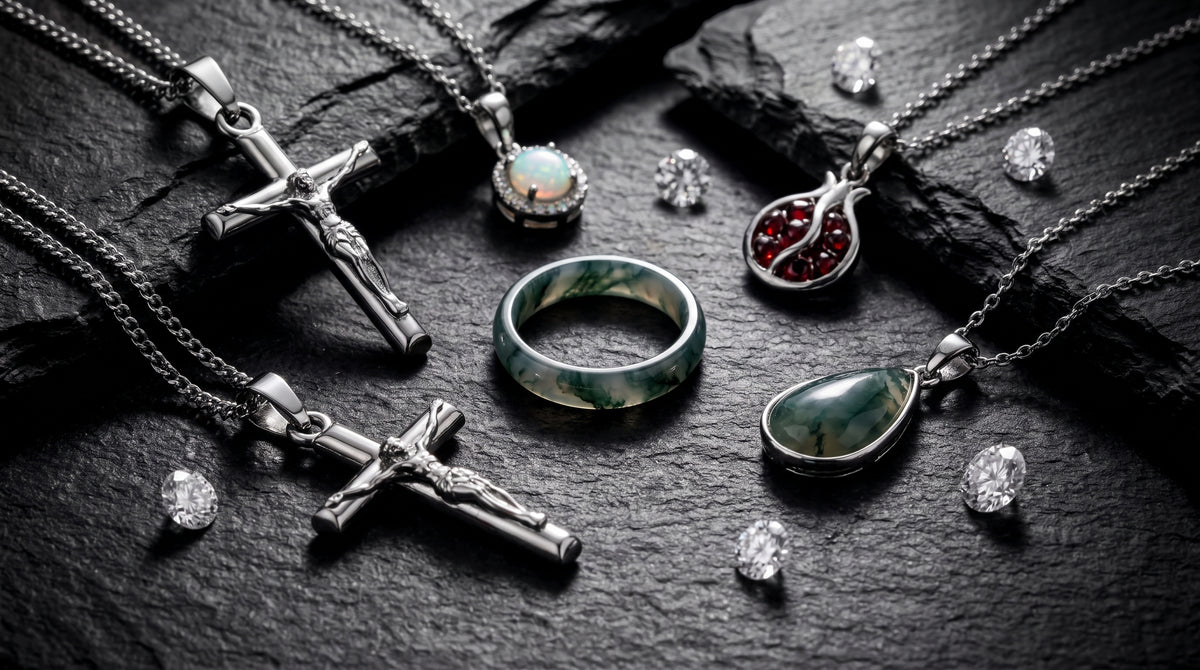
The word "simple" does more work in a moss agate ring than in almost any other gemstone ring. With a diamond, simplicity is an aesthetic preference. With moss agate, it is also a structural strategy. Moss agate is a chalcedony quartz that sits around 6.5 to 7 on the Mohs hardness scale, but its microcrystalline structure and internal fractures give it less real-world toughness than that number suggests, which means exposed edges and tall, elaborate settings are exactly where trouble starts. A low-profile bezel with an unadorned band is not the plain option. It is usually the durable one.
That is the argument this guide builds out. Rather than parading twenty ornate rings, it walks through the four decisions that determine whether a simple moss agate ring still looks good in three years: the setting silhouette, the stone's pattern legibility at ring scale, the metal and band profile, and the care habits you are genuinely willing to keep. Along the way it separates what gemology can support from what is symbolic tradition, because moss agate attracts both kinds of claims in roughly equal measure.
What Moss Agate Actually Is (And Why It Matters for Simple Rings)
Moss agate is a semi-precious variety of chalcedony, a microcrystalline form of quartz with the composition SiO2. The mossy green, brown, or black filaments inside it are inclusions of manganese or iron oxides that branch into shapes resembling moss, ferns, bushes, or entire miniature landscapes against a translucent to milky-white base. Despite the name, there is no organic matter in the stone at all. The plant-like appearance is a coincidence of mineral chemistry, not biology.
It is also not, strictly speaking, a true agate. Mineralogists generally reserve that term for chalcedony with concentric banding, and moss agate lacks those bands, presenting dendritic structures instead. Some sources classify it more precisely as a chalcedony with dendritic inclusions. In related dendritic agate, the filaments may be composed of green hornblende or chlorite rather than iron and manganese oxides, which accounts for subtle differences in color expression between the two.
Geologically, moss agate forms where silica-rich fluids fill cracks and cavities in volcanic rock and metal oxides enter through fissures as the chalcedony solidifies. Weathering later breaks the host rock apart, and the agate is collected as fragments. Notable source regions include India, Brazil, Uruguay, central Europe, and parts of North America including the western United States and Canada. Some material is dyed to intensify color, which is worth asking about before you commit to a stone.
Why the mineralogy shapes the design
Three practical consequences follow from that identity. First, because the visual interest lives inside the stone rather than in faceted light return, a busy setting competes with the stone instead of flattering it. Simplicity is the only way to let a small dendritic landscape read clearly. Second, because the material is quartz-based with internal microfractures, thin edges and corners are the weak points, so the setting should cover them. Third, because each specimen is unique, you cannot shop for moss agate the way you shop for a calibrated diamond. You are selecting a single piece of natural artwork, and that changes the evaluation process entirely.
The Four Simple Silhouettes Worth Considering
Most minimalist moss agate rings fall into a small number of recognizable forms. Each trades protection against presence differently, and the honest way to choose is by matching the trade-off to how you actually use your hands.
1. The full bezel solitaire
A continuous metal rim wraps the entire perimeter of the stone. This is the design most consistently recommended across gemological and jewelry guidance for moss agate, and for a clear reason: it shields the stone's edges, the most chip-prone region, from direct impact, and it eliminates prongs that can snag on fabric or bend out of position. Round, oval, and cabochon cuts all suit a bezel well. Visually, the bezel also frames the pattern like a picture window, which suits scenic stones. If you want one recommendation to start from, this is it.
2. The flush or gypsy set band
Here the stone sits level with the surface of the band, with no protrusion at all. This is the most protective mainstream option and the least likely to catch on anything. It reads as extremely understated, almost signet-like, which appeals to people who dislike anything that sits high on the finger. The compromise is that a flush setting typically suits smaller, shallower stones, so you lose some of the depth and light penetration that makes a thicker moss agate glow.
3. The low-profile prong solitaire
Prongs leave more of the stone visible and let light enter from the sides, which can make the dendrites appear to float. The cost is exposure. Thin prongs and lifted edges are a genuine risk for a stone with only moderate toughness, and some jewelry guidance suggests robust multi-prong designs that cradle the stone from several angles as a compromise. If you choose prongs, choose a low seat, thick metal, and accept that you will need to check the setting periodically.
4. The plain moss agate wedding band or stacking ring
For a wedding band, simplicity is nearly mandatory. Either a single small flush or bezel-set moss agate on a plain band, or a narrow band worn alongside a moss agate center ring. If you are planning a pair, our guide on pairing an engagement ring with a wedding band covers profile matching and gap control, which matter more with a bezel than with a knife-edge solitaire because a bezel's thicker rim can push a flat band away from the center stone.
One note on vintage-style designs: "vintage moss agate ring" is a popular search, but genuine antique-inspired rings tend toward milgrain, engraving, and halos, all of which pull against the simplicity you are looking for. If you want both, look for a plain bezel with a single line of milgrain on the rim rather than a full engraved gallery. Our vintage moss agate engagement ring guide goes deeper into that style family.
How to Judge a Moss Agate Stone at Ring Scale
This is where most buyers of simple rings go wrong, because when there is nothing else to look at, a mediocre stone has nowhere to hide. Specialist guidance on selecting moss agate for rings converges on three evaluation axes.
Pattern legibility
A moss agate slab can look spectacular at 40 mm and turn into a dark smudge at 8 mm. What you want is a pattern that stays readable at the finished size: a clear focal point, visible negative space, and dendrites or branches that remain individually distinct. Typical center stones for rings sit in the 6 to 8 mm range, so ask to see the stone at, or close to, its final dimensions rather than as rough. If the inclusions collapse into a single dark mass at arm's length in ordinary indoor light, the ring will look muddy no matter how good the metalwork is.
Transparency and depth
A clearer quartz base lets light travel through the stone and creates layered depth, so the mossy filaments appear suspended rather than painted on. Heavily clouded or opaque bases flatten that effect and obscure detail once the stone is set. A useful test: look at the stone without backlighting, held at a normal viewing distance. A stone that only comes alive when a light is placed behind it will spend most of its life looking dull on your hand.
Contrast, cut, and structural integrity
Strong contrast between the pale base and the green or earthy inclusions is what makes the pattern legible. Beyond appearance, check the physical soundness of the stone. Guidance for ring-destined moss agate emphasizes adequate thickness, so the stone has enough body to survive setting pressure and everyday knocks; an even profile without abrupt thin spots that become stress points; a smooth, mirror-like polish; and no surface-reaching fractures or visible shatter lines. Internal voids, particularly black pits that look like holes rather than moss, are generally rejected because they both weaken the stone and read poorly. A good cut also centers the most interesting part of the pattern rather than simply maximizing yield from the rough.
Authenticity and treatment questions
Genuine moss agate has inclusions that sit at varying depths within the stone. Patterns that look unnaturally uniform, suspiciously crisp, or as though they stop at the surface warrant a closer look under magnification. Because some agate is dyed to improve color, it is fair to ask a seller directly about origin, any treatments, and how the stone was cut. Very cheap stones are a signal to examine quality more carefully, not a bargain to grab. Moss agate occurs naturally and is not synthesized, so the question is treatment and cut quality rather than whether the stone is "real quartz."
Durability: The Honest Version
Moss agate's hardness of roughly 6.5 to 7 means it resists scratching better than many colored stones and better than the precious metals it is set in. It is hard enough to scratch glass, though that is not a test worth performing on a ring you intend to wear. But Mohs hardness measures only resistance to surface scratching by another material. It says nothing about toughness, which is resistance to chipping and breakage, and this is where moss agate underperforms its number.
Discussion of chalcedony's toughness, including reference to Gemological Institute of America data on the material, notes that the internal microstructure and natural fractures in moss agate make it more prone to chipping and abrasion than the hardness rating alone implies. Reported observations from one vendor's wear testing describe visible edge nicks and surface abrasions appearing within a few months of ordinary wear, and a substantial share of wearers noticing dulled polish within roughly four to six months, at which point professional re-polishing restores the surface. That figure comes from a single vendor-reported source rather than peer-reviewed research, so treat it as one observation set rather than an industry statistic. Still, it is consistent with the qualitative consensus across gemological and jewelry sources: moss agate can absolutely be worn daily with care, but it is not carefree.
How it compares
Diamond sits at 10 on the Mohs scale with very high toughness. Sapphire is 9, moissanite around 9.25, and both remain excellent daily-wear center stones with low repair rates. Moss agate, at 6.5 to 7 with only fair toughness, carries a higher likelihood of needing repair or re-polishing over a lifetime of wear, while costing considerably less than either diamond or sapphire at comparable size. That is the actual trade: you are exchanging some long-term ease for a stone whose pattern no one else on earth has, at a price point that lets you put more of the budget into the metal and the setting quality.
If maximum durability with minimal maintenance is your top priority, a sapphire or moissanite center in an otherwise identical simple setting is the more rational choice, and we would rather say so than oversell. Our solitaire engagement ring guide covers that comparison in more depth. If the stone's individuality and symbolism matter more to you than never thinking about your ring again, moss agate is a reasonable and widely recommended choice, with the caveats below.
What sensitivity means in practice
Beyond impact, moss agate is described as sensitive to thermal shock, strong acids such as vinegar, ammonia- and bleach-based cleaners, and prolonged ultraviolet exposure. Ultrasonic cleaners are widely discouraged for the stone because the vibration can propagate existing microfractures. None of this makes the stone fragile in normal life. It does mean that the ring should come off before certain routine tasks.
Metal, Band Profile, and Lifestyle Fit
Since the stone itself is semi-precious and far less expensive than a diamond of similar size, most of what you pay for in a moss agate ring is the metal and the craftsmanship. That is an advantage: it lets you specify a sturdier setting than you might otherwise afford.
Choosing metal
14k or 18k gold and platinum are common choices for moss agate rings and make sense structurally as well as aesthetically. A well-made bezel in a substantial metal holds its shape, keeps the stone seated, and resists the deformation that eventually lets a stone shift or loosen. Color is a matter of taste against the stone's greens and grays: yellow gold warms the earthy tones, white metals emphasize the cool translucency, and rose gold adds contrast. If you are weighing those options specifically, our breakdowns of rose gold moss agate rings and moss agate rings in silver compare the pairings side by side.
Band profile for a simple ring
For a minimalist design, a flat or softly rounded band of moderate width reads cleanest and gives the bezel something solid to sit on. Very narrow or knife-edge bands can look elegant but leave less material to support a bezel rim. Keep the total ring profile low. A stone that sits closer to the finger takes fewer knocks, snags less on pockets and sleeves, and slips under gloves more comfortably.
Matching the ring to your hands
Guidance across moss agate ring sources is consistent here. If your days involve gardening, weightlifting, heavy manual work, frequent dishwashing, or regular contact with cleaning chemicals, choose a full bezel or flush setting and get into the habit of removing the ring for those activities. If your ring is mostly worn in low-impact settings, a low-profile prong design becomes viable. One frequently mentioned and easily overlooked hazard: airborne dust contains quartz particles, so wiping a dusty surface with a bare hand can leave fine micro-scratches on a quartz-family stone over time. Gentle regular cleaning and occasional professional re-polishing address this rather than preventing it.
Moss Agate Spiritual Meaning and What a Simple Ring Signals
Part of moss agate's appeal is symbolic, and it would be incomplete to cover the stone without it. In jewelry lore and crystal traditions, moss agate is associated with growth, renewal, abundance, emotional balance, grounding, and harmony with nature. It is often connected to the heart chakra and has long been nicknamed the "Gardener's Stone," with folklore holding that gardeners and farmers carried it for a good harvest. Its green tones are read as symbols of prosperity and new beginnings.
Those associations map easily onto engagement and wedding symbolism, which is why moss agate engagement ring meaning is such a common search. Couples frequently describe the stone as representing a love that grows and is tended rather than one that is simply displayed, and moss agate is often chosen by people who prefer nontraditional symbolism, natural materials, and artistry over carat weight.
Two honesty notes. These are cultural and metaphysical interpretations, meaningful to many people but not scientifically demonstrable properties of silicon dioxide. Some sources go further and claim physical health effects such as immune support or assistance in childbirth; those belong to alternative-healing discourse and should not be treated as verified medical outcomes. We report the symbolism because it genuinely drives buying decisions, not as a factual property of the stone.
A simple design arguably serves that symbolism better than an elaborate one. With no halo, no pavé, and no ornament, the only thing to look at is the miniature landscape inside the stone. For a piece meant to represent growth and the natural world, letting the stone speak alone is the more coherent statement.
Where Awareness Avenue Fits, Plainly
We want to be straightforward about our own catalog. Our current moss agate offering is a pendant rather than a ring: the Natural Moss Agate Teardrop Necklace, a teardrop moss agate pendant in S925 sterling silver. If you came here for a minimalist moss agate ring specifically, that necklace is not a substitute, and we would rather tell you that than pretend otherwise.
It is, however, a genuinely relevant option in two situations. If you love moss agate's dendritic patterns but your work or hobbies put real stress on your hands, a pendant sidesteps the durability problem almost entirely, because a stone hanging at the chest takes a fraction of the impacts a ring finger absorbs. And if you are giving a gift to someone whose ring size you do not know, a pendant removes the sizing risk. You can see the rest of our moss agate pieces in the moss agate jewelry collection.
For readers who are ring-focused, our other moss agate ring guides go deeper into specific styles and formats: the complete moss agate engagement ring guide covers the category broadly, while the oval-cut guide is useful if you have settled on the shape that most often suits a bezel.
A Practical Checklist Before You Buy
Pulling the above together into the order you should actually work through it:
Decide the setting first, not the stone. Your hands determine this. Heavy hand use points to a full bezel or flush setting. Lighter use opens up low-profile prongs. Deciding this first narrows the stone shapes worth considering, since bezels favor rounds, ovals, and cabochons.
View the stone at final size, in ordinary light. Ask for images or the stone itself at ring scale, held at arm's length, without backlighting. Confirm the pattern still has a focal point and distinct branches.
Check thickness, polish, and fractures. Ask specifically whether the stone has surface-reaching fractures or internal voids, and whether its thickness is adequate for the intended setting. A stone that is beautiful but thin is a repair waiting to happen.
Ask about treatment and origin. Dyeing exists in the agate market. A seller who can answer clearly about where the stone came from, whether it was treated, and how it was cut is a better bet than one who cannot.
Put the savings into metal and construction. Since the stone costs less than a comparable diamond, specify a sturdier bezel, a well-supported band, and quality metal. This is the single best use of a moss agate budget.
Commit to the care routine before you buy. Clean with warm water and mild soap using a soft brush or cloth. Skip ultrasonic cleaners. Keep the ring away from bleach, ammonia, vinegar, household cleaners, perfume, hairspray, and cosmetics. Store it separately from harder stones so they do not scratch it. Remove it for gardening, gym sessions, dishwashing, and heavy manual work. Expect that a daily-worn moss agate may want professional re-polishing at some point, and treat that as normal maintenance rather than a defect.
Who a simple moss agate ring is right for
It suits someone who wants a one-of-a-kind stone, is drawn to nature-based symbolism, prefers understated design, and is willing to treat the ring as fine jewelry rather than something they never take off. It is less suited to someone who wants a ring they can genuinely forget about through gardening, lifting, and manual work. There is no shame in the second answer, and a sapphire or moissanite in the same clean bezel will give you that peace of mind.
The appeal of moss agate has never been sparkle. It is that a small piece of quartz somewhere in India or Brazil happened to capture manganese and iron into a pattern resembling a forest, and that no other ring will have that exact forest. A simple setting is simply the most honest way to show it, and, as it turns out, the most sensible way to protect it.

Leave a comment
This site is protected by hCaptcha and the hCaptcha Privacy Policy and Terms of Service apply.