


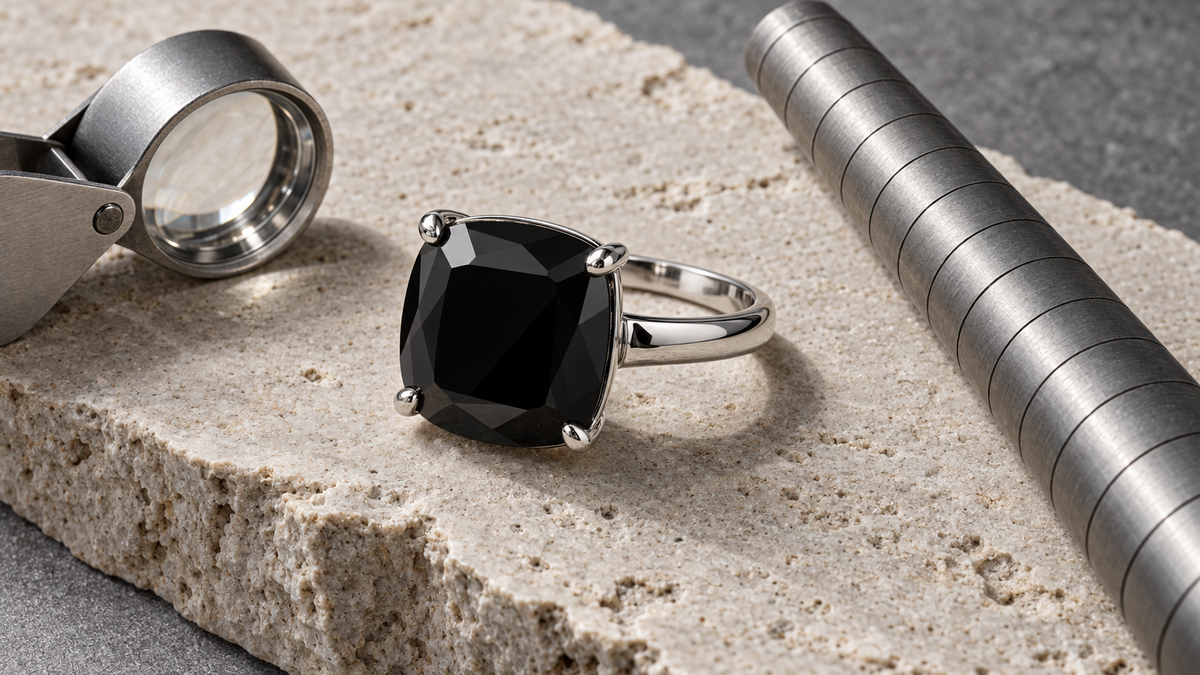
Two listings can share the same photograph: a flat black cushion cabochon, a bright white band, and a headline that reads "natural black onyx, 925 silver." One of them can be solid sterling holding a naturally formed chalcedony whose color came from a dye bath. The other can be a silver-tone plated alloy holding a molded insert. The headline does not separate them, because several of those words — natural, onyx, silver, vintage — carry more than one trade meaning.
This guide is a verification sequence rather than a style roundup. It covers how to read the metal description, how to ask about stone treatment without accusing anyone of selling fakes, how to compare construction in millimeters, how men's and women's silhouettes actually differ, what "vintage" has to prove, and which policy clauses decide whether a ring you dislike can be sent back. If you want to browse first and verify second, the shoppable assortment sits in the black onyx jewelry collection; this page is for making the decision well, here or anywhere else you shop.
Five questions that decide the purchase
- What is the metal made from, all the way through? Solid 925, plated, oxidized, rhodium-finished or an unspecified white metal.
- Is the stone naturally formed, and how did it get black? Origin and color are two separate facts.
- How big and how exposed is the ring on the hand? Stone length and width, face width, setting height, band width.
- Can this exact variant be returned, exchanged or resized? Stock and made-to-order items are frequently treated differently.
- Is each marketing word evidenced? "Vintage," "hypoallergenic," "certified" and "ethically sourced" each require a different kind of proof.
Everything below is simply those five questions in detail.
Quick chooser: which black onyx ring style are you actually looking for?
| Style | Typical profile | Who tends to search for it | What to check first |
|---|---|---|---|
| Solitaire | Single cushion, round or oval cabochon on a narrow band | Women's everyday or gift rings | Setting height and edge coverage around the stone |
| Signet | Flat-top rectangular or oval face set into a wider shank | Men's black onyx rings | Face width, shank width and whether sizes run large enough |
| Band or inlay | Onyx set flush into or alongside a metal band rather than raised | Stackable or minimalist styles | Whether the inlay is flush-set, which affects scratch exposure |
| Statement or cocktail | Larger stone, higher profile, often with a decorative setting | Occasion wear | Setting height and how the ring sits next to other rings |
| Vintage or estate | Period construction, often marcasite, milgrain or filigree detail | Collectors and gift buyers seeking an older piece | Age evidence: marks, provenance, condition, repair history |
A single listing can look like more than one of these at once in a thumbnail photo. The sections below give you the specific questions to ask for each.
What "black onyx" actually means on a spec sheet
Onyx is a variety of chalcedony, a microcrystalline or cryptocrystalline form of quartz. In strict gemological usage, onyx describes banded chalcedony; in everyday retail, the term is applied to uniformly black material, a looseness that gemological bodies have noted when explaining the chalcedony family (Gem-A).
Natural origin is not the same as natural color
Much of the uniform black material sold as black onyx is dyed black chalcedony; naturally black chalcedony is rare (GIA). That matters for how you read a product page. A treated stone can still be naturally formed; 'natural' does not necessarily mean untreated. A stone can be genuinely mined chalcedony — not glass, not resin — and still owe its even black tone to a color treatment, and a dyed stone is not automatically an imitation.
US guidance expects disclosure of treatments that are not permanent, that create special care requirements, or that materially affect value, and the Federal Trade Commission's jewelry guidance addresses how gemstone names and treatment information should be presented in online solicitations (16 CFR §23.24, FTC). Some sellers handle this well at product level: Angara's cushion black onyx listing identifies the stone's enhancement as dyed (Angara).
How to ask so you get a usable answer
Avoid "is it real?" — it invites a yes that tells you nothing. Ask instead: Is the stone natural chalcedony, a synthetic, or an imitation such as glass or resin? If natural, has the color been dyed or otherwise enhanced? Does the treatment require any special care? Three specific answers, in writing, are worth more than any adjective in the listing.
Decoding the word "silver"
In US jewelry guidance, sterling silver means at least 925 parts silver per thousand (16 CFR Part 23). "Silver-tone," "silver-plated" and "silver finish" describe appearance or a surface layer, not the body of the ring. The same part of the guides defines vermeil as a sterling silver base with a gold coating meeting stated karat and thickness conditions — useful when a listing mixes silver and gold language in one paragraph.
| Listing wording | What it tells you | What to confirm |
|---|---|---|
| 925 / S925 sterling silver | Claimed fineness of at least 925/1000 | Whether the claim applies to the whole ring, and whether any surface plating is present |
| Rhodium-plated sterling | Sterling body with a white surface layer | That cleaning advice accounts for the plating, which can wear |
| Oxidized / blackened silver | Intentionally darkened detailing | How to clean without stripping the finish |
| Silver-tone, silver finish, silver-plated | Appearance or coating only | The actual base metal |
| Sterling with gold accents | Mixed construction | Whether gold parts are solid or applied, and at what karat |
Expect sterling to change over time. Sterling silver can tarnish or darken, but routine polishing can restore its reflective finish (Jewelers of America). If a listing promises a metal that never changes color, that is a claim, not a property. Our companion piece on buying sterling silver rings honestly works through the same fineness-and-finish questions for a different stone, and if you are weighing metals at a higher price point, sterling silver versus white gold covers the trade-offs.
Millimeters beat adjectives
"Dainty," "bold" and "statement" are not measurements. Four numbers let you compare any two black onyx rings fairly:
- Stone length × width — the actual face you will see from above.
- Face or setting width — often wider than the stone when there is a frame or bezel.
- Setting height — how far the top sits above the finger, which drives snagging and knocks.
- Band width — comfort, visual weight, and how the ring sits against neighboring rings.
Retailers vary in how much of this they publish. Juwelo lists alloy, plating, stone count and dimensional detail on some silver onyx rings (Juwelo), while a mixed-metal men's ring at Ross-Simons is described with its sterling and 14K yellow gold construction and a size range of 8 to 12 (Ross-Simons). Where numbers are missing, ask before ordering rather than inferring from photography, where crops and hand models can distort apparent scale.
The exposure test
Onyx is approximately 6.5–7 or 7 on the Mohs scale and has good toughness, but it can still be scratched or damaged (GIA). Mohs measures scratch resistance, not impact resistance. When you look at a listing photo, note how much of the stone's edge is covered by metal and whether corners sit proud of the setting. A surrounding frame generally covers more edge than exposed corners do, although execution and metal thickness matter as much as setting type — which is why no one can promise a particular setting is "best" without testing that specific ring.
Men's, women's, and what the gender label is really telling you
The stone does not change across catalog genders; the silhouette does. Men's black onyx assortments lean toward signet faces, flat-top rectangles and wide statement shanks (Clocks and Colours, ItsHot, Glamira), and the Clocks and Colours collection lets you filter by material and size. Women's assortments foreground solitaires, stackables and vintage-inspired designs (Angara; a women's sterling-silver example at Target).
A catalog label alone does not prove who can wear a ring. What it usually encodes is face width, band width, weight and the available size range. If you want a men's signet look, search by those attributes rather than by the word "men's," and check that the size you need is actually offered — size ranges differ listing by listing, and the mixed-metal men's ring cited above, for example, is offered in US 8 to 12 (Ross-Simons).
If your search is specifically men's black onyx in gold
That is a different metal task and usually a different silhouette, and it should be shopped as such. Men's onyx rings are offered in gold as well as silver by specialist retailers (ItsHot). Two cautions carry over from the silver discussion: confirm whether a gold piece is solid alloy or plated, and do not read karat as a durability rating — karat states gold content, not how a finished ring will resist scratching or bending. If a women's slim-band solitaire is offered in a gold option, that does not convert it into a men's gold signet.
Vintage, estate, or vintage-inspired?
These three words sit side by side in search results and mean very different things. Marketplace and estate listings for older onyx rings typically foreground era, maker, condition and dimensions (1stDibs), while newly manufactured pieces can be sold in period styling and identified as reproductions (Antique Jewelry Mall). Both can be good purchases. Only one is old.
GIA's guidance on buying estate jewelry recommends inspecting for dents, scratches, missing stones and prior repairs, and obtaining written descriptions and material details (GIA). Before accepting "vintage" as an age claim, ask for an approximate production date, any hallmarks or maker's marks, repair history, whether the stone is original to the piece, and close condition photographs. Style alone proves nothing about age, and a seller who cannot date a ring should describe it as vintage-inspired.
Fit: sizing a ring you may not be able to resize
Professional ring sizing is preferable, especially when the band is wide or the knuckle is larger than the finger base (GIA). A signet-width band at the same nominal size will usually feel tighter than a slim band, so a size that works for a 1.7 mm solitaire may not work for a 7 mm men's style.
Resizing is also not a given. Whether a ring can be resized — and by how much — depends on its construction, the setting, shank thickness and any previous repairs, which is why you should get a jeweler's assessment of the specific ring rather than a general assurance. This matters most with made-to-order pieces produced in fixed sizes, where an incorrect size may not be fixable after the fact. Measure at the end of the day, check the knuckle, and if you are between sizes, ask the seller which way they recommend sizing for that particular band width.
Care for a dyed stone in a metal that tarnishes
Routine care is undemanding if you stay conservative. Clean onyx gently with lukewarm water, mild soap and a soft cloth or brush unless the seller specifies a more restrictive method (Jewelers Mutual). Avoid bleach, chlorine and strong household chemicals when caring for sterling-silver jewelry (Tiffany & Co.), and expect to polish tarnish occasionally rather than to prevent it entirely (Jewelers of America).
Two extra cautions apply to this category specifically. If the stone's color is treatment-derived, ask the seller what cleaning methods are approved before using ultrasonic or steam equipment or any proprietary dip. And if the ring has oxidized detailing or a plated surface, aggressive polishing can remove the effect you paid for. Keeping pieces dry and stored separately is the simple default; if your rings and chains currently share a drawer, our guide to choosing a jewelry box covers compartment and lining considerations.
Skin sensitivity: what "nickel-free" can and cannot promise
Nickel allergy is a recognized cause of jewelry-related allergic contact dermatitis, and reactions vary between individuals (Mayo Clinic). A seller can legitimately describe what an alloy contains; no seller can guarantee that a given wearer will not react. Treat "nickel-free" as a composition statement to be confirmed with supplier or testing documentation, and treat "hypoallergenic" and "safe for everyone" as marketing language rather than a medical assurance. If you have a diagnosed metal sensitivity, ask for the alloy composition in writing and consult your clinician, not a product page.
Meaning, symbolism, and the claims to discount
Retailer and spiritual-interest pages routinely attach protection, grounding and strength to black onyx. Treat that language for what it is.
Protection, grounding and strength are symbolic or spiritual associations, not established medical effects.
Objective health claims require competent and reliable scientific substantiation (FTC). Buy the ring because you like how it looks and what it means to you, and discount any listing that promises an outcome.
Two calendar points are worth getting right. GIA includes onyx in a seventh-anniversary gemstone guide but notes that no single authoritative anniversary list exists (GIA). And GIA's current December birthstones are turquoise, tanzanite and zircon; black onyx is not on that list (GIA, Jewelers of America). If you are shopping a birthday gift on a birthstone premise, check the list before you commit to the story.
The clause that changes everything: made-to-order, returns and warranty
A return window advertised at the top of a site may not apply to the variant in your cart. Made-to-order and customized pieces can be treated differently from stock items, and that distinction is decided by the policy page, not by a reassuring line in a product FAQ. Awareness Avenue's own refund policy is the governing document here; as read while preparing this guide, it separates stock items from made-to-order items and describes regular made-to-order pieces as exchangeable rather than refundable, with customized orders treated more restrictively. Because the terms can be updated, read the current page and get written confirmation of your specific variant's eligibility before ordering. The same applies to production timing: product copy and the shipping and delivery page should be reconciled with the seller so you know production time and transit time separately.
Warranty scope deserves the same treatment. A lifetime warranty on manufacturing and craftsmanship defects is a different promise from coverage of accidental damage, stone loss or normal wear; Awareness Avenue's current policy, for example, covers manufacturing and craftsmanship defects while excluding improper use, accidents and normal wear. Ask what is covered, what the remedy is, what documentation a claim needs, and whether resizing is included.
Finally, two consumer-protection points that apply to how listings are presented. A "was" or "regularly" price comparison should reflect a bona fide former price at which the item was actually offered (16 CFR Part 233). And reviews should not be organized or displayed in a way that distorts consumer opinion (16 CFR Part 255) — so before trusting a star rating next to a ring, check whether it belongs to that ring or to the store as a whole.
A worked example: the Lyarra Onyx Ring
Applying the checklist to a single listing shows what you can and cannot conclude. The Lyarra Onyx Ring is described by Awareness Avenue as a cushion cabochon in a split-shank setting. Awareness Avenue currently lists the Lyarra with an S925 sterling-silver option, a 7 × 8.6 mm cushion cabochon, a 1.7 mm band and US sizes 4–12. The listing also states that the piece is made to order, with approximately 15 days quoted for creation.
Awareness Avenue describes the Lyarra’s stone as naturally formed black onyx/chalcedony whose color has been enhanced. Product specifications and prices are seller-supplied and may change. Confirm the selected variant’s metal construction, production time and return eligibility before ordering.
What the checklist tells you:
- Metal: the sterling option is described as solid 925. Confirm whether any surface finish is applied, and note that the listing also offers 14K and 18K white gold options whose construction you should confirm at variant level before ordering.
- Stone: Awareness Avenue describes the Lyarra's naturally formed onyx as color-enhanced. Because uniformly black chalcedony in the trade is frequently dyed (GIA), ask the seller to confirm in writing what care that enhancement implies. Note too that the stone identity is not constant across the metal options: the listing states that 10K/14K/18K gold orders include an automatic upgrade to VVS moissanite for the center and accent stones, so the onyx description above applies to the sterling-silver variant. If black onyx is the whole point of the purchase, confirm exactly which center stone ships with a gold variant.
- Scale: a 1.7 mm band with a roughly 7 × 8.6 mm face is a slim-band solitaire profile, not a signet. The seller describes the profile as feminine; the size range extends to 12, but size range alone does not make a design a men's signet.
- Fit: fixed sizes plus made-to-order production means sizing accuracy matters more than usual. Get professionally sized first (GIA).
- Policy: Awareness Avenue's current policy says its regular made-to-order items are exchangeable but not refundable, while customized made-to-order items are generally final sale except for defects or warranty coverage. The Lyarra page and AA's made-to-order return policy currently conflict, so buyers should obtain confirmation of the selected variant's eligibility before ordering.
- Claims to set aside: the listing's nickel-free and hypoallergenic wording is a seller description; individual sensitivities vary (Mayo Clinic). The piece is newly made, so it is not a vintage or estate ring, and it should not be compared against period jewelry on provenance.
Used that way, a single listing becomes a test case rather than a verdict. For a parallel walk-through with a different colored stone — including how color, metal tone and vintage styling interact — see our guide to choosing peridot rings.
The pre-purchase checklist
- Metal stated as 925 sterling (not "silver tone"), with any plating or oxidation disclosed.
- Stone identified as natural chalcedony, synthetic or imitation, with treatment status confirmed.
- Stone dimensions, face width, setting height and band width given in millimeters.
- Edge coverage assessed from clear side-profile photographs.
- Size confirmed professionally, with band width taken into account.
- Resizing feasibility assessed for that construction, not assumed.
- Stone identity confirmed for the exact variant you are ordering, not only for the base metal option.
- Return or exchange eligibility for your exact variant confirmed in writing.
- Warranty scope, exclusions and claim process understood.
- Reviews checked for whether they belong to the product or the store.
- For vintage: date, marks, repairs, provenance and condition documented.
- Any sale comparison supported by a genuine former price.
Frequently asked questions
Is black onyx a real gemstone if it has been dyed?
Yes, in the sense that dyeing changes color rather than converting mined chalcedony into glass or plastic. Much of the uniform black material sold as black onyx is dyed black chalcedony, and naturally black chalcedony is rare (GIA). What you still need from the seller is confirmation that the material is chalcedony rather than an imitation.
Does "natural black onyx" mean untreated?
Not necessarily. A treated stone can still be naturally formed; 'natural' does not necessarily mean untreated, which is why treatment should be stated alongside the origin claim (16 CFR §23.24).
Will a sterling silver onyx ring tarnish?
Sterling silver can tarnish or darken, but routine polishing can restore its reflective finish (Jewelers of America). Dry storage away from bleach and chlorine helps (Tiffany & Co.).
Is onyx durable enough for everyday wear?
Onyx is approximately 6.5–7 or 7 on the Mohs scale and has good toughness, but it can still be scratched or damaged (GIA). Lower, better-protected settings reduce exposure; no setting eliminates risk.
Can a man wear a women's black onyx ring?
Catalog gender labels mostly encode silhouette and size range. Compare face width, band width and available sizes instead; if you want a classic signet look, shop men's assortments that are built around that shape (Clocks and Colours).
How can I tell whether a sterling silver onyx ring is genuinely vintage?
Ask for an approximate date, hallmarks or maker's marks, repair history, whether the stone is original, and detailed condition photographs; GIA's estate-buying guidance recommends close inspection and written descriptions (GIA). Period styling by itself is not evidence of age (example of a reproduction sold as such).
Is black onyx a December birthstone?
No. GIA's current December birthstones are turquoise, tanzanite and zircon; black onyx is not on that list (GIA, Jewelers of America). GIA includes onyx in a seventh-anniversary gemstone guide but notes that no single authoritative anniversary list exists.
What does black onyx mean?
Protection, grounding and strength are symbolic or spiritual associations, not established medical effects; objective health claims require scientific substantiation (FTC).
Should I buy from a marketplace or a specialist jeweler?
Either can work, but verification effort differs. Marketplace results mix handmade, mass-produced, sterling, plated and poorly specified items (Etsy, 1stDibs), so the checklist above does more work there. Wherever you buy, the answers you get in writing — on metal, treatment, measurements and returns — are the real product description.

Leave a comment
This site is protected by hCaptcha and the hCaptcha Privacy Policy and Terms of Service apply.