


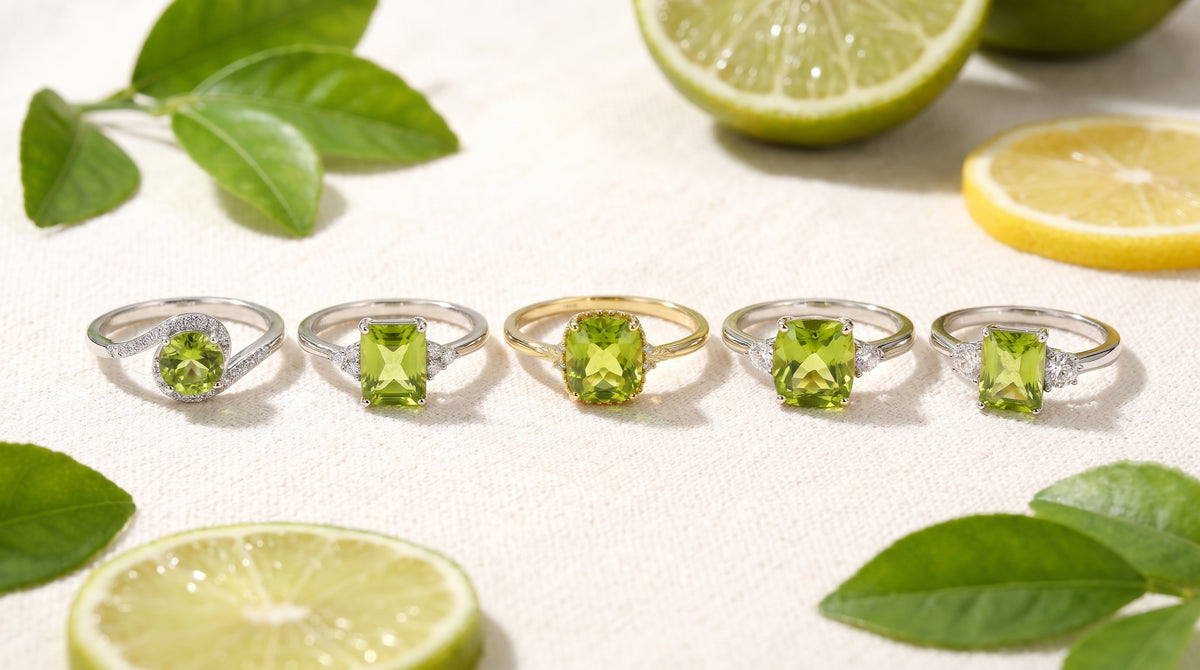
Peridot has only one color family. The green comes from iron inside olivine, the mineral species peridot belongs to, whose composition is dominated by magnesium and iron silicate — and the ratio of those two elements is what pushes a stone toward brighter or deeper green. So unlike sapphire or tourmaline, where you first choose a hue, shopping for a peridot ring is about choosing a position: somewhere between bright yellow-lime and dark olive, at a saturation you actually want on your hand every day. Everything else — metal, setting, vintage or new — either flatters that position or fights it.
This guide works through the decisions in the order they matter: color first, then clarity and cut, then the durability facts that should shape your setting choice, then metal, then the specific questions that come with vintage and vintage-style peridot rings.
Start With the Green: Color Is the First Filter
Gemstone specialists describe peridot's range as running from olive to lime green, with the most highly valued stones showing a bright, vibrant lime green at high saturation and without brown or yellowish modifiers. That is the benchmark used by dealers, but it is not automatically the right stone for you. A pale, yellow-leaning peridot can look luminous and summery in a slim gold band, while a deeper olive reads as more serious and vintage — which is exactly why period-style rings so often use the darker end.
Lime versus olive on the hand
Retailers who hand-select peridot commonly frame the choice as exactly this: look at the green, and decide whether you prefer lime or deep olive. A useful practical test when comparing listings is to look at the stone under two different light sources in the same photo set or video. Peridot is strongly bodycolor-driven rather than sparkle-driven, so a stone that looks brilliant only under a jeweler's spotlight may flatten in daylight or under office lighting.
Color zoning and evenness
Genuine peridot generally shows a uniform olive-to-lime hue that is free of obvious color zoning — banded or patchy areas of different color intensity within one stone. Evenness matters more in larger stones and in open settings such as solitaires, where there is nothing to distract the eye. In cluster or halo designs, minor unevenness is far less visible.
Match the green to the metal before you commit
Peridot is a warm green, and warm metals amplify it. Yellow gold pushes a lime stone toward gold-green and makes an olive stone look richer; white metals cool the same stone and make any yellow undertone more obvious by contrast. If you are cross-shopping several listings, our companion guide on choosing color, metal, and setting for a peridot ring walks through the same trade-off from the shopping-comparison side.
Clarity, Cut, and Carat: Reading a Stone That Grows Its Own Fingerprints
Peridot is typically transparent with a glassy luster, and transparency is one of the first things to check: a stone that looks cloudy, opaque, or unnaturally "perfect and glassy" deserves more questions.
Lily pads and black specks are normal
Natural peridot commonly contains characteristic inclusions, most famously "lily pads" — tiny discoid fractures or cracks that look like small floating discs — along with black mineral inclusions. These are identity markers, not defects to be embarrassed about. What natural peridot generally does not contain is round gas bubbles; bubble inclusions point toward glass or a synthetic imitation.
There is a durability angle here too. Gemstone durability guides note that heavy inclusions and internal flaws can reduce a stone's toughness. So in a ring — the most impact-exposed piece of jewelry you own — a stone with fewer and smaller inclusions, especially near the girdle and facet edges, is the safer buy, even at a slightly smaller carat weight.
Shape changes how the color behaves
Because peridot is prized for bodycolor, the outline you choose changes how much green you actually see. Broad, open outlines such as cushion and radiant cuts show more color face-up; elongated shapes such as pear and marquise stretch the color across the finger and can make a modest carat weight look larger. Square outlines give crisp, geometric corners that suit Art Deco-leaning designs but also put the most vulnerable part of the stone — the corner — closest to the edge of the setting.
If you want to see how those silhouettes sit on a hand before deciding, Awareness Avenue's Azurina cushion ring, Caelisia pear, and Arisala square ring illustrate the proportions of three of the most common outlines used for green center stones.
Hardness 6.5 to 7: What It Means for a Ring You Actually Wear
This is the single most useful technical fact for anyone buying a peridot ring rather than a peridot pendant. GIA places peridot at 6.5 to 7 on the Mohs scale with fair to good toughness — durable enough for jewelry, but requiring care to avoid scratches and hard blows that can cause fractures. Independent gemstone education sources give the same 6.5 to 7 hardness range and note that while peridot has no cleavage, so it is unlikely to split along a defined plane, it remains susceptible to impact damage, particularly along crystal and facet edges.
Practical translation
A stone in that range will pick up fine surface scratches over years of contact with everyday grit, and it can chip if it is knocked hard against a door frame, a gym bar, or a granite countertop. Durability guidance specifically flags rings and bracelets as needing extra care compared with earrings and pendants, because they take more knocks. None of that rules peridot out; it simply argues for choosing the design with that reality in mind rather than assuming a colored stone behaves like a diamond.
Settings that give the stone a fighting chance
Three design choices reduce risk meaningfully. A bezel — a continuous metal rim around the stone — shields the girdle and facet edges, which is where impact damage tends to start. A lower profile keeps the stone closer to the finger and out of the path of daily collisions. And on faceted shapes with points or corners, such as pear, marquise, or square cuts, prongs that specifically cover the corners protect the most fragile geometry.
Match the ring to the finger it lives on
If a peridot ring is intended for daily wear on a dominant hand, favor bezels, half-bezels, or sturdy four-prong settings with a compact profile. If it is a cocktail or occasion ring, an elevated claw-set solitaire is much less of a gamble. Some buyers who love the green but want maximum resilience keep peridot for the right-hand ring and choose a harder stone for a daily band; that is a legitimate compromise, not a defeat.
Peridot Ring Gold, Vermeil, or Silver: Choosing the Metal
Metal affects three things at once: how the green reads, how the ring ages, and how repairable it will be a decade from now.
Yellow gold, including 14K
Yellow gold is the classic partner for peridot and the reason "peridot ring gold" is such a common search. Warm metal and warm green share an undertone, so the pairing looks harmonious rather than contrasting. Jewelers offering peridot commonly work in 14K gold and in sterling silver, and 14K in particular is a sensible alloy for rings because its higher alloy content makes it harder-wearing than 18K, while 18K delivers a deeper, richer yellow. If you are weighing karat trade-offs in more depth, our 18K gold ring buying guide covers how karat affects color saturation and everyday resilience.
White gold: read the caution carefully
Peridot rings are widely sold in 18K, 14K, and 10K white gold, but at least one specialist wedding-ring resource advises against choosing white gold specifically for peridot. Treat that as one considered opinion rather than a rule — but there is a practical reason to think it through. White gold is normally rhodium plated, and that plating is refreshed periodically at the bench. Since GIA notes that peridot can be fractured by rapid or uneven heat and is attacked by acids, any future replating, sizing, or repair on a white gold peridot ring is a job to discuss with your jeweler in advance, ideally with the stone removed. If you want a cool-toned birthstone ring specifically, our guide to birthstone rings in white gold goes through the same maintenance considerations across stone types.
Sterling silver and gold vermeil
Sterling silver is the most common accessible setting for peridot and pairs cleanly with the lighter, more lime-leaning stones. Gold vermeil — a thick gold layer over sterling silver — gives the warm-metal effect at a lower entry point than solid gold, with the trade-off that the surface layer wears over time on high-contact pieces. For a ring worn daily on a working hand, solid gold is the more forgiving long-term choice; for occasional wear, vermeil and silver do the job well.
Vintage Peridot Rings: Art Nouveau, Art Deco, and Reissues
"Vintage peridot ring" covers at least three different products, and confusing them is the most common way buyers overpay.
True vintage, reissue, and vintage-inspired
Antique specialists list peridot pieces such as sculptural Art Nouveau square peridot rings in white gold, princess-cut Art Nouveau peridot rings in 14 karat white gold, and Art Deco crown solitaire peridot engagement rings in 18K yellow gold described explicitly as original vintage reissues. That last word matters. A reissue is a modern ring made to an older design; an original antique is a period piece with genuine age; a "vintage-inspired" ring is a contemporary design borrowing period cues such as milgrain, filigree, or engraved shoulders. All three can be beautiful. Only one of them is old.
Before you buy, ask the seller directly: was this ring made in the period it references, is it a reproduction of a period design, or is it a new design in a period style? A seller who cannot answer plainly is telling you something.
Condition checks for genuinely old rings
Older mountings have had decades of wear, so inspect the parts that fail first. Look at prong tips for thinning or flattening, at the shank for a worn, blade-thin section at the bottom, and at any bezel rim for gaps where the metal has lifted away from the stone. Ask whether the stone has been re-tipped or reset, and whether the ring has been resized before. Request macro photographs of the setting from the side and underneath, not just the flattering top-down view.
Then apply the peridot facts. A stone at 6.5 to 7 with fair to good toughness that has already spent decades in circulation may carry surface abrasions on the table facet or small chips at the girdle. These are worth checking under magnification, because they affect both value and the risk of future damage.
Resizing and repair
Intricate period detailing — engraving, milgrain, filigree, calibrated side stones — limits how far a ring can be resized without disturbing the design. Ask the seller what resizing range a bench jeweler considers safe for that specific mounting, and remember the heat caution above: peridot is sensitive to rapid or uneven temperature change, so torch work near a mounted stone is a conversation to have before purchase, not after.
How to Tell Real Peridot from Glass — and Where Simulated Stones Fit
Vintage and marketplace purchases are exactly where misidentified stones surface, because the pieces often arrive without documentation.
The checks a careful buyer can make
Gemstone education sources point to a short list of tells. Peridot is strongly doubly refractive: under magnification you can see the pavilion facet edges appear doubled when viewed through the table. Natural stones commonly show lily pad and black mineral inclusions. And, as noted above, round gas bubbles suggest glass or a synthetic rather than natural peridot. Color should be a uniform olive-to-lime green without obvious zoning, and the stone should look transparent with a glassy — not plastic-flat — luster.
None of that replaces expert testing. The consistent recommendation from gemstone specialists is to seek verification from a certified gemologist, who can run comprehensive tests and issue a report or certificate. For any peridot ring at a price point where being wrong would hurt, ask whether a report exists and, if not, whether the seller accepts returns after independent appraisal. The same logic applies across colored stones; our guide to buying a natural alexandrite ring and spotting a fake uses the same verification framework.
Simulated peridot, stated honestly
Not every green birthstone ring needs to contain mined peridot, and there is nothing wrong with a simulant as long as it is described as one. Awareness Avenue's August birthstone collection is built on simulated peridot in gold, which is the honest label for a stone chosen for consistent color rather than natural origin. The rule for buyers is simple: any listing should tell you plainly whether the green stone is natural peridot, a synthetic, or a simulant. If the wording is vague, ask.

August Birthstone Context and Why It Drives So Many Purchases
Peridot is the best-known modern birthstone for August, listed alongside sardonyx and spinel in current birthstone conventions, and much of the retail language around peridot rings is built on that association. Historically it has been called the "gem of the sun," and it carries long-standing symbolic associations with renewal, protection, prosperity, and warmth; birthstone retailers still repeat the traditional claim that peridot wards off evil. These are cultural traditions and lore rather than verified properties, but they are genuine reasons people choose the stone, particularly for August birthdays, milestone gifts, and rings meant to mark a fresh chapter.
Practically, this affects what you should look for in a gift purchase: a ring size you can verify, a stone color the recipient will actually wear, and a return or exchange path if the fit is wrong. Sizing is the single most common gifting mistake with rings, and it is far easier to solve before purchase than after.
Care That Keeps the Green Bright
GIA's guidance for peridot is specific and worth following exactly. Warm, soapy water is the best cleaning method. Ultrasonic and steam cleaners are not recommended. Peridot is stable to light, but it can be fractured by rapid or uneven heat, is easily attacked by sulfuric acid and more slowly by hydrochloric acid, and can be affected over long periods by acid perspiration. Gemstone durability guidance adds the same warnings about harsh chemicals and extreme temperature swings, and recommends gentle cleaning, careful storage, and periodic professional inspection.
A workable routine
Clean with lukewarm water, a drop of mild dish soap, and a soft brush; rinse and dry with a lint-free cloth. Remove the ring before swimming, cleaning with household chemicals, using hot tubs or saunas, and before workouts. Store it separately — a fabric pouch or a lined compartment — so that harder stones such as diamonds, sapphires, or cubic zirconia cannot scratch the surface. Once a year, have a jeweler check the prongs or bezel, especially on a vintage mounting.
A Practical Buying Checklist
Before you add to cart
Confirm the stone type in writing: natural peridot, synthetic, or simulant. Ask for photos or video in daylight and indoor light so you can judge the green in both. Check the stone's outline and whether its corners or points are protected. Confirm the metal and karat, and for vermeil, ask about the plating thickness policy. Verify your size, and confirm what resizing is possible on that specific design.
For vintage and antique listings, add
Ask whether the ring is period-made, a reissue, or vintage-inspired. Request close-up images of the prongs, shank, and gallery. Ask about previous repairs, resizing, or stone replacement. Ask whether an independent appraisal is welcome within the return window.
Matching ring to lifestyle
For daily wear on a busy hand, prioritize a bezel or protective prongs, a low profile, and solid gold. For occasional and evening wear, an elevated solitaire or a larger olive-toned cocktail stone is a reasonable risk. For a gift, prioritize sizing certainty and a color that photographs the way it looks in person. In every case, the same short list decides satisfaction: the exact green you want, a stone whose inclusions you have actually seen, a setting that respects a 6.5 to 7 hardness, and a cleaning routine of warm soapy water and nothing more aggressive.

Leave a comment
This site is protected by hCaptcha and the hCaptcha Privacy Policy and Terms of Service apply.