


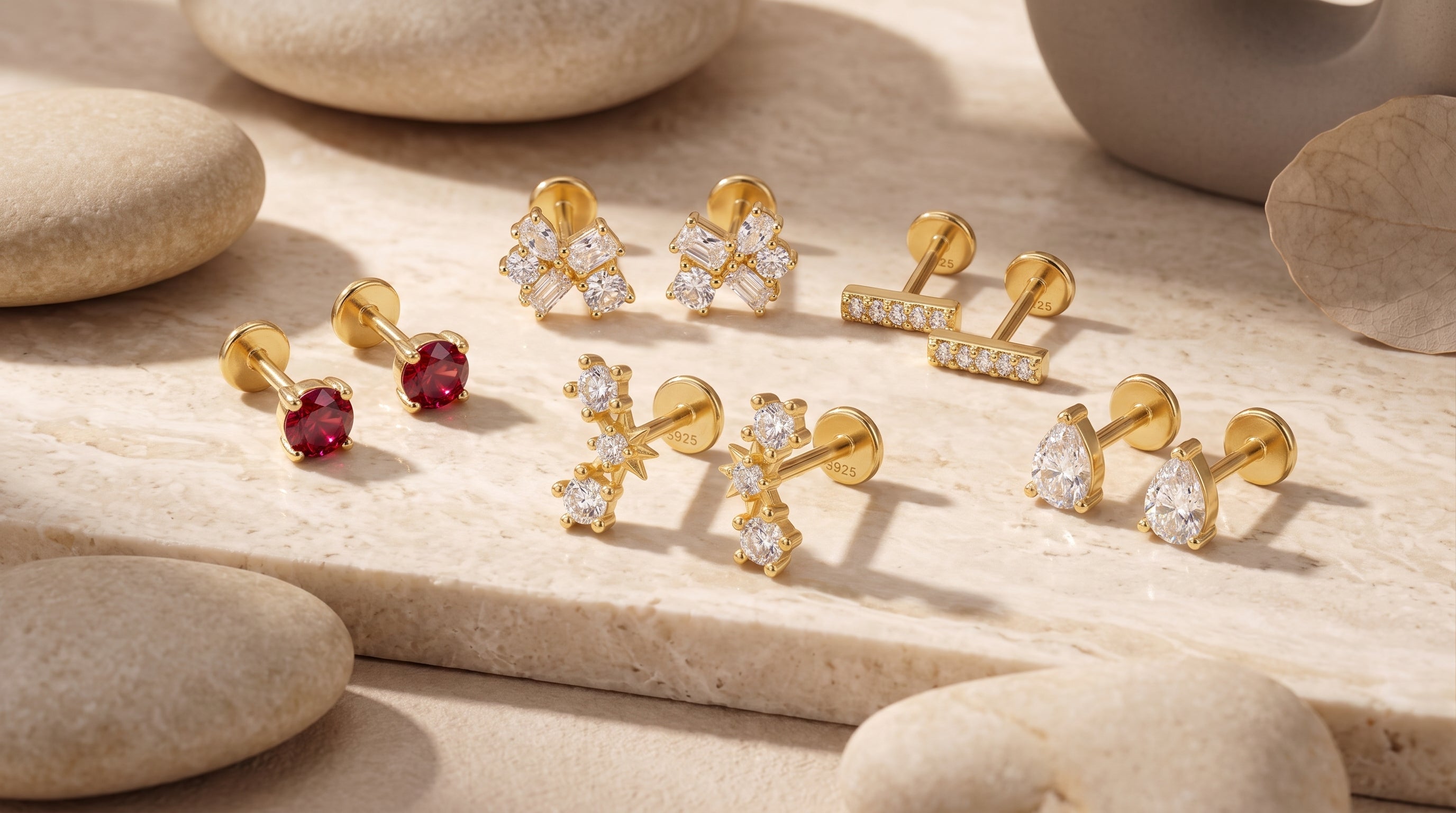
Most adults do not start searching for flat back earrings out of curiosity. They start after a specific, physical annoyance: a butterfly clutch pressed into the side of the neck at 2 a.m., a helix stud that aches under over-ear headphones on a long call, or a lobe that stays pink and tender no matter how many times the backing is loosened. Flat back earrings exist to solve exactly that class of problem, and the reason is mechanical rather than marketing. Instead of a small raised clutch gripping a protruding post, a flat back terminates in a smooth disc that lies level against the skin, so the contact pressure is spread over a wider surface instead of concentrated at one hard point.
That single design change is why flat backs, known in the piercing trade as labret studs, have become the default for cartilage placements, stacked lobes, and jewelry that stays in around the clock. But "flat back" is a family of designs, not one product, and the difference between a comfortable pair and a frustrating one usually comes down to three numbers most listings bury or omit: gauge, post length, and front diameter. This guide covers the mechanics, the sizing math for adult ears, the material questions worth asking, and a listing-vetting checklist you can use before you spend anything.
What Actually Makes an Earring a Flat Back
A flat back earring is any earring whose closure against the skin is a flat, smooth disc rather than a butterfly clutch, ball, or hook. The post is either fully enclosed by the back or terminates flush with it, so nothing protrudes behind the lobe or cartilage. In body-jewelry vocabulary this is a labret post, and it is the same hardware format used in professional piercing studios for many ear and facial placements.
Why the disc geometry matters
Flat back discs commonly measure around 3–5 mm across. Spreading load across that area, rather than across the narrow contact edge of a butterfly clutch, is the mechanism behind nearly every comfort claim you will read about flat backs. It is most noticeable in two situations adults encounter constantly: lying on one side, where a pillow presses the back of the earring into the skin for hours, and cartilage placements such as helix, tragus, forward helix, and conch, where the back sits against the fold of the ear or the side of the head.
Butterfly backs, by contrast
A butterfly back is a separate tension clutch that grips a straight post, leaving a stub of post behind the ear. Body-jewelry and piercing sources consistently describe that configuration as more prone to pinching, poking, snagging on hair and clothing, and trapping debris in the crevices of the clutch, and as a poor choice for fresh piercings. None of that makes butterfly backs useless — they remain perfectly serviceable in fully healed standard lobes for earrings you put in for an evening and take out at night. The distinction is about duration and pressure, not about one design being universally "bad."
The terminology you will see
Listings use "flat back," "flatback," "labret," "threadless," "push-pin," and "internally threaded" more or less interchangeably, which causes confusion. Strictly speaking, "flat back" describes the backing shape; "labret" describes the post-and-disc hardware; and "threadless," "push-pin," and "internally threaded" describe how the decorative front attaches. A product can be flat back and threadless, or flat back and threaded — they are different axes.
Closure Types and Which One Suits Your Hands
The closure determines how often you will realistically change your earrings, how gentle insertion is on tissue, and how confident you feel that the piece will still be there in the morning.
Threadless (push-pin)
A threadless flat back is a hollow post with the disc fixed at one end. The decorative top has a short pin that you insert into the hollow post; a slight bend in that pin creates tension that holds the top in place. To wear it, the post goes through the piercing from behind the ear, then the top presses in from the front until it seats. To remove, hold the disc steady and pull the top straight out without twisting. Many professional piercers favor threadless systems because there are no threads to drag through the piercing channel and top changes are quick once you understand the tension. If the top feels loose, the fix is re-bending the pin slightly, not forcing it.
Internally threaded
Internally threaded flat backs have the threading inside the hollow post, with the matching screw on the decorative front. You insert the post, then twist the top clockwise until snug. The advantage over externally threaded jewelry — where the thread is cut into the outside of the post and has to pass through the piercing — is a smoother surface travelling through the channel, which body-jewelry sources widely recommend for sensitive or healing tissue. If a listing does not say whether threading is internal or external, that is worth asking about.
Screw-back flat discs
Some flat-back studs use a screw-on backing rather than a friction fit. Sleep-focused guidance singles out screw-on backings as a good choice when your main worry is losing an earring overnight. The trade-off is fiddliness: threading a tiny screw behind your own ear is harder than pressing a threadless top in from the front, particularly in second or third lobe holes you cannot see.
Choosing between them
| Closure | Best for | Trade-off |
|---|---|---|
| Threadless / push-pin | Frequent top changes, fresh or sensitive piercings, minimal channel friction | Requires understanding pin tension; too little bend means a loose fit |
| Internally threaded | Set-and-forget wear, smooth insertion, secure once tightened | Small screws are easy to cross-thread or drop |
| Screw-back disc | Maximum security for sleeping in | Slowest to fasten, hardest in hard-to-see placements |
Sizing for Adult Ears: Gauge, Length, and Front Diameter
This is where most disappointing purchases originate. A flat back that is the wrong thickness will not pass through your piercing at all; one that is the wrong length will either float away from the ear or compress the tissue. The good news is that the working numbers are well established across piercing and body-jewelry sources.
Gauge: the thickness of the post
Gauge counts down as thickness goes up. Flat back earrings are commonly offered between 20g and 14g.
| Gauge | Diameter | Typical use |
|---|---|---|
| 20g | 0.8 mm | Thinner posts; second or third lobe holes and dainty styles |
| 18g | 1.0 mm | Standard for most adult lobe piercings |
| 16g | 1.2 mm | Cartilage: helix, tragus, forward helix, conch — in line with widely cited piercing-industry norms |
| 14g | 1.6 mm | Heavier-duty and stretched piercings |
The practical warning for adults: many mass-market fashion studs use thinner posts than body jewelry does. If your lobes were pierced with, or have only ever worn, a very fine post, moving straight to a 16g flat back may not fit without a piercer gently stretching or re-sizing the hole. Confirm the gauge of your existing jewelry before ordering rather than assuming compatibility. Our companion guide on flat back earrings for lobes goes deeper on lobe-specific fit.
Post length: the number people forget
Post length is the distance between the disc and the decorative front — effectively, how much room the earring gives your tissue. Typical guidance across piercing sources runs like this:
- Fresh piercings: around 8 mm, deliberately longer to leave room for swelling in the early weeks.
- Healed adult lobes: commonly around 6 mm for a snug fit that sits flush without pressing.
- Cartilage: roughly 6–10 mm depending on placement and tissue thickness.
Retailers that sell flat back studs in discrete lengths — 5 mm, 6.5 mm, 8 mm, and 10 mm are common increments — typically advise measuring the distance from the piercing to the edge of the ear to choose. Too short and the disc digs in and can hinder healing; too long and the front sits proud of the ear and swivels, which reintroduces the snagging you were trying to escape. If you have ever loved the look of a stud but hated how it sat, length is the first variable to interrogate.
Front diameter: visibility, not function
Decorative fronts on flat back studs typically span 2–6 mm. As a rough guide, 2–3 mm reads as subtle and minimal, 4–5 mm as medium visibility, and 6 mm and above as a statement piece. Holding a coin next to your ear is a reliable way to visualize scale before ordering. Front size mostly governs how noticeable the earring is; treat any claim that a specific front diameter prevents or causes ear problems with skepticism, since that is not something the available guidance supports.
Healing context
Within the piercing trade, lobes are generally described as taking roughly 6–12 months to heal fully and cartilage up to around 18 months, which is why longer posts are used early on and shorter ones once things settle. Treat these as typical practice rather than fixed timelines — individual healing varies, and your piercer's assessment of your specific piercing outranks any article.
Materials, Sensitive Ears, and Why "Hypoallergenic" Is Not Enough
"Hypoallergenic" is not a regulated guarantee, and it tells you nothing about what metal is actually touching your skin. The most useful thing a listing can do is name the alloy specifically.
Implant-grade titanium
Implant-grade titanium, often listed with its ASTM F136 designation, is the material most consistently recommended for fresh piercings and reactive skin: nickel-free, durable, and the standard choice in piercing studios for initial jewelry. It generally costs more than base metals, which is part of why it is not universal in fashion ranges.
Nickel-free sterling silver and solid gold
For fully healed piercings, nickel-free 925 sterling silver and solid 14k gold are widely recommended everyday options, and gold plating over sterling silver is a common construction. The critical detail with any plated piece is the base metal underneath: plating wears, and if the substrate contains nickel, sensitive wearers can react over time. A listing that names both the plating and the base — for example, 18K gold plating over nickel-free 925 sterling silver — is giving you the information you need.
What to avoid and what to ask
Be cautious with vague "surgical steel" descriptions that do not specify a grade, and with any listing that leans on the word hypoallergenic in place of a material spec. Sensitivities are individual: naming a good material lowers the likelihood of a reaction, but nothing eliminates it, and no article can promise your skin will tolerate a given metal. If you have a documented nickel allergy or a history of reactions, our detailed breakdown of flat back earrings for sensitive ears walks through the objections one by one.
Flat Back vs Butterfly Back Across Real Adult Routines
Sleeping
This is the strongest, most consistent case for flat backs. Sleep-focused guidance across lifestyle and jewelry sources converges on the same advice: sleep only in studs or small huggies, avoid heavy, dangling, or oversized earrings that can catch on bedding and hair and risk tearing the lobe, and prefer studs with flat (or silicone) backs because they do not poke or irritate the neck — a point repeatedly raised for side sleepers. If you routinely fall asleep in your earrings, backing design stops being a preference and becomes the main variable.
Long days, headphones, and travel
Here the reasoning is mechanical rather than directly documented, so treat it as a logical extension rather than a proven finding: because a flat disc sits flush rather than protruding, there is simply less hardware behind the ear to be compressed by over-ear headphone cups, a helmet liner, a headscarf, or a plane headrest. Many adults who wear jewelry through twelve-hour days report that this is where the difference registers most. Test it against your own routine rather than assuming.
Multiple piercings and ear stacks
Flat backs suit second holes, stacked lobes, and cartilage placements where bulky clutches start to feel awkward quickly, and their low profile makes it easier to sit several studs close together without the backs colliding. Small closed huggie hoops pair naturally with flat-back studs in a stack because neither format leaves a sharp protrusion for a pillow to press against. If you are assembling a coordinated set, the guide to building flat back earring sets that actually fit covers matching gauges and lengths across placements.
Healing piercings
Body-jewelry sources are close to unanimous that flat back labret posts are the better format for healing tissue: the flat disc leaves space for swelling, post length can be controlled deliberately, and internal threading or threadless pins mean fewer rough surfaces travelling through the channel. Butterfly-backed studs are generally described as unsuitable for fresh piercings because the clutch can irritate and the protruding post invites snagging.
When a butterfly back is still fine
For a fully healed standard lobe, in an earring you wear for an evening and remove before bed, a butterfly back is not a problem. The case for switching is strongest when you wear jewelry continuously, sleep in it, have cartilage piercings, or have had irritation you cannot otherwise explain.
How to Vet a Listing Before You Buy
Because "flat back" is a hardware description and not a style, you cannot infer it from a photograph of the front of an earring. Plenty of attractive studs are, mechanically, ordinary butterfly-back pieces. Before ordering, look for the following:
- Explicit backing language. Genuine flat back products almost always say so in the product name or description, and the photography shows the disc from behind. If the backing is not named, assume it is a standard butterfly back until the seller confirms otherwise.
- Gauge, stated in numbers. "18g" or "1.0 mm," not "standard."
- Post length options. A single unstated length is a red flag for anything meant to be worn continuously.
- Closure type. Threadless, internally threaded, or screw-back — and if threaded, internal rather than external.
- Full material spec. Alloy, plating, and base metal, with nickel status stated rather than implied.
- Front diameter. So you know whether you are getting 3 mm subtlety or a 6 mm statement.
Apply that checklist to every retailer, including this one. If you are shopping design first and intend to confirm the hardware details before ordering, the Awareness Avenue earrings collection is a starting point for style direction — check each product page for backing type, gauge, length, and materials, and ask if anything is missing. For a broader comparison of what separates a well-specified pair from a vague one, see our overview of how to choose the right flat back pair.
Insertion, Removal, and Everyday Care
Getting them in without a fight
Wash your hands thoroughly first — handling jewelry that goes through a piercing is the moment bacteria are most easily introduced. For a threadless flat back, feed the post through the piercing from behind the ear, hold the disc steady, and press the decorative top into the hollow post until it seats; resistance means it is holding. For a threaded design, insert the post, then turn the front clockwise until snug. Doing this over a towel or a closed drawer saves you crawling around after a 3 mm top.
Taking them out
Threadless tops come out with a straight pull while you hold the disc — never a twist, which can damage the piercing and deform the pin. Threaded fronts unscrew counterclockwise while the flat back stays put. If a threadless top keeps loosening, the pin has lost its bend; a very slight re-bend restores the tension.
Cleaning routine
Body-jewelry sources commonly recommend cleaning flat back earrings about weekly with saline solution or mild soap and warm water: soak for roughly five to ten minutes, then gently work around the disc and any textured areas of the front with a soft-bristled toothbrush, since crevices collect buildup. Rinse thoroughly — leftover soap residue is itself an irritant — dry the piece, and store it somewhere dry and clean rather than in a humid bathroom. A quick daily check that the front is still seated prevents both loss and the irritation that a half-loose stud can cause. These are widely recommended trade practices, not clinical protocols; follow your piercer's aftercare instructions for any healing piercing, and seek professional advice if you see signs of infection or persistent irritation.
Putting It Together
For an adult buying flat back earrings, the decision sequence that avoids most regret is short. Confirm the gauge your piercings currently take. Measure or estimate the post length you need — longer if the piercing is fresh or the tissue is thick, shorter once healed. Pick a closure that matches how often you actually change your jewelry and how much dexterity the placement allows. Insist on a named material rather than a hypoallergenic badge. Only then choose the front you like, at a diameter that suits how visible you want it to be.
Done in that order, a flat back stud does what the format is designed to do: sit flush, spread pressure, stay put, and stop demanding your attention. That is a lower bar than most marketing sets, and a far more useful one. For lobe-specific measurements and examples, our guide to flat back stud earrings for earlobes covers the fit details in more depth.

Leave a comment
This site is protected by hCaptcha and the hCaptcha Privacy Policy and Terms of Service apply.