


The "925" stamped inside a band tells you one thing only: the alloy is 92.5% silver. It says nothing about whether the engagement ring and the matching band in the same box will actually sit flush against each other, whether the center stone came with a grading report, or whether the piece is plated with a harder precious metal. Yet those three unknowns decide almost everything about how a sterling silver moissanite ring set looks after two years of daily wear.
This guide breaks the search term into its three parts — the metal, the gemstone, and the word "set" — and gives you a checklist for each. Where a claim comes from a gemological source, it is stated as measured property. Where it is brand positioning, it is labeled as such, because the gap between the two is exactly where shoppers in this category get burned.
What "Sterling Silver Moissanite Ring Set" Actually Means on a Spec Sheet
Retailers use "set" loosely. Before you compare two listings, confirm what is physically in the box and what the metal description covers.
How many rings is a "set"?
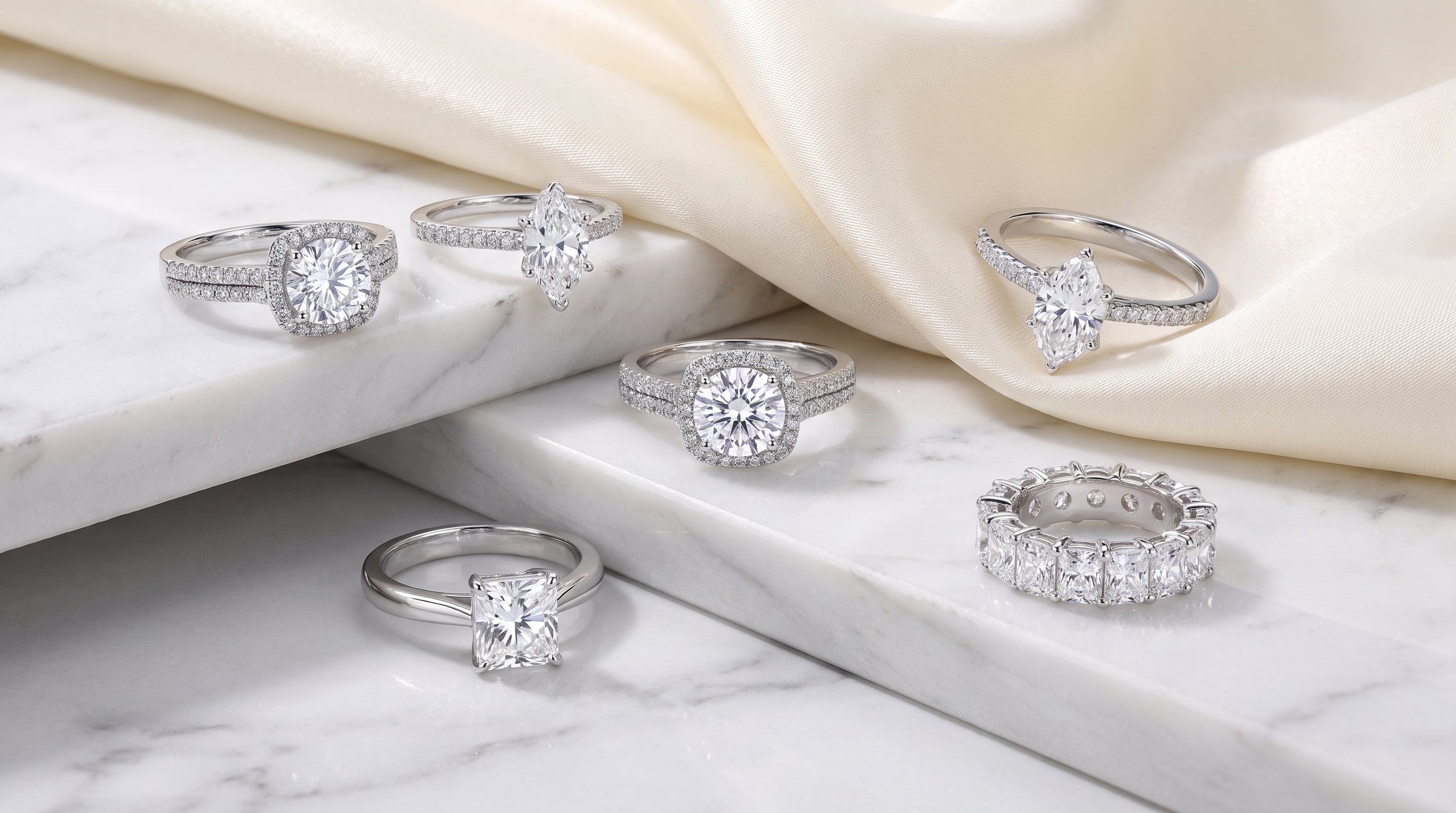
In bridal jewelry, a set usually means two coordinated rings: an engagement ring with a center stone, plus a wedding band designed to sit against it. Three-piece configurations also exist — typically one engagement ring plus two bands, or a three-stone center ring paired with contoured guards. Marketplace listings in this category commonly describe multi-piece bridal sets in 925 sterling silver with a round center stone and side stones set in double rows, and curated roundups of 925 sterling silver wedding ring sets highlight both halo styles and three-stone designs with total carat weights spread across all stones.
Two implications follow. First, "3.7 CTTW" on a set is total carat weight across every stone in every ring, not the size of the center stone — always look for the center stone's separate carat weight or its millimeter measurement. Second, a "jewelry set" is not always a ring set: some listings under that phrase bundle a necklace or earrings rather than a second band. Read the components list, not the title.
What the 925 stamp does and doesn't tell you
Sterling silver is an alloy of 92.5% silver with the balance made up of other metals, most commonly copper, and it is identified by the 925 or 0.925 stamp you will see quoted in product specifications. The stamp confirms the base alloy. It does not tell you:
- Whether the ring is plated, and with what. Some pieces are layered with platinum or plated with 18K white gold over sterling silver, which changes surface color, scratch behavior, and tarnish resistance.
- Whether the alloy is nickel-free or lead-free. Some brands state this explicitly on the listing; treat it as a manufacturer claim tied to that specific product rather than a universal property of sterling silver.
- Whether the ring can be resized. Some sterling silver moissanite sets are sold as non-resizable, which matters enormously for a two-ring purchase.
If a listing gives you the stamp but not the plating, the resizing policy, or the stone grades, that absence is itself information about how much documentation you can expect after purchase.
Moissanite Performance: The Numbers That Matter for a Daily-Wear Set
Moissanite is silicon carbide. The natural material was first identified in a meteor crater and is vanishingly rare, so the moissanite used in jewelry is lab-grown. That origin is a selling point for many buyers, but the reason it works as a bridal center stone is physical, not marketing.
Brilliance and fire: why moissanite does not look identical to diamond
Moissanite has a refractive index of roughly 2.65–2.69, higher than diamond's 2.42, so it bends light more strongly and returns a lot of it. Its dispersion — the property responsible for "fire," the rainbow flashes — measures about 0.104 against diamond's 0.044. In practice, that means a moissanite center stone throws noticeably more colored flash than a diamond of the same cut and size, especially under direct or point-source lighting.
Whether that reads as an advantage depends on taste. Some buyers specifically want the extra fire; others find it too showy in bright light. It is also a design variable in a ring set: halo and pavé arrangements multiply the number of small facets, so a set with a halo plus two pavé bands will produce far more colored flash than a plain solitaire with a smooth band. If you prefer restraint, choose a larger single center stone and keep the accompanying bands plain or bezel-set.
Hardness, toughness, and heat
| Property | Moissanite | Diamond |
|---|---|---|
| Mohs hardness | 9.25 | 10 |
| Refractive index | ~2.65–2.69 | ~2.42 |
| Dispersion (fire) | ~0.104 | ~0.044 |
| Cleavage plane | None | Present |
At 9.25 on the Mohs scale, moissanite is the second hardest gemstone in common jewelry use, behind diamond. Everyday abrasives will not scratch it; the realistic scratch risk comes from storing it loose alongside diamond jewelry. Moissanite also lacks the cleavage plane diamond has — the internal direction along which a diamond can split under a sharp blow — which contributes to its reputation for excellent toughness. Its heat resistance is high enough that damage during normal jewelry manufacturing or repair work is unlikely.
The honest framing: the stone in a sterling silver moissanite ring set is rarely the weak point. Prongs, band deformation, and surface tarnish on the metal are the parts that need attention.
Grading language: color, clarity, and cut
Moissanite is graded with vocabulary borrowed from diamond. Colorless stones are described in the D–F range, near-colorless in G–H–I, and faint tints in J–K. Clarity grades such as VVS1, VVS2, and VS1 appear routinely on bridal set listings. Cut is the variable that is hardest to verify remotely and the one that most affects sparkle: precise symmetry and well-controlled proportions are what turn moissanite's high refractive index into actual light return rather than dead zones under the table.
Two practical rules. Ask for millimeter dimensions of the center stone in addition to carat weight, because visual size on the finger is what you are really buying. And be skeptical of listings that use only vague phrasing like "near colorless" with no specific grade attached — buying guides in this category consistently flag that ambiguity as a warning sign.
Sterling Silver as the Setting Metal for a Multi-Ring Stack
Metal is where sterling silver moissanite sets diverge most sharply from the same designs in gold or platinum, and where most competing guides go quiet.
Why 925 rather than fine silver
Pure silver is too soft for prong settings and thin shanks. Alloying it to sterling makes it meaningfully harder, which is why brands working in this material argue that 925 supports intricate pavé work and fine prong detail that fine silver could not hold. That is a workable, widely accepted rationale, but note that it compares sterling to pure silver — not to gold or platinum. No published comparative wear testing in the sources behind this guide establishes that sterling silver matches 14K gold or platinum for long-term structural resilience, so treat any "just as durable as gold" claim as marketing until a seller shows you data.
Plating: platinum and rhodium layers
Plating a sterling base with a harder, more inert white metal is standard practice in this category and is one of the clearest quality differentiators between two otherwise identical-looking sets. Awareness Avenue's The Gleam single-row pavé band, for example, is built from S925 recycled sterling silver layered four times with platinum, set with round-cut moissanite in D color and flawless clarity, and offered in sizes 5–9. Elsewhere in the market you will see 18K white gold plating over sterling silver used for the same purpose.
What to ask: how many layers, and with what metal? Plating is a wear surface, and no seller in this evidence base publishes a wear-through timeline, so plan on eventual replating as a maintenance item rather than assuming permanence. This is also the single biggest reason to compare a silver set against a solid white-gold equivalent before you commit — our companion piece on choosing between sterling silver and white gold moissanite rings walks through that trade-off in detail.
Tarnish, micro-scratches, and skin sensitivity
Sterling silver reacts with its environment and dulls or discolors over time. Care specialists in the moissanite space note that most of the dullness people blame on the stone is actually surface film and dust buildup on the setting, not damage to the gem. They also warn against dry-scrubbing silver, which can grind particles across the surface and leave micro-scratches, and against air-drying, which leaves mineral spots. Harsh chemicals, especially chlorine and bleach, should be kept away from the ring — the risk there is to the metal setting rather than to the moissanite itself.
On allergies: some sellers describe their sterling silver as lead-free, nickel-free, and hypoallergenic. That is a product-level statement, not a guarantee that any sterling alloy suits every wearer, since sterling contains non-silver metals by definition and plating adds another surface. If you have known metal sensitivities, look for an explicit nickel-free statement on the specific product page and note which metal forms the outer plating.
Choosing the Set Design: Halo, Solitaire, Three-Stone, and Built Stacks
Because a set is worn as one object, design decisions compound. Here is how to think about them in order.
Pre-matched sets vs. building your own
A pre-matched bridal set solves the hardest problem for you: the band is contoured or notched so it meets the engagement ring without a visible gap. A halo set such as The Forevermore moissanite halo ring set or a coordinated wedding set like The Angel is designed as a unit; check each product page for the metal specification, stone details, and available sizes before you assume any particular alloy.
Building your own stack gives you more control over proportion and lets you add or change bands later. That is where a slim eternity or pavé band earns its place beside a solitaire — a straight, low-profile band such as The Gleam can sit under or over a solitaire, while a marquise or curved band can be used to fill the gap beneath an elevated center stone. If you are leaning toward a shaped band, our roundup of marquise moissanite wedding band sets covers how those silhouettes nest.
Profile height and setting style
Set height is the variable that determines whether you will actually wear the stack every day. A tall cathedral or high-set halo catches on gloves, pockets, and hair; low-profile and bezel settings sit closer to the finger and give the girdle of the stone more protection. Buying guides in the moissanite space routinely recommend low-profile or bezel settings for hands-on lifestyles, and that advice compounds in a stack, where a second or third band adds bulk in the same vertical space.
Band width and finger coverage
Two 2 mm bands plus a 2 mm engagement shank occupy 6 mm of finger. On shorter fingers that reads as a cuff rather than a ring set. If you want visible stacking without crowding, pair one detailed band with one plain narrow band rather than two pavé bands of equal width. Also check that the bands share a profile: a flat-topped band next to a rounded comfort-fit band will show a seam line no matter how well they are sized.
Solitaire, halo, three-stone, eternity
A solitaire — for example a pavé-shank design like The Opaline marquise cut pavé solitaire — keeps focus on one stone and is the easiest shape to pair with a straight band. A halo adds perceived size and more surface sparkle but usually raises the profile. Three-stone designs read wider on the finger and often need a contoured band. Full eternity bands, such as a radiant cut eternity design, look striking but cannot be resized, so treat them as a permanent size commitment. Browse the full silver moissanite rings range if you want to compare silhouettes side by side before deciding.
Sizing a Stack Correctly — and Why It's Harder Than Sizing One Ring
Sizing errors cause more returns in this category than any stone or metal issue. Two reliable at-home methods work:
- Paper or string method. Wrap a thin strip of paper or a length of string around the base of the finger, mark where it overlaps, lay it flat against a ruler, and match the measured circumference to a size chart.
- Existing ring method. Take a ring the wearer already wears on the intended finger, measure the inside diameter across the middle, and match it to a size chart.
Both methods must account for the knuckle: the ring has to clear the knuckle while still sitting securely at the base of the finger. If the knuckle is significantly larger, size to the knuckle and expect some rotation at the base.
Three additional considerations apply specifically to sets. First, added band thickness can make a stack feel tighter than a single ring at the same nominal size, so if you are between sizes, size up rather than down. Second, fingers change through the day and across seasons; a stack amplifies any snugness. Third — and this is the one that catches people — many pavé and eternity designs, and some complete sets, are sold as non-resizable. Confirm the resizing policy in writing before ordering, and if the product is non-resizable, measure twice. Because sizing risk is the main disadvantage of buying online, some shoppers searching for moissanite rings near them are really trying to solve a fit problem; a printed or physical sizer plus a clear exchange policy generally solves it more accurately than a quick try-on in an unrelated size.
Certification, Documentation, and Vetting the Seller
Grading practices for moissanite are less standardized than for diamond, and entry-level sets in particular may ship with limited paperwork. Reports issued by laboratories such as GRA or IGI appear on many moissanite listings; a useful report specifies the color grade, clarity grade, carat weight, cut grade, and a unique identifier number. If a certificate only repeats vague marketing adjectives, it adds little.
Questions worth asking any seller before you buy a set:
- What is the center stone's carat weight and its millimeter dimensions?
- What are the stated color and clarity grades — for the center stone and for the accent stones?
- Is the metal solid sterling, or sterling with plating? Which metal, and how many layers?
- Is the set resizable, and by how many sizes?
- Are the bands contoured to sit flush with the engagement ring, or straight?
One transparency point deserves emphasis: moissanite is its own gemstone, not a diamond and not a lab-grown diamond. Reputable moissanite specialists explicitly warn against sellers who market the stone as "synthetic diamond" or otherwise blur the distinction. A seller who is precise about what the material is tends to be equally precise about grades and metals.
Care Routine That Keeps a Silver Set Bright
The maintenance load on a sterling silver moissanite set is real but small, and it is mostly about the metal.
Weekly clean
Rinse the rings under warm water, add a drop of mild dish soap, soak for roughly ten to fifteen minutes if there is visible buildup, then work gently around the setting and under the stone with a soft-bristled toothbrush. Rinse thoroughly and dry immediately with a lint-free cloth rather than letting the rings air-dry. Never dry-scrub silver, and keep chlorine and bleach away from the set entirely.
Monthly check
Run a fingernail lightly over each prong to feel for lifted tips, and hold the ring near your ear and tap it gently — a faint rattle means a stone has loosened. Pavé and halo settings have many small prongs, so this check matters more in a detailed set than in a plain band. Annual professional cleaning and inspection is a reasonable habit for a ring worn daily.
Storage
Store the rings clean and dry, in anti-tarnish pouches, separated from each other and from any diamond jewelry that could scratch them. For long storage, double-bag with a silica gel packet and check the rings every few months. Take the set off before swimming, cleaning, and any task involving grit or solvents.
Matching the Set to the Buyer
If you work with your hands
Prioritize a low-profile or bezel center stone, two rings rather than three, and plain or channel-set bands. Moissanite's 9.25 hardness handles the abrasion; the setting is what needs the protection.
If maximum visual size is the goal
A halo set delivers the largest apparent spread per carat, and pairing it with a slim band keeps the center stone dominant. Ask for the halo's outer millimeter diameter, not just the center stone's carat weight.
If you want to expand the set over time
Start with a solitaire and a straight band in the same width and finish, then add a second band later. Keeping the metal and plating consistent across purchases matters more than matching stone shapes.
If you're shopping a matching men's band
Moissanite is used in men's rings as well as women's, and the same hardness and toughness figures apply. In a coordinated pair, most couples pair a stone-set ring with a wider plain or lightly accented band; ask whether the men's band shares the same alloy and plating so the two age at a similar rate.
Moissanite vs. Diamond, and Silver vs. Gold: Setting Expectations
Compared with diamond, moissanite bends and disperses light more strongly and is second only to diamond in hardness, but diamond remains harder at 10 on the Mohs scale and carries its own cultural weight. Neither material is superior across every dimension, and any source claiming moissanite "surpasses diamond in every way" is selling, not measuring. Choose based on which properties you actually value on the finger.
Compared with gold, sterling silver is the more accessible precious metal and takes fine detail well, but it tarnishes, benefits from plating, and asks for a more consistent cleaning habit. If you are still weighing metals, our guide to 925 sterling silver moissanite engagement rings goes deeper on the alloy, and the broader overview of choosing a moissanite engagement ring covers stone shape and setting selection in more depth. When you are ready to compare specific pieces, the moissanite rings collection lists metal, stone, and size details on each product page — read those specs against the checklist above rather than against the headline description.
Quick Pre-Purchase Checklist
- Components confirmed: how many rings, and are the bands contoured to the engagement ring?
- Center stone: carat weight, millimeter size, color grade, clarity grade, cut.
- Total carat weight understood as a sum across all stones, not the center.
- Metal: 925 confirmed; plating metal and layers stated.
- Nickel-free or lead-free stated, if relevant to you.
- Resizing policy, in writing.
- Size measured twice by two methods, with the knuckle accounted for and a half-size allowance for stack thickness.
- Grading report contents reviewed, including a unique identifier where provided.
- Care kit ready: mild dish soap, soft toothbrush, lint-free cloth, anti-tarnish pouches.
Work through that list and the decision stops being about which photograph sparkles most. It becomes a straightforward comparison of documented specifications — which is exactly how a set you intend to wear every day should be chosen.

Leave a comment
This site is protected by hCaptcha and the hCaptcha Privacy Policy and Terms of Service apply.