


Type "Hailey Bieber engagement ring" into a search bar and you'll be handed carat figures that swing from 6 to 18, and value estimates that stretch from roughly $400,000 to $1.5 million. Those numbers aren't all wrong, and they aren't all describing the same object. Hailey has worn at least three distinct engagement rings, and almost every specification attached to them comes from jewelers reverse-engineering photographs rather than from a disclosed appraisal. This guide untangles which figure belongs to which ring, flags exactly what has been confirmed by Hailey herself, and then translates the design language into something you can actually shop — including where replica listings quietly change the design without telling you.
Three Rings, One Signature: The Timeline Behind the Search Term
Hailey Baldwin became engaged to Justin Bieber in 2018, and the ring associated with that moment is the one most people picture: a large oval diamond solitaire on a slim yellow gold band. Jeweler Jack Solow of Solow & Co. has been publicly credited with creating that first ring, and told interviewers he had only a few weeks to produce the custom piece, according to Elle's explainer on her ovals.
At some point before 2024 she began wearing a second, more elongated oval solitaire on a similar yellow gold band, attributed by Elle and Harper's Bazaar to celebrity jeweler Lorraine Schwartz. More recently, while in Sydney to launch her beauty brand Rhode, she was photographed in a ring that breaks the pattern entirely: a super-elongated cushion-cut diamond set east–west across the finger, which Elle Australia describes as potentially a third engagement ring.
So when a headline says "Hailey Bieber's new engagement ring," it could mean the Schwartz oval or the cushion-cut piece, depending on when it was written. That single ambiguity explains most of the conflicting numbers you'll find.
What is confirmed versus what is estimated
Across every source in this space, there is essentially one first-party data point: Hailey told W Magazine that her upgraded diamond is "only one carat bigger" than the original, and that its elongated shape makes it read far larger than it is. Everything else — carat weights, dollar values, clarity grades — comes from jewelers and editors interpreting press photography. Treat all of it as informed estimation, not fact.
Ring One: The Original Oval Solitaire
The design
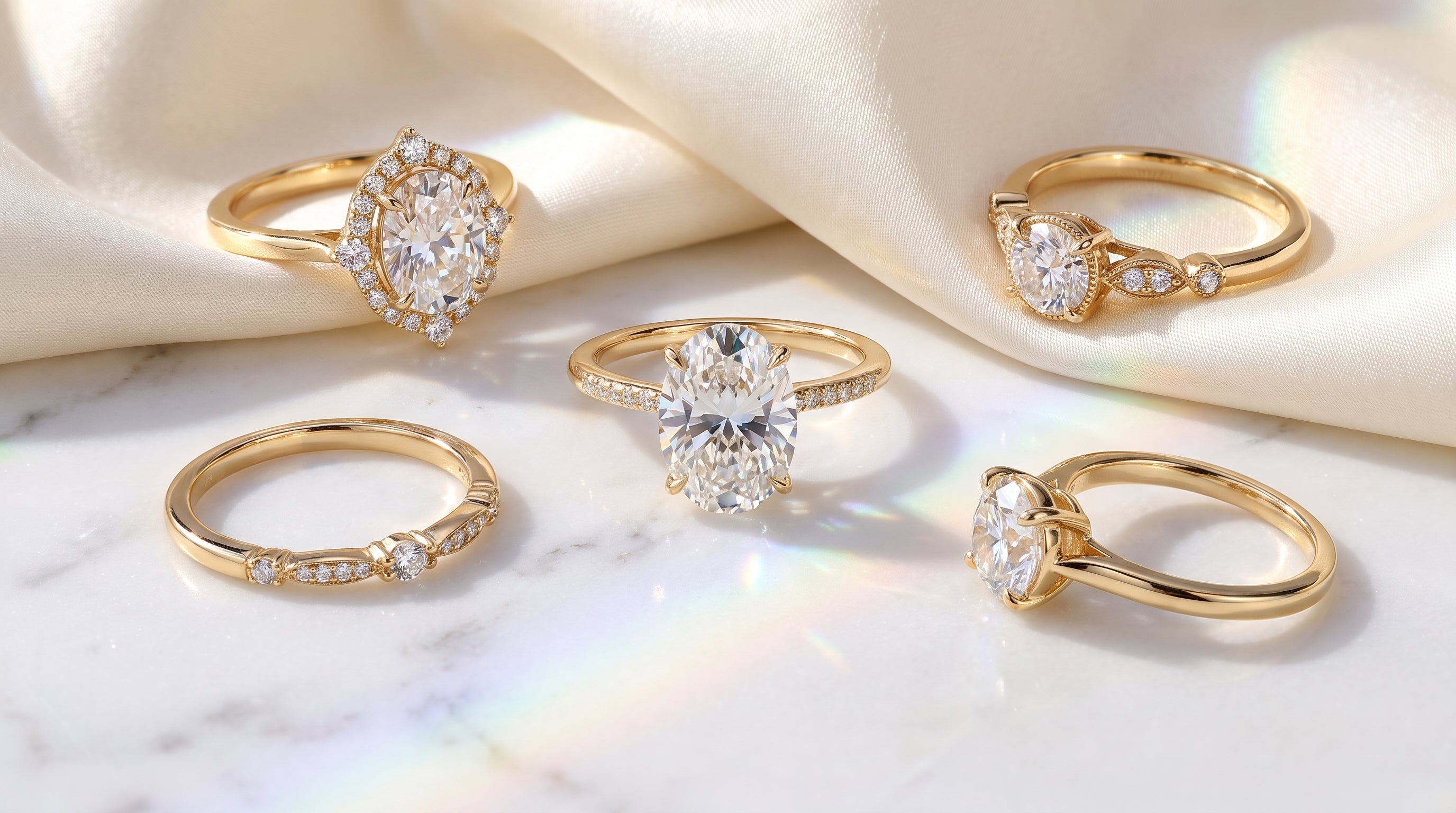
Sources converge tightly on the design: an oval-cut center diamond in a four-prong setting, mounted on a delicate 18-karat yellow gold band with no halo, no side stones, and no visible ornamentation. Goodstone, Lily Arkwright, Queensmith, and Carat Diamonds all describe the same minimalist solitaire. Queensmith adds one detail worth noting for anyone shopping look-alikes: a discreet hidden diamond bezel beneath the stone, which adds depth without breaking the clean silhouette from above. That is not the same thing as a hidden halo, a distinction we'll return to.
The carat question
Goodstone and Elle both report the original diamond at somewhere between 6 and 10 carats, explicitly framing this as a range because carat weight cannot be measured from a photograph. Queensmith narrows it to "just over 8 carats." Harper's Bazaar has referred to it as a 10-carat diamond. The honest summary: high single digits, most likely 8 to 10 carats, never publicly confirmed.
The cost question
Estimated values cluster in a fairly narrow band. Goodstone and Lily Arkwright both cite an estimated $400,000 to $500,000 at the time of the engagement. Queensmith's experts put it at around £400,000, which they convert to roughly $500,000. Harper's Bazaar has cited a higher figure of about £480,000 (around $600,000), reflecting assumptions about clarity and rarity. No purchase price has ever been disclosed by Hailey, Justin, or Solow & Co., so none of these should be quoted as the price paid.
Ring Two: The Elongated Oval Upgrade
The Lorraine Schwartz replacement keeps the formula — oval solitaire, four prongs, yellow gold band — and stretches the proportions. This is the ring responsible for the wildest numbers in circulation, and it's where reading carefully pays off.
Why "18 carats" and "7 to 11 carats" both appear
Harper's Bazaar quotes Laura Taylor of Lorel Diamonds describing the elongated oval as "considerably bigger, at roughly 18 carats," worth upwards of £800,000 (about $1 million). Lily Arkwright repeats a similar 18-carat estimate. But those assessments are derived from appearance alone. Elle takes Hailey's own "only one carat bigger" comment and does the arithmetic: if the original was 6 to 10 carats, the upgrade is likely 7 to 11. Lauren Boc, founder of Hera jewelry, told Elle the stone looks like 8 to 10 carats to her, noting it is longer and skinnier than a standard market oval, which inflates its visual size; a second expert, Mazuera, agreed the 7 to 11 range seems accurate and that the elongation makes precise calculation difficult. Queensmith independently estimates around 10 carats.
The lesson for shoppers is genuinely useful: length-to-width ratio changes perceived size dramatically. An elongated oval covers more finger per carat than a rounder one, which is why a modest weight increase can look like a doubling.
Value estimates
Reported estimates for the upgraded ring cluster between $1 million and $1.5 million. Harper's Bazaar cites both Taylor's "upwards of £800,000" figure and higher estimates of $1.5 million from UK retailer Steven Stone and Rare Carat CEO Ajay Anand. Elle notes the ring appears to be worth over $1 million. Queensmith is more conservative at upwards of £500,000. Again: expert valuations of a stone nobody outside the family has examined, not a receipt.
Ring Three: The East–West Cushion Cut
The Sydney ring is the least documented and the most stylistically interesting. Elle Australia describes a super-elongated cushion-cut diamond worn in an east–west setting — laid horizontally across the finger rather than pointing along it — on a thin gold band, and lists the jeweler as "TBC" and the carat size as unknown. Queensmith, analyzing the same imagery, calls it an ultra-elongated cushion cut in her signature yellow gold solitaire style and estimates 10 to 12 carats, while stressing that nothing is confirmed.
What can responsibly be said: the shape, the orientation, and the metal color are observable. The carat weight, the price, and the maker are not. If you see a product page claiming to replicate "Hailey's new ring" with exact specifications, those specifications are the seller's invention.
The Ring Stack That Does Half the Work
Much of the impact people attribute to Hailey's center stone actually comes from what sits beside it. Queensmith documents two 18k yellow gold "V" or wishbone pavé wedding bands framing her oval, one above and one below, creating a symmetrical frame that pushes the eye toward the center diamond and adds brilliance from the sides. JUNE Rings describes the same principle as double-stacked contour bands that follow the curve of the oval and form a "perfect trio" without covering the stone.
Two practical takeaways. First, a contour or wishbone band nests flush against an oval where a straight band leaves a visible gap, so shape matching matters more than metal weight. Second, stacking is reversible styling, not a permanent commitment — Harper's Bazaar noted that after debuting the larger oval, Hailey was still wearing her original engagement ring, relocated to her right pinkie. Rings move. If you're building a set over time, that flexibility is worth designing for. Our guide to solitaire engagement rings covers how a plain center ring behaves once bands are added on either side.
How Selena Gomez's Ring Compares — and Why It Shows Up in the Same Searches
Searches for Hailey's ring frequently pull in Selena Gomez's engagement ring from Benny Blanco, because both function as reference points for the same shopper. Elle describes Selena's ring as a natural marquise diamond set in a yellow gold pavé band with a clean prong setting.
The carat estimates illustrate how imprecise photo-based appraisal is. Ann Grimmett, vice president of merchandising at Jared Jewelers, told Elle she believes it is a six to eight carat marquise, and separately told People she'd value it around $225,000. Lauren Boc estimated about five carats and a value of $250,000 to $300,000, assuming a mined stone of exceptional quality and cut. Carat Diamonds summarizes the range at 6 to 8 carats while noting the total diamond weight has never been publicly disclosed. Two credentialed jewelers, the same photographs, a three-carat spread.
Design-wise, the comparison is instructive: marquise is a pointed, elongated shape that maximizes finger coverage in a similar way to an elongated oval, but with sharper drama and more fragile points. If you like Hailey's elongated look but want something less common, a marquise moissanite covers similar visual territory.
The Replica Market: What "Best Fake Engagement Rings" Actually Means Here
A large share of this search demand is transactional. Davidsimson sells a "Hailey Bieber engagement ring style" featuring an oval-cut diamond with a hidden halo in 14k and 18k gold. Etsy hosts a stream of listings titled things like "3CT Oval Cut Moissanite Diamond Ring, Oval Hidden Halo Solitaire, Hailey Bieber Replica Ring" and lab-grown diamond equivalents in 14k gold. Moissanite and lab-grown stones dominate the category because they make a large, high-clarity center stone attainable.
Three ways replicas quietly differ from the real thing
- The halo that wasn't there. Hailey's original ring is described as a minimalist solitaire with a hidden diamond bezel, not a hidden halo encircling the stone. Many replicas add a full hidden halo because it increases sparkle and perceived size. It's a legitimate design choice — see our breakdown of the hidden halo look — but it is not a like-for-like copy.
- Metal color drift. Her signature is yellow gold. A meaningful share of "replica" listings are white gold, which reads completely differently on the hand.
- Carat scale. Most listings sit around 3 carats. Hailey's stones are estimated in the high single digits and above. A 3-carat oval is substantial and wearable; it is not the same silhouette.
What to check before you buy any look-alike
Ask for the center stone type stated plainly (moissanite, lab-grown diamond, or simulant), the color and clarity grade, the length-to-width ratio of the oval — this determines whether it reads elongated like hers or rounder — the metal construction (solid gold, gold-filled, or vermeil over sterling silver), and the available size range. Listings that name a celebrity but omit these basics are selling the association, not the specification.
Oval Moissanite Alternatives That Follow the Same Design Logic
Awareness Avenue doesn't sell replicas, and no ring here is a copy of Hailey's. What we can do is match the design principles that make her ring work: an oval center stone, a warm gold tone, high color and clarity, and either a bare band that lets the stone dominate or continuous sparkle along the finger.
The Ornella — the closest read on the solitaire silhouette
The Ornella is a 3-carat D-color oval moissanite set in 18k gold vermeil or platinum vermeil over 925 sterling silver, offered in US sizes 3 to 13 and custom crafted for each order. The logic is the same as Hailey's original: one substantial oval, clean band, nothing competing with the stone. At 3 carats it is meaningfully smaller than the estimates attached to her diamonds, but it is a size most people can wear daily without catching it on everything.
The Celestine — the stacked-sparkle effect in a single ring
The Celestine takes the other route. It centers a 2-carat oval-cut moissanite with FL/IF clarity and a D color grade, claw-set on a full eternity band lined with smaller shared-prong stones, in 18k gold vermeil or platinum vermeil. Functionally, that band delivers something close to what Hailey achieves by flanking her solitaire with two pavé wishbone bands — continuous light around the finger — without needing three separate rings. Awareness Avenue describes the stone as offering colorless brilliance that rivals diamonds; that is our own product description rather than an independent lab comparison, and we'd rather say so.
A note on vermeil versus solid gold
Hailey's bands are reported as solid 18k yellow gold. Vermeil is a layer of gold or platinum over sterling silver — it gives the same warm tone at a very different price of entry, but as a plated construction it generally asks for gentler wear than solid gold. If you want to understand the trade-off properly before choosing, our 18k gold buying guide walks through how metal choice affects daily wear. You can also browse the full oval-cut moissanite collection to compare proportions side by side.
Hailey Bieber's Ring Size: What's Known, and What to Do Instead
This is worth stating plainly because the internet is not: no published source gives Hailey Bieber's ring size. Elle, Harper's Bazaar, Queensmith, Goodstone, and Lily Arkwright all document cut, metal, carat estimates, and value estimates, and none of them lists a finger size. Any page that tells you she wears a specific size is guessing.
What actually matters is your size, and an elongated oval has one quirk worth knowing: because the stone sits long along the finger, a ring that is slightly loose will rotate and the oval will point sideways. Fit tolerance is tighter than it would be with a round stone.
How to size an oval ring accurately
Awareness Avenue rings including the Celestine and Ornella are available in US sizes 3 to 13, with half sizes on the Celestine, and each product page includes a chart mapping US, UK, Australian, and Canadian sizes to internal diameter and circumference in millimeters — a US 3, for example, corresponds to a 14.1 mm diameter and 44.2 mm circumference. Measure the circumference of the intended finger with a strip of paper or a length of string, mark where it overlaps, measure against a ruler in millimeters, and match that number to the chart rather than guessing from a US size alone. Measure at the end of the day when fingers are at their largest, and size to the knuckle if your knuckle is wider than the base of the finger. Because each piece is made to order, getting the measurement right before ordering saves the most trouble.
Quick Answers
How many carats is Hailey Bieber's engagement ring?
It depends which ring. The original oval is estimated at 6 to 10 carats, narrowed by Queensmith to just over 8. The elongated Lorraine Schwartz upgrade is most defensibly placed at 7 to 11 carats, based on Hailey's own statement that it is only one carat bigger than the first, though some jewelers quoted in the press have speculated as high as 18 carats from appearance alone. The east–west cushion ring has been estimated at 10 to 12 carats with no confirmation. None of these figures has been officially disclosed.
How much did Hailey Bieber's engagement ring cost?
No purchase price has ever been made public. Jewelers have estimated the original at roughly $400,000 to $600,000 and the elongated oval upgrade at roughly $1 million to $1.5 million. Those are valuations based on photographs and assumed quality, not confirmed prices.
Who designed her rings?
Jack Solow of Solow & Co. has been credited with the original. The elongated oval upgrade is attributed to Lorraine Schwartz. The jeweler behind the east–west cushion ring has not been identified; Elle lists it as to be confirmed.
What's the closest way to get the look without a diamond budget?
Prioritize, in order: an oval with a long length-to-width ratio, a yellow gold tone, a four-prong or claw setting that leaves the stone exposed, a slim band, and a high color grade so the stone reads white rather than warm. Carat weight is the last variable to chase, because proportion does more visual work than weight. If you're browsing celebrity-inspired ovals more broadly, our Blake Lively oval ring guide covers a different take on the same shape.
The Honest Bottom Line
Hailey Bieber's engagement rings are unusually well-photographed and unusually poorly documented. The design language is clear and consistent — elongated stone, minimal setting, yellow gold, sparkle delivered by stacked bands rather than a busy center ring — and that language is entirely reproducible at any budget. The numbers, meanwhile, are estimates layered on estimates, and the only figure she has personally confirmed is a relative one. Buy the silhouette, not the carat count, and you'll end up with something that looks right on your hand rather than approximately right on someone else's.

Leave a comment
This site is protected by hCaptcha and the hCaptcha Privacy Policy and Terms of Service apply.