


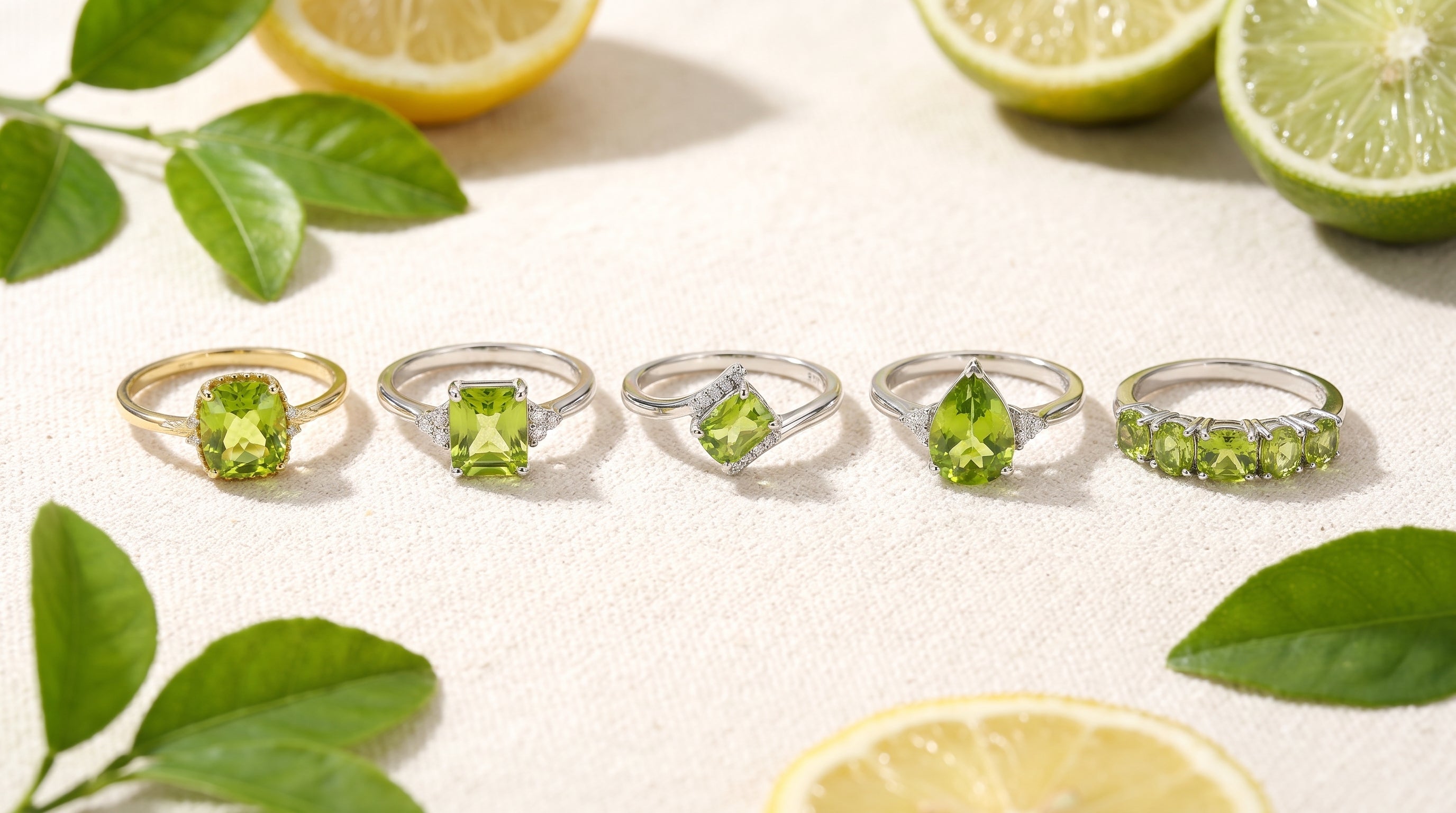
Peridot registers 6.5 to 7 on the Mohs hardness scale with fair to good toughness, according to the Gemological Institute of America. That single line of gemology shapes more of this purchase than any product photo will. It explains why a protective setting outperforms a high, exposed one; why ultrasonic and steam cleaners are off the table; and why one long-running wedding-ring resource argues against pairing peridot with white gold for a ring you intend to wear for decades. A peridot ring in silver sidesteps several of those problems by default, which is a large part of why sterling silver is so common in this category. Below is the full decision path: stone first, metal second, setting and care third, with the exact wording to look for on a listing before you check out.
Start With the Stone, Not the Setting
Peridot is the gem-quality variety of olivine, a magnesium iron silicate. Unlike sapphire or tourmaline, it comes in only one color family: green. Hues run from pale yellow-green through vivid grass green to deep olive, and the difference between a lively stone and a dull one is almost entirely a matter of hue, saturation, and how well the stone was cut. Peridot is also the widely recognized traditional birthstone for August, which is why so much of the category is merchandised around birthdays and gifting.
Traditional lore attaches peace, harmony, and protection to peridot. Those are cultural and marketing associations rather than tested properties, and it is worth treating them that way — they are a lovely reason to choose the stone, not a reason to overpay for it.
What 6.5–7 Mohs Actually Means in Daily Wear
Hardness measures scratch resistance; toughness measures resistance to chipping and fracturing. Peridot's combination — moderate hardness, fair to good toughness — puts it comfortably in the "wearable jewelry" tier while ruling out carelessness. Everyday household dust contains quartz, which sits around 7 on the Mohs scale, so a peridot worn constantly and cleaned rarely can accumulate fine surface abrasion over years. Hard knocks against door frames, gym equipment, or kitchen counters carry a genuine chip risk at the girdle and along facet edges.
The practical takeaway is not "avoid peridot." It is that setting style, wearing habits, and cleaning method matter more for peridot than they would for a sapphire ring. Every recommendation later in this guide flows from that.
Natural, Treated, or Simulated? Decode the Listing First
Before comparing prices across two silver peridot rings, confirm you are comparing the same category of stone. Three distinct things get sold under the word "peridot."
- Natural, untreated peridot. Mined olivine, cut and polished, with no enhancement that alters color or clarity. Jewelry educators consistently recommend buying from sellers who state explicitly that the stone is natural and untreated, particularly for milestone pieces.
- Enhanced or treated peridot. Some material receives treatments that should be disclosed; specialist guidance notes enhancement labeling using letters such as E, O, or F depending on the process. Treated stones typically demand stricter care — no ultrasonic cleaning, no chemical baths, no sudden temperature swings.
- Simulated peridot. A man-made or substitute material cut to mimic peridot's color. Awareness Avenue's own August birthstone collection is described this way, and the Peridelle design is specified with precision-cut A5 simulated peridot. Simulants are a legitimate choice for color-driven fashion jewelry, but they are not gemologically the same as mined peridot and should never be priced or represented as such.
None of these is inherently the "right" answer. If you want the gemstone itself — its origin story, its birthstone significance, its resale identity — buy natural. If you want the exact yellow-green against silver for a stacking ring or a gift, a clearly labeled simulant delivers consistent color at an accessible level. What matters is that the listing tells you which one you are getting, in plain language, before you buy.
Questions Worth Sending to a Seller
- Is the stone natural, treated, or simulated? If treated, what treatment and what care restrictions follow?
- Is there a certificate or appraisal, and who issued it? For rings with diamond accents, specialist guidance points to reports from recognized laboratories such as GIA, AGS, EGL, or IGI.
- What are the stone's measurements in millimeters, not just carat weight?
- What is the exact metal specification — solid sterling silver, plated base metal, or vermeil?
- What is the return window, and does it cover resizing?
Judging Quality: Color, Clarity, Cut, and Carat
Color
Peridot's most prized appearance is a strong, pure green — often described as a deep lily green or a vivid yellow-green — with minimal brown or muddy undertones. Pale, washed-out stones and olive stones with brown secondary flashes sit lower on the desirability scale. Because peridot has only one hue family, saturation does the heavy lifting: a smaller stone with punchy color will read better on the hand than a larger, weaker one.
Judge color in more than one light. Photograph lighting flatters green heavily. If a seller only shows the stone under a single bright studio light, ask for a shot in daylight or ordinary indoor light.
Clarity
The working standard is eye-clean: no inclusions visible to the unaided eye at normal viewing distance. Peridot can contain disc-shaped inclusions sometimes called "lily pads," along with mineral crystals; when they are prominent, they scatter light and flatten the stone's sparkle. Minor inclusions that you cannot see without magnification are normal and are not a reason to reject a stone.
Cut
Cut quality is where the biggest visible differences in this category live, and it is also where a lot of inexpensive peridot falls down. Poorly proportioned stones look glassy and flat; well-cut ones return light evenly across the table and deepen the apparent color. Oval, pear, round, and cushion shapes are the most common in peridot, and each behaves slightly differently — elongated shapes such as pear and oval read larger for their weight, while cushion and round cuts tend to concentrate color.
Look for even light return across the whole face of the stone, not a bright rim with a dead "window" in the middle.
Carat Weight and Proportion
Peridot is available in larger sizes more readily than many colored stones, which makes bold cocktail styles achievable. That accessibility can be a trap: a large stone with weak color and a mediocre cut is a downgrade, not an upgrade. Match carat weight to your hand and to the setting's proportions, and prioritize color and cut over sheer size within your budget. Note also that price per carat is not linear — quality tiers and larger sizes both push cost up steeply, and quoted per-carat figures vary widely between sources and over time, so treat any single number you see online as indicative only.
Why Sterling Silver Works Well With Peridot
What "925" Means
Sterling silver is an alloy of 92.5% silver with the remainder usually copper, hallmarked as 925 or S925. It is the standard for quality silver jewelry and the material behind most of the pieces you will find searching for a peridot ring in silver. Awareness Avenue's silver rings — including The Peridore Pear, The Perisara Row, and The Sidraea Octagon Ring — are specified in S925 sterling silver. Anything described only as "silver-tone," "silver plated," or "silver finish" is a different product entirely; confirm the 925 mark.
The Look
Silver's cool, neutral white throws peridot's yellow-green forward rather than blending into it. Against yellow gold, peridot reads warm, golden, and vintage; against silver, the same stone reads crisper, greener, and more contemporary. Neither is better — they are two different rings. If you want the green itself to be the loudest element, silver is the more effective frame.
Maintenance: Tarnish, and Why It Is the Easier Problem
Sterling silver tarnishes. That is chemistry, not a defect, and it is reversible with a soft polishing cloth used carefully around the stone. The important comparison is what each metal's upkeep does to the gem. Silver is maintained by polishing and gentle cleaning. White gold is typically maintained by re-plating with rhodium, a process involving chemical baths and, in some workshops, heat — both of which peridot tolerates poorly. In other words, the maintenance routine silver asks for is far gentler on a peridot than the routine white gold asks for.
Where Silver Has Limits
Silver is softer than most gold alloys and will show fine scratches and dings on the band sooner. Prongs in silver benefit from an annual check by a jeweler if you wear the ring daily. And silver does not carry the intrinsic material value of solid gold, so it is generally the wrong choice if resale or heirloom metal value is a stated goal. If you are weighing that trade-off in detail, our comparison of sterling silver versus white gold ring settings covers the same metal decision from the durability and finish angle.
Silver vs. Gold vs. White Gold for a Peridot Ring
| Metal | Effect on peridot's color | Routine upkeep | Best suited to |
|---|---|---|---|
| Sterling silver (925) | Cool contrast; green reads crisp and modern | Polishing to remove tarnish | Everyday, stacking, birthstone and gift rings |
| Yellow gold (incl. 14k) | Warm harmony; amplifies peridot's golden undertone | Occasional polishing | Vintage-leaning styles, heirloom intent |
| Rose gold | Blush contrast against green; distinctive | Occasional polishing | Buyers wanting an unusual pairing |
| White gold | Bright, neutral, platinum-like | Periodic rhodium re-plating | Occasional-wear pieces, with care caveats below |
| Gold vermeil | Gold tone over a sterling base | Gentle cleaning; avoid abrasives on the plating | Gold look at a silver-based level |
Yellow and Rose Gold
Yellow gold is the classic partner for peridot because the metal's warmth runs in the same direction as the stone's yellow undertone, producing a mellow, antique effect. Rose gold pushes the opposite way, setting a pink-toned metal against green for a higher-contrast, more unexpected result. Both are maintained by polishing rather than plating, which is why lifetime-wear guidance tends to favor them alongside silver, palladium, and platinum. For a broader read on tone, see our breakdown of yellow gold versus white gold rings.
14k Gold
Solid 14k gold is the workhorse specification across fine-jewelry peridot collections, and it appears constantly in searches for a peridot ring in 14k gold. It carries real precious-metal content while its alloy composition makes it harder and more wear-resistant than higher-karat gold, which suits a ring that will be worn often. Expect a meaningful step up in cost from silver, and expect that step to be driven by the metal as much as by the stone.
White Gold and the Rhodium Plating Issue
White gold peridot rings are widely sold and genuinely attractive — the cool metal keeps the green looking clean and modern. But there is a documented caution worth taking seriously. Guidance from Everything-Wedding-Rings notes that white gold rings typically need a fresh rhodium application roughly every one to two years, and that within three to five years repeated rhodium plating can severely damage a peridot set in white gold. That is consistent with GIA's warning that peridot is sensitive to heat, chemicals, and abrupt temperature change.
How to act on this: if you want a white gold peridot ring for occasional wear, discuss with your jeweler whether the stone can be removed before plating, or accept a slightly warmer, unplated white gold finish and skip re-plating altogether. If the ring is meant to be worn daily for decades — an engagement ring or wedding band — the safer route is a metal that does not depend on plating at all: sterling silver, yellow gold, rose gold, palladium, or platinum.
Gold Vermeil
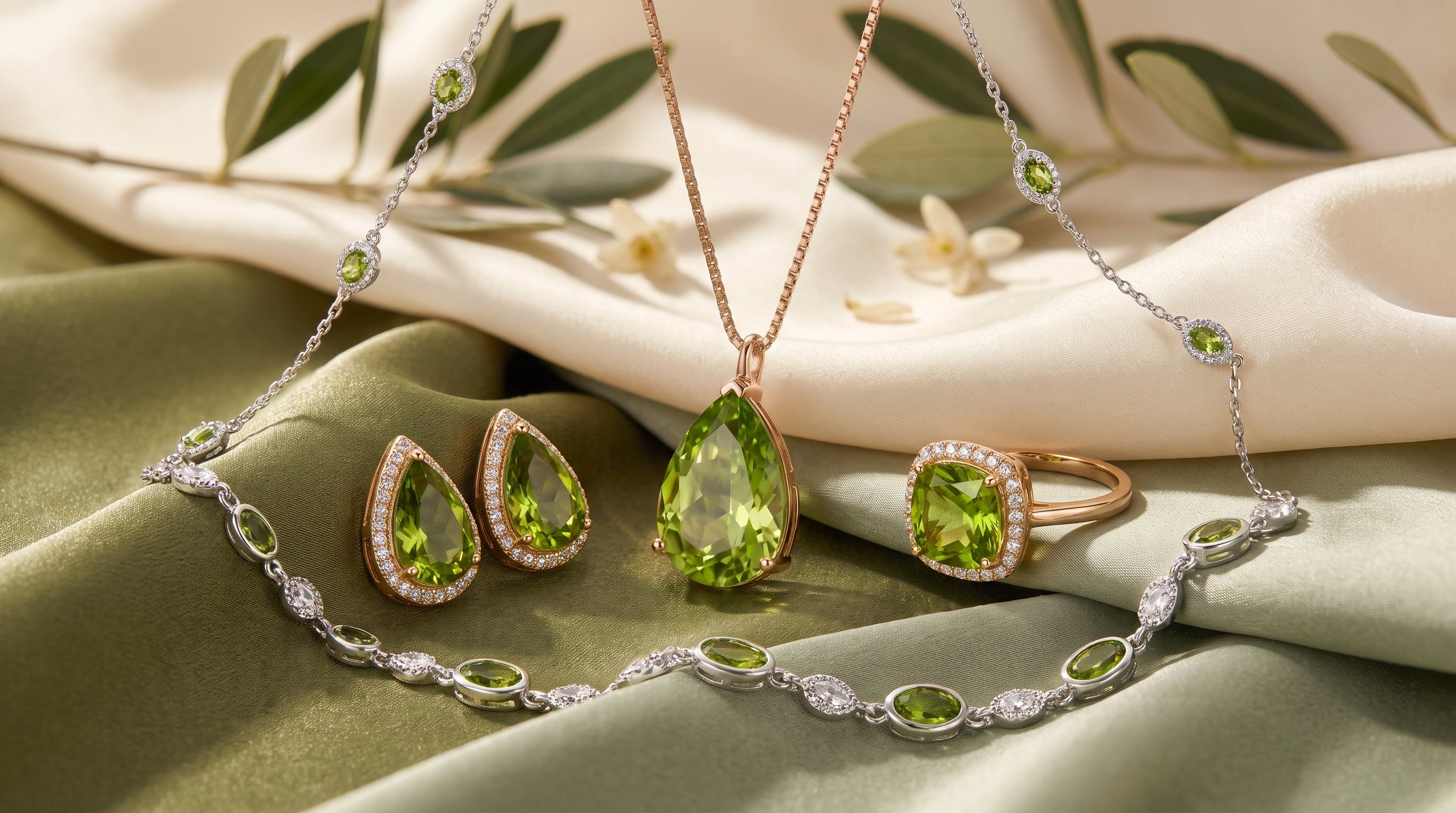
Vermeil is a gold layer over a sterling silver base, which gives you a gold appearance on a silver foundation. Awareness Avenue offers this route in pieces such as The Peridina Teardrop and The Azurina Cushion Ring. Treat vermeil as a finish decision rather than a solid-gold substitute: clean it gently, keep it away from abrasives and harsh chemicals, and expect the surface to need care over time.
Style, Occasion, and Shopping for Women's Peridot Rings
Everyday and Stacking
Slim silver bands with a small, well-cut peridot are the most forgiving format for regular wear: low profile, less to catch, easy to layer with other rings. A bezel or half-bezel adds a metal rim around the girdle, which is the single most useful protective feature you can specify for a stone in peridot's hardness range.
Statement and Cocktail
Peridot's availability in larger sizes makes it a natural for cocktail rings, halos, and bold solitaires. These sit higher on the finger and are more exposed, so they are better suited to evening and occasional wear than to typing, gardening, and gym days.
What "Peridot Rings for Women" Usually Signals
Retailers segment heavily by wearer, and searches for a peridot ring for women typically surface narrower bands, softer motifs, halo and cluster designs, and smaller finger-size ranges. That is a merchandising convention, not a gemological rule — the same stone and setting suit anyone who likes them. Use the label as a shortcut to a style aesthetic and a size range, then judge each ring on stone quality and construction.
Engagement and Wedding Rings
Peridot engagement rings exist and are sold by mainstream jewelers, but they ask for informed consent from the wearer. Specialist guidance is consistent on three points: choose natural, unenhanced stones for lifetime pieces; avoid white gold because of the plating cycle; and have an independent jeweler assess stone quality and cut before committing, since a great deal of poorly cut, weakly colored peridot circulates at low prices. A protective setting and a willingness to remove the ring for manual work do the rest. If you are cross-shopping harder alternatives, our guide to moissanite in gold versus silver settings covers the same metal logic with a far harder center stone.
Settings, Prongs, and Sizing
Setting choice does real work here. Bezels and half-bezels shield the girdle, where chips usually start. Four- and six-prong settings show more of the stone and let in more light but leave the edges exposed; if you choose prongs, ask for slightly heavier prongs and have them inspected annually, especially in silver. Halo designs surround the peridot with small accent stones, which adds sparkle and a degree of physical buffering, though the accents themselves are usually harder and can abrade the peridot if the ring is stored loose against other jewelry.
On sizing: order-and-resize is riskier with a colored-stone ring than with a plain band, because heat used during resizing is exactly what peridot dislikes. Get sized properly before you buy — measure at the end of the day when fingers are largest, and measure at room temperature, not after cold weather or exercise. Confirm the seller's resizing policy and whether the stone would need to be removed first.
Care That Keeps a Silver Peridot Ring Looking New
The care protocol is short and consistent across gemological and retail sources:
- Clean with warm — not hot — soapy water and a soft brush or cloth, then rinse and dry thoroughly.
- Skip ultrasonic and steam cleaners. Both are considered unsafe for peridot, and the risk rises sharply if the stone is included, fractured, or treated.
- Avoid harsh chemicals and acidic cleaners entirely, including household cleaning products and pool chemicals. Remove the ring before swimming in chlorinated water.
- Avoid sudden temperature changes, which stress the stone.
- Store the ring separately in a fabric-lined box or a soft pouch. Diamonds, sapphires, and even other silver pieces will scratch peridot if they share a compartment. Separate storage also slows tarnish on the silver.
- Polish silver gently with a dedicated silver cloth, working on the metal and keeping abrasive polish away from the stone and the setting seat.
- Book a periodic professional check — once or twice a year is a reasonable rhythm for a daily-wear ring — to confirm prongs are tight and the stone has not loosened.
Pre-Purchase Checklist
- The metal is stated explicitly: S925 sterling silver, solid 14k gold, or vermeil — not "silver-tone."
- The stone is stated explicitly: natural, treated (with the treatment named), or simulated.
- Stone measurements in millimeters are provided, alongside carat weight.
- The green reads saturated and even in at least one non-studio photo, with no obvious dead center window.
- The stone appears eye-clean in close-up images.
- The setting suits your wear pattern: bezel or low-profile for daily, higher settings for occasional wear.
- You have your size confirmed, and you know the resizing and return policy.
- If it is white gold, you have a plan for the rhodium re-plating cycle — or you have chosen a plating-free metal instead.
- For engagement or heirloom purchases, an independent assessment or certificate is available.
Work through that list and the two most common regrets in this category — a dull, poorly cut stone, and a metal whose maintenance routine quietly damages the gem — both disappear. If you are starting from a silver-first shortlist, browse the birthstone jewelry range and compare bezel, halo, and solitaire silhouettes side by side before you narrow on stone size; the setting decision is the one you cannot easily change later.

Leave a comment
This site is protected by hCaptcha and the hCaptcha Privacy Policy and Terms of Service apply.