
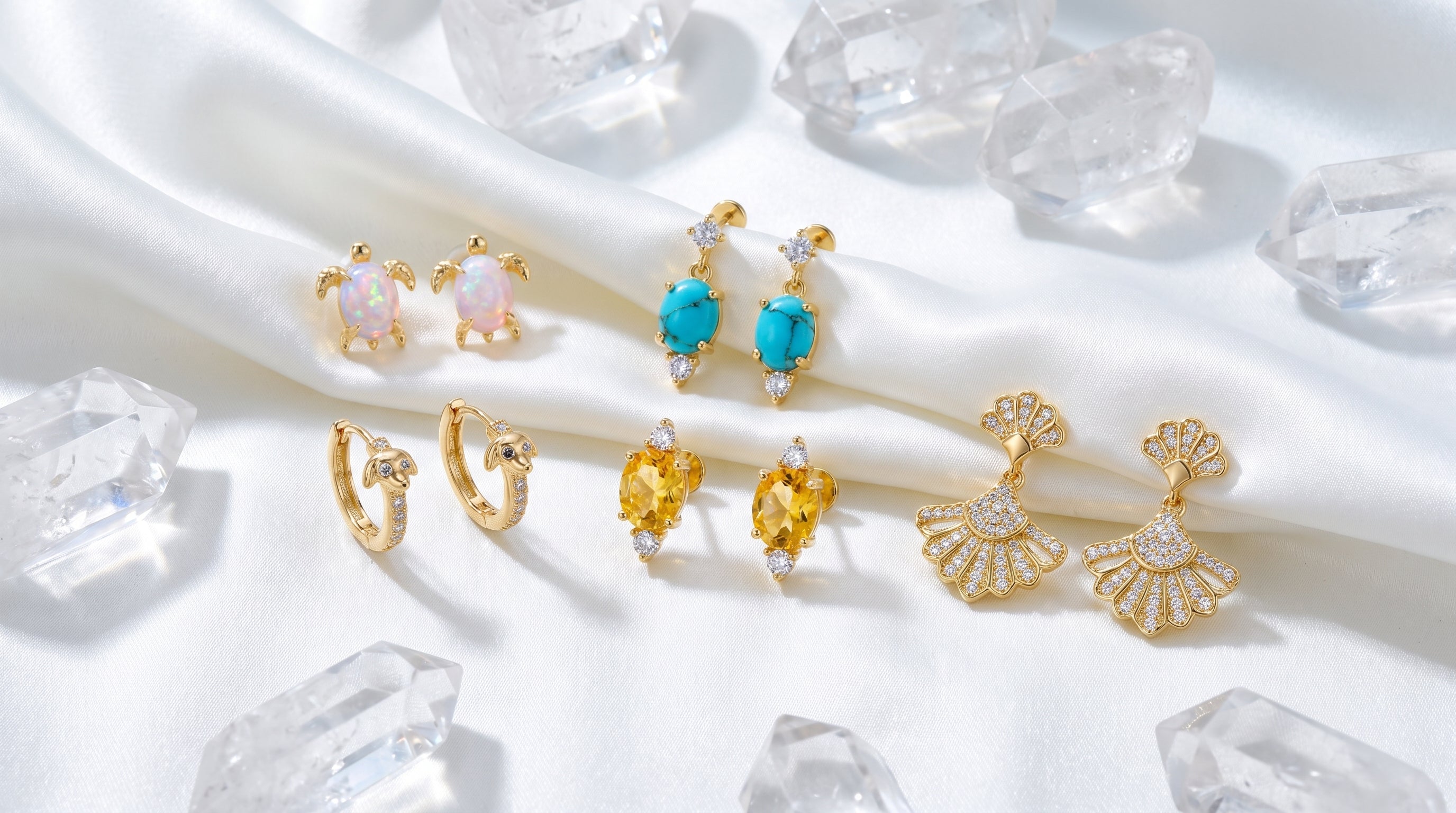
A flat back earring is defined by its hardware, not its sparkle. The back is a smooth, disk-shaped piece that sits flush against the skin behind the piercing, and the post is usually threaded through from the back of the ear so the decorative front fastens from the outside. The same category circulates under at least half a dozen names — push-pin studs, threadless studs, press-fit studs, labret studs, and “nap earrings” — which is a large part of why shopping for the best flat back earrings feels harder than it should.
Search results for this term are almost entirely brand collection pages. Each one declares its own flat back earrings the most comfortable and the most hypoallergenic, and very few publish the two specifications that actually determine whether a pair will work in your ear: the alloy and the gauge. This guide inverts that. Instead of naming a single winner, it lays out the decision criteria that separate a good purchase from a returned one, shows which brands publish enough detail to be evaluated, and states plainly where a claim is marketing language rather than verified fact.
What Makes a Flat Back Earring Different (and Why the Name Varies)
The mechanical difference is simple: a traditional butterfly clutch, hook, or screw-on ball protrudes behind the ear, while a flat back presents a flush disk. Brand descriptions across the category converge on the same language — the back “sits flush against the ear” and removes the pressure point a conventional post creates. Educational content from Made by Mary makes the practical consequence explicit: many people find they can sleep in flat back studs precisely because that pressure point behind the ear is gone.
What the sources do not provide is any mechanical or clinical measurement of that benefit. There is no published pressure-distribution data, no sleep-quality study, and no ergonomic testing behind phrases like “eliminates pressure points.” Comfort here is a widely reported user experience and a consistent brand claim — not a quantified outcome. Treat it as the former when you compare options.
Push-pin and press-fit (threadless)
A threadless or push-pin system uses a hollow post and a decorative front with a small pin. The pin is bent slightly and pressed into the post, and tension holds the piece in place. Instructional guidance for beginners covers exactly this: the amount of bend determines how firmly the front seats. Threadless systems are common in modern studios because the same back can carry many different fronts, and because there are no threads to catch inside a healing channel.
Screw-on and internally threaded
Screw-on flat backs use a threaded post with a front that screws down from the outside. Made by Mary describes its 14k bead flat back stud this way — a smooth flat back inserted through the back of the piercing, with the top screwing in for a secure fit intended for 24/7 wear. Linny Co likewise builds its collection around screwback flat back studs, marketed as secure and suitable for sleeping in. The trade-off is maintenance: threaded fronts should be checked periodically, since anything that screws on can loosen.
Externally threaded labret
With Bling's labret range includes externally threaded labrets, where the thread sits on the outside of the post. This style is common in fashion jewelry and is worth knowing about because the exposed thread passes through the piercing channel. Threadless and internally threaded designs are generally preferred by piercers for that reason, particularly in anything recently pierced or irritated.
The Five Criteria That Decide Which Flat Back Earrings Are Best for You
1. Alloy, stated by name
“Hypoallergenic” on a product page is a marketing descriptor, not a regulated certification. The American Academy of Dermatology is direct on this point: nickel allergy is a common cause of allergic contact dermatitis, and wearing nickel-containing jewelry is one of the most common ways people develop it, with earrings and earring backs among the main culprits. The AAD's advice is to choose jewelry that is nickel-free or hypoallergenic, or made from surgical-grade stainless steel, high-karat yellow gold (18-, 22-, or 24-karat), pure sterling silver, or platinum. If a listing won't name the metal, you cannot apply that advice to it.
2. Gauge
Gauge is post thickness, and it has to match your piercing. BodyCandy merchandises an entire 20G flat back earrings category aimed at lobes; With Bling lists 18G (1.0 mm) and 16G (1.2 mm) labrets, which are typical cartilage thicknesses. Buying a gauge finer than your piercing lets the channel shrink; buying one thicker forces it. This single number causes more fit problems than any design choice.
3. Post length relative to your ear
None of the collection pages surveyed publish post-length guidance, yet it matters as much as gauge. A post that is too short leaves the flat disk pressing hard into the back of the lobe; too long, and the front sits away from the skin and rocks. If you are unsure, a piercer can measure it — and the same visit answers whether your anatomy suits the front size you want.
4. Front size and visual weight
Front dimensions are usually what brands mean by “size.” Cords Club lists flat back studs at 2 mm, 3 mm, 4 mm, and 5 mm for delicate everyday wear. Estella Collection runs larger, offering 5 mm, 6.5 mm, 8 mm, and 10 mm options across lobes and cartilage. A 2 mm bezel and a 10 mm cluster are the same category of jewelry and completely different pieces on the ear.
5. The wear pattern you actually have
Semi-permanent wear is the use case flat backs were built for. If you take earrings out nightly, a threadless system offers little advantage and adds fiddliness. If you leave jewelry in for weeks, want to sleep and shower in it, and hate snagging, the flush back is the point. Be honest about which you are before paying a premium for the mechanism.
Materials for Flat Back Earrings, Weighed Against the Evidence
Titanium flat back earrings
Titanium is the most heavily promoted material in this category, and the brands that specify a grade are the ones worth shortlisting. Grayling Jewelry states its titanium pieces are crafted in F-136 implant-grade titanium, describing it as one of the most biocompatible metals available, comfortable, extremely durable, non-corroding, and naturally nickel-free. Maison Miru describes its cartilage and flat back earrings as medical-grade titanium (ASTM F136), hypoallergenic and nickel-free, and states they are safe for new and healing piercings. Get Pierced Co positions its flat back titanium studs as “piercer-grade” and piercer-approved.
Two honest caveats. First, all of the above are first-party specifications, not independent test results; no third-party lab reports or regulatory clearances appear in the public material. Second, the AAD's own list of safer metals does not name titanium, so anyone claiming dermatologist endorsement of titanium specifically is overreaching. What can fairly be said: implant- and medical-grade titanium are standard materials in professional piercing, brands that name the grade are being more transparent than those that don't, and titanium flat back earrings are the most commonly recommended starting point for flat back earrings for sensitive ears.
Flat back earrings in 14k gold
Solid gold is the premium end of the category. Estella Collection offers flat back studs and cartilage earrings in solid 14k yellow, rose, and white gold, with flush-fitting backs designed to avoid snags. Made by Mary's 14k bead flat back stud is a petite solid gold piece with a smooth flat back and a screw-in front. Impuria spans the middle, listing flat back studs in titanium, 14k gold, and 316L surgical stainless steel.
Here the nickel question gets more nuanced than most marketing admits. The AAD specifically recommends high-karat yellow gold at 18, 22, or 24 karat — not 14k. Lower-karat alloys contain more base metal, and white gold in particular can use nickel as a whitening agent unless the maker states otherwise. None of the 14k listings surveyed publish an alloy breakdown. Solid 14k gold flat back earrings are a durable, beautiful choice, and many nickel-sensitive wearers do fine in them, but if you have a confirmed nickel allergy, ask the brand directly whether the alloy is nickel-free rather than assuming that “solid gold” settles the question.
Surgical stainless steel
316L surgical stainless steel is a long-standing body jewelry alloy, and the AAD lists surgical-grade stainless steel among safer options. It does not name 316L specifically, and nickel-release behavior varies between steel alloys, so “surgical steel” is a reasonable choice for many people rather than a guarantee for everyone.
Who the Major Flat Back Brands Actually Serve
The table below summarizes only what each brand publishes about itself. Comfort, security, and hypoallergenic claims are the brands' own; treat them as positioning, not as tested performance.
| Brand | Published specifics | Best suited to |
|---|---|---|
| Grayling Jewelry | F-136 implant-grade titanium and 14k gold; collection built around sensitive skin and nickel allergy | Buyers who want a named titanium grade |
| Maison Miru | Medical-grade titanium (ASTM F136); nickel-free; stated as safe for new and healing piercings | New or healing piercings, curated ear projects |
| Get Pierced Co | “Piercer-grade” flat back titanium studs, custom designed and piercer-approved | Studio-style aesthetics; ask for gauge before ordering |
| Estella Collection | Solid 14k yellow, rose, white gold; flush-fitting backs; 5–10 mm fronts | Fine jewelry buyers wanting statement fronts |
| Made by Mary | Solid 14k gold bead stud; smooth flat back, screw-in front for 24/7 wear; educational blog content | Minimalists who want to understand the mechanism first |
| Impuria | Titanium, 14k gold, and 316L surgical steel flat back studs for cartilage | Shoppers comparing materials in one place |
| Linny Co | Micro screwback flat back studs; marketed as waterproof and sleep-in | Screw-on preference; alloy not stated |
| ComfyEarrings | Lightweight, hypoallergenic, multiple sizes | Comfort-led shoppers; request material details |
| BodyCandy | Dedicated 20G flat back earrings for lobes | Standard healed lobes needing a fine gauge |
| With Bling | 18G and 16G labrets, including externally threaded styles | Cartilage placements where gauge must match |
| Cords Club | 2 mm, 3 mm, 4 mm, 5 mm flat back studs | Delicate, layered everyday looks |
| J&CO Jewellery | Flat back labret studs in 4-prong, 6-prong, baguette and ball designs | Design variety across lobes and cartilage |
Read that table as a map of transparency rather than a ranking of quality. The brands at the top publish an alloy standard you can act on; those lower down publish sizes and styling but leave you to ask about metal. Neither group has provided independent verification of comfort or allergy outcomes.
Matching Flat Back Earrings to Common Buying Scenarios
If you have reactive or newly pierced ears
Prioritize a stated titanium grade — F-136 or ASTM F136 — and a threadless or internally threaded post. Grayling and Maison Miru are the two brands in this landscape that name the standard outright. If a rash blisters, becomes infected, or keeps coming back, the AAD's advice is to see a board-certified dermatologist rather than working through it by trial and error with new jewelry.
If you mainly want flat back earrings for lobes you can sleep in
Confirm the gauge first — 20G collections exist specifically for standard lobes — then keep the front small enough that it doesn't lever against a pillow. Our companion guide to flat back earrings for lobes goes deeper on lobe-specific sizing and placement.
If you're building a curated ear
Cartilage placements typically use thicker gauges than lobes, so a single “set” rarely fits every hole you own. Buying compatible fronts and backs in the same system is what makes an ear stack workable; our guide to building flat back earring sets covers how to assemble one that genuinely fits rather than one that merely matches.
If you want fine jewelry rather than body jewelry
Solid 14k gold flat back studs from brands that specify karat and color are the closest fit, with the alloy caveat above. If you are coordinating flat backs with the rest of your jewelry, our overview of 14k gold jewelry sets is a useful companion for tone-matching yellow, rose, and white metals across pieces.
Installing and Living With Flat Back Earrings
The single most useful piece of practical guidance in the public material is also the least glamorous: don't install or remove flat back earrings over a sink. Threadless pins and small fronts are easy to drop, and a drain is unforgiving. Work over a towel or a closed surface.
Beyond that, a few habits reduce most complaints:
- Understand your mechanism before the first attempt. A push-pin front seats by tension and needs a slight bend; a screw-on front needs to be turned down snug. Applying the wrong technique to the wrong system is the usual cause of “it won't stay in.”
- Check threaded fronts periodically. Anything that screws can back off with wear, and no brand in this space publishes loss-rate data to reassure you otherwise.
- Clean around the disk, not just the front. A flush back has a broad contact area against the skin, which is comfortable but also means it should be cleaned as thoroughly as the visible side.
- Ask a piercer if insertion is difficult. Beginner guidance points people to a local piercer when a flat back won't seat — often a post-length or angle issue rather than a faulty product.
- Read water claims as brand claims. Some brands market their flat backs as waterproof and suitable for swimming. No corrosion or wear testing accompanies those statements, so if you swim daily in chlorinated water, expect to make your own judgment.
Where Awareness Avenue Fits — Stated Plainly
Most of the earring styles in our current collection — drops, hoops, gemstone and moissanite studs, and bezel studs such as The Amara in 18K gold vermeil — are conventional stud and hoop constructions. We are not going to relabel them as flat back earrings to fit this article. Anyone shopping specifically for a flush, flat-disk back deserves that distinction to be honest, because back type is the entire reason you searched for this category.
We do produce flat back earrings: our Celestial Trio Earrings are described on their product page as three-stone flat back earrings crafted for 24/7 comfort, backed by a lifetime warranty and 14-day returns. Those policy terms are stated for that product and should be confirmed per item rather than assumed across the catalog.
If you are here for design rather than hardware — a gemstone stud, a solid gold pair, an everyday hoop — the full earrings collection and our solid gold pieces are the better starting points, including options such as The Aestria Heart Aquamarine Earrings in solid gold. If you specifically need a flush back for a healing piercing or for sleeping, buy from a range that publishes its gauge and its alloy grade, whether that's ours or another maker's.
Frequently Asked Questions
Can you sleep in flat back earrings?
Comfortable sleep is the benefit most often cited for this design, and educational content from Made by Mary answers yes — many wearers find that the flush back removes the pressure point a traditional post creates behind the ear. That is reported experience and brand positioning, not a clinically measured result, and comfort still depends on your post length and the size of the front.
Are flat back earrings good for sensitive ears?
They can be, largely because the category is dominated by titanium, surgical steel, and solid gold rather than mixed base-metal alloys. The determining factor is the metal, not the back shape. The AAD advises nickel-free or hypoallergenic jewelry, or surgical-grade stainless steel, high-karat yellow gold, pure sterling silver, or platinum — and notes that a hypoallergenic label reduces the likelihood of a reaction without eliminating it.
Do flat back earrings work in cartilage as well as lobes?
Yes — brands market them for helix, tragus, conch and other cartilage placements alongside lobes, which is why the same product is often called a labret stud. The practical difference is gauge: lobe-focused ranges commonly run 20G, while cartilage jewelry is typically 18G or 16G.
What size flat back stud should I choose?
Front diameters in this category run from roughly 2 mm at the delicate end up to 10 mm for statement cartilage and lobe pieces. Smaller fronts suit stacked and multi-piercing looks and sleep-in wear; larger fronts read as a focal point. Size in millimeters usually refers to the visible front, not the post.
Is threadless better than screw-on?
Neither is universally better. Threadless posts swap fronts easily and keep threads out of the piercing channel; screw-on fronts lock down positively but should be checked for tightness. Externally threaded labrets are the least favored for anything healing, because the thread passes through the channel. No published failure-rate data exists for any of the three, so choose based on how often you change jewelry and how confident you are handling small parts.
Are 14k gold flat back earrings nickel-free?
Not automatically. The AAD's gold recommendation is for 18-, 22-, or 24-karat yellow gold, and white gold can contain nickel as a whitening agent unless the maker states otherwise. If you have a diagnosed nickel allergy, ask the brand for the alloy composition of the specific piece rather than inferring it from “solid gold.”
The Short Version
The best flat back earrings for you are the pair whose alloy, gauge, post length, and front size are all published or answerable — and whose back mechanism matches how often you actually change your jewelry. Brands that name a titanium standard or a gold karat and color give you something to verify; brands that lead with “hypoallergenic” and nothing else are asking for trust they haven't documented. Comfort claims in this category are consistent and plausible but unmeasured, so weight them accordingly, and take allergy questions to a board-certified dermatologist rather than to a product description.

Dejar un comentario
Este sitio está protegido por hCaptcha y se aplican la Política de privacidad de hCaptcha y los Términos del servicio.