


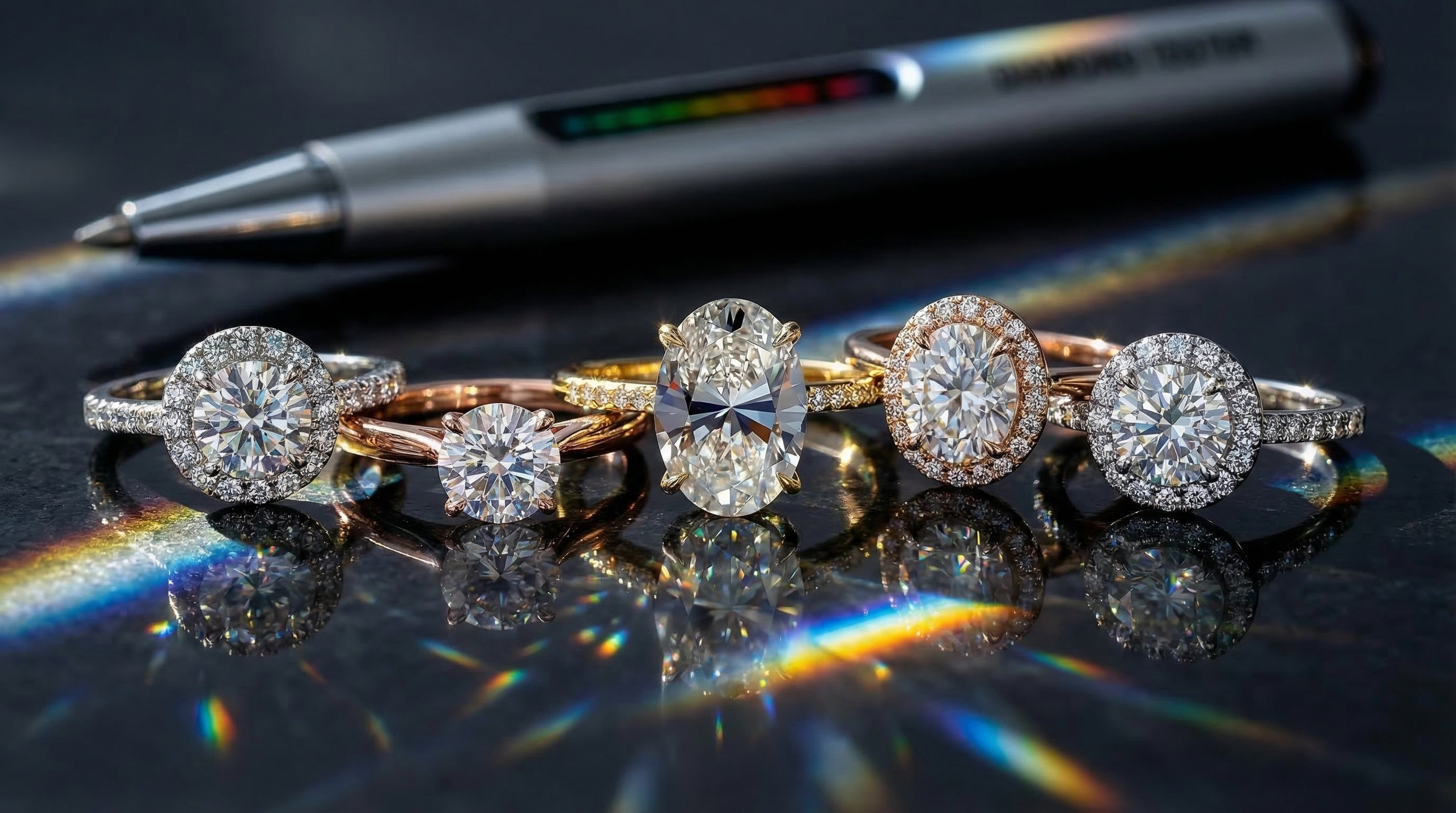
Voici la question qu’on nous pose plus que toute autre : la moissanite passe-t-elle les testeurs de diamant ? La réponse courte est oui — et comprendre exactement pourquoi changera à jamais votre perception de la moissanite. Les testeurs thermiques standards lisent la moissanite comme un diamant parce que les deux pierres conduisent la chaleur à des vitesses presque identiques. Ce simple fait a déconcerté les bijoutiers, surpris les acheteurs et suscité d’innombrables débats. Mettons tout cela au clair.

L’essor de la moissanite a fondamentalement changé la façon dont les gens achètent des bagues de fiançailles. Il y a des décennies, vous aviez très peu d’options offrant une durabilité authentique et un éclat époustouflant sans un prix exorbitant. Aujourd’hui, la moissanite s’impose fièrement par ses propres mérites. Mais les rumeurs persistantes selon lesquelles elle « tromperait » les bijoutiers et passerait les tests standards continuent de semer la confusion. Nous allons expliquer exactement pourquoi cela se produit, la science derrière ces pierres, et comment vous pouvez acheter en toute confiance.
La moissanite passe-t-elle un testeur de diamant ? La réponse courte
Oui, la moissanite passe les testeurs thermiques standards pour diamants. Parce que la moissanite conduit la chaleur à une vitesse presque identique à celle d’un diamant naturel, les testeurs thermiques basiques la lisent comme un diamant. Cependant, les testeurs avancés à double mesure, qui évaluent la conductivité électrique, peuvent facilement distinguer les deux pierres avec une précision totale.
Ce « oui » surprend souvent les gens. Comment une pierre coûtant une fraction du prix d’un diamant peut-elle déclencher un appareil conçu pour identifier les diamants ? La réponse ne réside pas dans une tromperie de la moissanite, mais dans les limites fondamentales de l’équipement de test lui-même. Lorsqu’un testeur standard émet un bip et s’allume en vert, il ne confirme pas la composition chimique de la pierre. Il ne confirme qu’une seule propriété physique spécifique.
Comprendre cette distinction est important pour toute personne achetant des bijoux de qualité. Des vendeurs peu scrupuleux ont utilisé des testeurs basiques pour convaincre des acheteurs non avertis qu'une pierre de moissanite était en réalité un diamant naturel, facturant des milliers d'euros de plus que la valeur réelle de la pierre. Savoir comment ces appareils fonctionnent vous protège des arnaques — et vous permet d’apprécier véritablement ce qu’est la moissanite.
Comment fonctionnent réellement les testeurs de diamant
Les testeurs de diamant fonctionnent en mesurant la conductivité thermique — la vitesse à laquelle la chaleur se déplace à travers une pierre. Les diamants transfèrent la chaleur à une vitesse extraordinaire. Le testeur envoie une petite impulsion de chaleur dans la pierre et mesure la vitesse de dissipation pour déclencher un résultat positif. La plupart des autres pierres précieuses échouent immédiatement à ce test.
Imaginez un testeur de diamant traditionnel : un petit appareil en forme de stylo avec une pointe en cuivre. Lorsqu'un bijoutier le presse contre une facette d'une pierre précieuse, l'appareil génère une infime quantité de chaleur. Des capteurs internes calculent alors exactement la rapidité avec laquelle cette chaleur se propage de la pointe vers la pierre.
Les diamants naturels sont parmi les conducteurs thermiques les plus efficaces sur la planète. Ils évacuent la chaleur de la sonde presque instantanément. La plupart des simulants — zircone cubique, saphir blanc, verre — sont des isolants thermiques. Ils retiennent la chaleur. Le testeur est calibré pour reconnaître cette chute rapide de la chaleur. La chaleur disparaît rapidement ? Diamant. La chaleur persiste ? Simulant.
Pendant des décennies, cette méthode était infaillible. Puis, à la fin des années 1990, la moissanite synthétique est arrivée sur le marché commercial et l’industrie de la joaillerie a connu un véritable choc technologique. Soudain, il y avait une pierre qui transférait la chaleur aussi efficacement qu’un diamant, rendant le testeur thermique standard obsolète pour les différencier.
Moissanite vs Diamant : Pourquoi le testeur se trompe
Dans la comparaison moissanite vs diamant, les deux pierres partagent une conductivité thermique exceptionnellement élevée. La moissanite est du carbure de silicium ; le diamant est du carbone pur. Comme leurs taux de transfert de chaleur sont presque identiques, un testeur thermique basique ne peut pas les distinguer — c’est une limitation de la machine, pas un défaut de la pierre.
Pour comprendre pourquoi elles réagissent de manière si similaire sous une sonde thermique, il faut examiner leurs structures atomiques. Les diamants sont des atomes de carbone pur arrangés en un réseau cristallin rigide et fortement lié — cette structure rend les diamants si durs et permet à la chaleur de circuler sans résistance. La moissanite, découverte à l’origine dans un cratère de météorite par le chimiste français Henri Moissan, est composée de carbure de silicium. Ses liaisons atomiques sont remarquablement similaires aux liaisons covalentes que l’on trouve dans les diamants.
Cette similarité structurelle confère à la moissanite des propriétés physiques qui rivalisent avec celles des diamants dans presque toutes les catégories. C’est pourquoi la moissanite obtient un score de 9,25 sur l’échelle de dureté de Mohs — plus dure que le saphir, plus dure que le rubis, juste derrière le diamant. Et c’est précisément pourquoi le testeur thermique se trompe. La machine demande : « Cette pierre conduit-elle la chaleur comme un diamant ? » La moissanite répond honnêtement : oui.
| Caractéristique | Moissanite | Diamant naturel |
|---|---|---|
| Composition | Carbure de silicium (SiC) | Carbone pur (C) |
| Dureté (Échelle de Mohs) | 9.25 | 10.0 |
| Indice de réfraction (Éclat) | 2.65 – 2.69 | 2.417 – 2.419 |
| Feu (Dispersion) | 0,104 (Éclats arc-en-ciel) | 0,044 (Lumière blanche) |
| Résultat standard du testeur thermique | Passe (Lu comme un diamant) | Passe (Lu comme un diamant) |
Voici où cela devient intéressant : l'indice de réfraction de la moissanite, de 2,65 à 2,69, est en réalité plus élevé que celui du diamant, qui est de 2,42. Sa dispersion de 0,104 est 2,4 fois supérieure à celle du diamant, qui est de 0,044. C’est la science derrière le feu arc-en-ciel qui capte la lumière directe du soleil et projette des couleurs dans une pièce d’une manière que les diamants ne peuvent tout simplement pas reproduire. Si vous souhaitez approfondir la comparaison visuelle de ces pierres, notre guide Moissanite vs. Diamant : Le guide comparatif définitif offre une analyse détaillée de leurs différences optiques.
Comment les professionnels font la différence (Le testeur de moissanite)
Les bijoutiers utilisent un testeur spécialisé pour moissanite qui mesure la conductivité électrique afin d’identifier la pierre. Les diamants résistent à l’électricité ; la moissanite la conduit. Les professionnels utilisent aussi une loupe de bijoutier pour rechercher la double réfraction — un effet optique visuel unique à la moissanite que les diamants naturels n’ont pas du tout.
Une fois que l’industrie a réalisé que les testeurs thermiques standards donnaient de faux positifs pour la moissanite, la technologie a dû s’adapter. Les ingénieurs ont développé des « testeurs doubles » — des outils améliorés qui mesurent toujours la conductivité thermique pour éliminer la zircone cubique et le verre, mais ajoutent une seconde étape cruciale : mesurer la conductivité électrique.
Les diamants en carbone pur sont d’excellents isolants électriques. La moissanite, cependant, est un semi-conducteur — elle laisse passer un très faible courant électrique. Lorsqu’un bijoutier utilise un testeur double moderne, l’appareil vérifie d’abord la conductivité thermique. Si la pierre passe ce test, il envoie immédiatement une impulsion électrique microscopique à travers elle. Conduit l’électricité ? Moissanite. Résiste à l’électricité ? Diamant. Simple, rapide, définitif.

Au-delà des gadgets électroniques, un gemmologue entraîné peut repérer la moissanite en quelques secondes avec rien d’autre qu’une loupe 10x. Ils recherchent la double réfraction. Quand la lumière entre dans un diamant, elle reste un faisceau unique. Quand la lumière entre dans la moissanite, la structure cristalline la divise en deux. Regardez attentivement à travers la couronne d’une pierre de moissanite sous un angle, et les jonctions des facettes sur le côté opposé apparaissent doublées ou légèrement floues. Pas besoin de piles.
La moissanite est-elle un faux diamant ou un diamant cultivé en laboratoire ?
La moissanite est-elle un faux diamant ? Non — c’est une pierre précieuse unique et légitime avec sa propre composition chimique et identité distinctes. Et la moissanite est-elle un diamant cultivé en laboratoire ? Non plus. Les diamants cultivés en laboratoire sont du carbone pur, chimiquement identiques aux diamants extraits. La moissanite est du carbure de silicium. Ce sont des pierres totalement différentes.
Clarifions la terminologie une bonne fois pour toutes. Un « faux diamant » est un simulant qui tente d’imiter un diamant mais qui est inférieur en durabilité et en performance optique — zircone cubique, verre, saphir blanc synthétique. Ces matériaux se rayent facilement, ternissent avec le temps et perdent leur éclat. La moissanite n’est un faux en rien. C’est une véritable pierre précieuse qui ressemble à un diamant tout en le surpassant en feu et en brillance.
La confusion autour du diamant cultivé en laboratoire est tout aussi courante. Un diamant cultivé en laboratoire est du carbone pur — chimiquement, physiquement et optiquement identique à un diamant extrait de la terre, simplement créé dans un environnement contrôlé. La moissanite est également créée en laboratoire (car la moissanite naturelle provenant de météorites existe sous forme de cristaux bien trop petits pour être taillés en bijoux), mais elle est cultivée à partir de carbure de silicium. Une origine différente. Une pierre totalement différente.
Choisir la moissanite, c'est opter pour une pierre précieuse avec sa propre histoire riche — née des étoiles, perfectionnée par la science et certifiée par le GRA. C'est un choix éthique, sans conflit, qui se défend par ses mérites propres. Pour un regard plus approfondi sur la comparaison de ces options créées en laboratoire, notre article Moissanite vs Lab Diamond côte à côte : la vérité complète vous donne une vue d'ensemble.
La vraie valeur : moissanite vs prix du diamant
La différence de prix entre la moissanite et le diamant est stupéfiante. Une moissanite premium d'un carat coûte entre 300 et 800 $. Un diamant naturel comparable exige 4 000 à 8 000 $ ou plus. Vous obtenez un feu supérieur, une dureté de 9,25 et une brillance exceptionnelle — pour une fraction du prix.
La réalité financière de l'achat de bijoux de qualité a changé. Pendant des générations, on a dit aux consommateurs de dépenser deux à trois mois de salaire pour une bague de fiançailles. C'était une campagne marketing, pas une règle. Les acheteurs d'aujourd'hui sont avisés. Ils veulent une esthétique époustouflante, mais aussi acheter une maison, voyager et investir dans leur avenir.
Regardez les chiffres. Un diamant naturel incolore et sans défaut de 2 carats peut coûter entre 15 000 et 20 000 $ selon la taille et les conditions du marché. Un diamant synthétique de 2 carats visuellement identique peut coûter entre 2 000 et 4 000 $. Une bague moissanite premium, sans défaut, de 2 carats ? Quelques centaines de dollars. La différence visuelle à l'œil nu est négligeable — et en plein soleil, la moissanite produit un feu plus coloré que les deux autres.
Cette différence de prix ne vient pas d'une mauvaise fabrication de la moissanite. La croissance des cristaux de carbure de silicium nécessite une chaleur intense, une pression élevée et une technologie avancée. Vous payez pour le matériau réel et le savoir-faire, pas pour une prime de marché artificiellement gonflée. Pour une répartition précise des coûts, consultez notre guide sur Moissanite vs Lab Grown Diamond Price : l'analyse complète.
Durabilité et port quotidien : la moissanite devient-elle trouble ou ternit-elle ?
La moissanite devient-elle trouble avec le temps ? Non — la moissanite authentique ne devient jamais définitivement trouble ni ne perd son feu. La moissanite ternit-elle ? La pierre elle-même ne ternit jamais. Toute opacité temporaire est due à l'huile de surface provenant du port quotidien, et elle s'élimine complètement avec de l'eau tiède savonneuse et une brosse douce.
Lorsque vous achetez une bague de fiançailles ou un bijou à porter au quotidien, la durabilité compte autant que la beauté. Vous avez besoin d'une pierre qui résiste aux claviers, au liquide vaisselle, aux volants et à tout ce que la vie lui réserve. Avec une dureté de 9,25 sur l'échelle de Mohs, la moissanite est plus dure que le saphir (9,0) et plus dure que toutes les autres pierres précieuses sauf le diamant (10,0). Elle ne se raye pas avec un usage normal.
Alors, d'où vient la rumeur de la turbidité ? La moissanite est si brillante qu'elle révèle plus visiblement les traces de lotion pour les mains, les huiles de la peau et la saleté quotidienne qu'une pierre plus terne. Parfois, cette accumulation crée une légère apparence voilée à la surface. Ce n'est pas un défaut. Ce n'est pas permanent. C'est juste de la saleté posée sur la facette.
La pierre elle-même ne se dégradera jamais, ne ternira pas et ne changera pas de couleur. Pour restaurer son éclat d'origine — ce flash blanc aveuglant et ce feu arc-en-ciel satisfaisant — il vous suffit d'une brosse à dents douce, d'eau tiède et d'une goutte de savon à vaisselle doux. Un brossage de 60 secondes élimine complètement les huiles. La moissanite est une pierre éternelle, conçue pour être transmise de génération en génération sans perdre un seul degré de son éclat.
Nos Meilleures Recommandations de Bagues en Moissanite
Nous avons aidé plus de 250 000 clients à trouver leur pièce parfaite, et chaque bague de notre collection est garantie à vie, certifiée GRA, et soutenue par notre engagement envers des pierres éthiques créées en laboratoire. Que vous souhaitiez un solitaire intemporel ou une pièce audacieuse colorée, ce sont les bagues dont nos clients tombent le plus amoureux.
Chaque pierre est taillée pour maximiser le retour de lumière, le feu et la scintillation — l'interaction dynamique de la lumière et de l'ombre lorsque la bague bouge sur votre doigt. Ce ne sont pas seulement de belles bagues. Elles sont conçues avec précision pour performer.
Élégance Classique : Tailles Ovale et Ronde
Il y a une raison pour laquelle les tailles ovale et ronde dominent les ventes de bagues de fiançailles. Elles offrent un éclat maximal, une silhouette intemporelle et une polyvalence qui flatte toutes les formes et styles de mains.
The Opaline est un chef-d'œuvre d'élégance allongée. Une moissanite taille ovale de 2 carats crée l'illusion de doigts plus longs et fins. La taille brillante capte la lumière sous tous les angles, offrant un spectacle spectaculaire d'éclat et de feu rivalisant avec n'importe quel diamant naturel. C'est le choix parfait pour le romantique moderne qui souhaite un look classique avec une présence maximale.

Si vous préférez une esthétique plus chaude et inspirée du vintage, The Luna - Or rose est un véritable rêve. Les tons rosés du sertissage en or rose contrastent magnifiquement avec l'éclat blanc glacé de la pierre centrale — romantique, unique et indéniablement féminine. Vous préférez les métaux blancs traditionnels ? Le classique The Luna offre le même design impeccable dans une finition argentée élégante.
Pour une touche originale au solitaire traditionnel, la Bague Twisted Band 1CT en moissanite taille ronde tisse l'élégance directement dans le sertissage. Le anneau métallique entrelacé mène à une pierre parfaitement proportionnée de 1 carat, taille brillant rond. Délicate, significative, et conçue pour capter la lumière à chaque mouvement.
Audacieuses et géométriques : les tailles émeraude
Les tailles émeraude sont pour les porteuses confiantes. Au lieu de l’éclat « glace pilée » d’un brillant rond, les tailles émeraude présentent des facettes en gradins qui créent un effet « hall de miroirs » — de larges éclats dramatiques de lumière plutôt qu’un millier de petits.
The Adelina Rae met en valeur une superbe moissanite taillée en émeraude de 2 carats qui attire tous les regards. Parce que les tailles émeraude ont de larges facettes ouvertes, elles nécessitent une clarté quasi parfaite — il n’y a aucun endroit où les inclusions peuvent se cacher. Nos pierres de moissanite sont pratiquement parfaites, faisant de cette taille une vitrine exceptionnelle pour la pureté et la profondeur glacée de la gemme.

Et puis il y a The Bella Jewel. Une pierre massive de 3 carats taillée en émeraude. Un glamour de niveau célébrité sans le prix astronomique. Le poids satisfaisant de la pierre sur votre doigt, les lignes architecturales épurées du sertissage — c’est de l’art portable.
Vibrante et unique : la moissanite colorée
Qui a décidé que les bagues de fiançailles devaient être incolores ? La moissanite colorée connaît un véritable engouement, permettant à celles qui la portent d’exprimer leur personnalité tout en profitant de la dureté de 9,25 sur l’échelle de Mohs et du feu extraordinaire de cette pierre précieuse.
The Camilla est résolument féminine. Une moissanite rose taillée en émeraude de 3 carats avec une couleur saturée et vibrante — une alternative époustouflante aux saphirs roses traditionnels ou au diamant rose quasi mythique.

Si vous êtes attiré par l'océan, The Bethany présente une moissanite bleue brillante de 1,5 carat taillée en rond — une couleur riche et envoûtante qui scintille d’un feu bleu plus clair lorsque la lumière du soleil la frappe. Pour une déclaration plus dramatique, The Faye passe à une moissanite bleue taillée en rond de 3 carats. Elle sera le centre d’attention dans n’importe quelle pièce.
Enfin, The Alina propose une pierre de moissanite brillante sertie dans un argent de qualité supérieure — élégant, moderne et accessible. Le point de départ parfait pour votre collection de moissanite, ou la bague que vous portez lorsque votre pièce principale reste en sécurité à la maison.
Questions fréquemment posées
Acheter des bijoux fins soulève beaucoup de questions légitimes. Nous avons compilé les plus courantes sur les tests de moissanite, sa durabilité et sa valeur à long terme — avec des réponses claires et directes pour que vous puissiez acheter en toute confiance.
Un bijoutier peut-il facilement reconnaître que ma bague est en moissanite ?
Oui. Un bijoutier formé identifiera la moissanite sans difficulté. Bien qu’elle passe un testeur thermique basique pour diamant, un professionnel utilise un testeur double qui mesure la conductivité électrique, ou examine simplement la pierre à la loupe 10x pour repérer la double réfraction unique à la moissanite. C’est un processus rapide et définitif.
Ma bague en moissanite perdra-t-elle son éclat avec le temps ?
Non. La moissanite est une pierre précieuse stable et durable avec une dureté de 9,25 sur l’échelle de Mohs. Elle ne ternira pas de façon permanente, ne se rayera pas facilement, ni ne perdra ses propriétés de réfraction. Si elle paraît terne, un simple nettoyage à l’eau tiède savonneuse suffit pour enlever les huiles de surface — c’est tout. L’éclat revient immédiatement.
La moissanite est-elle considérée comme une alternative « bon marché » ?
La moissanite est une alternative abordable, mais sa qualité n’est pas bon marché. C’est une pierre précieuse de laboratoire haut de gamme qui nécessite une technologie avancée pour être produite. Vous payez un prix juste pour une pierre belle et éthique — pas une prime de marché artificiellement gonflée. C’est une qualité, pas un défaut.
Puis-je transmettre ma bague en moissanite comme un héritage ?
Absolument. La moissanite est une pierre pour toujours. Sa dureté extrême et sa résistance aux éclats signifient qu’une bague en moissanite bien entretenue durera des générations. Elle porte un poids émotionnel sans le fardeau financier — et elle continuera à projeter un feu arc-en-ciel dans cent ans.
Faire votre choix final
L’angoisse de savoir si une pierre passera un testeur de diamant reflète en réalité un désir de qualité et de validation. Une fois que vous comprenez que la moissanite ne cherche pas à être un diamant — c’est une pierre précieuse spectaculaire en soi — cette anxiété disparaît complètement. Vous n’achetez pas une contrefaçon. Vous achetez une pièce de joaillerie brillante, durable, certifiée GRA, qui correspond à vos valeurs et à votre budget.
Et honnêtement ? Avec un indice de réfraction de 2,65 à 2,69, un taux de dispersion 2,4 fois supérieur à celui du diamant, et une dureté qui surpasse presque toutes les autres pierres sur terre, la moissanite n’a pas besoin de passer un test. Elle parle d’elle-même.
Votre bague parfaite vous attend. Explorez notre gamme complète de bagues de fiançailles en moissanite pour trouver la pièce qui raconte votre histoire d'amour unique. Découvrez ce dont plus de 250 000 clients tombent amoureux dans notre collection de bagues en moissanite les plus vendues, ou explorez les nouveautés dans notre collection des nouvelles arrivées. Chaque commande est expédiée avec un paiement sécurisé, un retour sous 30 jours, et le soutien d'une marque familiale qui exerce depuis des années. Votre héritage de brillance commence ici.

Laisser un commentaire
Ce site est protégé par hCaptcha, et la Politique de confidentialité et les Conditions de service de hCaptcha s’appliquent.