


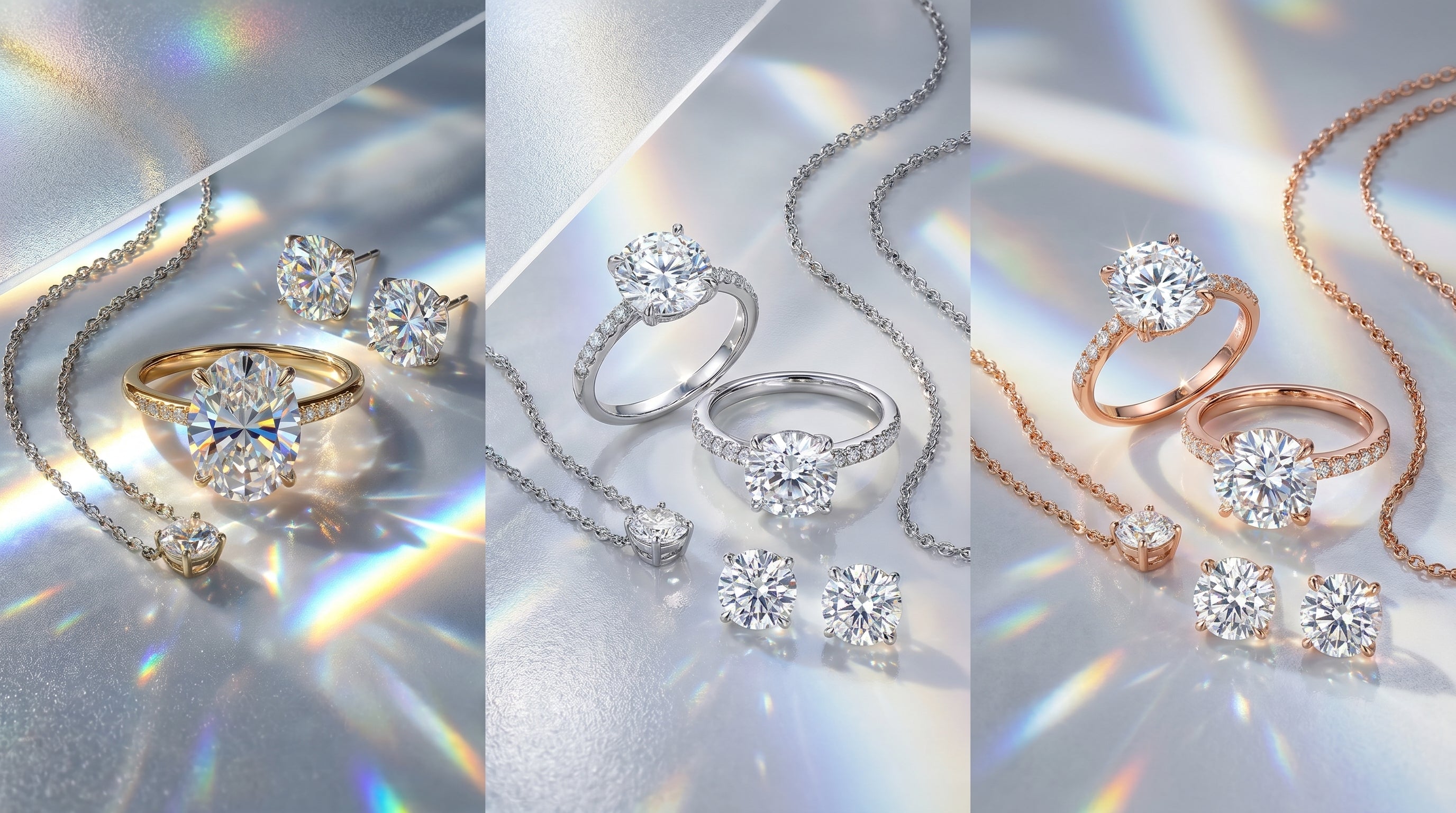
Quand vous comparez moissanite, diamant et diamant de laboratoire, les différences vont bien au-delà du prix. Il s’agit de compositions chimiques distinctes, de personnalités optiques très différentes et de valeurs totalement opposées. En 2026, les acheteurs ne se contentent plus de suivre la tradition. Ils veulent une vue complète—la science, l’éclat, l’éthique et le vrai coût—avant de s’engager. C’est exactement ce que ce guide offre.

Voici le problème—la plupart des guides de comparaison cachent l’essentiel. Ils passent trois paragraphes sur l’histoire avant de vous dire ce qui compte vraiment. Nous sautons cette étape. Nous avons aidé plus de 250 000 clients à trouver leur pièce parfaite, et les questions sont toujours les mêmes : Quelle pierre brille le plus ? Tiendra-t-elle dans le temps ? Suis-je en train de me faire avoir ? Vous aurez des réponses claires et confiantes à la fin de votre lecture.
Ce qu’il faut savoir avant d’acheter : les trois points clés expliqués
Avant d’acheter, comprenez les différences fondamentales. Les diamants naturels sont des cristaux de carbone extraits. Les diamants de laboratoire sont des cristaux de carbone chimiquement identiques, cultivés en environnements contrôlés. La moissanite est une pierre distincte en carbure de silicium créée en laboratoire, avec un indice de réfraction plus élevé, un feu supérieur et un prix bien inférieur—ce qui en fait une pierre fondamentalement différente, et non un substitut au diamant.
Diamants naturels : le choix traditionnel
Les diamants naturels se forment profondément dans le manteau terrestre sous une chaleur et une pression extrêmes pendant des milliards d’années. L’activité volcanique les pousse ensuite vers la surface, où ils sont extraits, taillés et polis. Depuis des générations, ils sont la référence incontestée pour les bagues de fiançailles—portant un poids culturel symbolisant la durabilité, la rareté et un romantisme intemporel.
Cette tradition a un coût élevé. Vous payez pour des opérations minières étendues, une chaîne d’approvisionnement mondiale complexe et une rareté perçue. Les initiatives modernes ont amélioré les normes éthiques dans l’extraction des diamants, mais l’empreinte environnementale de l’extraction de ces pierres reste une préoccupation réelle pour les acheteurs conscients en 2026.
Diamants cultivés en laboratoire : l’alternative moderne au carbone
Les diamants cultivés en laboratoire ne sont pas des imitations. Ce sont du carbone pur cristallisé. Les scientifiques reproduisent les conditions naturelles de la Terre en utilisant des presses à haute pression et haute température (HPHT) ou des réacteurs de dépôt chimique en phase vapeur (CVD). Le résultat est une pierre chimiquement, physiquement et optiquement identique à un diamant extrait—même un gemmologue expérimenté ne peut pas faire la différence sans équipement de laboratoire spécialisé.
Les diamants synthétiques offrent la même dureté (10 sur l’échelle de Mohs) et l’éclat classique des diamants naturels, mais à un prix nettement inférieur. Ils éliminent également les pratiques minières destructrices, ce qui en fait une option attrayante pour les acheteurs souhaitant un diamant « réel » sans les problèmes éthiques ni la majoration astronomique.
Moissanite : La Pierre Étincelante de Poussière d’Étoile
La moissanite a une histoire d’origine complètement différente. Le scientifique français Henri Moissan l’a découverte en 1893 dans un cratère de météorite en Arizona. La moissanite naturelle est si rare qu’elle est pratiquement introuvable — ainsi, toute la moissanite utilisée en joaillerie aujourd’hui est cultivée en laboratoire. Composée de carbure de silicium plutôt que de carbone, c’est une espèce de pierre précieuse unique en son genre.
Son indice de réfraction se situe entre 2,65 et 2,69, contre 2,42 pour le diamant. Cette différence est importante. Plus la lumière se plie. Plus la lumière se décompose en couleurs. Le taux de dispersion est de 0,104 — plus du double de celui du diamant à 0,044 — produisant un feu arc-en-ciel vif qui éclaire une pièce en plein soleil. Les bagues en moissanite ne cherchent pas à imiter les diamants. Elles offrent quelque chose de différent, et pour beaucoup d’acheteurs, quelque chose de meilleur.
La Moissanite est-elle un Diamant Synthétique ? Clarification
Non. La moissanite n’est pas un diamant synthétique. Les diamants synthétiques sont du carbone pur avec la même structure chimique que les diamants extraits. La moissanite est du carbure de silicium — un matériau complètement différent avec un indice de réfraction plus élevé, une plus grande dispersion et une identité optique propre. La seule chose qu’ils partagent est leur origine en laboratoire.
C’est la méprise la plus courante que nous rencontrons. Parce que la moissanite est créée en laboratoire et souvent utilisée comme alternative au diamant, les gens pensent qu’elles sont identiques. Ce n’est pas le cas. C’est comme comparer un rubis à un saphir — tous deux magnifiques, précieux, mais fondamentalement différents. Si vous achetez une moissanite en vous attendant à ce qu’elle se comporte exactement comme un diamant, vous serez surpris par son éclat intense et coloré. Ce n’est pas un défaut. C’est justement ce qui la caractérise. Pour une analyse plus approfondie de la comparaison des prix entre ces deux pierres synthétiques, notre guide Moissanite vs Diamant Synthétique : Analyse Complète des Prix couvre tous les détails.
Moissanite vs Diamant vs Diamant Synthétique : Principaux Critères de Comparaison
Les principaux critères de comparaison entre la moissanite, les diamants naturels et les diamants synthétiques sont le prix, la durabilité, la performance optique et l’origine éthique. La moissanite offre le plus de feu et le prix le plus bas. Les diamants synthétiques possèdent les mêmes propriétés que les diamants naturels pour un coût nettement inférieur. Les diamants naturels bénéficient d’un prestige traditionnel à un prix premium que ni les diamants synthétiques ni la moissanite ne peuvent justifier uniquement par la performance.
Examinons les données concrètes. Les différences entre ces trois pierres sont mesurables, significatives et méritent d’être comprises avant de dépenser un centime.
| Caractéristique | Diamant Naturel | Diamant Synthétique | Moissanite |
|---|---|---|---|
| Composition | Carbone pur | Carbone pur | Carbure de silicium |
| Dureté (échelle de Mohs) | 10 (Le plus dur) | 10 (Le plus dur) | 9,25 (Extrêmement dur) |
| Indice de réfraction (Brillance) | 2.42 | 2.42 | 2.65 – 2.69 |
| Feu (Dispersion) | 0.044 | 0.044 | 0.104 |
| Origine | Extrait de la terre | Créé en laboratoire | Créé en laboratoire |
| Fourchette de prix | Le plus élevé ($$$$) | Modéré ($$) | Le plus abordable ($) |
Performance optique, éclat et feu
La performance visuelle est généralement le facteur décisif. Les diamants naturels et synthétiques partagent des propriétés optiques identiques — un retour de lumière blanc classique et net mêlé à des éclats subtils de couleur. Les gemmologues appellent cela la scintillation. C'est l'éclat sobre et frais que vous avez vu dans toutes les vitrines de bijouterie. Élégant. Familier. Contrôlé.
La moissanite est une toute autre bête. Avec un indice de réfraction de 2,65–2,69 contre 2,42 pour le diamant, elle dévie la lumière plus agressivement. Son taux de dispersion de 0,104 est 2,4 fois supérieur à celui du diamant à 0,044. En pratique, cela signifie que la moissanite agit comme un prisme de précision — décomposant la lumière blanche en couleurs spectrales vives. Tenez une bague en moissanite en plein soleil et elle projette un feu arc-en-ciel sur le mur. En comparant côte à côte des bagues en moissanite et en diamant en extérieur, la différence est immédiate et indéniable. Certains acheteurs adorent cette personnalité vibrante. D'autres préfèrent la retenue plus froide du diamant. Aucune préférence n'est erronée.

Durabilité et port quotidien
Votre bague de fiançailles heurtera des volants, s'entrechoquera avec des tasses à café et supportera des décennies de vie quotidienne. La durabilité n'est pas optionnelle. Les diamants obtiennent un 10 parfait sur l'échelle de dureté de Mohs — le minéral le plus dur connu sur terre. La moissanite obtient 9,25. Cela la rend plus dure que les saphirs, rubis et émeraudes.
Pour un port quotidien, 9,25 est plus que suffisant. Vous ne verrez pas votre moissanite s'embuer, se rayer ou perdre son intégrité structurelle avec le temps. Les deux pierres nécessitent un nettoyage régulier pour éliminer les huiles et lotions qui s'accumulent à la surface et ternissent temporairement leur éclat — mais structurellement, les deux sont des investissements à vie. Notre moissanite est garantie à vie sur ses propriétés optiques, donc cet éclat est assuré.
Impact éthique et environnemental
L'extraction de diamants naturels déplace des tonnes de terre pour récupérer un seul carat de brut de qualité gemme. Même avec des réglementations strictes, l'empreinte écologique est massive. Les diamants synthétiques éliminent le coût humain et la destruction environnementale de l'extraction, bien qu'ils nécessitent une énergie importante pour alimenter les réacteurs. La moissanite est la grande gagnante ici. Entièrement créée en laboratoire, elle a une empreinte environnementale minimale et une origine garantie sans conflit. Vous pouvez porter des bagues de fiançailles en moissanite en sachant que votre symbole d'amour n'a rien coûté à la planète.
Fourchettes de prix et valeur : optimiser votre budget en 2026
En 2026, les diamants naturels restent l’option la plus chère. Un diamant naturel de 2 carats de haute qualité coûte entre 15 000 $ et 20 000 $ selon la taille, la couleur et la pureté. Un diamant synthétique avec des spécifications équivalentes GIA coûte entre 2 000 $ et 4 000 $. Une moissanite incolore et parfaite de 2 carats ? Quelques centaines de dollars. L’écart de prix n’est pas une erreur d’arrondi — c’est une réalité financière complètement différente.
Et honnêtement ? Cet écart change votre façon d’acheter. Au lieu de faire des compromis sur le sertissage pour pouvoir vous offrir la pierre centrale, vous pouvez avoir les deux. Or massif 14k ou 18k. Halo caché et complexe. Détails vintage élaborés. Les bagues de fiançailles en moissanite abordables libèrent de l’argent réel — pour un apport immobilier, une lune de miel ou simplement un peu de marge financière — tout en mettant une bague à votre doigt qui arrête les conversations. Pour une comparaison visuelle de ces pierres à prix similaires, notre Moissanite vs Diamond Side by Side : Le guide complet 2026 vaut la peine d’être mis en favori.
Comment repérer la qualité dans la pierre choisie
La qualité va bien au-delà du poids en carats. Priorisez une taille excellente pour maximiser le retour de lumière, assortissez le grade de couleur au métal de votre sertissage, et vérifiez les spécifications de pureté. Pour la moissanite, recherchez la certification GRA, un classement incolore (équivalent D-E-F) et une garantie à vie de votre bijoutier avant tout achat.
Ne faites pas l’erreur de vous focaliser uniquement sur la taille. Une pierre de 3 carats mal taillée paraît terne et sans vie. Une pierre de 1,5 carat taillée avec maîtrise vous éblouit par son éclat. La taille est le moteur de l’éclat d’une pierre précieuse — et pour la moissanite, une facettage précis est particulièrement crucial. Sa dispersion intense doit être bien canalisée, sinon la pierre peut paraître vitreuse ou sombre au centre.
La couleur est le facteur suivant. La moissanite premium d’aujourd’hui est cultivée totalement incolore, équivalente à un grade de couleur diamant D-E-F. Les générations précédentes présentaient parfois une légère teinte jaune ou verte, mais la production moderne a complètement éliminé cela. La pureté est rarement un souci — l’environnement contrôlé du laboratoire produit des pierres équivalentes VVS1/VVS2 en standard. Nos pièces sont accompagnées d’une certification GRA pour que vous sachiez exactement ce que vous achetez, sans deviner.
Nos meilleures recommandations pour 2026
Trouver la bague parfaite signifie associer votre style personnel à la pierre et au sertissage adéquats. Nous avons sélectionné nos designs de moissanite les plus époustouflants pour 2026 — des solitaires classiques aux tailles émeraude audacieuses — chacun conçu pour maximiser l’éclat et construit pour durer toute une vie.
Chez Awareness Avenue, nous associons une moissanite incolore premium à des sertissages finement travaillés en or massif 14k et 18k. Chaque pièce est livrée avec une garantie à vie, une certification GRA et une période de retour de 30 jours. Voici les modèles phares qui définissent la joaillerie nuptiale et de luxe en 2026.
Les solitaires classiques et les ovales
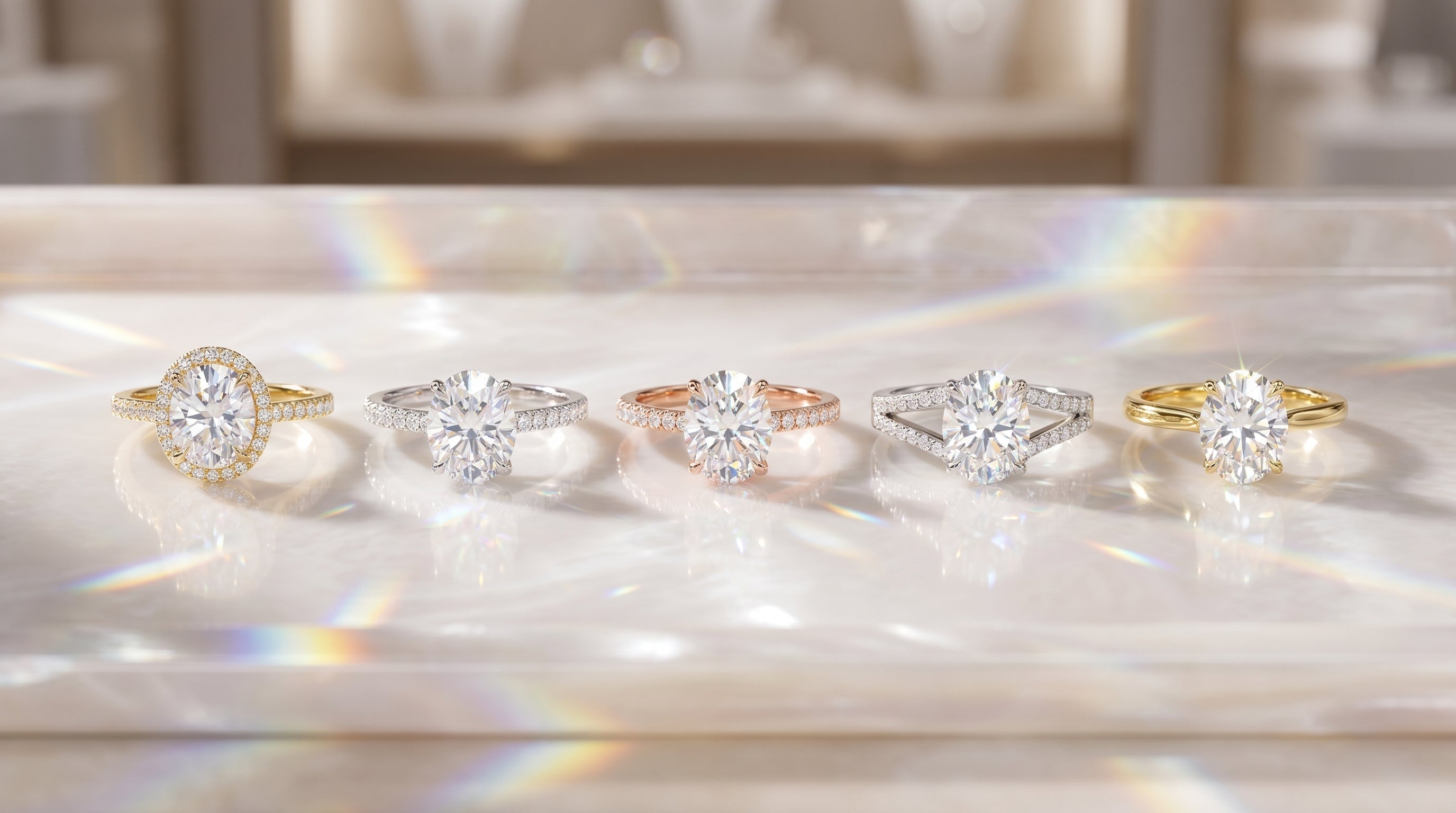
La taille ovale domine le marché pour une bonne raison. Elle allonge le doigt, maximise l’apparence du poids en carats et offre une brillance époustouflante sous tous les angles. The Opaline présente une moissanite taille ovale de 2 carats sur un anneau délicat qui garde la pierre centrale comme point focal incontesté. La façon dont elle capte la lumière au mouvement de votre main — cet éclat satisfaisant de feu arc-en-ciel — est quelque chose qu’il faut voir en personne pour pleinement apprécier.

Pour une présence plus marquée, La bague Luna Moissanite accueille un ovale brillant de 2 carats dans un sertissage robuste et élégant avec un poids satisfaisant au doigt. Vous préférez la taille brillant rond ? The Camilla - Taille ronde est conçue pour un retour maximal de lumière — la taille ronde produit plus de brillance par carat que toute autre forme, et ce sertissage laisse chaque photon faire son travail. Pour une déclaration plus imposante, The Liana offre un magnifique ovale de 3 carats en or blanc 14 carats ou platine, avec une sensation luxueuse et lourde qui attire tous les regards.
Tailles géométriques audacieuses et déclarations colorées
Les tailles à gradins connaissent une grande renaissance. Alors que les tailles brillantes produisent un éclat de glace pilée, les tailles émeraude offrent un effet sophistiqué de hall de miroirs — de longs éclats vitreux qui se déplacent lentement et délibérément au mouvement de la main. The Adelina Rae présente une moissanite taille émeraude de 2 carats qui dégage un luxe discret et une précision architecturale. C’est le choix du minimaliste moderne qui veut de la présence sans bruit.
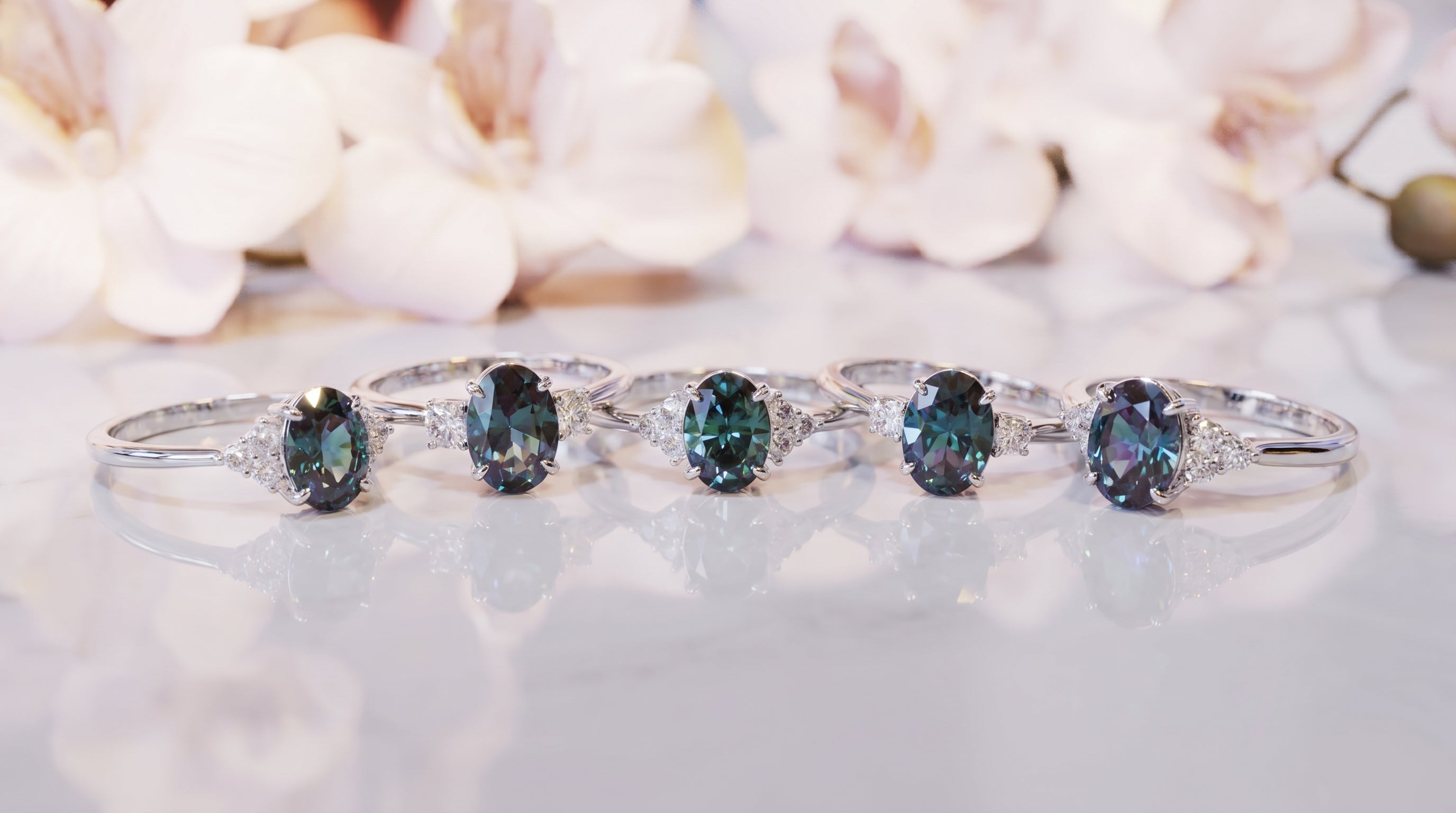
Mais pourquoi se limiter aux pierres claires ? La nature synthétique de la moissanite permet des couleurs vives qui coûteraient une fortune en pierres naturelles. The Camilla présente une moissanite rose taille émeraude de 3 carats à couper le souffle — romantique, audacieuse et totalement unique. Pour une palette plus froide, The Ulissa met en valeur une moissanite bleue profonde et envoûtante qui rivalise avec les plus beaux saphirs, mais avec beaucoup plus de feu.

La chaleur de l’or rose
Le choix du métal change complètement la personnalité d’une bague. L’or rose s’est imposé comme un classique moderne — chaleureux, d’inspiration vintage, flatteur pour tous les tons de peau. The Luna - Or Rose reprend notre design ovale adoré et le baigne d’une teinte romantique rosée. Le contraste entre la moissanite blanche glacée et l’or rose chaud est saisissant d’une manière que l’or blanc ne peut tout simplement pas reproduire. La bague de fiançailles Bethany en or rose ajoute des détails complexes et une esthétique douce et féminine qui semble à la fois antique et totalement contemporaine.
Vous explorez encore les styles ? Parcourez notre collection de bagues en moissanite les plus vendues pour découvrir ce dont plus de 250 000 clients sont déjà tombés amoureux.
Questions fréquemment posées
Les acheteurs comparant moissanite, diamants de laboratoire et diamants naturels posent toujours les mêmes questions sur la durabilité, les différences visuelles et la valeur à long terme. Voici des réponses directes aux questions les plus importantes.
Les bagues en moissanite paraissent-elles fausses comparées aux diamants ?
Non. La moissanite ne semble pas fausse — elle ressemble à une pierre précieuse haut de gamme à haute brillance. Comme son indice de réfraction (2,65–2,69) dépasse celui du diamant (2,42), elle scintille même davantage. Pour un œil non averti, une moissanite incolore est visuellement indiscernable d’un diamant parfait. La seule différence notable apparaît en plein soleil, où la moissanite projette un feu arc-en-ciel plus vif que le diamant. La plupart des porteurs considèrent cela comme une amélioration, pas un défaut.
Un bijoutier peut-il faire la différence entre la moissanite et un diamant de laboratoire ?
Oui, avec les bons outils. Un bijoutier formé utilisant une loupe recherchera la double réfraction — une propriété optique unique de la moissanite où les jonctions des facettes apparaissent doublées lorsqu'on les regarde à travers la couronne sous un angle. Les diamants sont à réfraction simple. Les testeurs de conductivité thermique standard confondent souvent la moissanite avec le diamant, mais les testeurs modernes qui mesurent aussi la conductivité électrique distinguent les deux avec précision.
Les bagues en moissanite pour hommes deviennent-elles plus populaires ?
La demande pour des bagues en moissanite que les hommes peuvent porter au quotidien a fortement augmenté en 2026. Les hommes choisissent la moissanite pour les alliances et les bagues d'exception car elle offre un look audacieux et luxueux sans le coût des diamants. Avec un 9,25 sur l'échelle de Mohs, la moissanite résiste aux chocs et aux abrasions des modes de vie actifs sans se plaindre. C'est un choix pratique qui ne sacrifie pas la présence.
Quelle pierre conserve le mieux sa valeur ?
Les diamants naturels conservent historiquement plus de valeur à la revente que les pierres créées en laboratoire — bien que vous perdiez toujours un pourcentage important du prix de détail en vendant. Les prix des diamants de laboratoire ont baissé avec l’amélioration des technologies de production, donc leur valeur de revente est actuellement faible. La moissanite est abordable à l’achat, et bien qu’elle n’ait pas un marché secondaire fort, vous ne bloquez pas des milliers d’euros dans un actif qui se déprécie. La vraie valeur réside dans les économies immédiates et le plaisir quotidien de porter quelque chose de beau.
Comment nettoyer ma bague en moissanite pour qu’elle reste étincelante ?
Les huiles, lotions et résidus de savon quotidiens s’accumulent à la surface de la pierre et ternissent temporairement son éclat — un phénomène parfois appelé « film huileux sur la moissanite ». La solution est simple : faites tremper la bague dans de l’eau tiède avec quelques gouttes de savon à vaisselle doux, frottez délicatement avec une brosse à dents à poils souples (surtout sous la pierre où les dépôts se cachent), rincez abondamment et séchez avec un chiffon non pelucheux. Faites cela toutes les quelques semaines et votre bague restera comme neuve indéfiniment.
Conseil final pour votre bague éternelle
Le choix entre moissanite, diamant naturel et diamant de laboratoire dépend de ce que vous valorisez réellement — pas de ce que la tradition vous dit de valoriser. Si l’histoire géologique et le prestige culturel sont vos priorités, un diamant naturel est le choix classique. Si vous souhaitez les propriétés chimiques exactes d’un diamant sans soutenir l’extraction minière ni payer des marges énormes, un diamant de laboratoire est une alternative moderne intelligente.
Mais si votre objectif est une brillance maximale, une pierre plus grande, une provenance éthique garantie et une véritable liberté financière ? La moissanite est unique. Ce n’est pas un compromis. C’est un choix conscient et valorisant — une pierre née de la science des étoiles, taillée à la perfection, certifiée GRA, et garantie à vie. Nous avons vu plus de 250 000 clients changer leur regard sur la haute joaillerie, et jamais personne n’a regretté d’avoir dépensé moins qu’une pierre extraite.

Ne laissez pas des règles dépassées dicter la façon dont vous célébrez votre engagement. Que vous soyez attiré par l'élégance intemporelle de The Luna ou par la personnalité audacieuse de nos pierres colorées, votre bague parfaite vous attend. Explorez notre collection complète de bagues de fiançailles en moissanite, découvrez les nouveautés dans notre gamme de nouvelles bagues en moissanite, et trouvez la pièce qui fait battre votre cœur à chaque regard porté à votre main.

Laisser un commentaire
Ce site est protégé par hCaptcha, et la Politique de confidentialité et les Conditions de service de hCaptcha s’appliquent.