


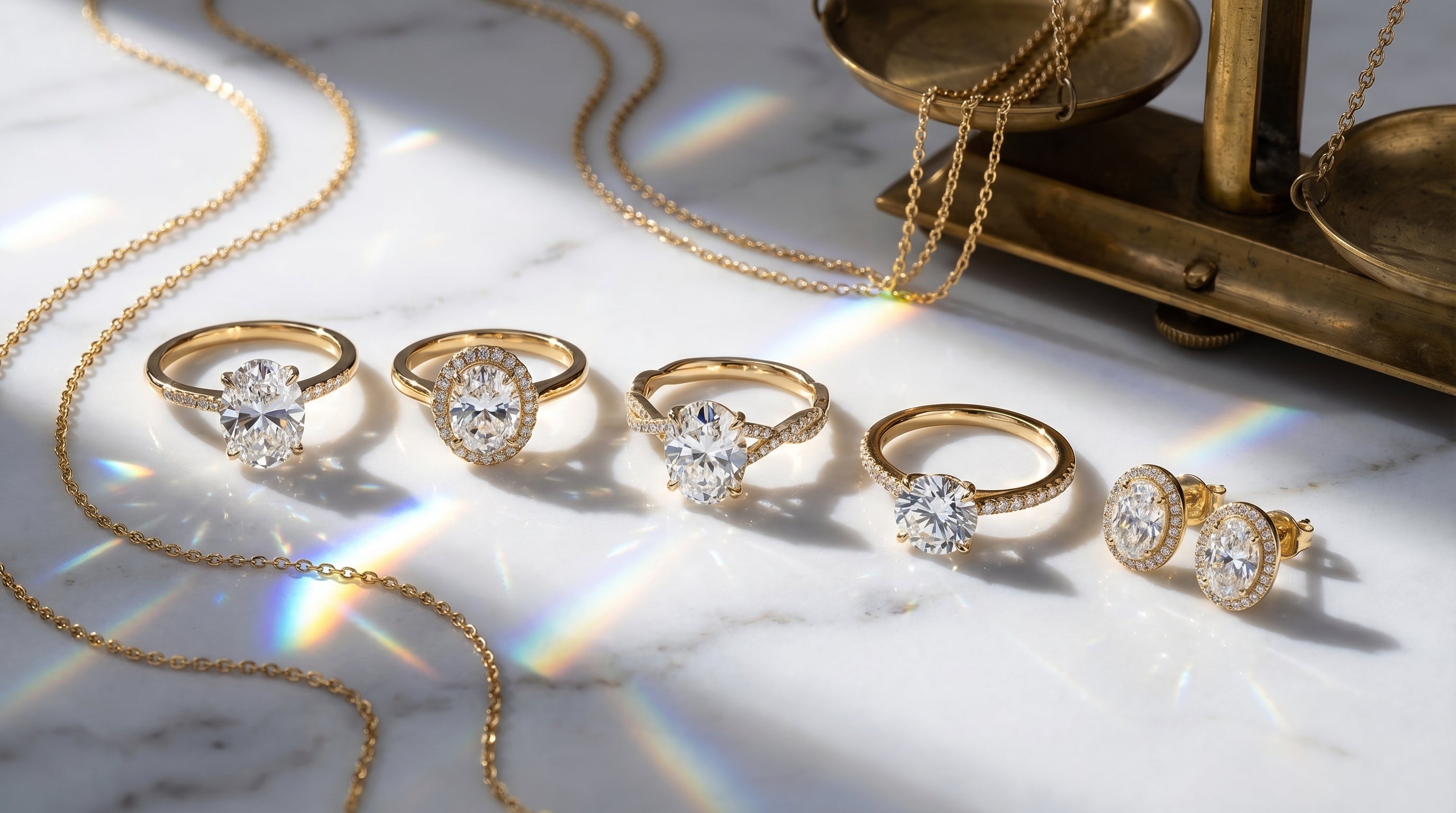
Quand il s'agit du prix moissanite vs diamant de laboratoire, l'écart est plus grand que ce que la plupart des gens imaginent—et cela change tout ce que vous pouvez vous permettre. On parle de 70 à 90 % de moins pour une pierre qui, dans de nombreuses conditions d'éclairage, brille plus qu'un diamant. Si vous hésitez entre ces deux options pour une bague de fiançailles, cette analyse couvre les chiffres réels, la science optique et les compromis honnêtes pour que vous puissiez prendre la décision qui vous convient—et non celle que l'industrie de la joaillerie veut que vous preniez.

Moissanite vs Diamant de Laboratoire : Répartition des Coûts en 2026
La différence de prix entre moissanite et diamant de laboratoire est importante—la moissanite coûte de 70 à 90 % moins cher qu'un diamant de laboratoire comparable. En 2026, une moissanite d'un carat se situe généralement entre 300 $ et 800 $, tandis qu'un diamant de laboratoire d'un carat coûte entre 800 $ et 3 000 $. Ce n'est pas une erreur d'arrondi. C'est une conversation budgétaire complètement différente.
Voici le point—les prix n'évoluent pas de la même manière pour les deux pierres. Les diamants de laboratoire suivent encore une courbe raide une fois le seuil d'un carat dépassé. La moissanite, elle, joue selon des règles complètement différentes. L'écart entre elles s'élargit considérablement à mesure que le poids en carats augmente.
Pour une pierre standard d'un carat, comptez environ 500 $ pour une moissanite premium contre 1 500 $ pour un diamant de laboratoire bien noté. C'est notable. Mais regardez ce qui se passe quand vous passez aux tailles qui font vraiment sensation à la main.
Une pierre centrale en moissanite de 2 carats à couper le souffle coûte entre 800 $ et 1 500 $. Un diamant de laboratoire de 2 carats de qualité comparable se situe entre 1 200 $ et 2 000 $—parfois plus selon la taille, la couleur et la pureté. Passez à une pierre de 3 carats, et l'écart devient un gouffre. Une moissanite de 3 carats reste accessible entre 1 200 $ et 2 200 $. L'équivalent en diamant de laboratoire ? Vous regardez entre 1 800 $ et 3 500 $ ou plus.
Cet avantage d'échelle est précisément la raison pour laquelle tant de couples choisissent des bagues en moissanite. Vous pouvez vous offrir une taille émeraude spectaculaire de 3 carats sans compromettre un sertissage en or massif ou en platine. Vous bénéficiez de l'expérience de luxe, du poids satisfaisant du métal précieux sur votre doigt, et d'une pierre qui attire l'attention—tout en faisant un choix financier stratégique. Pour une analyse plus approfondie de ces chiffres, notre guide sur le prix de la moissanite vs diamant de laboratoire décompose les tendances du marché qui influencent ces coûts.
La moissanite est-elle un diamant cultivé en laboratoire ?
Non, la moissanite n’est pas un diamant cultivé en laboratoire. Bien que les deux soient créés en laboratoire, la moissanite est composée de carbure de silicium, tandis que les diamants de laboratoire sont faits de carbone pur. Cette structure chimique distincte confère à la moissanite ses propres propriétés optiques uniques—y compris un feu arc-en-ciel 2,4 fois plus intense que celui d’un diamant.
C’est le point de confusion le plus courant pour quiconque entre sur le marché de la haute joaillerie. Et honnêtement ? C’est compréhensible. Les deux pierres sont créées en laboratoire, les deux sont éthiques, et les deux sont magnifiques dans une bague. Mais ce sont des pierres précieuses totalement différentes, avec des origines différentes, des compositions chimiques différentes, et des façons différentes d’interagir avec la lumière.
La moissanite naturelle a été découverte pour la première fois en 1893 par le scientifique français Henri Moissan dans un cratère de météorite en Arizona. Il pensait initialement avoir trouvé des diamants. Une analyse ultérieure a révélé que les cristaux étaient du carbure de silicium—un composé si rare dans la nature qu’il est pratiquement impossible à trouver pour la joaillerie. Les scientifiques ont passé des décennies à apprendre à le synthétiser en laboratoire, et le résultat est la moissanite que nous connaissons aujourd’hui.
Les diamants cultivés en laboratoire sont du carbone pur, point final. Créés soit par haute pression haute température (HPHT), soit par dépôt chimique en phase vapeur (CVD), ils reproduisent les conditions intenses trouvées profondément dans le manteau terrestre. Un diamant de laboratoire est chimiquement, physiquement et optiquement identique à un diamant extrait. C’est un diamant. Il s’est simplement formé dans un environnement contrôlé en quelques semaines plutôt que sous terre en millions d’années.
Parce que la moissanite est du carbure de silicium, elle se comporte différemment. Elle est doublement réfringente—lorsque la lumière pénètre dans la pierre, elle se divise en deux rayons. C’est la source de l’éclat explosif caractéristique de la moissanite. Les diamants sont simple réfringents. Cette distinction chimique explique pourquoi la moissanite n’est pas un « diamant de substitution ». C’est une pierre précieuse spectaculaire et durable, avec sa propre personnalité distincte.
Comparaison côte à côte : valeur, durabilité et éclat
Une comparaison côte à côte entre moissanite et diamant montre que les diamants de laboratoire offrent des propriétés identiques à celles des diamants extraits—y compris une dureté parfaite de 10 sur l’échelle de Mohs—tandis que la moissanite offre un feu arc-en-ciel supérieur, une dureté de 9,25, et un prix nettement plus bas pour des carats plus importants. Le choix dépend de la préférence esthétique, pas de la qualité.
Parlons d’abord de l’éclat, car c’est là que les choses deviennent vraiment intéressantes. Les gemmologues mesurent la capacité d’une pierre à plier la lumière grâce à l’indice de réfraction (IR). Les diamants ont un IR de 2,42, produisant ce retour de lumière blanche classique et nette appelé brillance. La moissanite a un IR de 2,65 — elle plie la lumière de façon plus agressive. Et son taux de dispersion est de 0,104, contre 0,044 pour un diamant. La dispersion crée le « feu » — ces éclats de lumière colorée qui apparaissent lorsque la pierre bouge. La moissanite a plus du double du feu d’un diamant. En plein soleil, une bague en moissanite projette des éclats arc-en-ciel spectaculaires sur les murs de votre voiture ou de votre salon. Certains adorent ce spectacle flamboyant. D’autres préfèrent la profondeur plus froide et plus blanche d’un diamant. Aucune préférence n’est mauvaise.
| Caractéristique | Moissanite | Diamant de laboratoire |
|---|---|---|
| Composition | Carbure de silicium (SiC) | Carbone pur (C) |
| Dureté (Échelle de Mohs) | 9,25 (Excellent pour un port quotidien) | 10 (Dureté maximale) |
| Indice de réfraction (Brillance) | 2,65 (Retour de lumière supérieur) | 2,42 (Lumière blanche classique) |
| Feu (Dispersion) | 0,104 (Éclats arc-en-ciel vibrants) | 0,044 (Lumière colorée subtile) |
| Prix par 1 carat (2026) | $300 - $800 | $800 - $3,000 |
| Impact environnemental | Très faible (Énergie minimale utilisée) | Modéré (Création énergivore) |
La durabilité compte autant que l’éclat. Vous achetez une bague pour la porter tous les jours — contre les encadrements de porte, les volants, le matériel de gym et tout ce que la vie peut lui faire subir. Les diamants obtiennent un 10 parfait sur l’échelle de dureté de Mohs. La moissanite obtient 9,25. Pour comparaison, les saphirs et rubis obtiennent 9. La moissanite est plus dure que presque toutes les autres pierres précieuses sur terre, juste derrière le diamant. Elle résiste aux rayures, éclats et cassures avec une fiabilité exceptionnelle. Vous pouvez en apprendre plus sur son comportement au quotidien dans notre analyse détaillée de la dureté moissanite vs diamant.
La moissanite résiste aussi à la chaleur jusqu’à 2 000 degrés Fahrenheit. Si un bijoutier doit jamais appliquer une torche pour redimensionner votre bague ou réparer une griffe, la pierre reste parfaitement intacte. Elle ne s’opacifie pas, ne ternit pas et ne perd jamais ses propriétés optiques. Chaque bague moissanite d’Awareness Avenue est accompagnée d’une garantie à vie et d’une certification GRA, donc cette promesse est garantie par écrit.
Ce que Reddit dit sur la moissanite et les diamants de laboratoire
En 2026, les communautés moissanite sur Reddit soulignent constamment la valeur imbattable de cette pierre pour maximiser la taille en carats avec un budget limité. Les utilisateurs louent fréquemment sa durabilité pour un port quotidien tout en notant que son feu arc-en-ciel distinct séduit ceux qui veulent un éclat maximal — et que la différence de prix entre moissanite et diamant rend les pierres plus grandes réellement accessibles.
Si vous voulez des avis francs et honnêtes sur les bijoux, vous allez sur les forums. La communauté moissanite sur Reddit est devenue un immense centre d’expériences partagées, de photos et de conseils d’achat — et lire ces discussions vous offre un aperçu fascinant de la façon dont les couples modernes envisagent réellement cette décision.
Le consensus écrasant ? Les gens en ont fini avec la pression traditionnelle de l’industrie du diamant. Ils ont rejeté la règle dépassée des « trois mois de salaire ». Un thème récurrent est la joie pure de déballer une bague en moissanite de 3 carats qui a coûté moins qu’une voiture d’occasion — et d’aimer chaque seconde. Les utilisateurs publient des vidéos de leurs bagues captant la lumière dans les supermarchés et les bureaux, s’émerveillant sincèrement de l’intensité du feu.
La communauté est aussi réaliste quant aux différences esthétiques. Vous trouverez des discussions honnêtes sur « l’effet boule à facettes » — car la moissanite diffuse beaucoup de lumière colorée, elle se comporte différemment d’un diamant sous certains éclairages. Les utilisateurs de Reddit conseillent régulièrement aux nouveaux acheteurs d’accepter la moissanite pour ce qu’elle est : une pierre précieuse spectaculaire et unique, pas un substitut au diamant. Ils célèbrent le feu. Ils adorent la brillance. Pour un aperçu sélectionné de ces avis communautaires, consultez ce que Reddit dit sur la moissanite pour découvrir de vraies expériences consommateurs.
L’empreinte éthique est également un sujet récurrent. Les diamants cultivés en laboratoire sont sans conflit, mais leur production nécessite encore d’énormes quantités d’électricité — souvent issue de réseaux fortement dépendants du charbon. La production de moissanite est beaucoup moins énergivore, ce qui en fait le choix évident pour les acheteurs soucieux de l’environnement. Cet impact environnemental minimal est un facteur décisif réel pour un nombre croissant de couples.
Les meilleures bagues de fiançailles en moissanite adaptées à votre budget
Les meilleures bagues de fiançailles en moissanite allient un savoir-faire exceptionnel à la brillance naturelle de la pierre précieuse. Des tailles ovales classiques aux designs audacieux en émeraude, ces pièces offrent le poids luxueux et l’éclat de la haute joaillerie à une fraction du coût des diamants cultivés en laboratoire comparables.
Nous avons aidé plus de 250 000 clients à trouver leur pièce parfaite, et les bagues ci-dessous représentent certains des modèles les plus appréciés de notre collection. Voir la différence de prix entre la moissanite et le diamant en action — à travers des bagues réelles que vous pouvez posséder — rend le choix concret.
The Opaline : Élégance classique en taille ovale
La taille ovale domine les tendances des bagues de fiançailles depuis des années, et il est facile de comprendre pourquoi. Elle allonge le doigt, paraît plus grande par carat qu'une pierre ronde, et offre une brillance incroyable. The Opaline présente une magnifique moissanite taille ovale de 2 carats qui capte la lumière sous tous les angles. La monture délicate laisse la pierre centrale prendre toute la place, créant un look de luxe intemporel et sans effort.

Glissez L’Opaline à votre doigt et vous ressentez immédiatement la qualité. Les proportions sont parfaitement équilibrées. Les facettes sont conçues pour maximiser le feu caractéristique de la moissanite — ainsi, même dans la lumière tamisée d’un restaurant, cette bague attire tous les regards. C’est le genre de pièce qui pousse les gens à tendre la main pour mieux la voir.
L’Adelina Rae : Une beauté architecturale audacieuse
Pour la femme qui apprécie les lignes épurées et la sophistication d’inspiration vintage, la taille émeraude est le choix ultime. L’Adelina Rae met en valeur une magnifique moissanite taille émeraude de 2 carats. Contrairement aux tailles brillantes qui fragmentent la lumière en petits éclats, les facettes en escalier créent un effet « hall des miroirs » — un éclat sophistiqué et confiant qui évoque un luxe profond.

Les tailles émeraude ont de grandes facettes ouvertes — il n’y a aucun endroit où les inclusions peuvent se cacher. C’est là que la clarté contrôlée en laboratoire de la moissanite devient un véritable avantage. Vous obtenez un éclat parfait et glacé qui semble coûteux parce qu’il est fabriqué avec expertise, pas parce qu’il a coûté une fortune.
La Camilla : Une touche de couleur romantique
Qui a dit qu'une bague de fiançailles devait être blanche ? Les pierres précieuses colorées connaissent un grand succès en 2026, et la moissanite rose offre une alternative romantique et profondément personnelle aux pierres traditionnelles. La Camilla présente une moissanite rose taille émeraude de 3 carats qui attire tous les regards. Audacieuse. Féminine. Inoubliable.

La teinte rose douce se marie magnifiquement avec les lignes géométriques nettes de la taille émeraude. C'est une bague qui suscite la conversation. Le prix d'un diamant rose de laboratoire de 3 carats devient astronomique. La moissanite rend ce niveau de luxe coloré et sur mesure véritablement accessible — et c'est tout l'intérêt.
La Luna : Le solitaire parfait
Parfois, la simplicité est la sophistication ultime. La Luna est un chef-d'œuvre de design minimaliste. En éliminant les halos lourds et les pierres latérales complexes, cette bague laisse la moissanite centrale brillante s'exprimer pleinement. Le sertissage est conçu pour permettre à un maximum de lumière d'entrer dans la pierre sous tous les angles, offrant un spectacle éblouissant de feu et de scintillement.

La Luna se marie parfaitement avec des alliances éternelles en diamant, des alliances en or simples ou des gardes vintage complexes. C'est la bague de fiançailles par excellence, sublimée par l'éclat inégalé de la moissanite premium—et assez polyvalente pour être portée toute une vie.
Questions fréquemment posées
Ma bague en moissanite deviendra-t-elle terne avec le temps ?
Non, une moissanite de haute qualité ne deviendra pas définitivement terne, ne se fanera pas et ne changera pas de couleur avec le temps. Avec une dureté de 9,25 sur l'échelle de Mohs, ses propriétés optiques sont verrouillées de façon permanente. Si votre bague commence à paraître terne, c'est simplement à cause des huiles, lotions et saletés quotidiennes qui s'accumulent à la surface. Un trempage rapide dans de l'eau tiède savonneuse et un brossage doux avec une brosse à dents souple restaurent instantanément son éclat d'origine. Pour des conseils d'entretien détaillés, lisez notre guide sur comment nettoyer les bagues en moissanite.
Un bijoutier peut-il faire la différence entre la moissanite et un diamant de laboratoire ?
Oui, un bijoutier formé peut faire la différence en utilisant une loupe de bijoutier. Parce que la moissanite est doublement réfringente, un bijoutier observant de près la pierre verra un effet de doublement sur les arêtes des facettes. Les diamants, étant simplement réfringents, ont des lignes de facettes nettes et uniques. Les testeurs de diamant standard qui mesurent la conductivité thermique détectent souvent la moissanite comme un diamant, mais les testeurs modernes qui mesurent aussi la conductivité électrique distinguent facilement les deux.
La moissanite est-elle considérée comme un diamant « faux » ?
La moissanite n'est pas un diamant faux—c'est une pierre précieuse complètement différente et légitime. Appeler la moissanite un diamant faux, c'est comme appeler un saphir un diamant bleu faux. Elle a sa propre composition chimique (carbure de silicium), sa propre histoire d'origine (découverte dans une météorite) et ses propres propriétés optiques distinctes. Des millions de femmes la choisissent non seulement pour son prix, mais aussi pour sa durabilité exceptionnelle et son éclat flamboyant qui surpasse le diamant sur l'échelle de dispersion.
La moissanite ressemble-t-elle exactement à un diamant à l’œil nu ?
À l’œil nu non entraîné—surtout pour des carats inférieurs à 1,5—la moissanite et les diamants se ressemblent étonnamment. Les deux sont clairs, brillants et très réfléchissants. En plus grande taille et sous la lumière directe du soleil ou les projecteurs des bijouteries, le taux de dispersion plus élevé de la moissanite devient visible : des éclats arc-en-ciel plus colorés comparés à l’éclat plus blanc du diamant. Beaucoup d’acheteurs préfèrent activement ce feu renforcé. C’est une caractéristique, pas un défaut.
Faire votre choix final pour 2026
Le choix entre la moissanite et un diamant de laboratoire dépend de votre budget, de vos préférences esthétiques et de vos valeurs. La moissanite offre une accessibilité inégalée et une brillance flamboyante—ce qui en fait le choix idéal pour quiconque souhaite une pièce spectaculaire, éthique et imposante sans le prix élevé d’un diamant de laboratoire.
L’industrie de la joaillerie a évolué. Vous n’êtes plus limité par une rareté artificielle et des prix gonflés. Si votre priorité est une pierre chimiquement identique à un diamant naturel—et que vous êtes prêt à payer le supplément pour cette structure spécifique de carbone—un diamant synthétique est un excellent choix. Il offre la même brillance à la lumière blanche et la dureté parfaite d’une pierre extraite, sans les problèmes éthiques.
Mais si vous souhaitez maximiser votre budget, rêvez d’un caratage plus important et tombez amoureux d’un feu coloré spectaculaire, la moissanite est le choix le plus judicieux. Point final. Elle libère vos finances pour le mariage, un apport pour une maison ou une lune de miel incroyable—tout en vous offrant une bague qui fait tourner les têtes. Assez durable pour être transmise à la génération suivante, son empreinte éthique est quasiment inexistante.
Votre bague de fiançailles est le symbole de votre histoire d'amour unique. Elle doit vous apporter de la joie à chaque fois que vous regardez votre main—pas du stress financier. Nous vous invitons à explorer notre collection complète de bagues de fiançailles en moissanite et à découvrir la pièce qui vous parle. Des solitaires classiques aux designs vintage complexes, nos bagues en moissanite les plus vendues sont conçues pour offrir une brillance époustouflante à vie—avec notre garantie à vie et un retour sous 30 jours, pour un achat totalement sans risque.

Laisser un commentaire
Ce site est protégé par hCaptcha, et la Politique de confidentialité et les Conditions de service de hCaptcha s’appliquent.