
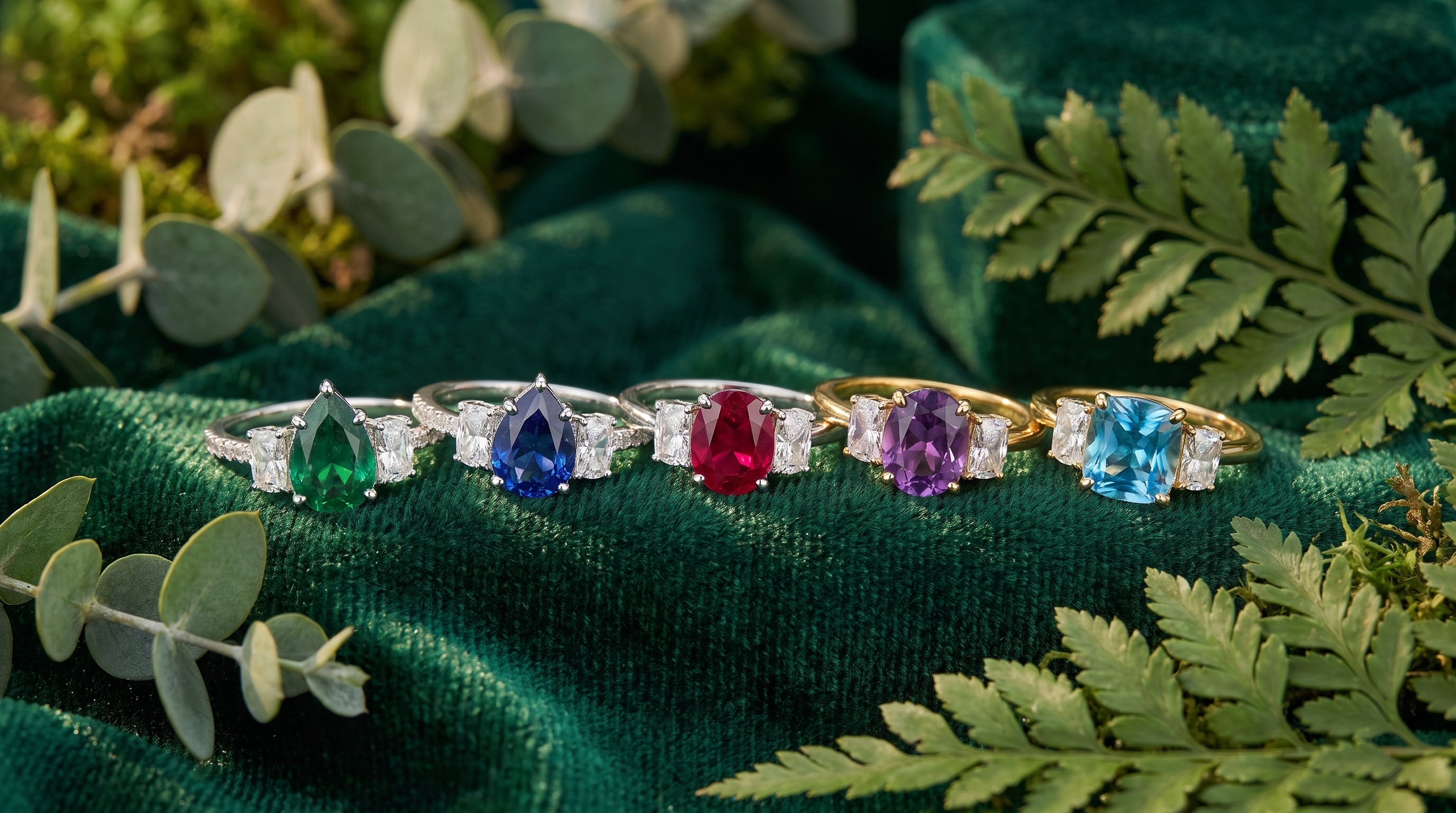
Search for a "birthstone ring 3 stones" and you land in two very different shopping experiences at once. On one side are configurators from large jewelers and family-ring specialists, where you pick a setting and then assign a birthstone to each position before checkout. On the other side are marketplace and artisan listings where the "3 stones" are baked into a fixed handcrafted design. Both sell the same idea, but they ask you to make different decisions, in a different order, and with different room for error. This guide sorts those decisions out: what three stones actually represent, how three-stone designs compare to two- and four-stone versions, which style and material choices matter most, and how to personalize a ring without discovering a misspelled name after it ships.
What a Three-Stone Birthstone Ring Actually Represents
Before comparing settings, it helps to know which of two overlapping traditions you are buying into, because they lead to different design choices.
The mothers ring reading
Blue Nile defines a mothers ring as personalized jewelry featuring birthstones that represent children, grandchildren, or other loved ones, with each gemstone corresponding to a family member's birth month. In that framing, a three-stone ring is a literal roll call: three people, three months, one band. Retailers that specialize in this category lean into the same idea. MothersFamilyRings.com maintains a dedicated three-stone mothers ring collection of custom designs, and The Vintage Pearl presents its three-stone mothers ring as a symbol of love with birthstones standing in for family members. Blue Nile also notes that mothers rings are traditionally worn on the ring finger of the right hand, which is a common convention rather than a rule, and one reason many shoppers treat the piece as a companion to wedding jewelry rather than a replacement for it.
The relationship reading
Three-stone rings carry meaning that predates the mothers ring category. Nelson Coleman explains that a three-stone ring is most widely read as past, present, and future, with each stone representing a chapter of a couple's story. The same piece describes alternative interpretations: two side stones for each partner with a center stone symbolizing the bond they share, a family reading of two parents and a child, and value-based readings such as love, trust, and respect, or faith, hope, and love. If your three stones are a partner, a child, and yourself, both traditions are in play at once, and a center-stone design will usually express that better than three identical stones in a row.
Birthstone jewelry, broadly
Eternate describes birthstone jewelry as pieces featuring gemstones that represent birth months, which are personal whether the stone belongs to the wearer or to someone they love. That distinction matters more than it sounds. A ring built entirely from other people's birthstones is a tribute piece; one that includes your own is something you wear for yourself. Deciding which you want is the fastest way to settle on a stone count.
Two, Three, or Four Stones: Matching Configuration to Your Family
Stone count is the structural spec that drives everything else — setting width, stone size, price tier, and how the ring reads from across a room. Blue Nile notes that mothers ring designs accommodate anywhere from one to six or more birthstones, so the count you want is almost always available in some form. The question is which count suits your situation now and later.
A birthstone ring 2 stones configuration
A mothers ring 2 stones design is the natural choice for two children, a couple, or a parent-and-child pairing. Because there is no odd stone in the middle, designers often use bypass or side-by-side arrangements where the two stones sit next to each other or curve past one another. Olivia Jewelry's duo birthstone ring, for example, sets two simulated birthstones on a gold band and frames the design as two distinct paths meeting as one. When considering a birthstone ring 2 stones arrangement, a two birthstone ring for mom also allows larger individual stones for the same overall ring width, which is worth knowing if you want each color to be clearly identifiable rather than reading as a single blur of gems.
A birthstone ring 3 stones configuration
Three is the configuration where symmetry works in your favor. A center stone flanked by two side stones gives you a built-in hierarchy — useful if one stone represents a partner or the wearer — while three evenly matched stones read as equals, which suits three siblings. Etsy sellers make this explicit, listing birthstone rings for mom 3 stones alongside stackable family ring options. If you are choosing a custom 3 stone birthstone ring, confirm early whether the design keeps all three stones the same size or elevates the center, because that single detail changes the ring's meaning as much as its silhouette.
Four stones and beyond
A mothers ring 4 stones configuration is widely offered too. Jewlr promotes four-stone mothers rings personalized with names or birthstones for each child, ArtCarved offers a mother's ribbon ring holding two to four marquise stones, and MothersFamilyRings.com sells a four-stone bypass mothers ring set with 3 mm birthstones. Kay Jewelers takes an even more flexible approach with a birthstone family and mother's ring built to hold two to four stones in a sterling silver band. If your family may grow, one of these adjustable-count settings — or a stackable approach — will age better than a fixed three-stone mounting.
Stackable or Traditional: The Style Choice to Make First
Joy Jewelers' mothers ring buyers guide opens with the distinction that shapes every other decision: stackable mothers rings are thinner bands meant to be worn in multiples on the same finger, while traditional mothers rings are designed to be worn alone.
Stackable means each band typically carries one or two stones, and the three-stone effect comes from wearing three bands together. The advantage is expandability — a new band can join the stack later — and the ability to mix metals or wear a single band on quieter days. The trade-offs are that thin bands must be sized carefully so they sit flush, and that a stack of three costs and behaves like three rings, not one.
Traditional means all three birthstones live in one mounting: a channel, a bypass curve, a ribbon, or a classic three-stone head. This reads as a single deliberate piece of jewelry and usually sits more securely under a glove or a work day. The trade-off is fixed capacity; adding a fourth stone later generally means a new ring, not an addition.
If you like layering, the same logic that applies to eternity bands versus stackable rings applies here — plan the whole stack before buying the first band, so widths and profiles align.
Metals and Stones: What Changes Look, Feel, and Cost
Metal options
Blue Nile lists yellow gold, white gold, rose gold, and sterling silver as the common metals for mothers rings, and specialist retailers extend that to platinum for custom work. Metal choice is not purely aesthetic in a multi-stone ring. Warm yellow gold flatters garnet, citrine, and ruby reds; white metals keep aquamarine, sapphire, and diamond looking cool and bright; rose gold softens pinks and greens. When three different birth months sit next to each other, the metal is the element that has to reconcile all three colors, so choose it after you know the stones, not before.
Natural versus simulated stones
This is the fork in the road that most affects budget and color consistency. Joy Jewelers recommends genuine birthstones for the mothers rings it sells, and MothersFamilyRings.com promotes natural birthstones with diamond accents set in gold and platinum. Other brands deliberately choose simulants: Olivia Jewelry sets simulated birthstones in its duo ring, and Awareness Avenue's birthstone solitaires use simulated stones as well.
Neither approach is universally correct. Natural stones carry the material authenticity many people want in an heirloom, and they vary from gem to gem the way natural material does. Simulated stones are chosen for consistent, predictable color — relevant when three stones must look intentional side by side, and when one natural stone in the trio would otherwise be far paler or darker than the others. These are brand descriptions rather than independently verified test results, so if stone origin matters to you, ask the seller directly what they set and how they describe it in writing before ordering. Blue Nile's own category guidance reflects the same divide: sterling silver designs with synthetic or semi-precious stones sit at the accessible end of the range, gold with natural birthstones in the middle, and precious gems in platinum at the top, so metal purity, stone type, and design complexity are the three levers that move cost.
Personalization: Getting Names and Birth Months Right
Joy Jewelers is blunt about the most common failure point in this category: after choosing a style, record the spelling of every family member's name carefully and double-check both the birth month and the birthstone that corresponds to it. Custom pieces are made to your specification, which means a typo becomes a manufactured object.
A practical order of operations:
- Write out each person's full name exactly as it should be engraved, including accents, hyphens, and capitalization, and have a second person read it back.
- List birth months, not stone names. Most configurators — Kay Jewelers and Jewlr among them — ask you to select by family member and month precisely so the stone mapping is handled for you.
- Decide stone order deliberately: birth order, oldest to youngest, is conventional, but center-out arrangements are common when one stone represents a partner.
- Confirm engraving capacity. Three names on a narrow band may exceed the character limit; a shank engraving on the inside is often the workaround.
- Check whether the piece is made to order. Ana Luisa, for example, lists its three-stone birthstone ring as custom-made with an estimated arrival window, so build lead time into gift deadlines.
Traditional birthstones by month
Blue Nile lists the conventional sequence used in most birthstone jewelry:
| Month | Birthstone | Month | Birthstone |
|---|---|---|---|
| January | Garnet | July | Ruby |
| February | Amethyst | August | Peridot |
| March | Aquamarine | September | Sapphire |
| April | Diamond | October | Opal |
| May | Emerald | November | Citrine |
| June | Pearl | December | Topaz |
Two practical notes when three of these share a band. Pearl and opal are generally softer than the crystalline stones around them, so a June or October stone in a daily-wear ring is worth setting protectively. And when two of your three months land on similar colors — emerald and peridot, for instance — a metal accent or a size difference between stones keeps them readable as two distinct people.
Where Three-Stone Birthstone Rings Are Sold, and What Each Source Does Well
Large jewelers with configurators
Kay Jewelers and Jewlr both let you assign birthstones position by position and, in Jewlr's case, add names for each child. The strength here is a predictable, guided flow with a fixed set of settings. The limitation is that you design within the options the configurator offers.
Family ring specialists
MothersFamilyRings.com builds custom mothers rings in gold and platinum with natural birthstones and diamond accents, including a dedicated three-stone collection and four-stone bypass designs. Joy Jewelers pairs its selection with the buyers guide referenced throughout this article. These sellers are the closest match if you want a traditional heirloom-style ring and are comfortable with custom production timelines.
Boutique and artisan makers
The Vintage Pearl, Olivia Jewelry, and Handwoven Bands each take a design-led approach — Handwoven Bands, for instance, lets you choose a center birthstone and have gold or gemstones woven into the band. This is where unique mothers rings 3 stones and unique mothers rings 4 stones formats tend to come from, because the maker is not working from a fixed catalog of mountings.
Marketplaces
Amazon and Etsy carry large volumes of multi-stone mothers rings, including personalized sterling silver family rings and stackable three-stone designs for three children. Selection and price competition are the advantage; the trade-off is that quality, materials, and personalization accuracy vary seller by seller, so read the listing's material description closely rather than relying on category labels.
Where Awareness Avenue Fits: Solitaires Beside a Three-Stone Ring
To be direct: the Awareness Avenue rings referenced here are single-stone designs, not three-stone mothers rings. They are worth knowing about for two specific scenarios rather than as a substitute for a family ring.
Scenario one — the ring that represents you. Many mothers wear a multi-stone ring for their children and want a separate piece for their own birth month. Eternate's framing is useful here: a birthstone piece is meaningful whether it carries your month or someone else's. The Valerine Cushion Ring centers a cushion-cut simulated garnet, January's stone, in 18K gold vermeil, as listed. The Azurina Cushion Ring uses a simulated peridot for August in the same 18K gold vermeil finish, and The Elianise Radiant Ring sets a radiant-cut simulated peridot in S925 sterling silver. Solitaires such as The Nyara Cushion Solitaire and The Marcella Pear Ring follow the same single-stone logic in different cuts and metals.
Scenario two — building a stack instead of buying one mounting. If you prefer the stackable route Joy Jewelers describes, three individual birthstone rings worn together can achieve a three-stone look with more flexibility than a fixed setting. This works best when band widths and profiles are compatible, so compare specifications and sizing carefully before committing to three separate purchases, and expect the result to sit differently on the finger than a single three-stone band would. You can browse the full range in the birthstone jewelry collection, or start with May birthstone pieces if emerald green is one of your three months. For a deeper look at that month specifically, see our guide to the best May birthstone rings.
If a ring is not the right format for three birthstones — for a recipient who works with their hands, for example — the same three-stone symbolism translates cleanly to other pieces. Our guides to three-stone birthstone necklaces and birthstone necklaces for mom cover that path.
A Pre-Purchase Checklist
- Confirm the count. Are three stones fixed, or would a two- to four-stone setting give you room to add later?
- Pick stackable or traditional first. Every later decision — width, stone size, budget — follows from it.
- Decide natural or simulated deliberately. Ask the seller how they describe the stones in writing, and treat marketing language as a brand claim, not a certification.
- Choose metal after stones. The metal has to reconcile three colors at once.
- Proofread twice. Names, spellings, birth months, and stone order — read them back aloud before submitting.
- Ask about production time. Custom and made-to-order pieces are not stocked items; confirm the lead time against your occasion.
- Plan for wear. Softer stones such as pearl and opal do better in protective settings on a daily ring.
Frequently Asked Questions
How many birthstones can a mothers ring hold?
Blue Nile notes that mothers ring designs accommodate anywhere from one to six or more birthstones. In practice, individual settings have fixed capacity — Kay Jewelers' family and mother's ring holds two to four, ArtCarved's ribbon design takes two to four marquise stones — so check the specific mounting rather than the category.
What does a three-stone ring mean?
Nelson Coleman describes the most common interpretation as past, present, and future, with alternatives including two partners plus the bond between them, two parents and a child, and value sets such as love, trust, and respect or faith, hope, and love. In the mothers ring context, three stones most often simply represent three family members.
Should I choose genuine or simulated birthstones?
Joy Jewelers recommends genuine birthstones for the mothers rings it sells. Other brands, including Olivia Jewelry and Awareness Avenue, set simulated stones, which offer consistent color across a multi-stone design. Choose based on whether material origin or color uniformity matters more to you, and confirm what you are buying in the product description.
Which finger is a mothers ring worn on?
Blue Nile notes the traditional placement as the ring finger of the right hand, which keeps it distinct from engagement and wedding rings. It is a convention, not a requirement — many wearers stack a mothers ring with existing rings instead.
Can I get a three-stone ring with three different stone shapes?
Artisan and custom makers are the likeliest source for mixed shapes; Handwoven Bands, for instance, builds around a chosen center birthstone with woven gold or gemstone detailing. Configurator-based retailers generally keep a single shape across all positions, so ask before assuming a mixed-cut design is possible.
Is a three-stone birthstone ring only for mothers?
No. The same structure works as a relationship ring, a milestone ring, or a self-purchase using three months that matter to you. If you are weighing that format against a single-stone design, our comparison of three-stone versus solitaire rings covers how each silhouette wears day to day.
The Short Version
A birthstone ring 3 stones is really three decisions stacked on top of each other: how many stones the design must hold now and later, whether those stones live in one mounting or across stackable bands, and whether you value natural material or consistent color. Settle those three, and the rest — metal, engraving, stone order — follows quickly. Get the personalization details verified before you order, since custom pieces are produced to exactly what you submit, and choose the seller type that matches how much design freedom you actually want.

コメントを書く
このサイトはhCaptchaによって保護されており、hCaptchaプライバシーポリシーおよび利用規約が適用されます。