
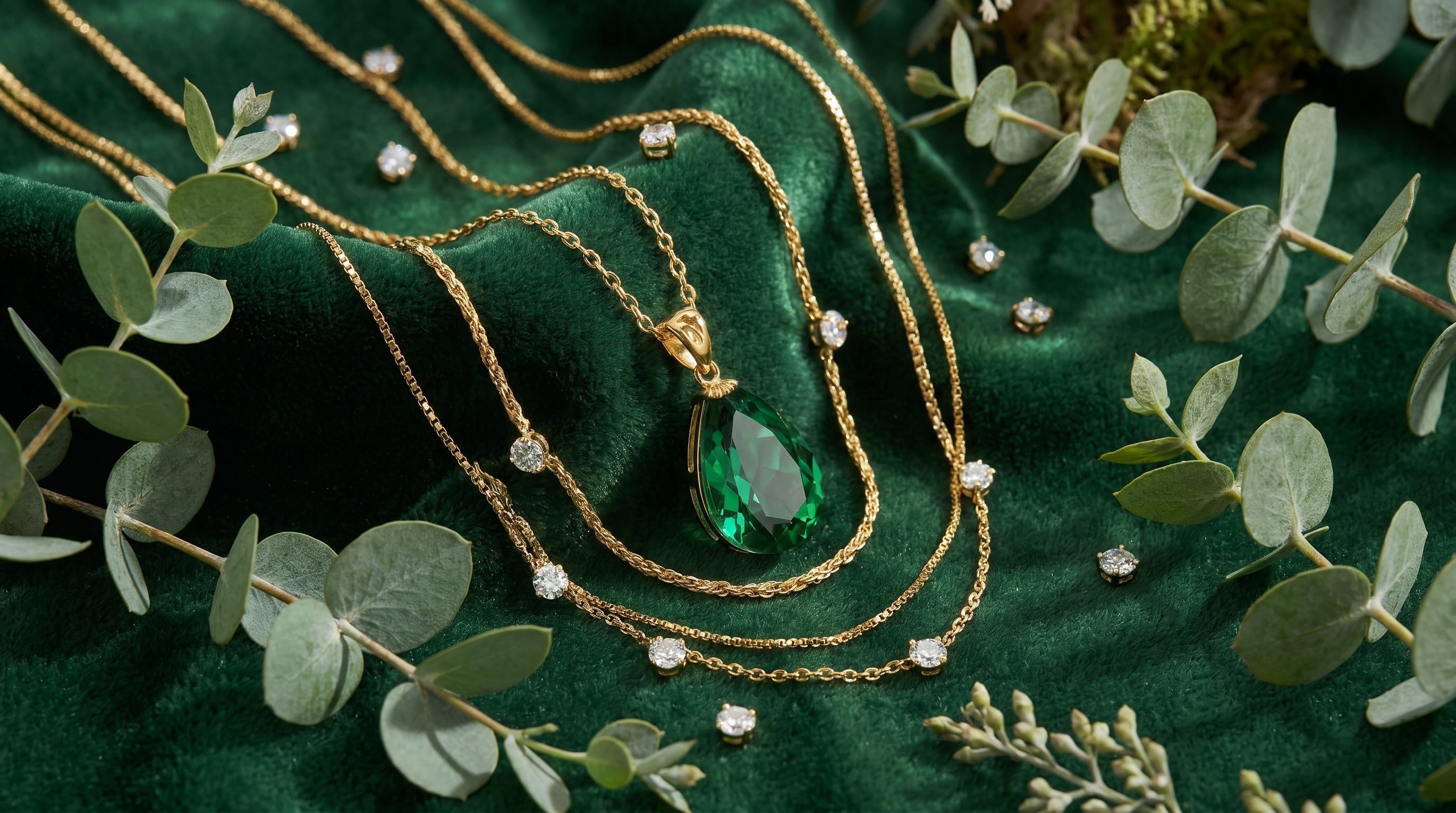
You're looking for a gold emerald pendant—and you want to get it right. Not just the color, not just the price, but the whole picture: the metal, the stone quality, the durability, and whether it'll still look stunning five years from now. That's exactly what this guide covers. The 2026 jewelry market offers more options than ever, from historic natural emerald necklace gold pieces to brilliant green moissanite alternatives that outperform mined stones in nearly every practical category. We've helped over 250,000 customers find their perfect piece, and we're going to help you find yours.

We'll decode gemstone quality, explain why certain metals perform better over time, and show you the real difference between a fragile natural emerald necklace and a robust, everyday-wear moissanite alternative. By the end, you'll know exactly what to buy—and what to avoid.
What to Know Before Buying a Gold Emerald Pendant
Before buying a gold emerald pendant, understand the difference between natural emeralds, lab-created stones, and durable alternatives like green moissanite. Natural emeralds offer historic prestige but require careful maintenance, while lab-grown and moissanite options provide exceptional everyday durability and brilliant color at a far more accessible price point.
A real emerald pendant carries genuine romantic weight. Mined from the earth, these stones have been coveted since the days of Cleopatra. But that romance comes with practical trade-offs. Natural emeralds are inherently brittle—they form under chaotic geological conditions, which means they almost always contain internal fractures and inclusions. You can't toss one into an ultrasonic cleaner or wear it during a workout without risking damage.
Here's the thing: the jewelry landscape in 2026 has expanded beautifully because of this limitation. Lab-created emeralds share the exact same chemical composition as natural stones but grow in controlled environments, resulting in fewer inclusions and better structural integrity. Even more compelling for daily wear is green moissanite. It delivers a vivid, mesmerizing green hue with a hardness rating that far surpasses emerald. If you want to put your necklace on and never think about it again, understanding these material differences is your first and most crucial step.
The setting and chain matter just as much. A pendant is only as secure as the metal holding it. The choice between solid gold, gold vermeil, and gold-plated stainless steel dictates not just the price, but how the piece ages with you. We'll break all of that down.
The 4Cs of Emeralds: Color, Clarity, Cut, and Carat
The value of an emerald is dictated by its 4Cs, with color being the most critical factor. A vivid, medium-dark green hue commands the highest price. Clarity is unique here—almost all natural emeralds feature visible internal characteristics called jardin, making completely flawless stones exceptionally rare and expensive.
If you've got your heart set on a natural emerald necklace, you need to speak the language of gemologists. Unlike diamonds, where a lack of color is prized, an emerald's entire identity is wrapped up in its hue, tone, and saturation. The most sought-after stones exhibit a pure, vibrant green, sometimes with a very slight bluish tint. Too pale and it looks washed out. Too dark and it loses its liveliness, appearing inky and flat. A premium colombian emerald pendant, for example, is famous for hitting that perfect glowing medium-dark green that seems to radiate its own internal light.
Clarity in emeralds is a completely different conversation than clarity in diamonds. Gemologists actually expect to see inclusions in an emerald. These internal features—tiny fractures, liquid-filled cavities, mineral crystals—are affectionately called "jardin," the French word for garden. They're proof of the stone's natural, chaotic birth deep within the earth. A beautiful jardin gives a real emerald pendant character and uniqueness. But if fractures reach the surface or compromise structural integrity, that's a serious red flag for durability.
Cut and carat weight work together to maximize visual impact. The traditional emerald cut—a rectangular shape with stepped facets—was designed specifically to protect the brittle corners of the gemstone from chipping. Today you'll also find stunning pear, oval, and round cuts in pendants. Because high-quality rough emerald is genuinely rare, price jumps exponentially as carat weight increases. A two-carat stone costs significantly more than double the price of a one-carat stone of identical quality.
Comparing Gemstone Options: Natural Emerald vs. Green Moissanite
Natural emeralds rank 7.5 to 8 on the Mohs hardness scale, making them susceptible to scratching and chipping during daily wear. Green moissanite ranks at 9.25, offering superior scratch resistance, brilliant fire with a refractive index of 2.65–2.69, and a vivid green hue that rivals the finest emeralds—without the fragility or high cost.
For decades, consumers believed that wanting a green gemstone meant accepting emerald's fragility. That's no longer true. Green moissanite has genuinely revolutionized colored gemstone jewelry. Moissanite is born from silicon carbide, originally discovered in a meteorite crater—it's stardust, essentially. Through advanced laboratory processes, we can now create it in a breathtaking array of colors, including a deep, rich green that rivals the finest Colombian emeralds.
The biggest differentiator is durability. Emeralds sit at 7.5 to 8 on the Mohs scale, but they're notoriously brittle due to internal fractures. A sharp tap against a desk or a drop onto tile can easily chip or shatter a natural emerald. Moissanite sits at 9.25. It's tough, scratch-resistant, and doesn't have the internal cleavage planes that make emeralds so vulnerable. You can read more about this structural difference in our detailed guide on Moissanite vs Diamond Hardness: What You Need to Know.
| Feature | Natural Emerald | Green Moissanite |
|---|---|---|
| Mohs Hardness | 7.5 - 8.0 (Brittle) | 9.25 (Highly Durable) |
| Brilliance & Fire | Soft, glowing light return | Exceptional sparkle; refractive index 2.65–2.69 vs. diamond's 2.42 |
| Clarity | Almost always included (Jardin) | Typically flawless or VVS clarity |
| Treatments | Over 99% are oiled or resin-filled | Untreated, permanent color |
| Everyday Wear | Requires caution; avoid harsh chemicals | Excellent for daily, worry-free wear |
And honestly? The optical performance alone makes moissanite worth serious consideration. With a dispersion rate of 0.104—that's 2.4 times higher than diamond's 0.044—moissanite throws rainbow fire that catches the light from across the room. While a natural emerald offers a soft, sleepy glow, a green moissanite pendant flashes brilliant green and white fire at every angle. For the modern buyer who wants maximum visual impact combined with peace of mind, moissanite is the stronger choice.
Choosing the Right Metal for Your Pendant
Selecting the right metal for your emerald pendant necklace gold depends on your lifestyle and budget. Solid 18K gold offers rich color and hypoallergenic properties, while 14K gold provides better scratch resistance. For budget-friendly durability, 18K gold vermeil and gold-plated stainless steel deliver luxurious aesthetics without the premium price tag.
The gemstone is the star, but the metal is the stage. The right metal secures your stone and dictates how the piece interacts with your skin and your wardrobe. When searching for an emerald necklace gold, you'll encounter several different metal purity levels and plating techniques. Understanding these saves you from disappointment later.
Solid gold is the traditional standard. 18K gold is 75% pure gold mixed with 25% alloy metals like copper and silver. It delivers that deep, buttery yellow color that pairs magnificently with green stones, and it's highly hypoallergenic. Because gold is a soft metal, though, 18K is more prone to scratching. 14K gold—58.3% pure gold—is often preferred for chains and everyday pendants because the higher alloy content makes it significantly harder against daily friction.
If solid gold stretches your budget, you don't have to settle for cheap, easily tarnished metals. 18K gold vermeil is an exceptional alternative. It takes a base of high-quality 925 sterling silver and coats it in a thick, legally regulated layer of solid gold—the exact look and feel of solid gold at a fraction of the price. Gold-plated stainless steel has also become a major trend in 2026. Stainless steel is tough, completely waterproof, and resistant to tarnish. Plated with gold, it creates a piece you can wear in the shower, at the gym, and out to dinner without a second thought.

Price Ranges and Understanding True Value in 2026
In 2026, a high-quality natural emerald necklace can cost anywhere from a few hundred dollars to tens of thousands for premium Colombian stones. Understanding treatments—such as oiling—is crucial, as over 99% of natural emeralds are treated to enhance clarity, which directly impacts their long-term value and care requirements.
The jewelry market can feel opaque when it comes to pricing. You might see an emerald necklace Tiffany sells for $5,000, then find a visually similar piece online for $200. That gap comes down to gemstone origin, clarity treatments, metal weight, and brand markup. Not magic—just math.
With natural emeralds, you're paying a massive premium for rarity. A high-quality half-carat natural emerald might cost $400 just for the loose stone. A clean, vivid two-carat stone? Easily $5,000 to $10,000. But here's where it gets interesting: over 99% of those natural emeralds have been treated. Because emeralds are full of tiny surface-reaching fractures, cutters soak them in cedarwood oil or synthetic resins. The oil seeps into the cracks, making them invisible to the naked eye. If you buy a natural emerald, you're buying an oiled stone. If that oil dries out or gets stripped by harsh cleaning chemicals, the stone will suddenly look cloudy and heavily fractured.
This is where the value proposition of moissanite becomes undeniable. A premium direct-to-consumer brand can offer a flawless, untreated green moissanite pendant set in heavy 18K gold vermeil for under $150. You get superior durability, permanent color that never requires re-oiling, and a level of sparkle a natural emerald can't match. You're paying for materials and craftsmanship—not the overhead of a legacy luxury brand. For a deeper dive into how alternative stones are priced against traditional mined gems, check out our analysis on Moissanite vs Lab Diamond Price: The 2026 Breakdown.
How to Spot Quality and Avoid Common Buyer Mistakes
To spot a quality real emerald pendant, look for vivid, even color and ask for disclosure regarding clarity enhancements. Avoid deals that seem too good to be true—heavily treated stones or glass simulants are common. Always insist on clear return policies and independent gemological certifications for high-value purchases.
Shopping for fine jewelry should be a joy, not a minefield. The most common mistake buyers make is falling for the phrase "genuine emerald" attached to a $30 price tag. If a natural emerald is completely transparent, vividly green, and costs less than a nice dinner, it's almost certainly green glass, cubic zirconia, or heavily dyed quartz.
When evaluating a piece, look closely at the setting. High-quality indian emerald jewelry, for example, is famous for its intricate, heavy gold work that securely cradles the stone. Whether you're buying a minimalist solitaire or an ornate halo design, the prongs should be thick, even, and smooth to the touch. A flimsy setting bends easily, and a bent prong means a lost gemstone. If you're buying a natural stone, ask the jeweler explicitly about treatment level. "Minor oil" is acceptable and standard. "Heavy resin filling" means the stone is structurally compromised and heavily artificially enhanced.
For those choosing moissanite, you still need to verify quality. Look for brands that are transparent about their materials—a reputable seller clearly states whether the metal is solid gold, vermeil, or plated steel. They offer robust warranties, GRA certification on their stones, and generous return policies that let you see the fire of the stone in your own home lighting before committing. To understand exactly what makes a premium stone stand out, read our comprehensive guide on How to Evaluate Moissanite Engagement Ring Quality.
Our Top Recommendations for Brilliant Pendants and Chains
Building your dream jewelry collection starts with versatile, high-quality pieces. We've curated a selection of our finest pendants and durable chains that deliver the luxurious look of a gold emerald pendant while utilizing advanced materials like 18K gold vermeil, sterling silver, and brilliant moissanite for lasting everyday wear.
At Awareness Avenue, we craft jewelry that delivers breathtaking luxury without the fragility or the exorbitant markups of traditional mined stones. Our pieces come with a lifetime warranty, secure checkout, and 30-day returns—because we're a family-run brand that stands behind every single piece we ship. Here are our absolute favorites for achieving that coveted green-and-gold aesthetic.
The Emera Pear - 18K Gold Vermeil
If you want the ultimate expression of elegance, The Emera Pear - 18K Gold Vermeil is a masterpiece. The pear cut is flattering in a way few shapes are—it draws the eye down and elongates the neckline beautifully. We use a brilliant green stone that captures the exact vivid hue of a premium Colombian emerald, but with the unmatched fire and durability of our advanced lab-created materials. Set in a thick layer of 18K gold vermeil over solid 925 sterling silver, this pendant delivers the rich, warm glow of solid gold. It's the perfect centerpiece for an anniversary gift or a signature daily wear piece.

The Emeraldine Bloom - Stainless Steel
For those who love intricate, nature-inspired designs, The Emeraldine Bloom - Stainless Steel is a revelation. A vibrant green center stone sits surrounded by a delicate, floral-inspired halo. Crafted from premium stainless steel with a durable gold-tone finish, it's completely waterproof and tarnish-resistant. Wear it through your toughest workouts and your longest days—the metal won't degrade, and it won't turn your skin green.
The Florisara Peridot Pendant & The Caelum Pendant
While emerald gets most of the spotlight, other green and blue-green stones offer incredible beauty. The Florisara Peridot Pendant set in S925 Sterling Silver offers a lighter, olive-toned green that feels fresh and vibrant—perfect for spring and summer styling. If you prefer cooler tones, The Caelum Pendant - S925 Sterling Silver delivers breathtaking brilliance in a sleek, modern setting. Both pieces showcase the versatility of sterling silver, providing a bright white-metal contrast that makes colored gemstones truly pop.
Building the Perfect Foundation: Our Premium Gold Chains
A pendant is nothing without a reliable, beautiful chain to hold it. The Boxed In Chain - Gold offers a sleek, geometric profile that catches the light beautifully while providing excellent tensile strength. For a more classic, fluid drape, the Connell Chain - Gold is an absolute staple. Its 2mm width is substantial enough to wear alone but delicate enough to slide perfectly through the bail of your favorite pendant.

If you prefer texture and visual interest, the Gilded Wheat Chain - Stainless Steel weaves links together in a complex pattern that looks luxurious while benefiting from the indestructible nature of stainless steel. For a modern, slightly edgy vibe, the Square Dance Chain - Gold Stainless Steel provides sharp, clean lines that pair exceptionally well with geometric pendants like emerald cuts or princess cuts.
For the men looking to make a bold statement—or anyone who loves a heavier, streetwear-inspired aesthetic—The Golden Standard Cuban - Stainless Steel delivers serious visual weight. And if you want a complete, coordinated look right out of the box, The Golden Duo Cuban Set - Stainless Steel gives you perfectly matched chain and bracelet proportions, engineered to last a lifetime without fading. Browse the full Men's Jewelry Collection for more options built to the same standard.
Frequently Asked Questions
Navigating the fine jewelry market brings up plenty of questions. We've compiled the most common inquiries about emeralds, moissanite alternatives, and gold chains to help you make an informed, confident decision for your next signature piece.
Can I wear my gold emerald pendant in the shower?
If your pendant features a natural emerald, take it off before showering. Warm water, soaps, and shampoos strip the protective oils from the stone's fractures, leaving it cloudy and brittle. If your pendant features green moissanite set in solid gold or gold-plated stainless steel, it's water-resistant and safe for occasional shower wear—though keeping it dry will prolong the life of any gold plating.
What is the difference between 14K gold and 18K gold vermeil?
14K gold is a solid metal alloy—58.3% pure gold mixed with other metals for strength—the same material all the way through. 18K gold vermeil is a solid 925 sterling silver core heavily plated with a thick layer of 18K gold. Vermeil gives you the rich, buttery color of 18K gold at a much more accessible price point, though the plating can wear over many years of heavy friction.
Why is green moissanite considered better for everyday wear than emerald?
Green moissanite is superior for daily wear because of its structural integrity. It ranks 9.25 on the Mohs hardness scale—making it nearly impossible to scratch—whereas emeralds sit at 7.5 to 8 and are notoriously brittle due to internal inclusions. Moissanite survives accidental drops and bumps that would easily chip or shatter a natural emerald.
How do I clean a pendant with a green gemstone?
For natural emeralds, use only a soft microfiber cloth and slightly warm water. Never use ultrasonic cleaners, steam, or harsh chemicals—these destroy the stone's oil treatments. For green moissanite, warm water, mild dish soap, and a soft toothbrush safely scrub away lotions and oils, restoring its brilliant fire in seconds.
Does a lab-created emerald look fake?
Not at all. Lab-created emeralds have the exact same chemical, optical, and physical properties as natural emeralds. They're real emeralds, grown in a controlled environment rather than mined from the earth. Because they grow in ideal conditions, they often look like the highest-quality natural emeralds—vivid color, excellent clarity, none of the heavy inclusions.
Final Advice for Your Forever Piece
Choosing the perfect pendant balances aesthetic desires with practical lifestyle needs. By understanding gemstone durability, metal quality, and true market value, you can confidently select a piece that delivers breathtaking brilliance, enduring strength, and a lifetime of beautiful memories.
You now know that while a natural emerald carries historical romance, it demands careful maintenance. You know that green moissanite—with its 9.25 Mohs hardness, refractive index of 2.65–2.69, and dispersion 2.4 times that of diamond—offers a revolutionary alternative that lets you live your life without constantly worrying about your jewelry. And you know how to choose the right metal foundation, whether that's the rich warmth of gold vermeil or the indestructible practicality of stainless steel.
Jewelry is meant to be worn, celebrated, and loved. It should make you feel confident the moment you clasp the chain behind your neck. If you're ready to find the piece that speaks to your unique style, explore our curated collections. Discover the perfect everyday staple in our Necklaces Collection, or find a meaningful gift in our May Birthstone Jewelry Collection. For those who want the absolute pinnacle of luxury and durability, browse our Solid Gold Pieces—and experience the Awareness Avenue difference for yourself. You can also explore our full range of Best Sellers to see which pieces our 250,000+ customers keep coming back for.

コメントを書く
このサイトはhCaptchaによって保護されており、hCaptchaプライバシーポリシーおよび利用規約が適用されます。