
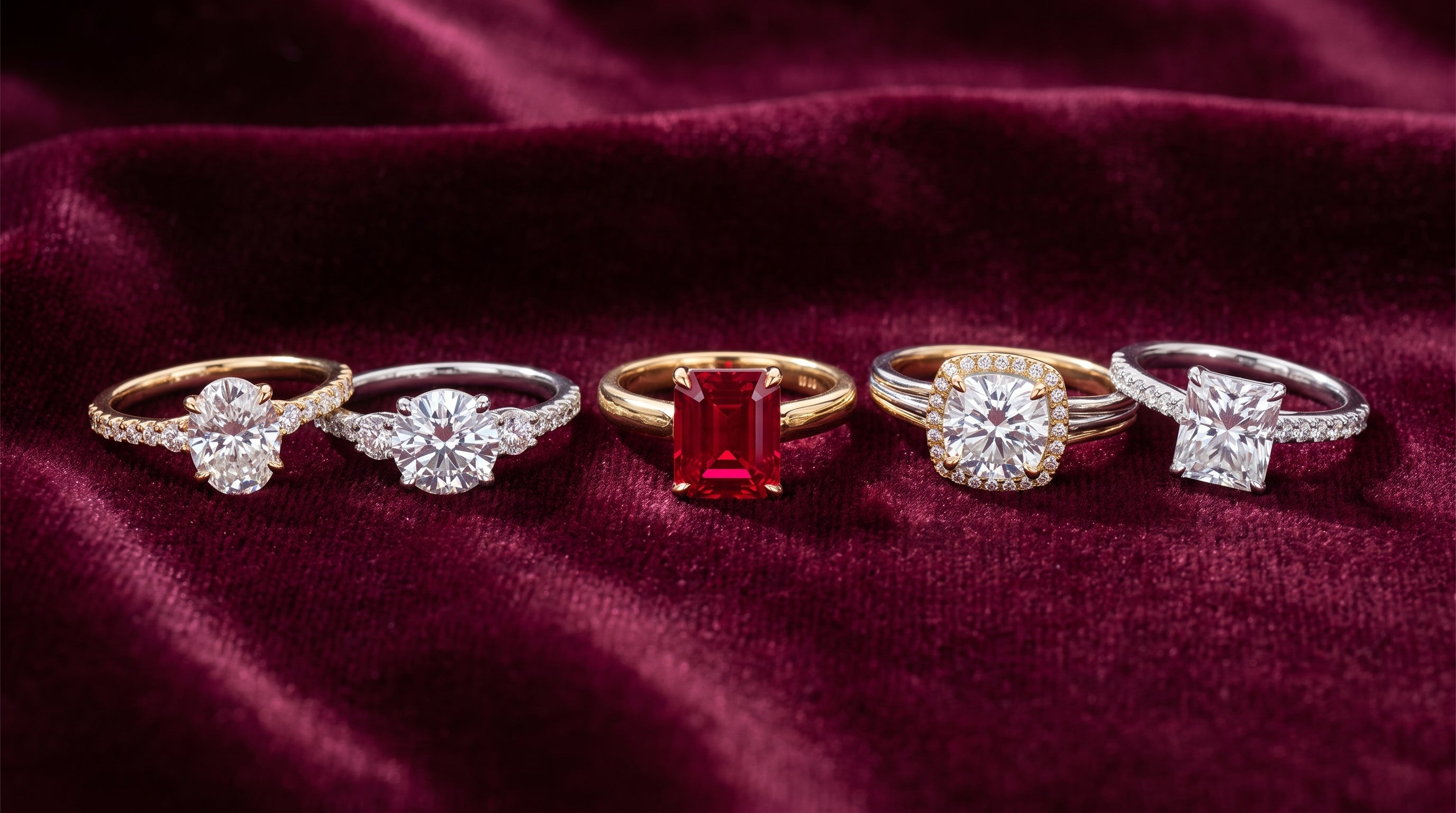
Search real ruby rings for sale and you land in three different stores at once. Specialist dealers show thousands of earth-mined ruby rings sorted by origin — Mozambique, Burma, Sri Lanka, Madagascar. Chain jewelers like Jared and Kay mix natural ruby styles with clearly labeled lab-created ruby halos in silver and gold. Estate specialists list one-off vintage 14k gold ruby and diamond rings that will never be restocked. All of them use the word "ruby." Not all of them mean the same thing by "real."
That single word is where most ruby shopping goes wrong. Below is what "real" means gemologically, what it means emotionally to most buyers, and how to tell — before you pay — which one you are actually being sold.
What "real ruby" actually means
The material test: is it corundum?
Ruby is the red variety of the mineral corundum, chemically aluminum oxide (Al₂O₃), colored red by traces of chromium. Gemologists identify it by measurable properties: a specific gravity of roughly 3.99 to 4.00, a refractive index in the approximate range of 1.760–1.779, and a hardness of 9 on the Mohs scale — one step below diamond at 10. That hardness is why ruby is a sensible choice for a ring you wear daily: corundum takes a high polish and resists the abrasion that dulls softer stones over decades.
Anything that is not corundum is not ruby, however red it looks. Red garnet and red spinel are different minerals with different compositions and optical behavior, and no amount of retail language turns them into ruby. If a listing avoids the word "ruby" on its own — using "ruby-colored," "simulated ruby," or a trade name instead — read that as a deliberate signal, not decoration.
The origin test: earth-mined or lab-grown?
Here is the collision. A lab-created ruby is grown under controlled conditions and has the same chemical composition and the same physical and optical characteristics as a natural ruby — it is corundum, it is 9 on the Mohs scale, it is red because of chromium. By the material test, it is real ruby. But most people typing "genuine ruby rings" or "natural ruby rings for women" are using "real" as shorthand for formed in the earth, not in a furnace. Both definitions are legitimate. Problems only start when a seller lets you assume one while delivering the other.
Practical consequences of the split: natural rubies command higher prices and are the ones collectors and investors buy, because their value has historically tended to appreciate. Lab-created rubies cost less and are typically cleaner inside, which means a bigger, brighter red stone for the same money — excellent for fashion rings, birthstone pieces, and buyers who care about color rather than provenance. Neither is a scam. An undisclosed swap between them is.
Judging quality: color first, then clarity, cut, and carat
Color does most of the work
Every credible ruby guide puts color ahead of the other factors. The most sought-after rubies are vivid red with a hint of pink or purple, saturated and evenly distributed through the stone. Too dark and the ruby reads dull or blackish in ordinary light; too light and it drifts toward pink and loses the intensity people buy ruby for. The trade term "pigeon blood" describes the peak of this range: a deep, intensely saturated red with subtle purple flashes. Very few stones genuinely qualify, and the phrase is used loosely in marketing — treat it as a description to be verified with your own eyes, not a grade.
Ask to see the stone in more than one lighting environment and against the skin tone of whoever will wear it. Red is unusually sensitive to light source, and a ruby that glows under a jeweler's spotlights can flatten under office lighting.
Clarity: inclusions are normal, and often useful
Natural rubies form over long periods in the earth and almost always carry internal features — silk-like fibers, needle-shaped inclusions, crystals, feathers or cracks, cavities, and fingerprint-like curved patterns. Some are visible unaided; most need a 10x loupe. Perfectly eye-clean natural rubies are rare and priced accordingly, but a stone with minor inclusions that do not disrupt its face-up beauty is usually the better value.
Inclusions also carry information. Under magnification, natural rubies tend to show straight growth lines and natural color zoning, while flame-fusion synthetic material often shows curved color banding or gas bubbles. Lab-grown stones are frequently "too perfect" — few or no inclusions at all. A large, flawless, deeply saturated red stone at a low price is not a bargain hiding in plain sight; it is a description of lab-created or treated material.
Cut: not graded like diamonds, but still visible
Rubies are not assigned cut grades the way diamonds are, so you have to look. A well-cut ruby has a pleasing outline, balanced proportions, and obvious brightness rather than dead patches. Specific checks worth making: round stones should have no flat spots or bulges in the outline; pear, heart, and marquise shapes should be symmetrical along their axis with sharp, well-defined points; and viewed from the side, the stone should be neither so shallow that it windows nor so deep that its weight hides below the setting. Emerald cuts, with their open tables and step facets, show color and clarity honestly — which is exactly why they suit a saturated red stone.
Carat: the most expensive way to buy beauty
Large rubies are exponentially rarer than small ones, so price does not scale in a straight line. If your budget is fixed, a slightly smaller stone with better color and cleaner appearance will usually out-perform a bigger stone that is dark, gray, or heavily included. Size is the easiest specification to inflate and the least reliable indicator of quality.
Treatments and origin claims: the disclosures that decide value
Heat treatment
Heating natural ruby to improve color and clarity is common and broadly accepted across the trade. It should still be disclosed. Genuinely untreated natural ruby is a premium category with premium pricing, and the difference between "natural" and "natural, untreated" is worth real money — so it is worth asking about in writing.
Lead-glass filling
This is the one to understand before you spend. Lead-glass filling infuses fractures so a stone looks dramatically clearer and more vibrant than the underlying ruby material. Composite stones like these are effectively a different product: less durable, vulnerable to heat and chemicals, and priced far below untreated ruby — when they are honestly labeled. For an engagement ring or anything worn daily, a smaller stone with clean, documented treatment status beats a large one that only looks impressive because it has been filled.
Origin claims
Origin genuinely affects desirability: Myanmar (Burma) ruby is the most prized in the trade, with Thai and Mozambique material close behind and capable of excellent clarity and color. But an origin label is only as good as the report behind it. Origin should never be allowed to overshadow the things you can actually see and verify — color, cut, treatment disclosure, and documentation. If a seller leads with "Burmese" and cannot produce a respected laboratory report, treat the claim as marketing.
How to verify a ruby before and after you buy
You can do a surprising amount yourself, and you should know where your own checks stop.
- Look first. Is the color consistent with ruby, or does it read orange, brownish, or artificially uniform? Does the color sit evenly through the stone or pool in one area?
- Use a 10x loupe. Natural inclusion patterns and straight growth zoning point toward earth-mined material; curved color banding and round gas bubbles point toward synthetic growth.
- Understand hardness, don't test it. Ruby at 9 on the Mohs scale can only be scratched by diamond or other corundum. Scratch testing is destructive and, when it is done at all, is confined by professionals to hidden areas such as the girdle or pavilion with the owner's permission. It is not a home test.
- Know the limits of UV. Many rubies fluoresce under ultraviolet light, but synthetic rubies can fluoresce too. Fluorescence supports the identification of ruby; it does not prove natural origin.
- Get a report for anything expensive. A report from a reputable gemological laboratory is the most reliable way to confirm that a stone is natural ruby, state its treatment status, and in many cases indicate geographic origin. For a significant purchase, this is the single highest-value step you can take.
Reputable sellers expect these questions. The answer you want is specific — "natural, heat-treated, report available" or "lab-created corundum" — not "it's a real ruby."
Where real ruby rings are actually sold — and which seller suits you
Specialist natural-ruby dealers
Dealers who focus exclusively on natural ruby list stones by country of origin and publish education on how color, clarity, cut, carat, origin, treatment, metal, and accent diamonds each move the price. Their catalogs run into the thousands of rings, including dedicated men's sections in 18k white and yellow gold. This is where to go if you want untreated, earth-mined material with documentation — and where you should expect natural, untreated, well-cut sub-carat ruby rings to be a four-figure purchase before accent diamonds or heavier metals are added.
Chain jewelers
Shoppers looking specifically for Jared ruby rings or Kay Jewelers ruby rings will find that both chain jewelers run large ruby categories that mix natural and lab-created stones. Jared carries designer natural ruby pieces — oval-cut ruby with accent diamonds in branded gold alloys — alongside simpler natural ruby stackable bands. Kay labels its lab-created ruby styles plainly, such as heart-shaped lab-created ruby haloed with small diamonds in sterling silver, complete with care instructions to avoid chemicals, heat, and ultrasonic cleaning. The trade-off is depth of disclosure: catalog copy rarely discusses treatment, inclusions, or lab reports. The upside is brand familiarity and in-store services like cleaning and resizing.
Vintage and estate specialists
If you searched "vintage ruby rings" or "vintage 14k gold ruby ring," estate dealers such as EraGem, Levy's Fine Jewelry, and Jack Weir & Sons are your segment. Their inventory is genuinely one-of-a-kind: period settings, 14k yellow gold, ruby-and-diamond combinations, with pricing driven by design, gold content, and rarity as much as by gem quality. Buyers here often accept older stones with more character — softer color, visible inclusions — as part of the appeal. Ask the same treatment and origin questions you would ask anywhere else; age does not exempt a stone from disclosure.
Ruby rings for men
Men's ruby rings are a distinct design category, not scaled-up women's rings. Both specialist natural-ruby dealers and customization-led jewelers run dedicated men's sections built around wider bands, heavier metal, simpler stone arrangements, and signet or wedding-band formats. If that is your search, filter into a men's category rather than a general one — the settings, not just the sizes, are different. Our related guide to men's gold engagement rings covers band width, metal color, and daily-wear durability in more detail.
Lab-created and simulated ruby sellers — including us
Sellers of lab-grown ruby position it on two arguments: chemically identical material to natural ruby, and a deep red color without mining or the natural-stone premium. That is an honest pitch as long as the label is on the front of the listing.
So, plainly: Awareness Avenue does not sell earth-mined natural ruby, and we do not sell vintage or estate pieces. Our red-stone rings are lab-created or simulated ruby — the Red Dream emerald-cut ruby sculpted ring in 18K gold vermeil and the Crimson Love emerald-cut ruby ring set in S925 sterling silver — and they sit in our July birthstone simulated ruby and colored gemstone rings collections. Check the individual product page for the exact stone description on any piece you are considering. If your definition of "real" requires an untreated, earth-mined stone with a laboratory report, buy from a specialist natural-ruby dealer — that is the right recommendation, even though it is not the one that sells you a ring today.
Budget: what you are really paying for
Ruby ring pricing is driven by a stack of variables, and the order matters more than any single number:
- Stone type. Natural untreated commands the most, followed by natural heat-treated, then lab-created, with lead-glass composites in a category of their own.
- Color. Saturation and evenness move price more than any other quality factor.
- Origin. Myanmar material carries a documented premium; Thai and Mozambique stones can deliver comparable beauty for less.
- Carat weight. Rarity rises steeply with size, so price does too.
- Clarity and cut. Eye-clean, well-proportioned stones cost more and look it.
- The ring itself. Platinum versus gold versus vermeil or sterling silver, accent diamonds, and design complexity can rival the stone's share of the total.
Set your range before you browse, then decide which single attribute you refuse to compromise on — color richness, stone size, or setting detail. Budget also extends past checkout: periodic cleaning, possible resizing, and insurance for a valuable piece are ongoing costs. Buyers weighing a colored center stone against a colorless one may also find our guides to 18k gold engagement rings and real alexandrite rings useful for comparing how gem type changes the math.
Settings, wearability, and care
Ruby's hardness makes it well suited to everyday wear, but the setting decides how much punishment the stone actually takes. Solitaires show color best and leave the girdle exposed; halos add perceived size and protect the edges; three-stone and vintage-inspired designs frame a smaller ruby so it reads larger. Emerald cuts pair naturally with clean bezel or four-prong settings. For hands-on work, a lower profile and protective prongs matter more than carat weight.
Metal changes the color reading, too. Yellow gold warms a ruby and emphasizes its red; white metals give a cooler contrast that can make lighter stones look more saturated; rose gold blends with pink-leaning rubies for a softer effect. Browse formats side by side in our rings collection before committing to a metal.
For cleaning, warm water, mild soap, and a soft brush handle ordinary buildup on most ruby rings. Avoid harsh chemicals and heat, and skip ultrasonic cleaners — the standard care instruction attached to lab-created ruby and diamond-accented styles at major retailers — unless the seller specifically confirms the piece is safe for them. Fracture-filled or composite stones are particularly vulnerable to chemicals and heat, which is one more reason treatment disclosure matters at purchase, not later.
A shopping checklist for real ruby rings
- Decide which definition of "real" you are buying: corundum, or earth-mined corundum. Write it down before you shop.
- Ask three questions of every seller: natural or lab-created; what treatment; is there a laboratory report.
- Prioritize color, then cut, then clarity, then carat.
- Look at the stone in at least two lighting conditions and on the wearer's hand.
- Treat "pigeon blood" and named origins as claims to verify, not specifications.
- For high-value purchases, budget for an independent laboratory report and insurance.
- Match the seller to the goal: specialists for natural and untreated stones, estate dealers for vintage 14k gold, chain jewelers for branded convenience, lab-created and simulated ruby for color-first buying at accessible prices.
Ruby rewards a buyer who asks specific questions. The stone's chemistry is fixed, its hardness is genuinely excellent for daily wear, and its color is the most emotionally direct in the gem world. The only variable you fully control is how clearly you understand what is sitting in the setting — and that is entirely answerable before you pay.

Laat een reactie achter
Deze site wordt beschermd door hCaptcha en het privacybeleid en de servicevoorwaarden van hCaptcha zijn van toepassing.