
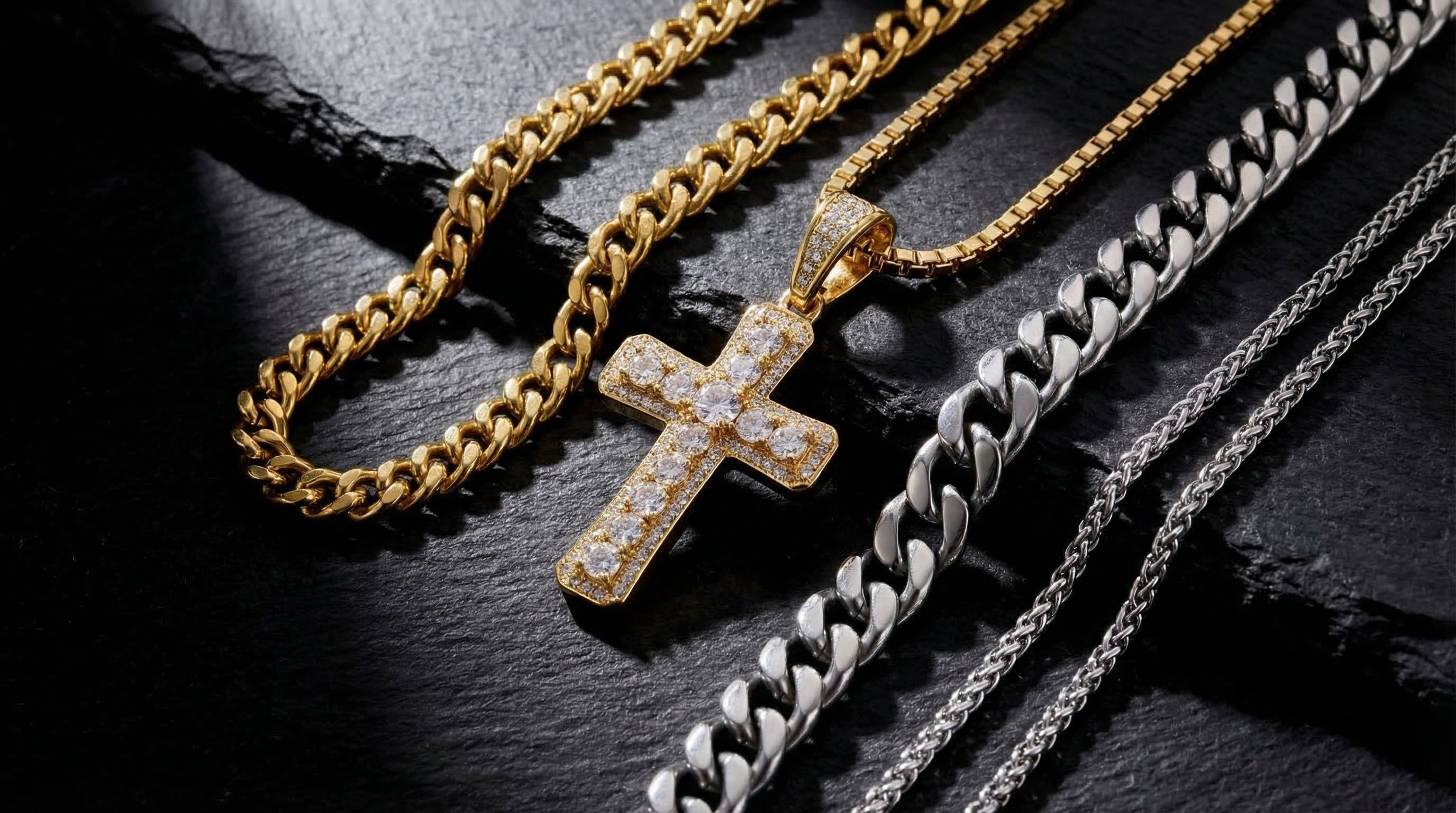

The most common failure in a men's gold pendant necklace is not the gold. It is the half-inch where the bail meets the chain, and the clasp on the other side of the neck. A pendant concentrates its entire weight on two or three links, and every time you pull a hoodie over your head, that stress repeats. This is why two necklaces that look identical in a product photo can behave completely differently after six months: one was built around the pendant, the other just happened to have a pendant hung on it.
This guide is built around that reality. Instead of listing pendant shapes, it works through the decisions that actually determine whether a gold pendant necklace survives daily wear and looks proportionate on your frame: purity and construction, chain style and width, bail and clasp engineering, length, and what to specify if you want something custom or genuinely unique.
Start With the Pendant, Then Buy the Chain to Match
Most men shop in the wrong order. They fall for a chain, then hang whatever pendant they own on it and wonder why the whole thing looks off-balance or sags at the front. Pendant first, chain second — because the pendant dictates the minimum chain width, the bail opening, and the clasp grade you need.
The proportionality rules that prevent most regret
Industry guidance on pendant-to-chain pairing is fairly consistent, and it is worth treating as a hard constraint rather than a suggestion:
- Small pendants (under 1 inch): pair with delicate chains around 2–3mm. Understated, easy to wear under a collar, appropriate in conservative workplaces.
- Medium pendants (1–2 inches): pair with chains around 4–5mm. This is the most versatile combination for men, moving between casual and dressed-up contexts without looking costume-like.
- Large pendants (2–3 inches): require substantial chains in roughly the 5–8mm range so the chain does not visually disappear or physically strain.
- Oversized pendants (over 3 inches): demand the most robust chains and work best as a single focal point, not as one layer in a stack.
Undersizing the chain is the expensive mistake. A thin chain paired with a heavy pendant creates stress concentration at the connection point, which is precisely where clasps fail and links deform. Oversizing goes the other way: a heavy chain with a tiny pendant reads as imbalanced, and the pendant stops being the point.
Check the bail before you check anything else
The bail is the loop or hoop at the top of the pendant. It has to physically accept your chain, and a 4mm Cuban link will not thread through a bail sized for a 2mm cable. Before buying, confirm the bail's internal opening against the chain width you intend to use. If a seller does not publish that measurement, ask — reputable sellers welcome verification questions and supply specifications without resistance.
Gold Purity Decoded: 10K, 14K, 18K and Gold-Tone Alternatives
"Gold" on a product page can mean four different things, and the difference matters more for a pendant necklace than for almost any other piece of men's jewelry, because pendants swing, knock against buttons, and rest against skin all day.
What the karat numbers actually mean
Karat is a purity fraction. 10K gold is 41.7% pure gold, 14K is 58.3%, and 18K is 75%. The remaining percentage is alloy metal, and that alloy is what supplies hardness.
- 10K gold: the most alloy-heavy of the three, which makes it the most scratch-resistant and the least expensive per gram. The tradeoff is a noticeably paler yellow tone that some men find washed out next to richer gold.
- 14K gold: widely regarded as the sweet spot for men's everyday jewelry, offering meaningfully better durability than higher-karat gold while retaining a distinctly warm yellow color. It is the most popular karat for men's pieces.
- 18K gold: the richest color and the highest precious metal content, but softer and more prone to scratching and bending. Reasonable for an office environment, less sensible for manual work, contact sports, or a piece you never take off.
If you work with your hands or train regularly, the honest recommendation is 14K or even 10K. If your pendant lives mostly under a dress shirt, 18K is defensible. Our companion guide to 14K gold chains for men goes deeper on how karat interacts with chain construction.
Solid, hollow, plated, and gold-tone stainless steel
Karat tells you purity. It does not tell you how much metal is actually in the piece. Hollow chains reduce material by making the links tubes rather than solid wire; they are lighter and cheaper, but they develop thin spots and break in ways that are often uneconomical to repair. Solid construction is substantially more durable. For a chain that has to carry a pendant, solid is the safer specification.
Gold-plated pieces put a thin gold layer over a base metal, and that layer wears through at friction points — exactly where a bail rubs a chain. Gold-tone stainless steel is a different proposition: the color is a finish, but the underlying metal is chosen for corrosion resistance rather than as a cheap filler. Stainless steel resists tarnishing, tolerates sweat and humidity, and requires minimal maintenance, which is why it consistently earns praise from men with active lifestyles and why it is the base we use across pieces like the Avenue Cuban Chain in gold stainless steel and the Divine Cross Pendant in gold stainless steel. Be clear with yourself about which category you are buying, and be suspicious of any listing that blurs the line.
Reading hallmarks
Karat gold jewelry is normally stamped, usually on the clasp or near a connection point. Look for:
- 10K or 417
- 14K or 585
- 18K or 750
On authentic pieces the stamp should be sharp and well defined, not smeared or shallow. Marks from recognized assay offices — an anchor for Birmingham, a leopard's head for London, and similar pictorial symbols — indicate that an independent institution verified purity. A magnet test is a useful first screen, since real gold is not magnetic, but it is not conclusive: some counterfeit chains use non-magnetic base metals. For a significant purchase, an appraisal from an established jeweler gives you a retail value benchmark before you negotiate, not after.
Chain Styles That Can Actually Carry a Pendant
Chain pattern is not purely cosmetic. Each construction distributes load differently, and a few popular styles are genuinely poor choices for pendant duty.
Reliable pendant carriers
- Cable: uniform oval links, strong, and among the easiest chains to repair when a link does give out. A sane default for a first pendant necklace.
- Cuban link: tightly interlocking links of uniform size, giving bold visual weight and excellent durability. Ideal when the pendant is medium to large, or when you want the chain to hold its own. The Everyday Armor Cuban Chain at 4mm sits right in the versatile mid-range.
- Figaro: one elongated link alternating with two or three shorter links, distinctive without being loud, and structurally sound.
- Franco: a V-shaped interlocking pattern that is notably durable and flexible, resisting tangles and kinks while still draping well.
- Box: square links that sit flat and feel substantial for their width — see the Boxed In Chain or the faceted Square Dance Chain.
- Wheat and rope: both offer texture and light-catching surface. Rope is known for strength and sparkle but must be thick enough not to sag under a pendant; a 4mm option like the Golden Rope Chain handles more weight than a 2.5mm version such as the Legacy Rope Chain, which suits a small pendant or solo wear. The 3mm Gilded Wheat Chain splits the difference. Our guide to gold rope chains covers the thickness question in more detail.
Styles to avoid under a pendant
Snake chains are built from tightly connected plates that resemble snakeskin. They look sleek, but they are prone to kinking, and a kink is usually permanent. Herringbone behaves similarly. Both are frequently chosen on looks alone and then abandoned after the first crease. Very thin chains under 3mm are also poor pendant carriers unless the pendant is genuinely tiny — a 2mm chain like the Connell Chain is excellent worn alone or as a fine layering piece, but it is not the right base for a heavy medallion.
A field test worth doing
If you can handle the chain in person, gently flex a short section. Quality links resist deformation and return to shape. Inferior links bend or twist permanently, which tells you the alloy or the craftsmanship is not up to standard.
The Clasp: The Cheapest Part That Costs the Most
Across consumer complaints, the single most cited failure is not a snapped chain — it is a clasp that opened on its own and took the entire necklace with it. The economics are brutal: a modest saving on the fastener routinely results in the loss of an expensive chain and pendant together.
Clasp types ranked for pendant necklaces
- Lobster clasp: spring-loaded, claw-shaped, secure, and easy to operate one-handed. The right default for anything valuable or heavy.
- Spring ring: smaller and more discreet, but less reliable, with a tendency to release under pressure because of its size.
- Magnetic: convenient, but insecure. It can separate without warning, which makes it a poor match for a piece you care about.
How to judge clasp quality
Look for thick walls around the clasp opening rather than thin stamped metal. The spring should move smoothly and snap back decisively every time, not intermittently. Connection points should be welded rather than soldered or glued, since glued joints degrade. Finally, the clasp metal should match the chain's karat; mismatched metals can corrode or oxidize at the junction, which is both an appearance and a structural problem. The governing principle: the weakest component of the necklace should still be stronger than the chain itself.
Length, Fit, and How the Pendant Sits
Standard men's necklace lengths run from 18 to 24 inches, and the choice changes where the pendant lands and how visible it is.
- 18 inches: sits close to the base of the neck. Best under a collar, or for men with slimmer necks who want the chain visible above a crew neckline.
- 20 inches: rests on or just below the collarbone for most men, and is the most popular everyday length. A pendant here reads clearly without dominating.
- 22 inches: a more relaxed fit, and the practical choice if you plan to wear the pendant over a shirt. Our dedicated breakdown of the 22-inch men's chain covers who this length suits best.
- 24 inches: lands mid-chest, which gives maximum visibility over garments and suits larger pendants and streetwear styling.
Two adjustments matter. First, add length if you have a broader neck or chest, since the same nominal measurement rides higher. Second, remember that a pendant adds visual drop below the chain's resting point — a 2-inch pendant on a 22-inch chain sits roughly where a bare 24-inch chain would.
Metal color and wardrobe
Yellow gold complements warm skin tones and pairs naturally with earth tones, browns, and deep colors like royal blue or hunter green. White gold and platinum tones stay neutral and work well with black, dark gray, and cool winter palettes. Rose gold brings warmth and flatters a wide range of skin tones. Introducing a new metal color to your rotation means either committing to more pieces in that tone or choosing outfits that accommodate it — worth thinking through before you buy a fourth chain in a color you own nothing else in.
Custom and Unique Gold Pendants: What to Specify Before You Order
Custom work is where men's gold pendants get genuinely personal, and where vague briefs produce disappointing results. Engraving — initials, dates, coordinates, a short phrase — consistently increases how much owners value a piece, because the meaning is fixed to them rather than to a design trend.
The brief checklist
- Finished dimensions in millimeters, not "medium." Height, width, and thickness.
- Metal and karat, plus whether the piece is solid or hollow. Hollow custom pendants exist and are not always disclosed.
- Approximate finished weight in grams. This drives both cost and whether your chain can carry it.
- Bail internal diameter, matched to the chain you already own or intend to buy.
- Engraving depth and placement, including whether it is on the reverse and whether it will remain legible after polishing.
- Finish: high polish, brushed, matte, or a two-tone contrast. Brushed hides micro-scratches better than high polish on daily-wear pieces.
- Stone specifications, if any: stone type, cut, size, and setting style.
Stones on men's pendants
If you want visible sparkle, understand what you are choosing. Moissanite is silicon carbide, not carbon, and scores 9.25 on the Mohs hardness scale against diamond's 10 — hard enough to resist scratching from nearly anything other than a diamond. Its refractive index is higher than diamond's, so it throws more colorful fire and a rainbow flash, while diamond returns a whiter brilliance. Whether that is a feature or a drawback depends entirely on the look you want; it is a real aesthetic difference, not a defect. Notably, moissanite shares diamond's thermal conductivity, so a standard diamond tester will not distinguish the two. If a seller supplies a GRA report for a moissanite stone, verify the report number on the issuer's own site and check that the stated carat weight, color, clarity, and proportions match the stone in hand. GIA remains the recognized authority for diamond grading; a GRA certificate is a preliminary grading document and should not be presented as its equivalent.
Symbolism still drives most purchases
Cross pendants remain the most broadly worn men's pendant category, carrying associations of faith, sacrifice, hope, strength, and protection — the reason we offer both a slim Divine Cross and the heavier Apostle Cross. Dog tags suit men who want a structured, masculine silhouette that takes engraving well. Animal motifs — lion, wolf, eagle, serpent — communicate leadership, independence, vision, and transformation. Minimalist geometric and abstract forms serve men who want presence without narrative. If you are still deciding on a shape, our roundup of unique men's pendants is a useful shortlist, and the full men's jewelry collection shows how pendants pair with different chain widths.
Vetting the Seller Before You Spend
Design and price are the easy parts to compare. The harder and more consequential comparison is the seller.
What to verify
- Published specifications. Metal, karat or base material, construction (solid or hollow), chain width in millimeters, length options, clasp type, pendant dimensions, and weight. Missing specs are a signal, not an oversight.
- Independent reviews. Look for patterns across Google, Trustpilot, or jewelry forums rather than a handful of testimonials on the seller's own site.
- Legitimate business details. A physical address, working contact channels, and responsive support.
- Return policy clarity. A straightforward return process matters most with jewelry, where fit and scale are hard to judge from photographs.
- Documentation on request. Receipts, hallmark confirmation, and appraisal or certification paperwork where relevant.
Be skeptical of dramatic discounts from unfamiliar sellers. Prices far below the market for a stated karat and weight usually indicate misrepresented purity, hollow construction sold as solid, or plating sold as solid gold. Where warranty or protection coverage is offered, read what it actually requires — some programs are conditional on periodic professional cleaning and inspection, and coverage lapses if those are skipped.
Care That Extends the Life of a Gold Pendant Necklace
Match the piece to your routine rather than fighting your routine. Chlorinated pools, salt water, and harsh chemicals accelerate wear on lower-karat gold and silver; corrosion-resistant materials handle those environments far better. Take the necklace off before contact sports, and be aware that never removing a chain is convenient but increases cumulative stress on the bail and clasp.
Store pendants flat and separately so chains do not abrade one another, and never coil a snake or herringbone chain tightly. Clean with warm water, a drop of mild soap, and a soft brush around the bail, where skin oils and lint collect first. Every few months, run a fingernail along the links either side of the bail — if you feel a flat spot or thinning, that is your early warning to have the section repaired before it separates. Chain repairs and clasp replacements are routine work for a bench jeweler, and a soldered link caught early costs far less than a replaced chain.
If you are building a coordinated look rather than a single piece, matching metals and finishes across chain, bracelet, and rings is the fastest way to make a collection read as intentional. Our guide to men's jewelry sets covers how to layer without clashing, and the Origin 1 collection is built around consistent gold tone across pieces.
Quick Answers
Does the pendant have to be the same karat as the chain?
It should at minimum match in metal type and tone. Mismatched metals at the bail and clasp junction can oxidize or corrode where they contact, and mismatched color reads as accidental. Deliberate two-tone combinations can work, but they need to look chosen, not compromised.
Is 10K or 14K better for a men's pendant?
10K is harder and more scratch-resistant thanks to its higher alloy content, but paler in color. 14K is warmer in tone and still substantially more durable than 18K. For most men wearing a pendant daily, 14K is the balanced answer; choose 10K if scratch resistance outranks color for you.
What chain width supports a heavy pendant?
For pendants over 2 inches, plan on 5–8mm. For pendants in the 1–2 inch range, 4–5mm is appropriate. Below 3mm, restrict yourself to pendants under an inch.
Can I wear a gold pendant necklace in the shower or the gym?
Solid karat gold and stainless steel tolerate moisture and sweat well; plated pieces do not, since friction and moisture wear the plating at contact points. Chlorine and salt water are the harshest exposures — remove the necklace for swimming regardless of material.
Will a jeweler be able to tell moissanite from diamond?
Not with a standard thermal diamond tester, because both stones conduct heat similarly. A trained jeweler distinguishes them visually by the difference in fire and dispersion, and by examining any laser inscription on the girdle under 10x magnification.
Buy in this order and the rest resolves itself: choose the pendant that means something to you, size the chain to carry it, insist on a lobster clasp and welded connections, confirm the hallmark or the base material in writing, and pick a length that puts the piece where you actually want it to sit. That sequence eliminates nearly every failure mode described above — and it is the difference between a pendant you wear for a season and one you keep.
Laat een reactie achter
Deze site wordt beschermd door hCaptcha en het privacybeleid en de servicevoorwaarden van hCaptcha zijn van toepassing.