
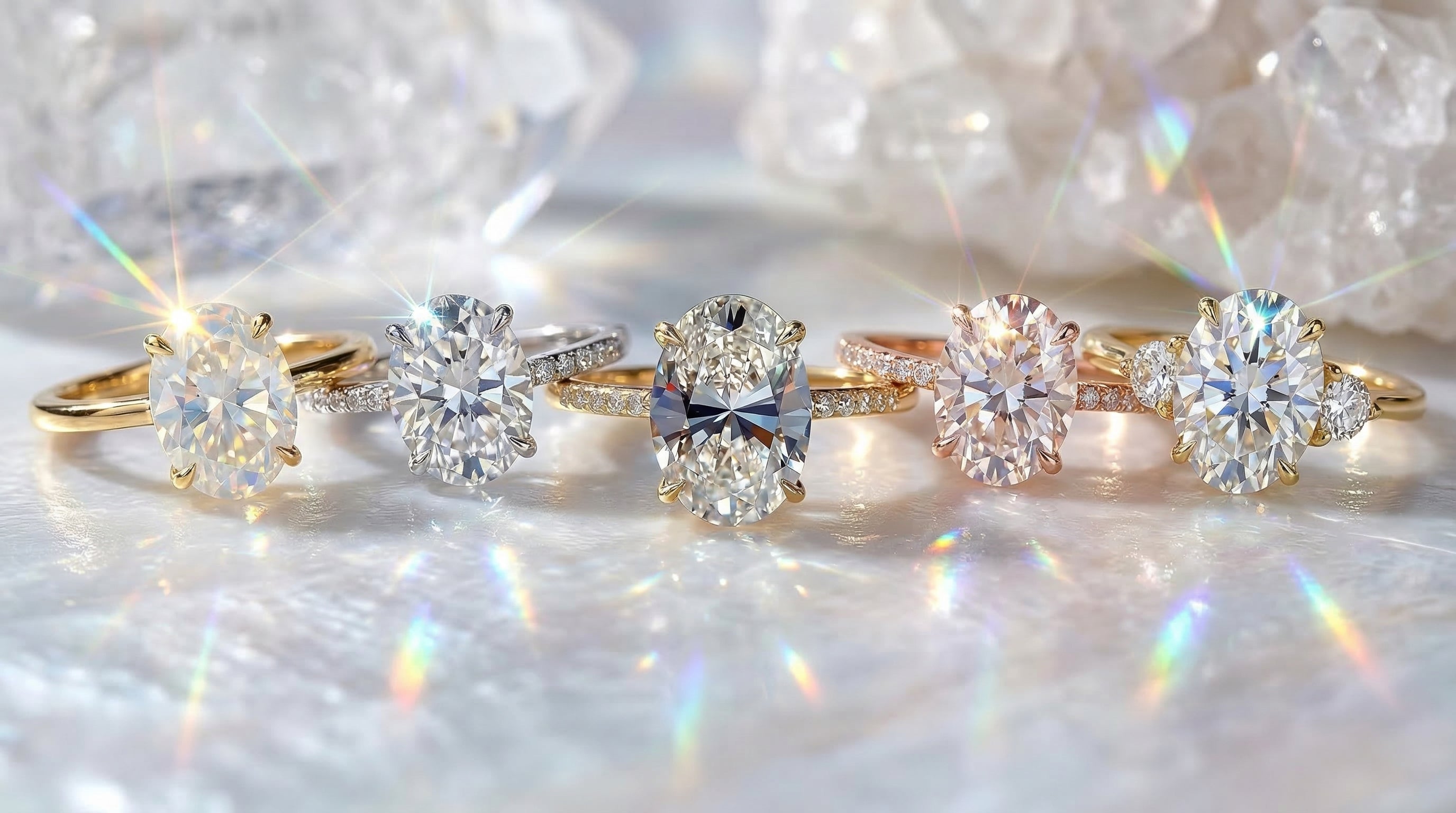
If you've been Googling "moissanite vs cubic zirconia vs diamond" for the past hour, here's the short answer: one of these stones will look identical in ten years, one will look better than a diamond, and one will be cloudy and scratched before your first anniversary. Knowing which is which changes everything about how you shop for fine jewelry. We've helped over 250,000 customers make this exact decision, and the right choice is almost never the one the traditional jewelry industry wants you to make.

What to Know Before Buying: The Big Three Explained
When comparing moissanite vs cubic zirconia vs diamond, the main differences come down to durability, brilliance, and price. Diamonds offer traditional prestige and maximum hardness. Moissanite delivers superior fire and lifetime durability at a fraction of the cost. Cubic zirconia is a budget-friendly option that degrades within months of daily wear.
Diamond: The Traditional Standard
Diamonds have held the crown in the bridal jewelry market for nearly a century. Formed deep within the Earth's mantle under extreme heat and pressure, natural diamonds are composed of pure carbon and score a perfect 10 on the Mohs hardness scale—the hardest known natural substance on the planet. That density means a diamond won't scratch unless it's rubbed against another diamond. The sparkle is classic: crisp, white, and undeniably prestigious.
But that prestige carries a steep financial premium. And for a growing number of modern couples, the environmental and ethical concerns surrounding mined diamonds are impossible to ignore.
Cubic Zirconia: The Temporary Sparkle
Cubic zirconia—CZ—is a synthesized crystalline material made from zirconium dioxide, introduced to the mass market in the 1970s as a low-cost diamond simulant. Fresh out of the box, a high-quality CZ can look remarkably similar to a flawless diamond. Completely colorless. Zero inclusions. Genuinely impressive at first glance.
Here's the thing—that beauty is fleeting. CZ is relatively soft and highly porous. As you wear it, the stone absorbs hand lotions, soaps, and skin oils while simultaneously accumulating microscopic scratches from keys, countertops, and door handles. Within six to twenty-four months of daily wear, a cubic zirconia stone develops a cloudy, hazy appearance that no amount of cleaning can reverse. It's not a jewelry investment. It's a temporary placeholder.
Moissanite: The Brilliant Sweet Spot
Moissanite is a gemstone born from the stars—literally. Originally discovered in 1893 by French scientist Henri Moissan inside a meteorite crater in Arizona, natural moissanite is extraordinarily rare. Today, the moissanite used in fine jewelry is lab-created from silicon carbide under tightly controlled conditions, making it both ethical and consistent in quality.
It scores 9.25 on the Mohs scale, making it the second-hardest gemstone used in jewelry. It survives decades of daily wear without scratching. But here's where it gets interesting: moissanite has a refractive index of 2.65–2.69, compared to diamond's 2.42. Light doesn't just pass through moissanite—it splits, bounces, and returns to your eye as vivid flashes of spectral color. That phenomenon is called dispersion, or "fire," and moissanite's dispersion rating of 0.104 is 2.4 times higher than diamond's 0.044. Every GRA-certified stone we carry is engineered to maximize that effect. For buyers seeking engagement moissanite rings, this stone offers a permanent, ethical, and visually stunning alternative that stands entirely on its own merits.
Moissanite vs Cubic Zirconia vs Diamond: The Ultimate Comparison
The ultimate comparison between these three stones reveals clear distinctions in everyday performance. Diamond scores a perfect ten on the Mohs scale, while moissanite follows closely at 9.25—both ideal for lifetime wear. Cubic zirconia scores an eight, meaning it scratches and clouds quickly with daily use. Moissanite also leads on optical performance, with the highest refractive index and fire of the three.
| Feature | Diamond | Moissanite | Cubic Zirconia (CZ) |
|---|---|---|---|
| Hardness (Mohs Scale) | 10 (Maximum durability) | 9.25 (Excellent durability) | 8 to 8.5 (Prone to scratching) |
| Refractive Index (Brilliance) | 2.417 | 2.65 to 2.69 (Highest) | 2.15 to 2.18 |
| Fire (Dispersion) | 0.044 | 0.104 (Vibrant rainbow flashes) | 0.058 to 0.066 |
| Lifespan with Daily Wear | Lifetime / Heirloom | Lifetime / Heirloom | 6 months to 2 years |
| Visual Degradation | None. Remains clear forever. | None. Resists dirt and oils. | High. Clouds and scratches easily. |
Durability and Everyday Wear
The Mohs scale isn't linear—it's exponential. The gap in absolute hardness between an 8 and a 9.25 is enormous in practical terms. Moissanite's rating means it repels the daily hazards that destroy lesser stones without a second thought. Knock your moissanite ring against a granite countertop, a car door, or a gym weight. The stone stays pristine.
Cubic zirconia, sitting at an 8, can't survive that lifestyle. Micro-abrasions quickly dull the facet edges of a CZ, turning a once-sharp cut into a rounded, lifeless piece of glass. When evaluating cubic zirconia vs diamond or moissanite for anything you plan to wear every day, the choice narrows fast. Only diamond and moissanite qualify as true lifetime stones.
Brilliance, Fire, and Optical Magic
The way a gemstone handles light determines its beauty. Diamond has a refractive index of 2.417, giving it that classic, bright white sparkle that GIA standards have long used as the benchmark. Moissanite's RI of 2.65–2.69 means light entering the stone splits into two rays—because moissanite is doubly refractive—bouncing through the internal facets before returning to your eye with extraordinary intensity.
Hold a moissanite ring under a spotlight or direct sunlight and you'll see vivid flashes of blues, reds, and greens dancing within the stone. That's the dispersion at work. Some traditionalists prefer diamond's stark white light, and that's a completely valid preference. But many modern jewelry lovers actively seek out moissanite's mesmerizing, high-energy fire. Cubic zirconia, with its lower RI of 2.15, looks flat by comparison. It lacks depth. In motion, under real light, it fails to capture the magic that makes a ring worth wearing every day for the rest of your life.

Price Ranges and True Lifetime Value
True lifetime value goes beyond the initial price tag. Cubic zirconia costs the least upfront, but frequent replacements make it a poor long-term investment. Moissanite delivers the best durability-per-dollar, offering the longevity of a diamond at roughly eighty to ninety percent less than a comparable mined stone.
A high-quality, one-carat natural diamond runs between $4,000 and $8,000, depending on its specific grading. That price is driven by decades of controlled supply and marketing campaigns that equated financial sacrifice with romantic devotion. It's a powerful story. It's also an expensive one.
A one-carat cubic zirconia ring might cost $50. Feels like a steal—until you do the math. Because it clouds and scratches within a year, you'll replace it. Buy a new $50 ring every year for a decade and you've spent $500 on jewelry that always looks slightly degraded. You never build a sentimental attachment to the piece because it's inherently disposable.
Now consider moissanite. A flawless, precision-cut one-carat moissanite ring typically ranges from $400 to $1,000. Zero replacements required. It will look exactly the same on your fiftieth anniversary as it did the day you unboxed it. That's the financially savvy choice: lifetime durability and breathtaking optical performance, while preserving your capital for a house down payment, a dream honeymoon, or future investments. If you're weighing the specific costs between lab-created options, our detailed breakdown of moissanite vs lab grown diamond price offers even more clarity on how to maximize your budget.
How to Spot Quality in Your Chosen Stone
Spotting quality requires looking past the price tag and focusing on cut, color, and clarity. For moissanite, prioritize excellent cuts that maximize light return while minimizing unwanted color tints. High-quality moissanite should appear completely colorless and maintain its structural integrity and brilliant sparkle for a lifetime.
Evaluating Moissanite vs Lab Diamond
The conversation has shifted. Many buyers now find themselves comparing moissanite vs lab diamond rather than mined diamonds—and for good reason. Both are created in controlled laboratory environments. Both are ethically sourced and environmentally responsible compared to earth-mined stones. The choice between them comes down to optical preference and budget.
A lab diamond is chemically identical to a mined diamond. Same white sparkle, same single refraction, same GIA grading standards. Moissanite is a completely different mineral—silicon carbide—with its own fiery personality. When evaluating high-quality moissanite, look for stones graded D, E, or F on the color scale. Older generations of moissanite sometimes carried a slight yellow or grayish-green tint under certain lighting. Modern, premium moissanite is engineered to be completely colorless, letting its natural fire take center stage without muddy undertones.
Why Cut Matters Most
Whether you're comparing moissanite rings vs diamond, cut is the engine that drives the sparkle. A poorly cut diamond looks dull and lifeless. A poorly cut moissanite can look glassy or exhibit a "nailhead" effect—a dark circle in the center of the stone that kills the brilliance entirely.
Because moissanite has a different refractive index than diamond, it requires specialized cutting techniques. Expert lapidaries adjust the angles and proportions of each facet to maximize the stone's unique double refraction. A precision-cut moissanite delivers a crisp, clean pattern of light and dark areas—contrast—that gives the stone depth and character. If you want to dive deeper into selecting the perfect stone, our guide on how to choose the perfect moissanite breaks down the exact proportions to look for.

Our Top Moissanite Recommendations
Finding the perfect ring means matching your personal style with enduring quality. Each piece below features a GRA-certified, precision-cut moissanite set in premium metal, backed by our lifetime warranty and 30-day returns. These aren't just beautiful rings—they're the pieces our 250,000+ customers come back to recommend to their friends.
And honestly? The hardest part isn't choosing moissanite over diamond or CZ. It's choosing just one ring.
The Opaline: Elongated Elegance
Oval cuts are dominating the bridal landscape, and The Opaline shows exactly why. A breathtaking 2-carat oval cut moissanite elongates the finger while delivering a massive surface area of sparkle. The brilliant faceting of the oval shape captures moissanite's signature fire perfectly, throwing flashes of light with every movement of your hand. Substantial presence without feeling heavy. Modern romance, defined.
The Adelina Rae: Architectural Perfection
For those who prefer clean lines and understated luxury, The Adelina Rae is a revelation. Step-cut stones don't hide flaws—they demand absolute perfection in the material. This 2-carat emerald cut moissanite features long, parallel facets that create a "hall of mirrors" effect: broad, dramatic flashes of light rather than crushed-ice sparkle. Sophisticated. Bold. Unapologetically glamorous.

The Luna in Rose Gold: Warmth and Romance
Metal choice dramatically changes the personality of a ring. The Luna - Rose Gold pairs the icy, colorless brilliance of a premium moissanite center stone with the vintage-inspired warmth of a rose gold setting. The contrast is spectacular—flattering on a wide range of skin tones, with a soft romantic backdrop that makes the moissanite pop. Among our best selling moissanite rings, this combination of classic design and warm metal is a consistent favorite. Moissanite rings gold settings like this one prove that the right pairing elevates both the stone and the setting.
The Twisted Band: Dynamic Movement
Sometimes the magic is in the setting details. The Twisted Band 1CT Round Cut Moissanite Ring takes the timeless appeal of a round brilliant solitaire and elevates it with a beautifully interwoven shank. The twisted metal catches light from multiple angles, drawing the eye upward toward the perfectly proportioned 1-carat center stone. Delicate. Feminine. Structurally secure. Everyday luxury at its most wearable.
Frequently Asked Questions
Navigating the fine jewelry landscape naturally brings up questions about longevity, testing, and visual differences. Here are the most common questions we hear from customers deciding between moissanite, cubic zirconia, and diamonds for their engagement rings and everyday fine jewelry pieces.
Does moissanite get cloudy like cubic zirconia?
No—and this is the most critical distinction between the two stones. Cubic zirconia gets cloudy because it's a porous, relatively soft material that absorbs oils and accumulates micro-scratches over time. Moissanite is a dense, non-porous mineral with a hardness of 9.25. It won't cloud, haze, or change color. A quick wash with mild dish soap and warm water restores a moissanite ring to its original, day-one brilliance—even decades later.
Can a jeweler tell the difference between moissanite and diamond?
Yes, a trained gemologist looking through a jeweler's loupe can tell the difference. They look for "doubling"—because moissanite is doubly refractive, the facet junctions on the back of the stone appear doubled when viewed through the crown at an angle. Worth noting: basic thermal diamond testers will often read moissanite as a diamond because both stones conduct heat similarly. To learn more about how these stones interact with testing equipment, read our deep dive: does moissanite pass a diamond tester.
Is moissanite suitable for men's jewelry?
Moissanite is an exceptional choice for men's jewelry. Men's rings often endure significant daily abuse from tools, gym equipment, and active lifestyles—conditions that shatter or scratch a CZ stone rapidly. Moissanite's extreme durability makes it built for that kind of wear. The trend of moissanite rings men choose—from bold pinky rings to sophisticated wedding bands—is growing fast, because it delivers the flash of a diamond with the rugged resilience an active life demands.
Does moissanite look fake because it has too much fire?
Moissanite doesn't look "fake"—it looks like moissanite. The intense rainbow fire is a natural optical property of silicon carbide, not a flaw. While early generations of moissanite sometimes looked overly colorful or slightly tinted, modern precision cutting has refined this effect considerably. Today's premium moissanite balances white light return with vibrant dispersion. In natural daylight, it looks remarkably similar to a high-quality diamond. Under indoor spotlighting, it shows more colorful flashes. Many buyers actively prefer that heightened level of sparkle.
Final Advice for Your Forever Piece
Your final choice should align with your values, budget, and lifestyle. If you want lifetime durability and spectacular fire without the traditional diamond markup, moissanite is your definitive answer. It delivers an uncompromising balance of breathtaking beauty, ethical peace of mind, and exceptional everyday wearability—for decades.
The era of compromising on your jewelry is over. You don't have to go into debt for a mined diamond, and you don't have to settle for a cubic zirconia ring that clouds within a year. Moissanite offers a third path: genuine, lifetime luxury that respects your intelligence and your budget. A gemstone that stands proudly on its own, celebrated for its cosmic origins, its brilliant fire, and its indestructible nature.
Whether you're drawn to the classic warmth of moissanite rings gold settings, the sleek modernism of platinum, or the bold geometry of an emerald cut, your perfect piece is waiting. Stop settling for temporary sparkle. Invest in a stone that shines just as brightly on your golden anniversary as it does today. Explore our complete collection of engagement moissanite rings and discover the brilliant, ethical luxury you deserve.

Laat een reactie achter
Deze site wordt beschermd door hCaptcha en het privacybeleid en de servicevoorwaarden van hCaptcha zijn van toepassing.