
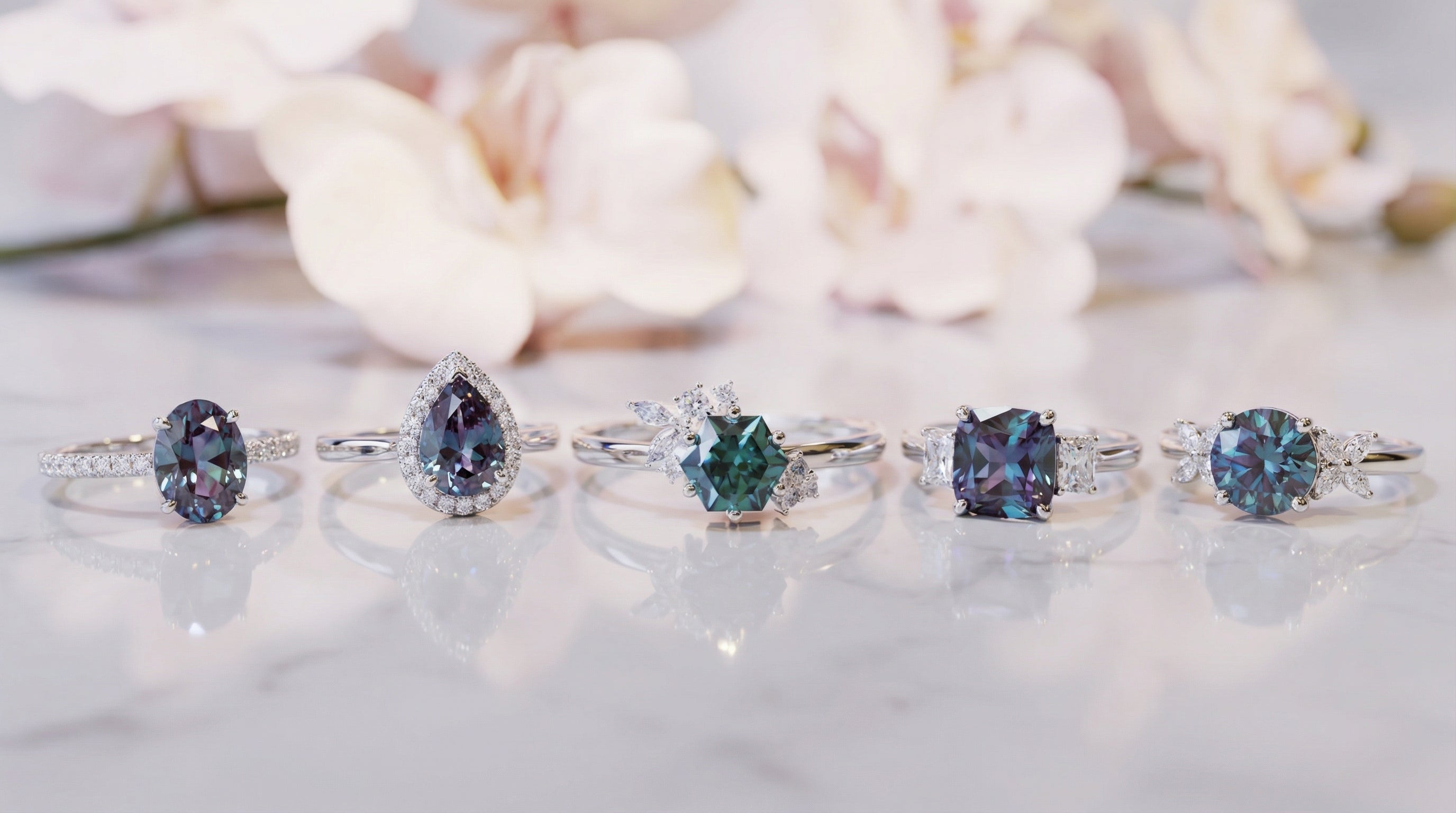
Sie betrachten einen Alexandrit-Verlobungsring – und wenn Sie erst einmal verstanden haben, was dieser Stein wirklich kann, werden Sie sich fragen, wie andere Edelsteine da mithalten sollen. Er wechselt von einem lebhaften Türkisgrün bei morgendlichem Sonnenlicht zu einem tiefen Himbeerlila bei Kerzenschein. Kein subtiles Schimmern. Eine vollständige, dramatische Verwandlung. Dieser Einkaufsführer für 2026 deckt alles ab: natürlich vs. im Labor gezüchtet, das Farbwechselverhalten in der realen Welt, Haltbarkeit und die zehn besten Alexandrit-Verlobungsringe, die derzeit erhältlich sind – damit Sie mit vollem Vertrauen kaufen können.

Was ist ein Alexandrit-Verlobungsring?
Ein Alexandrit-Verlobungsring besitzt einen seltenen, farbwechselnden Chrysoberyll-Edelstein, der sich bei Tageslicht von grünlich-blau zu rötlich-violett unter Glühlicht verfärbt. Bekannt als der Geburtsstein des Juni, trägt dieser Edelstein eine Alexandrit-Bedeutung, die in Glück, Wohlstand und Intellekt verwurzelt ist – was ihn zu einer begehrten Wahl für nicht-traditionelle Anträge macht, die tatsächlich etwas bedeuten.
Die Ursprünge des Steins sind so dramatisch wie sein Farbwechsel. In den 1830er Jahren im russischen Ural entdeckt, wurde er nach dem zukünftigen Zar Alexander II benannt – seine roten und grünen Farbtöne passten zu den Farben des Militärs des Kaiserlichen Russlands, und er wurde fast über Nacht zu einer nationalen Obsession. Heute sind diese ursprünglichen russischen Vorkommen im Wesentlichen erschöpft. Hochwertige Natursteine sind seltener als Diamanten, und ernsthafte Sammler zahlen entsprechend.
Hier ist die Wissenschaft hinter der Magie. Der Farbwechsel – offiziell als "Alexandrit-Effekt" bezeichnet – geschieht, weil Spuren von Chrom innerhalb der Kristallstruktur gelbes Licht absorbieren, während sie grüne und rote Wellenlängen durchlassen. Im Sonnenlicht dominiert die Empfindlichkeit Ihres Auges für Grün, so dass der Stein als Türkis oder Smaragd erscheint. Wechselt man zu warmem Wolfram- oder Kerzenlicht, übernehmen die roten Wellenlängen und fluten den Stein mit tiefem Himbeer- oder Violett. Diese doppelte Persönlichkeit verleiht der Bedeutung des Alexandrits einen romantischen Unterton, der schwer zu reproduzieren ist: eine Liebe, die sich verwandelt und in jeder Jahreszeit schön bleibt.
Natürlicher vs. im Labor gezüchteter Alexandrit-Verlobungsring
Ein natürlicher Alexandrit-Verlobungsring wird aus der Erde gewonnen und kostet zwischen 1.500 und 10.000 US-Dollar aufgrund seiner extremen Seltenheit. Ein im Labor gezüchteter Alexandrit-Verlobungsring hat genau die gleichen chemischen und optischen Eigenschaften, wird aber ethisch gewonnen und kostet zwischen 300 und 2.000 US-Dollar – derselbe Stein, ohne den zerstörerischen Bergbau-Fußabdruck.
Dies ist die folgenreichste Entscheidung, die Sie während Ihrer Suche treffen werden. Natürlicher Alexandrit ist tatsächlich einer der seltensten Edelsteine der Erde. Neue Vorkommen gibt es in Brasilien, Sri Lanka und Ostafrika, aber Steine mit einem dramatischen, nahezu 100%igen Farbwechsel sind außergewöhnlich schwer zu beschaffen. Wenn Sie sich natürliche Alexandritringe in den Luxushäusern angesehen haben, die Tiffany-Niveau haben, wissen Sie, was diese Knappheit kostet. Ein erstklassiger Zwei-Karat-Naturstein kann den Preis eines vergleichbaren Diamanten ohne zu zögern übertreffen.
Ein im Labor gezüchteter Alexandrit-Verlobungsring ist hingegen keine Fälschung oder Imitation. Diese Steine werden in kontrollierten Laborumgebungen mittels des Czochralski-Ziehvorgangs oder des Flussmittelwachstums gezüchtet – wodurch ein Edelstein mit identischer Mineralzusammensetzung, Härte und Farbwechselverhalten entsteht wie jeder aus der Erde gewonnene. Der Unterschied liegt im Ursprung, nicht in der Qualität.
Für den bewussten Käufer im Jahr 2026 bieten im Labor hergestellte Steine drei konkrete Vorteile. Sie sind konfliktfrei. Sie sind oft sauberer – natürlicher Alexandrit weist häufig sichtbare Einschlüsse auf, die aus der chaotischen Geologie der Erdkruste resultieren, während im Labor gezüchtete Varianten eine augenreine Klarheit bieten, die das Licht ungehindert durch den Stein lässt. Und sie kosten einen Bruchteil des Preises, wodurch Ihr Budget für eine bessere Fassung, ein passendes Band oder einfach mehr Geld in Ihrer Tasche frei wird.
Die Farbwechsel-Realität: Beleuchtung und Sichtbarkeit
Der Farbwechsel eines Alexandrit-Rings ist am dramatischsten beim Übergang von natürlichem Sonnenlicht zu warmem Glühlicht. Büro-Leuchtstofflampen und kühle LEDs lassen den Stein oft in einem schlammigen Bräunlich-Grün oder Gräulich-Violett erscheinen – nicht hässlich, aber nichts im Vergleich zu den lebhaften Vorher-Nachher-Fotos in der Schmuckwerbung.
Hier lauert die Reue des Käufers, und sie ist vollständig vermeidbar. Schmuckfotografie zeigt die extremen Enden des Spektrums – lebhaftes Smaragdgrün neben einem satten Rubinrot –, weil dies die Spitzenmomente des Steins sind. Das ist präzise. Aber es repräsentiert nicht, was Sie um 14 Uhr an Ihrem Schreibtisch unter kühler Bürobeleuchtung sehen werden.
Stellen Sie sich Ihren tatsächlichen Tag vor. Morgensonne durch das Küchenfenster: Ihr Ring blitzt in brillantem Türkis und Cyan. Kerzenlicht-Dinner am Abend: Er vertieft sich zu einem satten, samtigen Violett. Diese Momente sind real und wirklich atemberaubend. Aber in den fluoreszierenden Gängen eines Supermarktes oder unter den grellen LEDs der meisten modernen Büros nimmt der Stein eine gedämpftere Farbe an. Er wird nicht schlecht aussehen. Er wird einfach nicht seine volle Wirkung entfalten.
Hier realistische Erwartungen zu setzen, ist kein Pessimismus – so lieben Sie Ihren Ring auch noch in fünf Jahren. Wenn Sie einen Stein wollen, der unter allen Lichtverhältnissen einen gleichmäßigen, blendenden Glanz liefert, ist das eine ganz andere Sache. Aber wenn Sie die stimmungsvolle, transformative Qualität dieses Edelsteins anspricht, gehen Sie mit offenen Augen hinein und Sie werden nie enttäuscht sein. Entdecken Sie die gesamte Alexandrit-Ringkollektion, um zu sehen, wie verschiedene Schliffe und Fassungen mit dem Licht interagieren.
Haltbarkeit und täglicher Gebrauch: Hält er ein Leben lang?
Alexandrit hat eine Härte von 8,5 auf der Mohs-Skala – robust genug für den täglichen Gebrauch, erfordert aber mehr Pflege als härtere Steine. Für sehr aktive Lebensstile reduzieren schützende Fassungen wie Lünetten das Absplitterungsrisiko erheblich, oder ziehen Sie Moissanit mit 9,25 Mohs in Betracht, wenn Sie nahezu unzerstörbare Sicherheit benötigen.
Ein Verlobungsring lebt an Ihrer Hand durch alles: Lenkräder, Trainingseinheiten, Küchenarbeit, Gartenarbeit. Das Verständnis der Mohs-Skala ist nicht nur Gemmologie-Trivia – es ist praktisch. Alltäglicher Staub enthält Quarz, der auf der Skala bei 7 liegt. Mit 8,5 widersteht Alexandrit diesen täglichen Abnutzungen leicht. Er ist härter als Smaragde (7,5–8) und Morganit (7,5–8), zwei beliebte Alternativen, die tatsächlich mehr Schonung erfordern.
Wo Alexandrit schwächelt, ist im Vergleich zu Saphiren (9), Moissanit (9,25) und Diamanten (10). Wenn Sie im Gesundheitswesen, im Baugewerbe oder in der Gastronomie arbeiten – überall dort, wo Ihre Hände stark beansprucht werden – müssen Sie den Ring vor intensiven Aktivitäten bewusst ablegen. Absplitterungen an den Facettenkanten sind das Hauptrisiko, nicht Kratzer.
Ihre Wahl der Fassung ist genauso wichtig wie die Härte des Steins. Eine Lünettenfassung, die den gesamten Gürtel des Edelsteins in einem Rand aus Edelmetall umschließt, bietet einen wesentlich besseren Schutz als ein hochprofilierter Vier-Krappen-Solitär. Und wenn Sie die absolute Sicherheit eines Steins wünschen, der keinerlei Schonung benötigt, erklärt unser Leitfaden Moissanit vs. Diamant Härte: Was Sie wissen müssen genau, warum die 9,25er-Bewertung von Moissanit die Gleichung für den täglichen Gebrauch verändert.
Alexandrit vs. Moissanit: Was ist das Richtige für Sie?
Alexandrit liefert eine stimmungsvolle, wechselnde Farbe, die kein anderer Edelstein nachbilden kann. Moissanit bietet einen konstanten, blendenden Glanz unter allen Lichtbedingungen, mit einem Brechungsindex von 2,65–2,69, der den Diamanten (2,42) übertrifft, einer Dispersion von 0,104, die 2,4-mal so hoch ist wie die des Diamanten (0,044), und einer Mohs-Härte von 9,25, was ihn zur praktischsten Wahl für den lebenslangen täglichen Gebrauch macht.
Beides sind außergewöhnliche nicht-traditionelle Entscheidungen. Sie bedienen lediglich völlig unterschiedliche ästhetische Wünsche. Hier ist die Aufschlüsselung:
| Merkmal | Alexandrit (im Labor gezüchtet) | Moissanit |
|---|---|---|
| Visueller Reiz | Farbwechselnd (Grün/Türkis zu Rot/Violett) | Farblos mit intensivem Regenbogenfeuer (Dispersion) |
| Härte (Mohs-Skala) | 8.5 (Sehr gut) | 9.25 (Ausgezeichnet, nur vom Diamanten übertroffen) |
| Beleuchtungsabhängigkeit | Hoch. Die Farbe ändert sich dramatisch je nach Lichtquelle. | Niedrig. Funkelt brillant unter fast allen Lichtbedingungen. |
| Preisspanne (1 Karat) | $300 – $800+ | $100 – $300+ |
| Am besten geeignet für | Den Romantiker, der einen stimmungsvollen, einzigartigen, gesprächsanregenden Edelstein möchte. | Den praktischen Käufer, der maximalen Glanz, Haltbarkeit und Wert wünscht. |
Und ehrlich gesagt? Die Wahl läuft meist auf eine Frage hinaus: Möchten Sie einen Stein, der sich verändert, oder einen Stein, der konstant funkelt? Alexandrit ist eine lebendige, atmende Entität, die auf ihre Umgebung reagiert. Der Brechungsindex von Moissanit von 2,65–2,69 bricht Licht effizienter als Diamanten und wirft von jeder Facette, jederzeit, in jedem Raum, spektrales Regenbogenfeuer. Beide sind GRA-zertifiziert bei Awareness Avenue, beide kommen mit unserer lebenslangen Garantie und beide haben die Loyalität unserer über 250.000 Kunden weltweit gewonnen. Keine der beiden Antworten ist falsch.
Top Alexandrit-Verlobungsringe für 2026
Die besten Alexandrit-Verlobungsringe für 2026 kombinieren vintage-inspirierte Fassungen mit moderner, langlebiger Handwerkskunst. Von kühnen Sechseckschliffen über klassische Tropfenformen bis hin zu kompletten Brautsets maximieren diese Designs die farbwechselnden Eigenschaften des Edelsteins und bieten gleichzeitig einen sicheren, alltagstauglichen Tragekomfort.
Wir haben Jahre damit verbracht, diese Kollektion auf der Grundlage echten Feedbacks von echten Kunden – über 250.000 davon – zu verfeinern. Jeder der unten gezeigten Ringe wird in unserem ethischen Laborumfeld gefertigt, ist GRA-zertifiziert und wird durch unsere lebenslange Garantie und 30-tägige Rückgabemöglichkeit abgesichert. Hier sind unsere Top-Empfehlungen.
Das geometrische Wunder: The Gianna
Für die Braut, die Konventionen trotzt, ist The Gianna eine atemberaubende Offenbarung. Ein 1-Karat-Alexandrit im Sechseckschliff, gefasst in hochwertigem S925 Sterlingsilber, lehnt sich stark an modernes architektonisches Design an. Die scharfen, klaren Linien des Sechsecks schaffen ein faszinierendes Fenster in die farbwechselnden Tiefen des Steins – die stufenförmigen Facetten betonen Klarheit und tiefe, stimmungsvolle Töne, wodurch der Übergang von Türkis zu Violett bewusst und auffällig wirkt und nicht zufällig. Er passt wunderschön zu eleganten, minimalistischen Eheringen.
Der zeitlose Klassiker: The Martha
Wenn Sie die traditionelle Solitär-Silhouette lieben, aber die Persönlichkeit eines farbwechselnden Edelsteins wünschen, ist The Martha Ihr Match. Ein 0,8-Karat-Alexandrit im Rundschliff, erhältlich in Gold, Roségold und Silber. Der runde Brillantschliff ist für maximale Lichtreflexion konzipiert – selbst bei schwachem Licht fängt er jedes verfügbare Photon ein und zeigt den Farbwechsel in vollem Umfang. Das zarte Band hält den Stein als unbestrittenen Mittelpunkt.

Der königliche Heiligenschein: Die Aerina
Eine birnenförmige Stein, umgeben von einem Heiligenschein aus brillanten Akzenten, hat etwas unbestreitbar Königliches an sich. Die Aerina verfügt über einen 1,5-Karat-Alexandrit im Tropfenschliff in einem klassischen Halo-Design. Die Akzentsteine erfüllen zwei Zwecke gleichzeitig: Sie fügen einen Umfang aus hellem, weißem Glanz hinzu, der sich von dem wechselnden Mittelstein abhebt, und sie schützen physisch die spitze Spitze der Birne – den anfälligsten Teil des Schliffs. Dieses Design fängt die Essenz von natürlichen Alexandritringen im Vintage-Stil mit der Haltbarkeit ein, die das moderne Leben erfordert.
Das Statement-Oval: The Alexandria
Ovalschliff dominieren seit Jahren die Verlobungsringtrends, und ihr Einfluss auf 2026 lässt nicht nach. The Alexandria trägt einen 2-Karat-Alexandrit im Ovalschliff, der den Finger verlängert und eine riesige Oberfläche für das Farbspiel bietet. Ovalschliff haben eine größere Aufsichtsfläche als runde Schliffe mit gleichem Karatgewicht – Licht sammelt sich in der Mitte und erzeugt einen tiefen, satten Farbkern, der sich dramatisch verschiebt, wenn Sie Ihre Hand bewegen. Die visuelle Wirkung ist sofort spürbar. Durchsuchen Sie unsere gesamte Ovalschliff-Kollektion, wenn diese Silhouette Sie anspricht.

Der elegante Tränenfall: The Alvana
The Alvana bietet eine sanftere Variante der Birnenform – einen 1-Karat-Tränenalexandrit in einer raffinierten, flachen Fassung. Diese flache Fassung ist wichtig. Sie liegt eng an der Hand an, was weniger Hängenbleiben, weniger Verfangen an Stoffen und ein drastisch reduziertes Risiko bedeutet, den Stein an harten Oberflächen anzustoßen. Es ist die richtige Wahl für jeden, der mit den Händen arbeitet oder einfach einen Ring möchte, der im Alltag verschwindet, bis das Licht ihn genau richtig trifft.
Die komplette Vision: Das Chiara Set
The Chiara eliminiert das Rätselraten beim Anpassen eines Eherings an einen unkonventionellen Stein. Dieses 2-teilige Alexandrit-Verlobungsring-Set konzentriert sich auf einen kühnen 2-Karat-Alexandrit im Drachenschliff – eine scharfe, geometrische Form, die avantgardistischen Geschmäckern anspricht und auf dem Markt einzigartig ist. Der konturierte Ehering schmiegt sich perfekt an die scharfen Winkel des Verlobungsrings an und schafft einen fest miteinander verbundenen, kohärenten Look, der genau das symbolisiert, was er soll: zwei Leben, die nahtlos zusammengeführt werden.
Der zarte Ovalschliff: Die Dora
Wenn The Alexandrias 2-Karat-Präsenz für den täglichen Gebrauch zu viel ist, liefert The Dora dieselbe geliebte ovale Silhouette mit einem dezenteren 1-Karat. Erhältlich in mehreren Metallausführungen, liegt er bündig am Finger und bietet einen subtilen, raffinierten Farbschimmer. Dies ist der Ring, der Luxus flüstert, anstatt ihn anzukündigen – perfekt für die minimalistische Braut, die dennoch etwas wirklich Besonderes möchte.

Der Art Deco Traum: The Mercedes
The Mercedes ist ein Meisterwerk der Zurückhaltung. Ein 0,5-Karat-Alexandrit im Smaragdschliff in einem Design, das reine Art-Déco-Geometrie kanalisiert. Die Stufenschliff-Facetten funkeln nicht im traditionellen Sinne – sie erzeugen einen "Spiegelsaal"-Effekt, der breite, dramatische Lichtebenen über die Oberfläche des Steins blitzen lässt. Dieser Schliff erfordert eine außergewöhnliche Klarheit, da es keine brillanten Facetten gibt, die Einschlüsse verbergen könnten. Das Ergebnis ist ein zutiefst raffinierter Ring, der die reinste, gesättigtste Farbe zeigt, die der Stein erzeugen kann.
Der brillante Solitär: The Misella
Manchmal ist Einfachheit die kühnste Wahl. The Misella fasst einen 1-Karat-Alexandrit im Rundschliff in einem klaren, schmucklosen Band. Keine Halo. Keine aufwendige Metallarbeit. Nichts, was um Aufmerksamkeit wetteifert. Ohne Ablenkung geht der Blick direkt auf den Edelstein, und maximales Licht dringt aus jedem Winkel ein – wodurch der Farbwechseleffekt so lebendig und reaktionsschnell wird, wie der Stein es zulässt. Es ist ein zeitloses Design, das auch in dreißig Jahren nicht veraltet wirken wird.
Der romantische Schwung: The Vania
The Vania schließt unsere Top-Auswahl mit einem 1-Karat-Alexandrit im Ovalschliff auf einem subtil verdrehten, geschwungenen Band ab. Das sich verflechtende Metall fügt eine organische Textur hinzu und trägt seine eigene Symbolik – zwei Wege verschmelzen zu einem. Der Ovalschliff bietet eine hervorragende Fingerabdeckung und eine großzügige sichtbare Oberfläche, damit der Farbwechsel zur Geltung kommt, während das verdrehte Band das Gesamtdesign niemals gewöhnlich erscheinen lässt.
So erkennen Sie Qualität und vermeiden Kaufreue
Um einen hochwertigen Alexandritring mit Vertrauen zu kaufen, verlangen Sie eine gemmologische Zertifizierung durch Dritte, die Herkunft und Farbwechselstärke bestätigt, und kaufen Sie nur bei Juwelieren, die transparente Rückgaberichtlinien anbieten. Sie brauchen Zeit, um das Verhalten des Steins in Ihren eigenen Beleuchtungsumgebungen zu testen, bevor Sie sich festlegen.
Der Markt für erlesenen Schmuck hat seinen Anteil an unseriösen Akteuren, insbesondere bei seltenen farbwechselnden Steinen. Farbwechselnde Granate, synthetische Saphire und beschichtetes Glas werden von weniger gewissenhaften Anbietern alle als echter Alexandrit vermarktet. So schützen Sie sich.
Erstens: die Zertifizierung. Bei Natursteinen ist ein GIA- (Gemological Institute of America) oder AGS-Zertifikat (American Gem Society) unerlässlich. Es bestätigt, ob der Stein natürlich oder im Labor gezüchtet wurde, dokumentiert eventuelle Behandlungen und verifiziert das Karatgewicht. Bei im Labor gezüchteten Steinen stellen namhafte Marken eine GRA-Zertifizierung und eine detaillierte Dokumentation der chemischen Zusammensetzung und Wachstumsmethode des Steins bereit. Bei Awareness Avenue wird jeder Stein mit dieser Dokumentation versendet.
Zweitens: Rückgaberecht. Wie wir im Abschnitt über die Beleuchtung erläutert haben, hängt das Farbwechselverhalten von Alexandrit vollständig von Ihrer spezifischen Umgebung ab. Sie müssen den Ring zu Hause tragen, ihn mit ins Büro nehmen und ihn unter der Beleuchtung Ihres Lieblingsrestaurants betrachten, bevor Sie sich entscheiden. Jeder Anbieter, der eine strikte Rücknahmeausschlussrichtlinie für einen Alexandritring anbietet, ist ein Warnsignal. Unser 30-tägiges Rückgaberecht besteht genau aus diesem Grund – wir möchten, dass Sie sich in Ihren Feinschmuck in der realen Welt verlieben, und nicht nur unter Studiolicht.
Drittens: Qualität der Fassung. Ein hochwertiger Edelstein verdient eine hochwertige Basis. Achten Sie auf massives 14k oder 18k Gold, Platin oder S925 Sterlingsilber. Überprüfen Sie die Krappen – sie sollten gleichmäßig verteilt sein und bündig am Stein anliegen, ohne an Stoff hängen zu bleiben. Eine gut gefertigte Fassung schützt Ihre Investition und hält den Stein jahrzehntelang sicher. Unsere Massivgoldstücke werden genau nach diesem Standard gefertigt.
Häufig gestellte Fragen
Die Wahl eines so einzigartigen Rings wirft echte Fragen auf. Im Folgenden finden Sie die häufigsten, die wir von Kunden hören – direkt und ohne Umschweife beantwortet.
Sind Alexandritringe gut für Verlobungen geeignet?
Ja. Alexandrit-Verlobungsringe sind eine ausgezeichnete Wahl für alle, die eine nicht-traditionelle Ästhetik mit echter gemmologischer Substanz suchen. Mit 8,5 auf der Mohs-Skala sind sie gut für den täglichen Gebrauch geeignet – obwohl sie bei starker körperlicher Aktivität etwas mehr Pflege benötigen als Diamanten oder Moissanit. Der Farbwechseleffekt macht sie als Symbol der Verbundenheit wirklich einzigartig.
Warum ist natürlicher Alexandrit so teuer?
Natürlicher Alexandrit ist teuer, weil er wirklich selten ist. Die geologischen Bedingungen, die zur Bildung von Chrysoberyll mit der präzisen Chromkonzentration führen, die für den Farbwechseleffekt erforderlich ist, sind außerordentlich selten. Hochwertige Natursteine sind seltener als Diamanten – und der Marktpreis spiegelt diese Realität unumwunden wider.
Wie reinige ich meinen Alexandritring?
Warmes Wasser, ein paar Tropfen mildes Spülmittel und eine weiche Zahnbürste. Sanft hinter dem Stein bürsten, wo sich Lotionen und Öle ansammeln, gründlich abspülen und mit einem fusselfreien Mikrofasertuch trocknen. Verzichten Sie auf Ultraschallreiniger, wenn Ihr Stein sichtbare Einschlüsse hat, und vermeiden Sie scharfe chemische Reiniger vollständig.
Sieht im Labor gezüchteter Alexandrit gefälscht aus?
Nein. Im Labor gezüchteter Alexandrit hat genau die gleichen chemischen, optischen und physikalischen Eigenschaften wie aus der Erde gewonnener Alexandrit – einschließlich des vollständigen Farbwechseleffekts. Im Labor gezüchtete Steine sehen oft optisch überlegen aus, da ihnen die trüben Einschlüsse fehlen, die bei Natursteinen üblich sind. Sie sind keineswegs gefälscht; der einzige Unterschied ist, wo sie gewachsen sind.
Kann ich meinen Alexandritring unter der Dusche tragen?
Wasser schadet dem Stein nicht, aber Seifen, Shampoos und Conditioner hinterlassen einen stumpfen Film auf den Facetten, der den Farbwechseleffekt mit der Zeit dämpft. Nehmen Sie den Ring vor dem Duschen ab. Das dauert zwei Sekunden und sorgt dafür, dass der Stein jahrelang optimal funktioniert.
Ob Sie sich von den launischen, wechselnden Farbtönen eines Alexandritsteins oder dem unvergleichlichen Regenbogenfunkeln unserer charakteristischen Moissanit-Stücke angezogen fühlen, der richtige Ring ist derjenige, der Ihre Beziehung widerspiegelt – nicht ein Trend. Wir haben über 250.000 Kunden geholfen, dieses Stück zu finden, und wir würden Ihnen gerne helfen, Ihres zu finden. Entdecken Sie unsere Bestseller und unsere Neuheiten, um zu sehen, was gerade angesagt ist – und finden Sie den Ring, der Ihre Geschichte ein Leben lang erzählen wird.

Hinterlasse einen Kommentar
Diese Website ist durch hCaptcha geschützt und es gelten die allgemeinen Geschäftsbedingungen und Datenschutzbestimmungen von hCaptcha.