
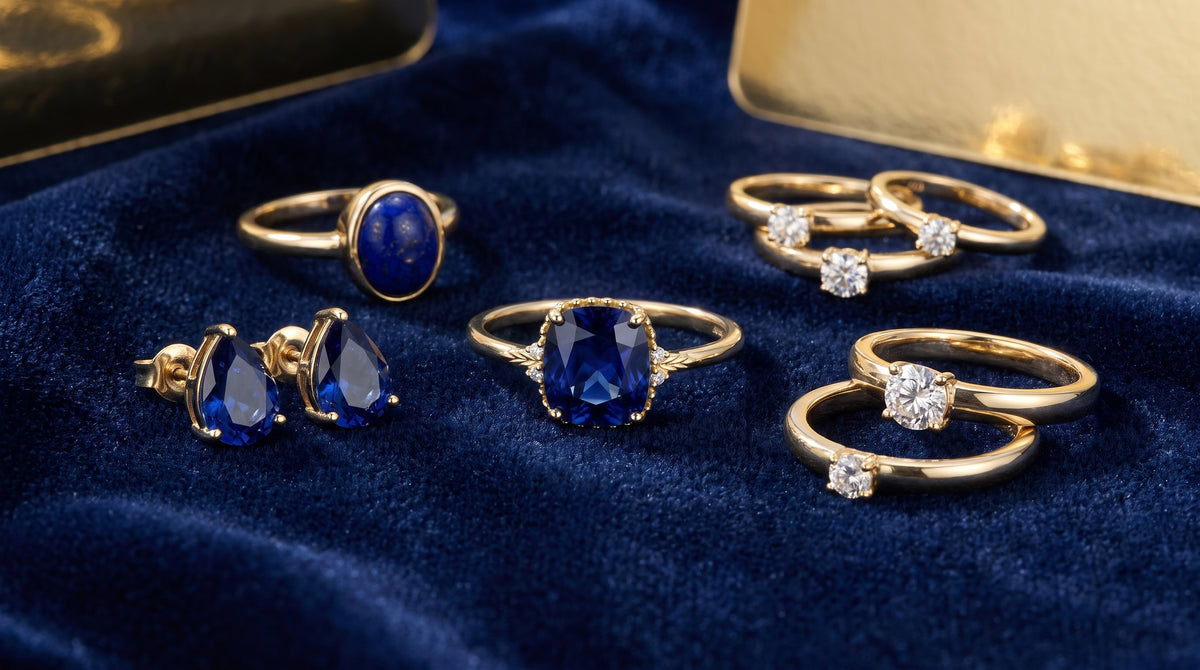
Two rings can both be listed as a "September birthstone ring in gold" and share almost nothing under the surface. Antique Jewelry Mall's vintage-inspired Art Deco reproduction is 18K yellow gold with a natural blue sapphire center weighing 0.80 carats, held in a traditional fishtail four-prong setting, with four F/G color, VS clarity round side diamonds totaling 0.06 carats. Made by Mary's September birthstone stacking band is gold vermeil with prong-set sapphire cubic zirconia running along half the ring. Same birth month, same blue color story, completely different stone, structure, price bracket, and purpose.
That gap is the single most useful thing to understand before you buy. The phrase "September birthstone" tells you the intended color and meaning; it does not tell you whether the stone is mined, grown in a lab, or a look-alike. The word "gold" tells you the finish you'll see; it does not tell you whether there is gold all the way through. This guide separates both questions, shows what the market actually offers, and then labels Awareness Avenue's gold and gold-tone rings for exactly what their product names and collections say they are — no more.
What "September birthstone" means on a product page
Sapphire is the stone retailers consistently assign to September. Angara states plainly that "Sapphire is the September birthstone and is best known in blue, although sapphire naturally occurs in a broad range of colors." Antique Jewelry Mall labels the natural blue sapphire in its engagement ring as the September birthstone in the specification table itself. Jared frames the September birthstone as a trending choice for engagement rings, bridal jewelry gifts, promise rings, and more — a useful signal that this stone is bought for milestones, not only for birthdays.
The important nuance is that "sapphire blue" is a look, and several different materials can produce it. Read the specification line, not the product title.
Natural sapphire
Mined sapphire is what most people picture, and it is usually the most expensive option. It also frequently carries disclosed treatment. The Antique Jewelry Mall listing includes an AGTA code of "H" for its natural blue sapphire, indicating the stone has been heated — a routine, widely disclosed sapphire enhancement. If provenance and gemstone rarity matter to you, look for that level of disclosure: stone type, carat weight, setting style, and treatment code. A listing that says only "sapphire ring" without specifying natural origin is not making a natural-origin claim.
Lab-grown sapphire
Lab-grown sapphire is chemically the same material produced in controlled conditions. Rainbow Rocks, for example, sells a "Mira Lab Blue Sapphire Ring" described as a September birthstone piece in 14K gold vermeil. Brands that use lab-grown stones generally say "lab" or "lab-created" in the title or the specs. If that word is absent, don't assume it.
Simulated sapphire, sapphire CZ, and man-made crystal
This is the largest and most often misread category. Made by Mary specifies "prong-set sapphire CZ" — sapphire-colored cubic zirconia, not sapphire. Pandora's September Birthstone Eternity Circle Dangle Charm is described as sterling silver with an openwork infinity braid around a central blue man-made crystal surrounded by three clear cubic zirconia. These are simulants: they deliver the color and sparkle that make a birthstone piece read correctly at arm's length, at a fraction of the cost of a mined center stone. Awareness Avenue is explicit about this too, grouping its September pieces under a September birthstone (simulated sapphire) collection rather than implying mined origin.
None of these three options is objectively "better." Natural sapphire suits heirloom and engagement intent; lab-grown suits buyers who want the same material without the mined premium; simulated stones suit stacking bands, gifts, and everyday wear where you'd rather not worry about the ring. What matters is that the label matches reality before you pay. For a deeper breakdown of color saturation, cut, and stone type trade-offs, see our guide to choosing a sapphire birthstone ring.
Blue stones that are not sapphire
Deep blue lapis lazuli, with its opaque, flecked surface, is often bought by September birthdays because the color reads the part — but lapis is not the traditional September birthstone, and any honest roundup should say so. Treat lapis rings as a style choice in September's palette, not as a substitute birthstone.

Decoding "gold": three constructions that look similar and behave differently
Search results for a gold September birthstone ring mix solid gold, gold vermeil, and sterling silver in one grid. Here is how to tell them apart and what each one implies.
Solid gold
Solid gold means the alloy runs through the entire ring, so the color cannot wear off. The Antique Jewelry Mall example is 18K yellow gold, and its listing includes a physical profile that's worth noting when comparing: 5.5 mm wide at the top of the ring, 1.7 mm at the bottom of the band, and 5.6 mm of height off the finger. Those numbers tell you it's a statement piece that sits up, not a flush everyday band. Solid gold is the right choice for engagement rings, promise rings, and pieces you intend to wear daily for decades. Awareness Avenue's solid gold pieces sit in this category.
18K gold vermeil
Vermeil is a substantial layer of gold over a precious base metal — typically sterling silver — and it is the dominant construction in the demi-fine birthstone market. Made by Mary's September stacking band is gold vermeil; Rainbow Rocks' lab sapphire ring is 14K gold vermeil. Vermeil gives you the warmth of gold at an accessible price, which is why it pairs so often with simulated or lab stones. The honest caveat: any plated or layered finish is a surface, and surfaces respond to abrasion, so vermeil rewards gentler handling than solid gold. One customer review on Simple & Dainty's September birthstone ring page reports no tarnishing after a month of near-constant wear — a helpful anecdote, but a single short-term user account rather than a durability test, and not something to generalize.
Sterling silver (and why it shows up in "gold" searches)
Much of the mainstream birthstone market is built on sterling silver. Pandora's September and December Birthstone Eternity Circle Dangle Charms are both crafted in sterling silver, and that silver base underpins a large share of its birthstone rings and bracelets too. Silver pieces surface in gold-intent searches simply because they're strongly relevant to "September birthstone." If you want gold, check the metal line rather than trusting the thumbnail lighting. Our guide to gold birthstone rings goes further into karat choice, setting security, and band width.
Which gold color flatters a blue stone
Yellow gold pushes a blue stone warmer and more vintage; Antique Jewelry Mall pitches its 18K yellow gold sapphire ring precisely at the buyer "who appreciates the warmth of yellow gold." White metals read cooler and let a saturated blue look icier and more modern. Rose gold creates the strongest contrast of the three. None is more correct — match it to the other jewelry you actually wear, because a birthstone ring usually joins an existing stack.
The four September birthstone ring formats you'll actually encounter
1. The dainty stacking band
Slim, low-profile, one or several small blue stones. Made by Mary positions its gold vermeil band as a half-set stacking ring; reviewers on Simple & Dainty's September birthstone ring describe theirs as "simple, eloquent," good for stacking, and an everyday favorite, with one noting the stone hadn't caught on anything. This is the format most people mean when they buy a birthstone ring for themselves or for a child's birth month, and it's the easiest to gift because it forgives small sizing mismatches when worn alongside other bands.
2. The single-stone statement ring
One clear focal stone — cushion, oval, marquise, or teardrop — in a raised setting, worn alone on the finger. It's the most direct way to say "this is my birthstone" without the engagement-ring signal.
3. The vintage-inspired engagement ring
Blue sapphire has a long bridal history, which is why Jared connects the September birthstone to engagement and bridal buying. Antique Jewelry Mall's Art Deco reproduction, described as a new reproduction of a circa-1920s design made in the USA of U.S. and imported materials, shows the type: geometric shoulders, diamond accents, a four-prong fishtail head, 18K gold. Expect detailed specs at this tier — and expect to be given them.
4. The brand-system ring
Pandora's September Birthstone Eternity Circle Ring is listed with dimensions of 4.1 mm deep, 7.7 mm high, and 8 mm wide, and across its UK, Irish, and US sites the eternity circle pieces are tagged "Available in 12 colors" — one core design repeated across the calendar with a different central crystal color per month. That's the defining appeal of a system: your September ring, charm, and bracelet share one visual language, and the December turquoise-blue variant of the same charm looks like a sibling rather than a stranger. The trade-off is that you're buying into that design vocabulary, and mostly into sterling silver with man-made stones.
Awareness Avenue gold and gold-tone picks, labeled honestly
Awareness Avenue's September birthstone pieces are grouped as simulated sapphire, and the rings below are named for their metal and silhouette rather than for a birthstone. We're presenting them the way the product pages present them: as gold and gold-tone rings suited to September's blue palette. Check each product page for its current stone specification before you buy, and don't take a name as a gemological claim.
Best gold-tone cushion silhouette: The Arisara Cushion Ring – 18K Gold Vermeil
A cushion-shaped focal stone is the shape most people associate with a classic blue birthstone ring: softer than a square, broader than a round, and generous with surface area. The Arisara Cushion Ring in 18K gold vermeil delivers that profile in a vermeil construction — the same category used by the demi-fine September rings referenced above. Best for a self-purchase or gift where you want presence on the finger without solid-gold outlay.
Best solid gold option: The Adalind – Solid Gold
The Adalind in solid gold is the pick if the ring needs to survive daily wear indefinitely, because there's no finish to wear through. This is the construction tier to choose for a milestone birthday, a push present, or a promise ring — the same reason fine jewelers reach for 18K when they build a sapphire ring meant to be kept.
Best marquise look for stacking: The Adalind – 18K Gold Vermeil
A marquise stone elongates the finger and sits lengthwise along the band, which makes it unusually stack-friendly. The Adalind marquise in 18K gold vermeil is the gold-tone counterpart to the solid gold version above, and the better choice if you want to layer two or three bands without committing a large budget to each.
Best teardrop: The Aethelra Teardrop, in solid gold or sterling silver
The teardrop (pear) shape reads softer and more romantic than a cushion and gives a blue stone a pleasing directional sparkle. The Aethelra Teardrop in solid gold is the long-haul version; the S925 sterling silver version is there for anyone whose existing jewelry is cool-toned — worth flagging clearly, because silver is silver, not gold, however the product photography is lit.
Also consider: oval and lapis lazuli alternatives
The Alorian oval in S925 sterling silver covers the classic oval silhouette in a white metal. For deep opaque blue rather than transparent sparkle, the Starscape, Alexandria, and Amarys rings use natural lapis lazuli. To repeat the point plainly: lapis is not the traditional September birthstone. Choose these because you love the ink-blue, gold-flecked look, not because you believe they stand in for sapphire.
To complete the set: Teardrop Sapphire Earrings
If you're assembling a September gift rather than buying a single ring, the Teardrop Sapphire Earrings echo the pear silhouette on the ears. They are earrings, not a ring, so they answer a different half of the search — and our guide to September birthstone earrings covers that category properly.
If you're shopping the Pandora birthstone ecosystem
Many people searching for a September birthstone ring already own part of a charm collection, so the ring has to sit alongside it. Pandora builds its birthstone range around the eternity circle and infinity braid motif: the September Birthstone Eternity Circle Dangle Charm is sterling silver with an openwork infinity braid, a central blue man-made crystal and three clear cubic zirconia, and the December Birthstone Blue Eternity Circle Dangle Charm repeats the design with a turquoise man-made crystal at 4 mm deep, 12.4 mm high and 10 mm wide, with the brand describing the intricate design as symbolizing eternity. Charms, dangle charms, sliding Moments bracelets, braided dangle necklace sets, and matching earring gift sets all exist within the same September assortment, and the twelve-color tagging means a family can collect a month each.
Two practical notes. First, a gold ring from another brand won't belong to that system — it won't clip onto a charm bracelet, and no independent ring should be marketed as compatible with a proprietary charm platform. It can, however, coordinate on color and stone shape, which is usually what people actually want. Second, if the charm you own is sterling silver with a blue crystal and you add a yellow gold ring, you are deliberately mixing metals; that reads intentional when the blue stones match in tone, and accidental when they don't. Our broader look at birthstone jewelry in gold covers mixed-metal layering in more detail.
How to choose: a short decision path
Start with intent. Engagement, bridal, or heirloom means natural or lab-grown sapphire in solid gold, with full specs disclosed — stone type, carat weight, treatment, setting, metal karat. Birthday gift, stacking, or everyday sentiment means vermeil or silver with a lab-grown or simulated stone is entirely reasonable, and often the smarter buy.
Then check the stone line. "Natural sapphire," "lab-created sapphire," "sapphire CZ," "simulated sapphire," and "man-made crystal" are five different statements. If a page only says "September birthstone," ask before assuming.
Then check the metal line. Solid gold, gold vermeil, and sterling silver. If it isn't stated, treat the gold appearance as a finish.
Then check the profile. Height off the finger and band width decide whether a ring stacks flush or snags. The Art Deco example's 5.6 mm height off the finger is a statement height; a half-set stacking band is the opposite. If you'll wear the ring while typing, cooking, or in gloves, low and smooth wins.
Finally, plan for care and sizing. Size for the widest knuckle and the warmest weather, not a cold morning. Remove plated and vermeil rings before abrasive tasks, store pieces separately so harder stones don't scuff softer settings, and clean with a soft, dry cloth rather than anything aggressive. Opaque stones such as lapis lazuli are more porous in character than transparent faceted stones and are best kept away from soaks, lotions, and perfume. We avoid promises about how long any finish will last, because no one can honestly make that claim for your hands and habits.
Frequently asked questions
Is the September birthstone always blue?
Blue is the signature, and it's what almost every September birthstone ring uses. But Angara notes that sapphire naturally occurs in a broad range of colors, so pink, yellow, and other sapphire hues are legitimate September stones if you prefer them — just expect blue to dominate the shopping results.
Is simulated sapphire a "real" birthstone ring?
It's a real ring with a stone chosen to represent September's color and meaning; it is not mined or lab-grown sapphire. Mainstream birthstone jewelry relies heavily on simulants — sapphire-colored cubic zirconia and man-made crystals appear in some of the best-known September designs on the market. If the sentiment is the point, that works. If the material is the point, buy natural or lab-grown and insist on the disclosure.
Should I choose solid gold or 18K gold vermeil?
Solid gold if the ring is a lifetime piece, worn daily, or paired with a valuable center stone. Vermeil if you want a gold look across several stacking bands, or if the ring is one of multiple gifts. The stone tier and metal tier usually move together: fine stone with solid gold, simulated or lab stone with vermeil.
Can a sapphire birthstone ring work as an engagement ring?
Yes — Jared explicitly frames the September birthstone as a choice for engagement rings, bridal gifts, and promise rings, and vintage-inspired sapphire-and-diamond designs like the 18K yellow gold Art Deco reproduction exist precisely for that use. For that purpose, prioritize a secure setting, solid gold, and full stone disclosure.
How do I pick between cushion, oval, marquise, and teardrop?
Cushion reads classic and holds the most visual width; oval is the safest all-rounder; marquise elongates the finger and stacks neatly lengthwise; teardrop is the softest and most distinctive. With blue stones, shape changes the character more than size does.
Will a gold birthstone ring match a silver birthstone charm bracelet?
It can, if the blue stones are close in tone and the shapes rhyme. Mixed metals look deliberate when something else ties the pieces together — here, the stone color does that work.
Bottom line: the search term "September birthstone ring gold" hides two separate specifications, and every good decision here comes from reading both. Decide how real you need the sapphire to be, decide how much gold you need in the metal, and let those two answers narrow the field before style ever enters the conversation.

Hinterlasse einen Kommentar
Diese Website ist durch hCaptcha geschützt und es gelten die allgemeinen Geschäftsbedingungen und Datenschutzbestimmungen von hCaptcha.