


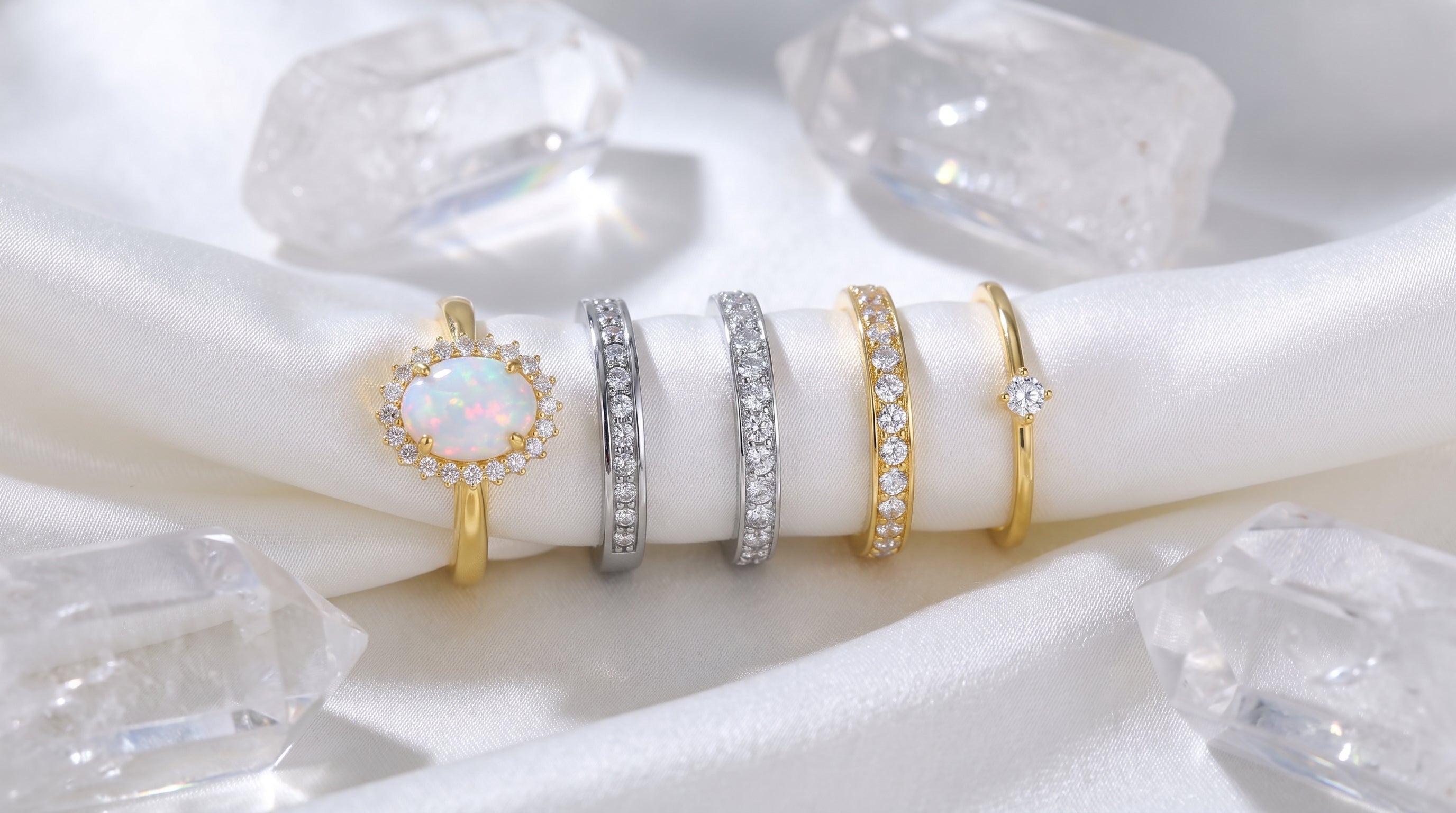
There is a meaningful difference between a birthstone ring that holds three stones and a birthstone ring you can add a fourth stone to later. Most jewelry marketed as "multi-birthstone" is the first kind: a fixed composition, configured once at checkout, complete on arrival. Search for birthstone jewelry that can be added to and you will find both types mixed together on the same category pages, described with almost identical language. The distinction only becomes obvious two years later, when a new baby arrives and the piece you chose has no room for them.
This guide sorts the field into three genuinely different mechanisms for adding to birthstone jewelry, based on how brands in this space actually describe their own products. It covers what each format can and cannot absorb over time, which choices quietly lock you in, and the specific questions worth asking a retailer before you commit to a base piece you intend to build on for a decade.
What "Added To" Actually Means: Three Different Mechanisms
Birthstone jewelry pairs a gemstone with the wearer's birth month, with a stone assigned to each of the twelve months, and it appears in necklaces, rings, bracelets, and earrings. That much is standard. What varies enormously is whether a given piece is built to change.
When shoppers say they want jewelry they can add to, they usually mean one of three things without realizing the three are structurally distinct.
1. Component addition: charms on a chain
The most literal form of addable birthstone jewelry is a charm system. Nolia Jewelry, for example, sells a product explicitly titled a birthstone charm add-on, offering custom birthstone charms in more than twenty gemstone options and in metals including 14k gold filled, sterling silver, and solid 14k gold, and it invites customers to add them to their own chains or to pair them with one of the brand's chains. The charm is the unit. The chain is the platform. Adding is a matter of opening a jump ring.
Brook & York works from the same logic in a different direction with a build-your-own birthstone stacking necklace, where the shopper designs a piece by selecting up to six custom birthstone charms on a 14k gold plated brass base. That product demonstrates that multi-charm configurations are normal at the point of purchase. Whether a seventh charm can be added to that same necklace three years later, or whether individual charms are sold separately for that purpose, is not something the product page spells out, and it is exactly the kind of thing worth confirming before you buy.
2. Unit addition: stackable rings and bands
The second mechanism does not modify any single piece. Instead, you add a whole new piece alongside the existing ones. Kay offers a family and mother's stackable birthstone band with two stones, describing it as wearable alone or stacked to create dedicated bands for different family members. That framing is the entire concept in one sentence: each band is a chapter, and the stack is the book.
Mint & Lily's stacking rings collection includes items such as a super dainty birthstone stacking ring and a stackable birthstones band ring, and the brand's own guide to stacking rings argues that gemstone stacking rings add personality and meaning, with stones ranging from birthstones representing loved ones to gems chosen for symbolic associations like love, protection, and strength. Its practical recommendations include mixing gold, silver, and rose gold, varying ring thickness and shape, and combining different elements such as gemstones and engravings to build a stack that reads as one of a kind.
The advantage here is that nothing has to be dismantled. The constraint is finger real estate and comfort, which we will come back to.
3. Alteration: new stones set into an existing piece
The third and rarest mechanism is genuine alteration of a piece you already own. Haverhill, in its collection of personalized birthstone jewelry for mom in 14k gold, states directly that as her family expands, so can her jewelry, with the addition of new birthstones and initials to represent each loved one. That is a clear statement that the same piece is intended to receive new elements after purchase.
What the brand does not publish in that collection description is the process: whether the piece is mailed back, what the work costs, how long it takes, or how many additions a given design can absorb. Those are reasonable things to ask before treating alteration as a guaranteed feature. When a retailer offers this, it is a service commitment as much as a product design, and services have terms.
Why the distinction changes your shopping
These three mechanisms fail in different ways. A charm system rarely runs out of capacity but can become visually crowded and heavy on a delicate chain. A ring stack never runs out of design flexibility but does run out of comfortable fingers. An alteration-based piece can stay a single elegant object indefinitely, but you are dependent on one maker continuing to offer that work.
Most personalized birthstone jewelry sits in a fourth category that is not addable at all: fixed multi-stone designs. Kay's birthstone family and mother's bracelet is offered in one through six stone configurations on a 6.5-inch cable chain with a 1.5-inch extender and a lobster clasp, in sterling silver with lab-created white sapphire accent stones. You choose your stone count at checkout. That is a customized piece, and a lovely one, but customization at purchase is not the same as expandability afterward. Neither Kay's nor Jared's mother's jewelry pages advertise adding stones to an existing item later.
How to Choose a Base Piece You Can Keep Building On
If your intent is a collection that grows, the most consequential decision is not which stone comes first. It is what you are attaching everything to.
Plan the layout for the family you might have
A symmetrical design is the enemy of expansion. A necklace with one central stone flanked by two matching stones looks resolved and balanced, which is precisely why a fourth stone ruins it. Asymmetrical or linear arrangements absorb additions far more gracefully, because a row that reads left to right can simply get longer.
The same principle applies to rings. A single band set with three evenly spaced stones is finished. Three separate single-stone bands worn together are not finished, and that is the point. If you anticipate more people to represent, whether through births, marriages, or blended families, choose the format that treats "more" as normal rather than as a disruption.
Match metals before you match stones
Metal consistency is what makes an assembled collection look intentional rather than accumulated. Brands in this category work across quite different material tiers. Nolia's charms are available in 14k gold filled, sterling silver, and solid 14k gold. Brook & York's stacking necklace uses 14k gold plated brass. Kay's family bracelet and stackable band are sterling silver. Olivia Jewelry's duo birthstone ring uses 18K gold plated stainless steel, which the brand describes as waterproof and tarnish-free. Little Sky Stone frames birthstone jewelry as retaining timeless value when expertly crafted from gold vermeil and other precious metals.
These are not interchangeable. A plated piece and a solid gold piece bought years apart may not age at the same rate, which becomes visible when they sit side by side on the same hand. Before you commit to a base piece you plan to expand over a decade, decide which metal and which construction standard you want to be able to buy again. If you are building in gold, our solid gold collection gives you a sense of what a consistent long-term standard looks like.
Mint & Lily's stacking advice does recommend deliberately mixing gold, silver, and rose gold for a modern, eclectic look, and that works well as a styling choice. The important thing is that mixing be a decision rather than an accident of buying whatever was available in a given year.
Interrogate the hardware, not just the design
On charm-based jewelry, the parts that determine longevity are the ones nobody photographs. The clasp bears the load every time the piece is fastened. The jump rings holding each charm are the points that open and close. The chain gauge determines whether five charms hang beautifully or drag the necklace into a sad V.
Product specifications sometimes give you a window into this thinking. Kay lists a lobster clasp and a 1.5-inch extender on its family bracelet, which tells you the brand is accounting for secure closure and fit adjustment. When you are evaluating a base chain you intend to load with charms over time, look for that level of specificity, and if a chain's gauge or clasp type is not stated, ask.
Decide how many stones you actually want on your hand
Stone count is the most underrated decision in this whole category. Our birthstone ring buying guide works through stone counts, metals, and multi-stone designs in detail, and the short version is that the right number is a function of your hand, your daily activity, and how the piece will be worn rather than how many people you love.
Two-stone designs are their own established format for a reason. Olivia Jewelry's duo birthstone ring features two simulated birthstones set on a refined gold band, and two-stone pieces are widely chosen to represent pairs, whether a couple, a mother and child, or two siblings. If your representation needs are genuinely limited to two people, a birthstone ring 2 stones design is often the most elegant answer, and our guide to choosing a birthstone ring with two stones covers how to pair colors that do not fight each other.
Formats Compared: Charms, Ring Stacks, and Bracelets
Charm necklaces: highest capacity, most upkeep
Charm systems handle growth better than anything else. A chain can accept several charms, they can be reordered, and a new stone does not require redesigning what already exists. Brook & York's design of a necklace around up to six charms shows the format comfortably supports substantial multi-stone arrangements.
The trade-offs are practical. More charms means more weight, more places for the chain to twist, and more clinking against clothing. Charms of slightly different sizes or from different sources can look mismatched. And because the whole appeal is modularity, you have to actually think about the order in which stones sit, since a charm necklace with no logic to its sequence reads as random.
Initials are worth considering alongside stones. For those seeking a custom birthstone necklace for mom, Little Sky Stone notes that an initial birthstone necklace takes personalization further by showcasing a name or a loved one's initial along with their birthstone, and Haverhill's approach pairs birthstones with initials in the same expandable framework. When several children share a birth month, initials are what keep the piece legible.
Stackable rings: cleanest additions, hardest physical limit
Adding to a ring stack is the simplest form of expansion available, because nothing existing has to change. Kay's stackable birthstone band with two stones is described as suitable for stacking to create dedicated bands for family members, which is expansion by acquisition rather than modification.
Multiple birthstone jewelry and stackable birthstone rings are both well-established categories, and the real question is which structure you want. One ring holding several stones is a single statement that is finished when you buy it. Several single-stone rings worn together are an ongoing project. Our two-stone gift guide for couples, moms, and families works through that comparison for smaller stone counts.
The hard limit is comfort. Fingers have finite length, knuckles swell in heat, and a stack that felt elegant at three rings can feel like a splint at six. Band thickness matters enormously here, and Mint & Lily's guidance about layering thin stackable rings against chunkier bands for contrast is as much about physical fit as it is about style. If you are building a stack, our guide to styling a two-piece ring set is a useful place to see how two bands relate before you plan for five.
Bracelets: readable stones, less obvious expandability
Bracelets display multiple stones better than almost any other format, because a wrist gives you linear space that a finger does not. Multi-stone bracelets are common in the market, including designs built around multiple marquise or multiple baguette birthstones.
Expandability, though, is less commonly advertised. Kay's family and mother's bracelet is available in one through six stone configurations, which is a configuration choice at purchase rather than a stated capacity for later additions. If a custom birthstone bracelet is your preferred format and growth matters to you, prioritize designs built on links or chains that a jeweler can extend, and ask directly whether stones can be added to the existing setting. Our guides to a personalized birthstone bracelet for mom and a two-stone bracelet for mom go deeper on format and fit.
Natural Versus Simulated Stones When You're Adding Over Time
Stone type is a routine decision for a single piece and a compounding one for a collection you intend to extend.
Both options are firmly established in the market. Olivia Jewelry's duo birthstone ring uses simulated birthstones. Choosing between natural and simulated stones is one of the standard criteria in multi-birthstone ring selection, alongside stone count, stackable versus traditional styles, and metal.
Where expandability changes the calculation is color matching. Natural gemstones vary. Two natural sapphires bought four years apart can differ noticeably in saturation and tone, which is fine in a piece where each stone is distinct but awkward when two people share a birth month and their stones are meant to look like siblings. Simulated stones are generally more consistent from one production run to the next, which makes matching a later addition more predictable.
Stone count also has budget implications that scale. A piece representing five people needs five stones, and the difference between natural and simulated multiplies accordingly. There is no single correct answer, but the decision is worth making deliberately at the start rather than discovering the consequences at addition three.
For a full explanation of month-by-month stone assignments and the meanings attached to them, our ultimate guide to birthstone jewelry covers the traditional associations in depth.
Questions to Ask Before You Buy a Base Piece
Because so few retailers publish the mechanics of expansion, the burden of asking falls on you. These are the questions that actually distinguish a piece that will grow from one that merely looks like it might.
On capacity and limits
How many charms or stones is this design intended to hold? Not the maximum you can technically force onto it, but the number the maker considers appropriate. Brook & York's build-your-own necklace names six charms as its design range, which is a usefully concrete answer of the kind worth requesting from any brand.
On future availability
Will the same charm, band, or stone setting still be available in two or five years? Nothing undermines a growing collection faster than a discontinued component. If a brand cannot commit, favor formats where a competent local jeweler could source a compatible substitute.
On whether alteration is offered at all
Can new stones be set into this existing piece, or is expansion accomplished only by buying additional separate pieces? These are fundamentally different propositions. Haverhill states that its mother's jewelry can take on new birthstones and initials as a family expands; most brands make no such claim. Get an explicit answer rather than inferring one from marketing tone.
On reversibility
Can stones or charms be removed or rearranged later without damaging the piece? Lives change. Relationships change. A design that can only be added to and never edited is a narrower commitment than it first appears, and this is one of the least documented aspects of modular jewelry anywhere in the market.
On cost and logistics of additions
What does an addition cost, how long does it take, and does the piece need to be shipped to the workshop? Pricing and turnaround for alteration work are almost never published, so ask before you build a plan around a service whose terms you have not seen. Confirm details with the individual retailer rather than assuming an industry norm exists.
On accents and consistency
If the base piece includes accent stones, will those be matched in later additions? Kay's family bracelet, for instance, uses lab-created white sapphire accent stones alongside the birthstones. Accent details are easy to overlook at purchase and glaringly obvious when an addition omits them.
Building a Collection Deliberately Rather Than by Accident
Most people arrive at a multi-stone birthstone collection through drift. A ring for one child, a necklace for the next, a bracelet from a different brand for a third, and eventually a jewelry box holding four unrelated interpretations of the same idea. That is not a design; it is a sequence of separate purchases.
The alternative takes one extra decision at the outset: pick your mechanism and stay in it. If you choose charms, buy a chain robust enough for the number of charms you may eventually want, and buy charms from a source that offers your metal consistently. If you choose ring stacks, settle on a band profile and metal you can return to, and be honest about how many rings your hand will comfortably carry. If you choose alteration, choose the maker as carefully as the piece, because you are entering a long relationship with their workshop.
Where a fixed multi-stone piece is still the better answer
Expandability is not automatically superior. If the people you want to represent are already all here, a single well-proportioned multi-stone piece is often more beautiful than any assembled arrangement, because it was designed as a whole. Etsy's marketplace for custom birthstone family rings includes delicate multi-stone designs and engraved sterling silver pieces, and brands like Eternate allow customers to combine multiple birthstones in rings, necklaces, or bracelets to create custom birthstone jewelry for mom representing loved ones. Jewlr offers personalized birthstone rings with names where the customer selects gem, metal, and engraving.
All of those are excellent routes to a finished piece. Just recognize that a design-your-own service is customization at the point of purchase, and unless the brand says otherwise, that is where the flexibility ends. Our guide to choosing birthstone jewelry for mom walks through matching format and setting to how a piece will actually be worn.
How this looks in a real stack
A workable structure many people land on is one anchor piece plus additions. The anchor carries the most personal stone or stones and sets the metal standard. Additions arrive over time and are chosen to sit alongside it rather than compete with it.
Within our own range, the Personalized Family Birthstones Stackable Ring in stainless steel is designed around exactly that stackable, family-birthstone premise. As with any product in this category, check the current product page for the specific personalization options, stone selections, and stone counts available before you plan a long-term build around it, since those details are what determine whether a piece fits your particular family.
Plain and gemstone bands also earn their place in a growing stack as spacers and frames rather than as birthstone pieces. Designs such as the Aeliana Eternity Ring in sterling silver or the Iridiana Stack Opal Ring function this way: they add texture and separation between personalized bands. They are stacking and gemstone designs rather than customizable birthstone pieces, so treat them as supporting elements around a personalized anchor rather than as the piece that carries the birthstones themselves. You can browse the wider birthstone jewelry collection to see how stones and metals sit together before committing to a direction.
The Honest Summary
Birthstone jewelry that can be added to comes in three real forms. Charms attach to a chain and offer the highest capacity with the most styling upkeep. Stackable rings and bands let you add whole new pieces without touching the old ones, limited mainly by comfort. And a small number of brands, Haverhill among them, explicitly offer to add new birthstones and initials to an existing piece as a family grows, though the mechanics of that work are rarely published.
Everything else in the category is a fixed multi-stone design, configured once and complete. Those pieces can be gorgeous, and for a settled family they are frequently the right call. They simply are not expandable, and the marketing language around them often does not make that clear.
So the practical move is to decide up front which of the three mechanisms you want, choose a base piece and metal you can realistically buy into again, plan an asymmetrical layout that treats additions as normal, and ask the retailer directly about capacity, availability, reversibility, and the cost of adding later. The market does not volunteer that information. Asking for it is what separates a collection that grows with your family from a drawer of pieces that each tell only part of the story.

Leave a comment
This site is protected by hCaptcha and the hCaptcha Privacy Policy and Terms of Service apply.