


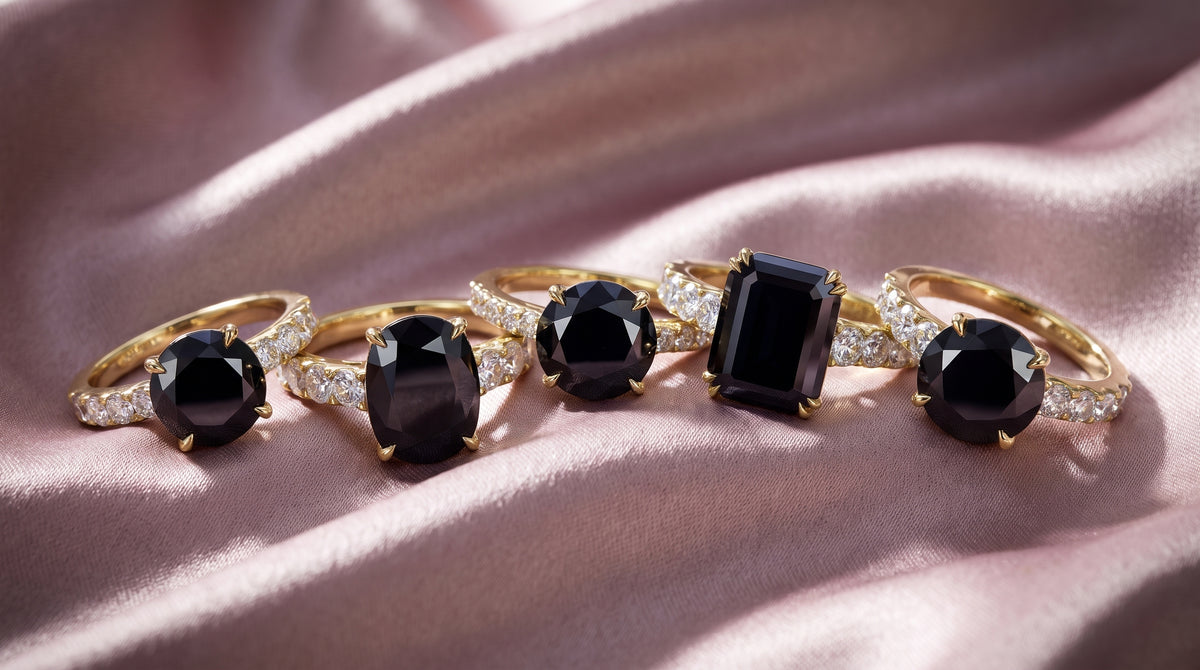
Here is the single fact that most pages about black moissanite skip: it does not sparkle the way colorless moissanite does. Retailers who specialize in loose black moissanite describe the stones as opaque, meaning they do not transmit light through the crystal at all. That one property changes everything downstream. The rainbow fire that makes colorless moissanite famous comes from light entering the stone, bouncing between facets, and splitting into spectral colors on the way out. Remove light transmission and you remove that mechanism. What you get instead is a dense, mirror-like surface that throws sharp white glints off its facet planes — closer in feel to polished black glass or a treated black diamond than to a brilliant white stone. If you buy black moissanite expecting diamond-style fire, you will be disappointed. If you buy it for graphic contrast, weight of color, and a hard, glossy surface, it delivers something no colorless stone can.
This guide separates what is actually documented about black moissanite from what gets borrowed, uncritically, from colorless moissanite marketing — and then walks through the practical decisions: stone size, cut shape, setting, metal, care, and which product categories genuinely exist versus which are mostly custom work.
What Black Moissanite Actually Is
The material underneath the color
Moissanite used in jewelry is laboratory-created silicon carbide — silicon and carbon bonded in a crystalline lattice. It is not a diamond, and it is not a diamond simulant in the cubic zirconia sense either; it is its own gem species with its own measured property set. Gemological reference data for moissanite consistently lists:
- Composition: lab-created silicon carbide (SiC)
- Refractive index: roughly 2.648 and 2.691 (it is doubly refractive), versus about 2.42 for diamond
- Dispersion: about 0.104, compared with roughly 0.044 for diamond
- Birefringence: near 0.043, which can produce visible facet doubling under magnification
- Specific gravity: about 3.22, lower than diamond's approximate 3.52
- Mohs hardness: about 9.25 — above sapphire and ruby at 9, below diamond at 10
- Toughness: rated excellent for synthetic moissanite, meaning good resistance to chipping and breakage under impact
- Thermal conductivity: high enough that moissanite can register as diamond on heat-based diamond testers
Black moissanite is not a different mineral. It is the same silicon carbide, produced with color centers or internal features that render it visually black. Vendors selling black stones describe them as lab-grown silicon and carbon, and the durability case for them rests on the same hardness and toughness figures above. One thing to be skeptical of: some black moissanite sellers claim the gem has an internal structure identical to diamond. That is not accurate. Diamond is pure carbon; moissanite is silicon carbide. The two share a reputation for hardness, not a chemistry.
Why the optics change when the stone goes black
The high refractive index and dispersion figures above describe what happens to light inside a transparent stone. In an opaque black moissanite, light does not travel that path. Reflection happens at the surface, so the visual character is gloss, contrast, and crisp facet edges rather than internal brilliance. This is why a well-polished black emerald cut reads as a series of dark mirrors that flip between deep black and bright white depending on the angle, and why a black round brilliant produces tighter, more concentrated glints than a colorless round of the same size.
Practically, this means facet quality and polish matter more than they do in a colorless stone. In a transparent stone, sparkle disguises a lot. On a black surface, the eye reads flatness, edge crispness, and reflection quality directly — there is nothing to hide behind.
What is not publicly documented
Retail pages for black moissanite rarely explain how the black coloration is produced, and they do not publish data on how that coloration behaves under bench heat, laser soldering, or aggressive ultrasonic cleaning. The structural hardness and toughness of silicon carbide are well established; the long-term stability of a specific black treatment under extreme conditions is not something you can verify from a product listing. That is not a reason to avoid black moissanite jewelry — it is a reason to ask your jeweler before any repair or resize that involves heat.
Black Moissanite vs. Black Diamond vs. Black Onyx
Most people shopping for a black center stone are choosing between three materials. They look similar in photos and behave very differently on a hand.
| Material | What it is | Appearance | Mohs hardness | Positioning |
|---|---|---|---|---|
| Black moissanite | Lab-created silicon carbide with black coloration | Opaque; does not transmit light; glossy, mirror-like surface reflection rather than internal fire | ~9.25 (moissanite value) | Lab-grown, bold, accessible; widely sold as loose stones and as set rings |
| Black diamond | Natural diamond made black by dense inclusions or graphitized features, or lighter diamond treated with high heat or irradiation | Opaque to heavily included; minimal internal brilliance; surface luster with occasional glints. GIA assigns a single color designation, “Fancy Black,” without tone or saturation grades | 10 | Natural-origin prestige; generally the most expensive of the three |
| Black onyx | A variety of chalcedony (quartz) | Opaque; typically a softer, quieter sheen, often cut as cabochons | ~7 | Most affordable; least scratch-resistant of the three |
How to read that table as a buyer
Against black diamond, the honest difference is provenance and price rather than day-to-day function. Diamond is harder, and diamond carries the cultural weight of a mined stone. But from normal viewing distance, two well-polished opaque black stones of the same cut and size look far more alike than a black diamond and a colorless diamond do. If natural origin matters to you symbolically, that is a legitimate reason to pay for it. If what you want is the look, a lab-grown silicon carbide stone at 9.25 on the Mohs scale with excellent toughness is a serious, durable choice, not a compromise.
Against black onyx, the gap is wider and more functional. At roughly 7 on the Mohs scale, onyx is meaningfully softer and will scuff and lose edge definition faster in a ring worn daily. Black moissanite's hardness advantage is the main reason to choose it for a piece that lives on your hand every day rather than in a jewelry box.
One caution that applies to all three: on a dark, glossy surface, a scratch or chipped corner is more visible than it would be on a faceted transparent stone, where sparkle breaks up the surface and camouflages small defects. Hardness reduces the odds of damage; it does not make damage invisible.
How to Choose a Black Moissanite Ring
Carat size reads differently in black
Guides written for colorless moissanite ring buyers report that around 2 carats is a common landing spot — noticeable presence without feeling oversized. Black stones do not scale the same way. Because the stone is a solid block of color rather than a field of broken-up light, a black center reads larger and heavier on the hand than a colorless stone of identical dimensions. If you normally gravitate toward 2 carats in white stones, try a 1 to 1.5 carat black stone before assuming you need to match the number.
That gives you a usable ladder: around 1 carat for something wearable and quietly graphic, 1.5 to 2 carats for a clear statement that still sits comfortably under a keyboard or a coat sleeve, and 3 carats when the point is drama. If you are calibrating between sizes, our comparison of 1 carat versus 2 carat moissanite rings covers how carat weight translates to face-up presence on different hand sizes.
Cut shape: step cuts versus brilliants
In black moissanite the cut decides the personality of the stone more than it does in white.
- Emerald cut: broad, flat step facets create long planar reflections — the most mirror-like and architectural option. It is also the shape where polish quality is most exposed, and where vulnerable corners most need protection from the setting.
- Princess cut: sharp square geometry with tighter facet breakup; modern and graphic, with corners that again benefit from protective prongs.
- Round cut: the softest outline and the most scattered glints; the easiest black shape to wear if you want the color without the hard-edged look.
- Oval and elongated shapes: stretch the dark surface along the finger, which can make a smaller carat weight read longer and more elegant.
Setting: halo or solitaire
There are really two design strategies for a black center stone. The first is contrast: ring the black stone with colorless accents so the halo supplies the sparkle the center cannot, and the border visually enlarges the piece. The second is purity: a clean solitaire that lets the black stone be a single, uninterrupted shape. Contrast settings feel more traditionally bridal; solitaire settings feel more modern and more like design objects.
Whichever you choose, favor a lower profile and secure coverage of corners and edges for a ring you will wear daily. Lower-profile settings with slimmer bands are widely recommended for everyday moissanite wear because they snag less and stack more comfortably next to a wedding band.
Metal choice
Yellow gold creates the warmest, highest-contrast frame for a black stone — the pairing most people picture when they imagine a black center ring. White metals produce a cooler, more monochrome, almost industrial result. Rose gold softens the contrast with a pink undertone and is the least common of the three in black-stone designs, which can be an advantage if you want something unusual. Construction matters too: a gold vermeil band built over a 925 sterling silver core gives you a gold surface at a different price point than solid gold, while solid gold is the choice when you want the metal itself to be permanent. Our 18k gold engagement ring buying guide explains how karat, plating, and solid-gold construction differ in practice.
Black Moissanite Rings Worth Comparing
Our black moissanite rings cover the size and shape ladder described above, so you can match a design to a brief rather than scroll blindly.
- The Caterina — a 1CT princess cut, the most wearable entry point if you want black geometry without scale.
- The Katalina — a 1.5CT round cut, the softest silhouette of the group and the easiest to wear with existing jewelry.
- The Adelina Rae — a 2CT emerald cut for step-cut mirror reflections at a mid-scale size.
- The Camilla — a 3CT emerald cut black moissanite center framed by D color, FL/IF clarity side accents, set in an 18K gold vermeil band over a 925 sterling silver core, in a classic fit with full US sizing. This is the clearest example of the contrast strategy: opaque black center, luminous halo.
- The Bella Jewel — another 3CT emerald cut for buyers who want maximum surface area.
- Design-led alternatives include The Opaline, The Luna, The Bethany, and The Celestine, plus The Geometric Star couples rings for matched sets.
If you are shopping specifically for a proposal rather than a fashion ring, our roundup of striking black moissanite engagement rings looks at these designs through a bridal lens, and the wider moissanite engagement rings collection lets you compare black and colorless centers side by side.
Black Moissanite Beyond Rings: Earrings, Watches, and Custom Work
Earrings
Searches for moissanite earrings gold often return colorless stones, and the material's properties suit studs well: high hardness for daily wear, and a specific gravity lower than diamond's, so a stone of the same dimensions weighs slightly less on the earlobe. For many buyers, 1 carat moissanite earrings tend to be the balance point — visible presence without weight or excessive protrusion.
Finished black moissanite earrings in gold are much less represented in mainstream retail than black moissanite rings. Loose black moissanite stones are easy to source in a range of shapes and sizes, so the realistic path to black studs is usually custom setting work with a jeweler rather than an off-the-shelf purchase. Treat any claim about standard pricing or wide availability of black moissanite earrings with skepticism until you see the actual product page.
Moissanite watches, including Rolex-style pieces
Searches for a moissanite watch vendor or specific queries like moissanite watch rolex often lead to specialist sellers offering timepieces set heavily with moissanite across bezels, dial markers, and bracelet links, frequently named after well-known luxury models. Moissanite makes sense in that application: it is hard enough for the abrasion a bezel takes, and in colorless form it returns a lot of light.
Two honest caveats. First, black moissanite is essentially absent from this category — iced-out watch design is built around maximum light return, which opaque stones cannot provide. Second, these vendor pages typically do not disclose whether a watch is an authentic timepiece customized with moissanite, an aftermarket build, or an homage design, nor do they publish movement type, water resistance, or service details. If you are shopping for a moissanite-set watch, verify authenticity, movement, return policy, and seller reputation independently before you spend. We make rings and fine jewelry, not watches, and we will not pretend a ring answers a watch question.
Care, Cleaning, and Long-Term Wear
Black moissanite does not cloud — but it does smudge
A persistent worry about moissanite is that it turns cloudy over the years. It does not. What actually happens is surface buildup: films from hand cream, soap, makeup, and skin oils accumulate on the stone and dull its appearance. Gentle cleaning removes the film and restores the look.
On black moissanite the symptom presents differently. Instead of losing sparkle, the stone loses gloss and starts to look hazy or fingerprinted, much the way polished black glass or a phone screen does. Because dark, reflective surfaces show touch marks readily, expect to wipe a black moissanite ring more often than a colorless one — not because it is fragile, but because the contrast reveals everything.
A practical routine
- Wipe the table and crown of the stone with a soft, lint-free cloth every few wears to restore gloss.
- For a deeper clean, use warm water with a mild, non-abrasive soap and a soft brush around the setting, then dry thoroughly.
- Avoid abrasive pastes, scouring cloths, and harsh chemicals. The stone is hard, but the metal and any plating are not equally resilient.
- Remove rings for gym sessions, gardening, and cleaning — impact against hard surfaces is what chips corners on step cuts, regardless of stone type.
- Before any ultrasonic cleaning or professional repair, ask the jeweler about heat and vibration exposure. Because black coloration methods are not publicly documented, a cautious professional assessment is the right default.
Sizing and resizing
Measure your finger at the end of the day when hands are slightly larger, and account for knuckle width — the band has to pass the knuckle, not just sit on the base of the finger. If you fall between sizes, going slightly larger is usually the safer call, because reducing a ring is generally more straightforward than expanding it. For black-stone rings specifically, discuss the resizing method with the jeweler before work begins rather than assuming a standard torch procedure is appropriate.
Questions Buyers Ask Before Choosing Black Moissanite
Does black moissanite sparkle?
Not in the way colorless moissanite does. Because it is opaque and does not transmit light, it cannot produce the internal brilliance and dispersion that give white moissanite its fire. It produces surface reflection: bright, sharp glints off polished facets against a deep black field.
Is black moissanite a real gemstone or a fake?
It is a real, lab-created gemstone — silicon carbide, with a Mohs hardness around 9.25 and toughness rated excellent. It is not glass, and it is not diamond. Choosing it is choosing a specific modern material with its own look, not settling for an imitation of something else.
Is black moissanite appropriate for an engagement ring?
It can be, and plenty of people choose it deliberately for its graphic, non-traditional look. Durability is not the limiting factor; taste and shared expectations are. If your partner's reference point for an engagement ring is a traditional colorless center stone, a black center will read as a deliberate departure. That is a conversation worth having, not a rule. For a middle path, consider a black center with a colorless halo, or a black stone in a wedding band or right-hand ring alongside a colorless engagement stone. Our guide to choosing a moissanite engagement ring works through those trade-offs in more detail.
How does black moissanite compare on cost?
Moissanite is consistently positioned in the market as a lower-cost alternative to diamond per carat, which is why it lets buyers reach larger carat sizes within a given budget. Black moissanite sits in the same value territory: well below natural black diamond of comparable face-up size, and above inexpensive black onyx, with hardness that justifies the difference. Because live pricing varies by stone size, cut, metal, and construction, check the current price on the product page you are considering rather than relying on any quoted range.
Will a black stone show wear more than a white one?
Potentially, yes. Moissanite's hardness resists most everyday scratching, but if a mark does occur, a large flat facet on a black stone will show it more clearly than a busy, sparkling white stone would. Protective settings, sensible daily habits, and regular gentle cleaning are the whole maintenance story.
The Short Version
Black moissanite is lab-created silicon carbide with an opaque black color: hard at about 9.25 Mohs, tough enough for daily wear, and optically a completely different proposition from colorless moissanite. Buy it for depth of color, mirror-like facet reflections, and graphic contrast against gold or silver-toned metal — not for fire. Size down slightly from the carat weight you would choose in a white stone, protect the corners on step and princess cuts, decide early between a contrasting halo and a clean solitaire, and keep the surface wiped so the gloss stays sharp. If you want to see the range in one place, browse the full moissanite rings collection and compare black centers against colorless ones before you commit.

Leave a comment
This site is protected by hCaptcha and the hCaptcha Privacy Policy and Terms of Service apply.