


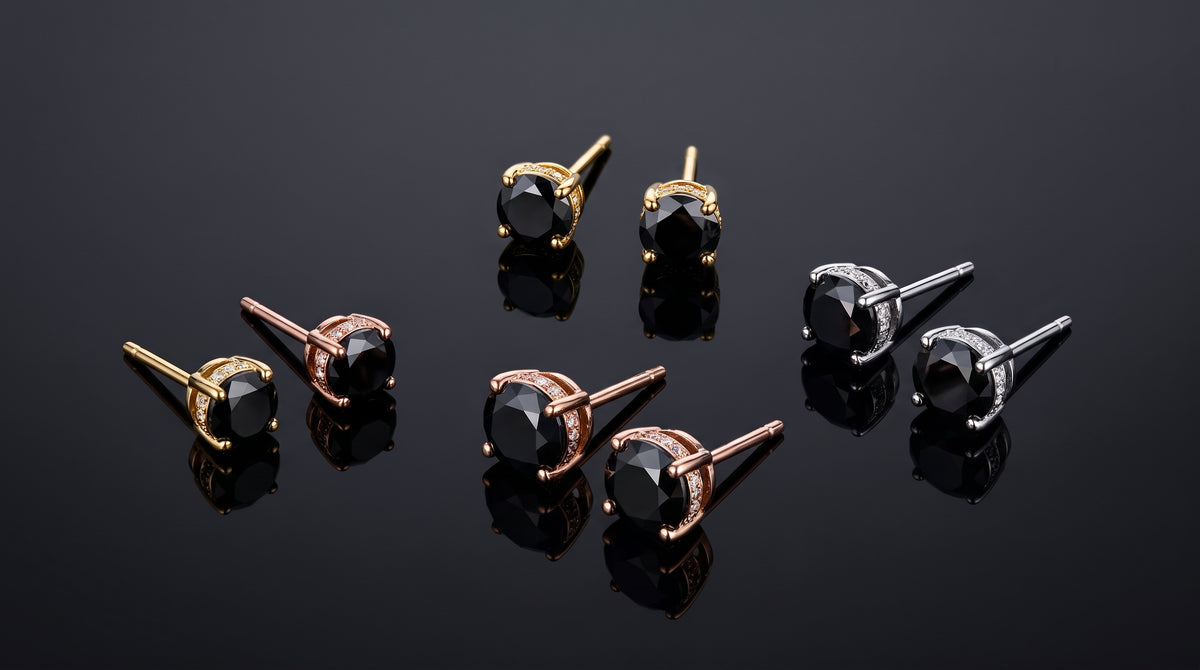
Search for black moissanite earrings and you will find plenty to buy and almost nothing to read. Nordstrom lists Sterling Silver Round Black Moissanite Studs and describes them simply as genuine 925 sterling silver set with a 7 mm round moissanite in a black finish, hypoallergenic and free of lead and nickel. DiamoniteShop's "Blaine" four-prong studs let you choose between D color and black stones across sizes from 0.1 to 5 carats, in gold and platinum-plated sterling silver stamped S925. Amazon sellers offer 1 carat D color VVS1 moissanite studs in 925 silver with a certificate of authenticity, some in black, alongside black moissanite halo studs. What none of these pages tell you is what actually changes when the stone is black rather than colorless — and that gap is where most buying mistakes happen.
This roundup is built the other way around. It documents which black moissanite earring styles genuinely exist in the market today, shows how carat weight maps to visible millimeter size so you can shop by dimension instead of guesswork, and states plainly which durability and sparkle facts are established for moissanite as a material versus which are unverified for black stones specifically. One point of transparency first: Awareness Avenue's current moissanite earring lineup — the Beatrice range — is colorless, and the only black moissanite piece in the collection is The Opaline black moissanite ring. This guide therefore covers the black-stone earring category honestly rather than pretending to sell it to you.
What black moissanite actually is — and what the evidence does not cover
Moissanite is silicon carbide, and the properties that make it a serious diamond alternative are well documented by jewelers and specialist retailers. It sits at approximately 9.25 on the Mohs hardness scale, just below diamond at 10, which places it above almost every other gemstone commonly used in jewelry. It is also tough, meaning it resists chipping and fracturing under the knocks of ordinary wear, and chemically stable: it does not react with moisture, skin oils, cosmetics, or household cleaning products in a way that alters the stone. Jewelers writing on moissanite longevity are consistent on the key point — there is no mechanism by which the crystal clouds, yellows, or loses its refractive properties with age, and apparent dullness in an older piece is residue in the setting rather than degradation of the stone.
Optically, graded colorless moissanite is measured at a refractive index of roughly 2.65 to 2.69, against about 2.42 for diamond. That higher figure is why moissanite throws more visible fire — the rainbow flashes that read like tiny prisms in bright light — while diamond brilliance tends to look cooler and whiter. Sparkile publishes the same figures on its product pages, listing a refractive index of 2.65 and Mohs hardness of 9.25 for the moissanite in its huggie hoops.
The honest limits of the black-stone evidence
Every one of those measurements comes from sources discussing colorless or near-colorless moissanite. No retailer or educational source currently available explains how black coloration in moissanite is achieved — whether through inclusions, doping, or a surface treatment — or publishes optical and durability data for black stones specifically. Retailers describe them as "genuine moissanite," which reasonably implies the same silicon carbide core, but that is an inference, not a documented specification.
What this means practically: you can expect the moissanite core in a black stone to be hard, tough, and chemically stable, but you should not expect it to behave like a colorless stone optically. A dark stone does not return light the way a transparent one does, so buy black moissanite for its color, contrast, and presence on the ear — not because a listing borrows the refractive index of a D color stone. If a seller quotes 2.65 refractive index for a black stone without stating how that was measured, treat it as boilerplate carried over from their colorless range.
The black moissanite earring styles that actually exist
The market for black stones is narrower than the market for moissanite earrings overall. Here is what the evidence supports, style by style.
Round prong-set studs — the core of the category
For those seeking moissanite earrings studs, single-stone round studs are where black moissanite is genuinely established. Nordstrom's sterling silver version uses a 7 mm round stone with a black finish and is positioned for both daily wear and special occasions, with hypoallergenic, lead-free and nickel-free construction called out in the description. DiamoniteShop's "Blaine" studs are the most configurable example found: four-prong settings, sterling silver stamped S925 under gold and platinum plating, white or yellow gold color options, and a stone-size ladder running from 0.1 carat all the way to 5 carats, with black offered as an alternative to D color at every step. Amazon sellers occupy the accessible end with 1 carat moissanite earrings in 925 silver featuring black stones.
Round prong studs make sense for black stones for a structural reason as well as an aesthetic one: prongs hold the stone from the sides and leave the crown and girdle exposed, so a dark stone reads as a clean, defined circle against the metal rather than being visually swallowed by a bezel wall.
Halo studs — contrast on purpose
Black moissanite halo studs are sold on Amazon, pairing a dark center stone with a ring of smaller stones. Halos are a size play: multiple stones around a focal center increase perceived scale for a given center weight. With a black center, the halo also does something a colorless halo cannot — it creates a deliberate light-to-dark contrast ring, which is why this configuration is popular for shoppers who want the drama of a dark stone without losing sparkle entirely.
Hoops and huggies — still a colorless-dominated style
Multi-stone moissanite hoop earrings are widely available, but the documented examples are colorless. Sparkile's moissanite huggie hoops are typical of the construction: small 925 sterling silver hoops with rhodium, 18K gold, or rose gold plating, a hinged huggie latch, and five shared-prong-set round brilliant stones of roughly 3 mm each graduating along the front of the band — about 1 carat diamond equivalent weight per earring, with light passing between the stones so the fire follows the curve. Moissanite UK also lists hoop and stud collections in its classic colorless moissanite. If you want black stones in a hoop, expect a limited or made-to-order search rather than an off-the-shelf category, and scrutinize how the stones are secured in a shared-prong channel.
Princess cut and geometric shapes
Gema&Co sells moissanite earrings princess cut styles — four prongs, push-back posts, deliberately simple — and OneCarat and SuperJeweler show the range of setting styles across the wider market, including martini three-prong solitaires and bezel designs, often in 14K white gold or gold-plated finishes. Franc Laurent's one-carat studs use a six-prong setting in rhodium-plated 925 silver for two carats total across the pair. These are colorless in the examples available, but they illustrate the settings a jeweler could apply to a black stone: square and step-cut shapes read as strong graphic blocks in a dark stone, which suits minimalist and high-contrast styling.
Drop earrings
Moissanite drop earrings exist as a broad category, but no black moissanite drop earring is documented in the sources reviewed here. If a listing appears, verify stone color per stone rather than assuming the whole drop is black, since mixed black-and-colorless drops are a natural design solution.
Carat weight, millimeters, and how to buy the right size
With a dark stone, size is the variable you can judge reliably, so buy by millimeter diameter. DiamoniteShop's own size table for round stones gives a workable reference: roughly 3 mm at 0.1 carat, about 6.5 mm at 1 carat, around 7.5 mm at 1.5 carats, approximately 8 mm at 2 carats, and about 11 mm at 5 carats. Nordstrom's 7 mm black studs therefore sit close to a 1.5 carat equivalent in visual footprint, even though the listing does not state a carat weight. General moissanite size charts from specialist retailers show the same nonlinear pattern — diameter grows far more slowly than weight — and conversions vary by cut proportions and manufacturer, so treat any chart as approximate and prioritize the seller's stated millimeter figure.
Two more sizing details worth checking before you buy. First, whether a carat figure is per stone or total for the pair: some brands quote one carat per earring, others quote total carat weight, and multi-stone designs quote a diamond equivalent weight built from several small stones rather than one large one. Second, when evaluating the best moissanite earrings for your style, remember that a black stone at a given diameter will look more solid and visually heavier than a colorless stone of the same size, because it reads as a filled disc rather than a light-scattering point. If you normally wear 1 carat colorless studs, a 1 carat black stud will feel like a bigger statement, not an equivalent one. For a sense of how the larger end of the scale sits on the ear, our breakdown of the 2 carat stud earring look is a useful visual benchmark, and our 1 carat versus 2 carat comparison covers the same jump in stone scale.
Metals, settings, and the claims worth verifying
Across the moissanite earring market, three metal approaches dominate, and each has a different maintenance profile.
Sterling silver and plated sterling silver
925 sterling silver is the standard base — used by Nordstrom, Amazon sellers, Sparkile, Franc Laurent, and DiamoniteShop, the last of which adds gold and platinum plating over the S925 base. Sterling silver is a durable base metal for daily wear, but plating is a wear layer. Jewelers note that rhodium-plated sterling silver will need replating at intervals depending on how hard the piece is worn, whereas solid gold does not. That is a genuine ownership cost difference, and it matters more for earrings you never take off than for occasional-wear pieces.
Gold and gold-plated settings
"Gold" in moissanite earring listings can mean solid karat gold or gold plating over silver. For shoppers seeking moissanite earrings gold options, OneCarat's studs, for example, are described as 14K white gold plated, while SuperJeweler lists high-carat martini studs in 14K white gold. Read the metal line rather than the color name, because the two have very different long-term behavior. With black stones, warm metals amplify the contrast while white metals keep the look monochrome and graphic.
Backs, posts, and comfort claims
Push-back posts are the default on simple studs; huggie hoops use a hinged latch. For heavier stones, look for a secure back and a post that is thick enough not to flex. On comfort claims, be precise about their source: Nordstrom describes its black moissanite studs as hypoallergenic, lead-free and nickel-free, and Amazon sellers make similar statements about their 925 silver. These are retailer and seller descriptions, not independent laboratory or clinical verification. If you have a diagnosed metal allergy, treat them as a starting point for questions rather than a guarantee.
Everyday wear, cleaning, and care for dark stones
Moissanite is a strong candidate for everyday earrings. Its Mohs 9.25 hardness means very few everyday materials will scratch it, it resists bumps and knocks, and it is heat resistant and stable under normal household conditions such as hand washing and errands. Unlike cubic zirconia, it does not become cloudy with wear. Chlorine and saltwater do not damage the stone itself, although settings and plated metals are more sensitive to those environments. Earrings also have an advantage over rings: they take far fewer direct impacts, so setting integrity is the main long-term variable.
A cleaning routine that will not risk a finish
Jewelers recommend warm water with a drop of mild dish soap, a five to ten minute soak, then gentle work around the prongs and stone with a soft-bristled brush, a rinse under clean running water, and patting dry with a soft, lint-free cloth. For pieces worn daily, every two to four weeks keeps them performing. Avoid ultrasonic and steam cleaners on rhodium-plated pieces where the plating already shows wear, since both can accelerate thinning. Store earrings separately so harder stones do not abrade softer metals, and have settings checked periodically by a jeweler.
One black-specific caution follows directly from the evidence gap described earlier: because no source documents how black coloration is produced or whether any surface treatment is involved, skip abrasive polishes, harsh chemicals, and aggressive machine cleaning on black stones entirely. Mild soap, warm water, and a soft brush carry no such risk and are sufficient for the moissanite core in every case.
Black moissanite versus the alternatives
Against colorless moissanite
Colorless moissanite is the better choice if maximum fire and brilliance is the goal, since that is where the refractive index advantage over diamond is documented and where graded color and clarity designations such as D color or DEF, VVS actually describe what you receive. Black moissanite is the better choice if you want contrast, weight, and a stone that reads as deliberate rather than diamond-adjacent. Many buyers end up wearing both, using black studs as the everyday anchor and colorless studs for occasions where sparkle is the point. If sparkle character is what you are weighing, our guide to crushed ice versus brilliant cut moissanite explains how cut style changes light behavior.
Against black diamonds
The clearest reason shoppers arrive at black moissanite is cost. Comparisons published by jewelers put moissanite stud pairs at a small fraction of the cost of natural diamond studs of similar size and perceived quality, which is why a larger stone is realistic on a modest budget. The honest counterweight is resale: jewelers report moissanite's resale value as close to zero, while natural diamonds retain some. Buy black moissanite earrings for how they look and what they cost to own, not as a financial asset. On origin, moissanite in jewelry is typically lab-grown, which is the basis for the ethical positioning most brands use — but sourcing claims for a specific black stone need that brand's own documentation, not a category-wide assumption.
A short buying checklist
- Stone dimension in millimeters, not just carat weight — and confirm whether the figure is per stone or per pair.
- Metal line, not metal color: solid 14K gold, gold-plated sterling silver, and rhodium-plated 925 have different upkeep.
- Setting type: four- or six-prong for a defined outline on a dark stone; halo if you want contrast and added scale.
- Back security for stones above roughly 7 mm, where weight starts to matter.
- Who is making the claim: hypoallergenic and certificate statements on marketplace listings are seller-provided.
- Skepticism about borrowed specs: colorless grading language such as D color or VVS1 does not describe a black stone.
If colorless studs are the better fit
Some shoppers arrive at black moissanite for the drama and leave preferring the sparkle. If that is you, Awareness Avenue's Beatrice round brilliant studs run a straightforward carat ladder in silver — 0.4CT, 0.6CT, 1CT, 1.6CT, 2CT, and 4CT — with gold and rose gold versions for warmer metal preferences. The full moissanite earrings collection shows the range side by side, and our roundup of 2 carat moissanite earrings goes deeper on the statement end of the scale. For a black stone in the collection today, The Opaline ring is the piece to look at — and it pairs cleanly with colorless studs if you want dark and bright in one look.
Frequently asked questions
Is black moissanite as durable as colorless moissanite?
The silicon carbide core is the same material, and moissanite as a material is documented at roughly 9.25 Mohs with high toughness and chemical stability. No source publishes durability testing for black stones specifically, so the sensible position is that the stone is robust while any coloration process is undocumented — which is exactly why gentle cleaning only is the right default.
Do black moissanite earrings sparkle?
They are marketed for sparkle, but the measured refractive index figures that explain moissanite's fire come from colorless stones. Expect surface luster, facet definition, and contrast rather than the rainbow fire of a D color stone, and read any sparkle claim on a black listing as marketing unless the seller substantiates it.
What size black moissanite stud should I choose?
For an everyday stud that still reads as intentional, 5 mm to 6.5 mm is a comfortable range; 7 mm to 8 mm (roughly 1.5 to 2 carats in round equivalents) is a clear statement. Remember that a dark stone at the same diameter looks more substantial than a colorless one.
Can I wear them every day?
Yes, with normal sense. Moissanite handles daily activity and household exposure well, and earrings take far fewer knocks than rings. The parts that age are the metal and the mechanism, so check prongs and backs periodically and keep plated finishes away from harsh chemicals and machine cleaning.

Leave a comment
This site is protected by hCaptcha and the hCaptcha Privacy Policy and Terms of Service apply.