


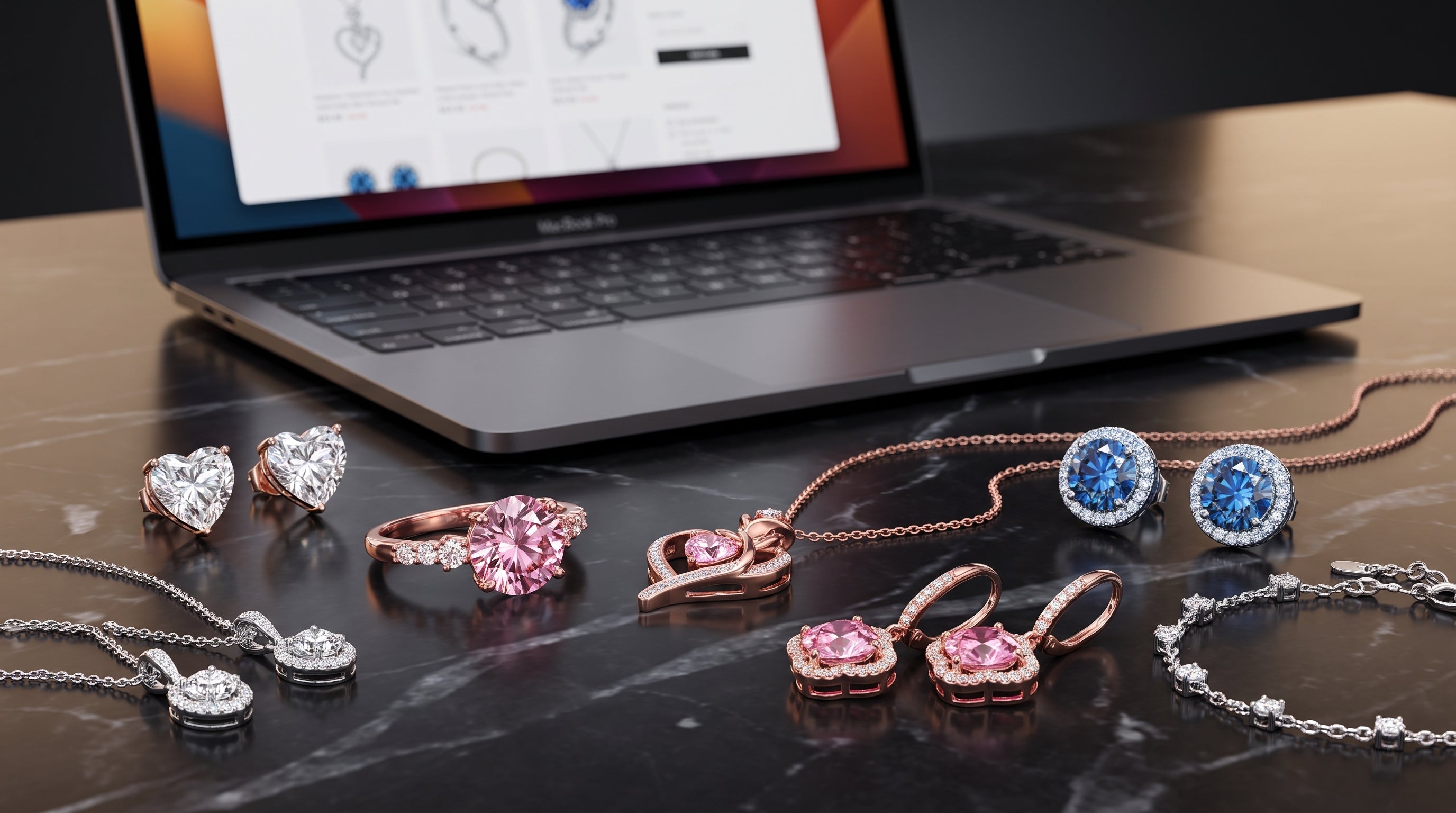
Type moissanite vs lab diamond reddit into a search bar and something odd happens: you rarely land on Reddit. What surfaces instead is a wall of jeweler education pages — Brilliant Earth, GoodStone, With Clarity, Lily Arkwright, Frank Darling — plus a handful of blogs whose entire premise is telling you what Reddit supposedly thinks. You wanted unfiltered opinions from people who already bought the ring, and you got marketing departments interpreting those people for you.
That gap is worth naming, because it changes how you should read everything below. This article does not claim to speak for Reddit, and it does not claim Reddit has reached a verdict. It doesn't have one. What Reddit reliably produces is a repeatable set of objections — the same six or seven complaints, restated in every thread — and those objections are testable against gemology. So that's the approach here: take each argument as it's actually made, separate the part that's true from the part that's brand positioning, and tell you plainly where the evidence runs out.
What the threads are really arguing about
Read enough of these discussions and you notice people are answering two different questions while believing they're answering one.
Question one: which stone performs better?
This is a materials question, and it has fairly stable answers. Hardness, toughness, refractive index, dispersion, color grading, certification practices — these don't change based on who is arguing.
Question two: which stone will I feel good about in five years?
This is a values and social question, and it has no universal answer. It involves how you feel about tradition, whether your partner cares about the word "diamond," whether anyone in your life will comment, and how much you mind the possibility that a jeweler or a relative will clock the stone as something other than diamond. Frank Darling's anti-moissanite piece leans hard on this dimension, arguing that a simulant sacrifices the "essence" of a center stone. Awareness Avenue's own coverage of moissanite and lab diamonds side by side takes the opposite emotional starting point. Both are positions, not facts. Notice which question you're actually stuck on before you weigh anyone's advice.
The fact that ends about a third of the arguments
A large share of Reddit confusion comes from one misunderstanding: people assume moissanite is a type of lab-grown diamond. It isn't, and Brilliant Earth's guide states this explicitly.
- Moissanite is silicon carbide — silicon and carbon bonded in their own crystal lattice. It was first identified by Henri Moissan in 1893 in microscopic crystals from a meteor crater. Natural deposits are vanishingly rare, so essentially all gem-quality moissanite sold today is lab-created.
- Lab-grown diamond is pure carbon in the same tetrahedral lattice as mined diamond, produced by high-pressure high-temperature (HPHT) or chemical vapor deposition (CVD) methods. It is a diamond. Different origin, same material.
- Cubic zirconia is zirconium dioxide, engineered in the 1970s specifically to look like diamond at minimal cost.
So the honest framing is: lab diamond is a diamond with a different birthplace; moissanite is a genuinely different gemstone that happens to be brilliant and colorless-ish. That's why "is moissanite lab grown?" and "is moissanite a lab diamond?" get different answers — yes to the first, no to the second.
| Property | Moissanite | Lab-grown diamond | Cubic zirconia |
|---|---|---|---|
| Composition | Silicon carbide | Carbon (identical to mined diamond) | Zirconium dioxide |
| Mohs hardness | ~9.25 | 10 | ~8.5 |
| Light behavior | High dispersion; pronounced rainbow fire | Crisp white brilliance | Lower refractive index; softer sparkle |
| Typical grading | Usually color only | Full 4Cs report (e.g., GIA, IGI) | Generally none |
Objection 1: "Moissanite looks fake — it's a disco ball"
This is the most common and the most legitimate complaint in the entire debate, and it deserves better than a defensive brush-off.
Why it happens
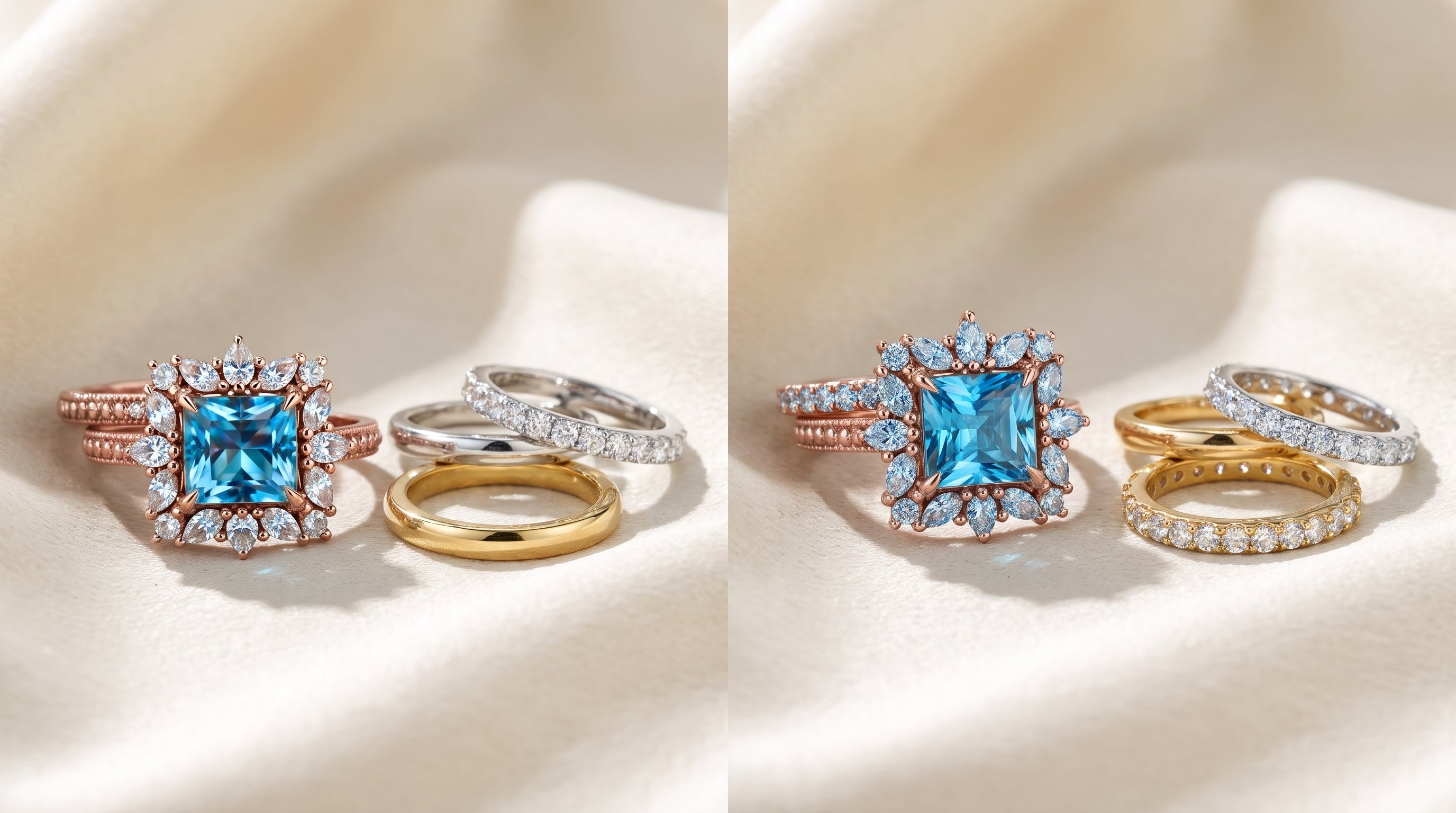
Moissanite has a higher refractive index than diamond — Frank Darling cites roughly 2.65 to 2.69 — and materially higher dispersion, the property that splits white light into spectral colors. Frank Darling describes moissanite's fire as more than double diamond's. GoodStone and Lily Arkwright both frame the practical result the same way: a diamond, lab-grown or mined, tends to throw crisp white flashes back at you, while moissanite throws visible rainbow. With Clarity uses the "disco ball" phrasing directly, and LaneWoods Jewelry acknowledges that some buyers genuinely worry the effect reads as flashy or artificial.
What that means for you
The objection is not that moissanite is a poor imitation of diamond. It's that moissanite outperforms diamond optically in a way diamond never does, and some eyes read excess as artificial. Two variables amplify it: size and light. The effect is far more noticeable in larger stones and under harsh direct lighting — restaurant spotlights, phone flash, sunlight — than in ambient indoor light. Frank Darling makes a sharp related point: because moissanite costs so much less, buyers often size up, which makes the difference from diamond more obvious rather than less.
How people manage it
If you love moissanite's look, none of this is a problem — it's the reason you're buying. If you're worried about it, three levers help: choose a more modest carat weight than your budget technically allows; consider precision cuts such as the Hearts & Arrows patterns Do Amore describes as distributing white and colored sparkle more evenly; and look at stones in several lighting conditions before committing. Seeing a moissanite vs diamond side by side in person is often the only way to know which visual profile you actually prefer. We go deeper on the light behavior in our breakdown of moissanite vs lab diamond sparkle. If after all that you still want sparkle that reads as unmistakably diamond, the honest answer is: buy the lab diamond. No amount of framing fixes a preference.
Objection 2: "Moissanite isn't durable enough for daily wear"
Here Reddit usually collapses two different properties into one word. Hardness and toughness are not the same thing.
Hardness is scratch resistance. Diamond sits at 10 on the Mohs scale — mined or lab-grown, the rating is identical — and moissanite at roughly 9.25, which puts it above sapphire and ruby. With Clarity notes the gap exists but doesn't disqualify moissanite from daily wear. One independent comparison video observes that over many years of constant wear, moissanite can pick up fine surface scratches that slightly soften its look.
Toughness is resistance to chipping and breaking. This one runs the other way. GoodStone points out that diamond has a cleavage direction — planes along which the crystal can split if struck at the wrong angle with enough force. Moissanite lacks a comparably pronounced cleavage plane, which is why GoodStone and Diamante de Laboratorio both describe it as tougher, even while being softer.
So the realistic risk profile is: with a diamond you worry about a hard knock at a bad angle; with moissanite you worry about accumulated micro-scratching over a decade or more. Neither is a reason to avoid either stone for an engagement ring. Both are reasons to take prong checks seriously.
Objection 3: "Even 'colorless' moissanite isn't colorless"
This objection is more grounded than most people realize. GoodStone's comparison suggests moissanite often reads roughly like a K-color diamond equivalent, and With Clarity notes that stones marketed as colorless can still appear yellowish or grayish in practice. The tint tends to reveal itself in larger stones and under certain light temperatures.
Lab-grown diamonds sidestep this because they're graded on the same D-to-Z color scale as mined diamonds by labs such as GIA and IGI. You can choose a documented D, E, or F and know what you're getting. With moissanite, color quality varies by grade tier and by supplier, and you're relying more on the seller's description and your own eyes.
The practical takeaway: if truly icy white is non-negotiable for you or your partner, a graded lab diamond removes the guesswork. If you're comfortable with a whisper of warmth — or you're choosing a colored moissanite deliberately, where tint is the point rather than the flaw — this objection loses most of its force.
Objection 4: "There's no certificate, so what am I actually buying?"
Largely accurate, and worth understanding rather than dismissing. Lab-grown diamonds are typically sold with a grading report covering cut, color, clarity, and carat, and that document follows the stone for life. Moissanite is usually graded for color only; because most of it is eye-clean and cut to standard patterns, the trade has never built out full clarity and cut certification the way it has for diamond.
For a Reddit-shaped audience that instinctively wants independent verification, this is a real asymmetry. It doesn't mean moissanite is misrepresented — it means the verification infrastructure is thinner. If documentation matters to you emotionally or practically, that's a legitimate point in the lab diamond column.
Worth knowing: gemologists can distinguish these stones with testing. Diamond conducts heat efficiently, which is what classic diamond testers exploit; With Clarity notes that moissanite's electrical conductivity is what modern combination testers use to separate it from diamond. Nobody is being fooled at the professional level in either direction.
Objection 5: "Lab diamonds are collapsing in value — you're buying a depreciating asset"
This one comes up constantly, and the honest answer is uncomfortable for both sides.
GoodStone states plainly that lab-grown diamonds have low and declining resale value as production capacity expands, and that moissanite typically returns only about 30–50% of the original purchase price on resale. Frank Darling — a source that is openly critical of moissanite — goes further and argues that moissanite rings hold no meaningful resale value, while also conceding that diamonds don't function as investments in the way popular belief assumes.
Put those together and the resale objection stops being an argument between moissanite and lab diamond. It's a general truth about modern fine jewelry: you are buying a consumable luxury good, not an appreciating asset, whichever stone you pick. The correct response isn't to choose the stone with the least-bad resale story. It's to decide how much you're comfortable spending on something you intend to wear rather than liquidate — and then to buy the version you'll actually enjoy looking at.
Objection 6: "Moissanite rings are cheap plated junk"
The most underrated point in the entire debate, and it isn't about the stone at all.
One independent comparison observes a market pattern: moissanite is frequently set in vermeil or plated sterling silver, while lab diamonds are more often set in 14k or 18k gold or platinum — a difference that affects wear resistance, resizing, and whether the piece survives as an heirloom. That pattern is a tendency, not a law. There are moissanite rings in solid gold and lab diamond rings in mediocre mountings.
Which is exactly why the sensible move is to evaluate the setting as a separate purchase decision from the stone. Ask what the metal actually is, whether it's solid or plated, how the prongs are constructed, and whether the shank can be resized. When evaluating a moissanite vs diamond ring, remember that a superb stone in a failing mounting is a worse outcome than a modest stone in a well-built one. Solid sterling silver and solid gold behave very differently over ten years of daily wear than plating does — and no gemstone, diamond or otherwise, compensates for a setting that wears through.
Why this article doesn't quote dollar figures
You'll notice we haven't given you prices. That's deliberate, and it's the part most competing pages get wrong.
The published figures across jeweler blogs are brand-specific catalog prices, undated, and in at least one case internally inconsistent — the same article citing two different per-carat ranges for moissanite in separate sections. Quoting them as though they represent the market would be misleading, particularly for lab-grown diamonds, where the direction of pricing has been moving.
When looking at moissanite vs diamond vs cubic zirconia, the ordering is stable enough to plan around:
- Cubic zirconia is the least expensive by a wide margin.
- Moissanite costs substantially more than cubic zirconia and substantially less than diamond of comparable size.
- Lab-grown diamond sits above moissanite and well below a comparable mined diamond.
- Mined diamond is the most expensive.
Use that hierarchy to set expectations, then get live quotes from the specific vendors you're considering rather than trusting any blog's number — including ours. If you want the reasoning behind the gap in more detail, see our discussion of moissanite vs diamond price dynamics and lab diamond trends.
Where cubic zirconia fits into the conversation
Reddit threads often pull CZ in as a gotcha — "if you'll accept moissanite, why not CZ?" The materials answer is straightforward. CaratBee describes cubic zirconia as strong but faster-wearing than moissanite, accumulating small scratches that dull its luster over time. With Clarity places it around 8.5 on the Mohs scale with a lower refractive index than diamond, meaning less sparkle, and notes that CZ can be manufactured completely colorless — its one genuine advantage over moissanite on the color question.
The distinction that matters: cubic zirconia is generally positioned as a short-horizon or fashion stone, while moissanite is durable enough for daily wear over years. If you want that comparison unpacked properly, our moissanite vs cubic zirconia side-by-side guide covers it. For the purposes of this debate: moissanite is not "just a nicer CZ," and treating it as one is the fastest way to reach a bad conclusion.
How to actually use Reddit for this decision
Community threads are genuinely useful — just not for the thing most people use them for.
What Reddit is good for
- Vendor behavior. Return windows, resizing policies, how a seller handled a problem order, whether documentation arrived as promised. This is where crowdsourced experience beats any brand page.
- Long-term wear reports. People posting photos of a stone after three or five years tell you more than any spec sheet.
- Discovering objections you hadn't considered — like the setting-metal issue above, which almost never appears in stone-versus-stone comparisons.
What Reddit is bad for
- Consensus. There isn't one. Threads contain enthusiastic moissanite owners and people who regret it, lab diamond defenders and people anxious about value. Any article claiming "Reddit prefers X" is selecting evidence.
- Predicting your own reaction to sparkle. Nobody else's eyes can tell you whether moissanite's fire reads as gorgeous or garish to you.
- Pricing. Posts age quickly and rarely specify quality grades.
A useful discipline when reading a thread: check whether the person answering owns the stone they're recommending, and how long they've owned it.
A straight decision framework
Choose a lab-grown diamond if: the word "diamond" matters to you or your partner; you want a formal grading report and documented color; you strongly prefer crisp white brilliance over rainbow fire; or you'd rather have a smaller stone that reads unmistakably as diamond than a larger stone that doesn't.
Choose moissanite if: you actively like intense fire; you want more visible size and presence for your budget; you're comfortable without a full 4Cs report; you value that it's lab-created and conflict-free by nature; or you're buying jewelry you intend to wear and enjoy rather than resell.
Reconsider cubic zirconia for a piece you expect to wear every day for years, given its lower hardness and faster wear.
Regardless of stone: interrogate the metal, the prongs, and the resizing options as hard as you interrogate the gem.
Frequently asked questions
Is moissanite lab grown?
Yes. Natural moissanite is exceptionally rare — it was first found in meteorite material — so essentially all gem-quality moissanite on the market is created in a lab. It is lab-grown; it is simply not a lab-grown diamond.
Can a jeweler tell moissanite from a lab diamond?
Yes, routinely. Thermal testers alone can't reliably separate them, but moissanite's electrical conductivity allows modern combination testers to distinguish it, and the optical difference is apparent to a trained eye.
Is a lab diamond "fake"?
No. Lab-grown diamonds are carbon in the same crystal structure as mined diamonds, with the same hardness and optical behavior. The difference is origin, not identity.
Will people notice it's moissanite?
Most people won't examine your ring closely. Where it becomes noticeable is in larger stones under harsh light, where the rainbow dispersion is strongest — which is why sizing up aggressively is the single choice most likely to make the difference visible.
Where we stand, and where we don't
Awareness Avenue makes moissanite jewelry, so treat our enthusiasm accordingly. What we won't do is pretend the objections above are imaginary. Moissanite's fire really is stronger than diamond's, and some people won't like that. Its color really can read warmer than a graded D-color stone. It really doesn't come with a full 4Cs report. And its resale value is poor — as is, by several jewelers' own accounts, that of lab-grown diamonds.
If those trade-offs are dealbreakers, buy the lab diamond, from us or from anyone else. If they read as acceptable — or as advantages — you can browse our moissanite rings and see how the stone behaves in person before deciding. Either way, make the call on the specific stone in front of you and the setting holding it, not on the loudest comment in a thread.

Leave a comment
This site is protected by hCaptcha and the hCaptcha Privacy Policy and Terms of Service apply.