


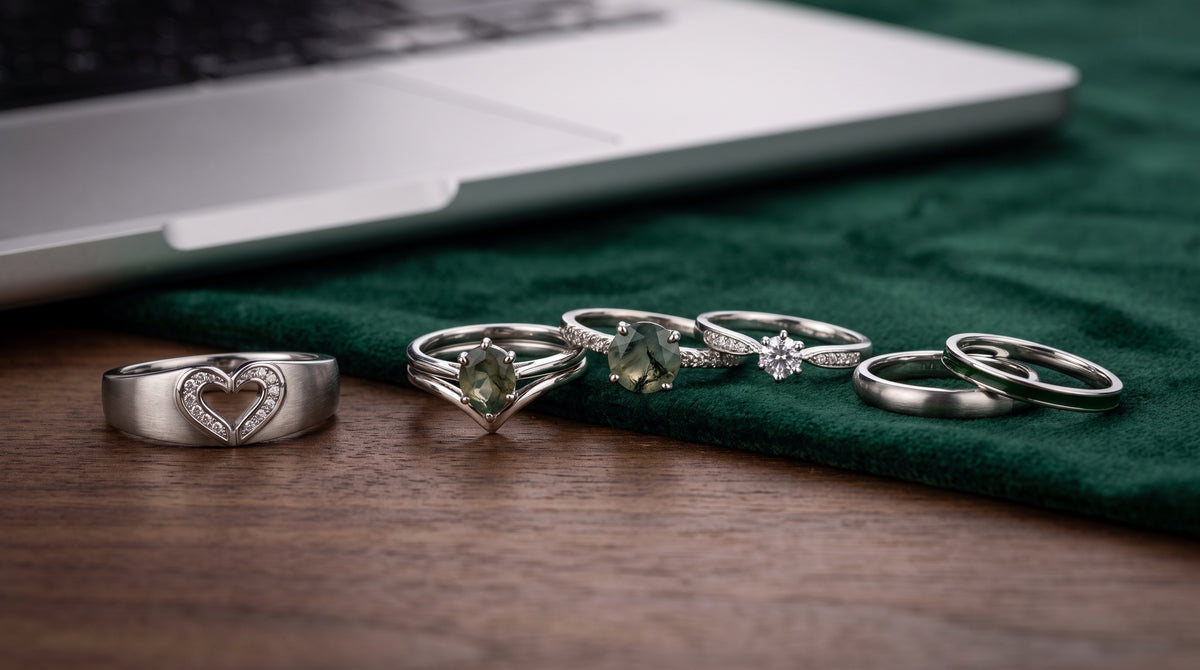
People who search for community discussion about moss agate engagement rings have usually already fallen for the stone. They have seen the green dendritic patterns floating in milky chalcedony, noticed that no two stones look alike, and then hit the wall every non-traditional gem buyer hits: a stone that sits around 6.5–7 on the Mohs scale is being proposed for the one piece of jewelry that never comes off. The searcher is not looking for more photographs. They are looking for the paragraph that product pages skip.
This article handles those objections one at a time. A note on sourcing before we start: nobody should quote you anonymous threads as if they were lab reports, and no honest writer can tell you what "most people" on a forum concluded. What is verifiable is the gemology — hardness, toughness, fracture behavior, chemical stability, setting mechanics — plus the fact that nearly every moss agate guide currently published is structured around the same handful of worries, which tells you exactly which worries are real. Where something is inference rather than evidence, it is labeled as such.
What moss agate actually is, and why it underpins every objection
A chalcedony, not a banded agate, and no actual moss
Moss agate is a variety of chalcedony — a cryptocrystalline form of quartz (silicon dioxide) made of microcrystals too small to resolve with the naked eye. Gemological references place it in the chalcedony family rather than treating it as a true banded agate, and the "moss" is not organic material at all. The fern-like and landscape-like figures are mineral inclusions suspended in the quartz matrix; sources variously describe them as manganese- and iron-bearing, or as hornblende, which likely reflects differences between deposits and between the conventions individual gem writers use.
Two consequences follow, and they matter for the rest of this discussion. First, because moss agate is quartz, its physical behavior is quartz behavior: the same hardness band as amethyst and citrine, a compact microcrystalline structure, and a conchoidal (smooth, curved) fracture rather than a cleavage plane waiting to split. Second, because the pattern is the product, moss agate is graded by artistry as much as by metrics — distinctness and distribution of the dendrites, contrast of green against white or grey, and a gentle translucence at the edges when backlit. A stone with muddy, smeared inclusions is a lower-quality stone even if it is perfectly durable.
What "6.5 to 7" means on a real hand
Numbers on the Mohs scale are ordinal, not linear, so translation helps. At roughly 6.5–7, moss agate is harder than window glass and a steel knife blade (both commonly cited near 5.5) and far harder than gold. It will scratch a steel nail. It is softer than topaz (8), sapphire (9), and diamond (10), and slightly harder than opal (5.5–6.5) and in the same region as tanzanite (6–7).
The practical threshold that gets overlooked is quartz dust. Ordinary household and street grit frequently contains quartz particles of similar hardness to moss agate, which means the stone is not immune to its own environment. Wiping a gritty stone hard with a dry cloth, or gardening bare-handed with the ring on, is an abrasion event. This single fact explains why credible guides place moss agate in a "good for careful daily wear" category rather than in the set-and-forget category occupied by sapphire and diamond.
Toughness is the underrated half of durability
Scratch resistance is only one axis. Toughness — resistance to chipping and breaking under impact — is described as moderate to very good for moss agate, attributed to its compact chalcedony structure and conchoidal fracture. In comparative terms, that is a genuine strength: some prettier, pricier stones are harder yet more fragile. Emerald, for example, is higher on the Mohs scale but notoriously prone to chipping because of poor toughness and internal fissures, and at least one detailed durability analysis argues moss agate resists cracking better in day-to-day wear for that reason. Vintage agate jewelry surviving in wearable condition is the informal evidence that chalcedony can take decades of handling.
Objection 1: "It's too soft for an engagement ring"
What realistically happens over five to ten years
The honest projection is not catastrophic failure; it is gradual dulling. Under constant wear, a moss agate center stone can accumulate fine surface abrasions that flatten its polish and mute the contrast of the pattern, particularly on the highest point of the dome where contact is most frequent. The important half of that sentence is the remedy: a bench jeweler can usually re-polish the stone and restore the luster. Aggressive compounds such as diamond paste are cautioned against; gentle professional polishing is the route.
Chipping, where it happens, is almost always an impact story rather than a slow-wear story — a knuckle-first grab at a car door, a dumbbell rack, a granite countertop — and it is heavily mediated by the setting, which is the subject of the next objection.
A lifestyle test more useful than a hardness number
Instead of asking "is 6.5–7 enough," ask how many hours a week your hands do work that a stone would not survive, and whether you are willing to take the ring off for those hours. A desk-based routine with normal cooking, typing, and childcare sits comfortably inside what moss agate handles. Regular weight training, climbing, trades work, clay or soil contact, and heavy cleaning do not, and the published guidance is consistent: remove the ring for sports, manual labor, gardening, and the gym. If "I will never take it off" is a firm identity statement rather than an aspiration, the evidence points you toward a harder stone. That is not a scare tactic; it is the same logic that makes tradespeople choose plain bands. It is also why hands-on wearers often look at heavier, lower-profile constructions, a theme covered in our guide to a moss agate men's ring.
Objection 2: "It will chip" — the setting does most of the arguing
Bezel and low-profile designs versus tall solitaires
If there is one lever that changes moss agate's risk profile more than anything else, it is ring architecture. A bezel wraps metal around the stone's girdle, shielding the vulnerable edge and absorbing knocks that would otherwise land on gem material. A low-profile mount keeps the stone close to the finger, which both reduces the leverage of an impact and makes the ring less likely to snag on clothing, bags, and door handles. Halos can add a buffer of accent stones around the center, though they also add more components and more surfaces to maintain.
Conversely, a tall cathedral or high-set prong solitaire leaves the stone's perimeter exposed and multiplies the force of any strike. Cautionary commentary about delicate inclusions and high settings being vulnerable in daily wear is aimed squarely at that design language. The reasonable reading is not "prongs are forbidden" but "if you want prongs, keep the profile low and accept a slightly higher maintenance burden."
Cabochons, pears, and pointed shapes
Cut geometry follows the same logic. A smooth cabochon dome has no corners to chip, which is why it is treated as the most durable presentation for moss agate. Faceted and pointed outlines look sharper and more "engagement ring," but a point is a stress concentrator. For anyone specifically drawn to a pear-shaped moss agate engagement ring, the tip is the whole conversation: it should be protected, typically by a V-prong or an extension of the bezel, and it should not be the thinnest part of an already thin stone. Excessively thick, tall cuts are also flagged as a hazard because they catch on fabric and increase leverage stress at the girdle.
Ring sets and contoured bands
A moss agate ring set solves a real problem and creates a small one. The upside is fit: a contoured or V-cut wedding band designed for the specific center stone nests without riding up onto the gem, which prevents a hard metal edge from repeatedly grinding against chalcedony. The trade-off is that metal-on-stone contact is still a wear point in any stacked configuration, so a set that was engineered as a pair is preferable to two rings that merely happen to sit together. If a coordinated pair is the goal, our moss agate ring set buying guide works through how the bands are matched.
Objection 3: "Is real moss agate even a thing?"
Two different questions hide inside this one, and conflating them is why the topic stays muddy.
The first question — is moss agate a genuine gemstone — is settled. It is a naturally occurring material, classified within the chalcedony group of quartz, not a resin composite and not a lab invention masquerading as a mineral. The low price relative to diamond is a function of abundance and the absence of a luxury supply chain, not a sign of fakery.
The second question — is this particular stone natural and untreated — is legitimately open. Dyeing exists in the broader agate and chalcedony trade, and the practical tell described in the literature is color that reads as neon or implausibly saturated green rather than the sage-to-forest range of untreated material. Mineral community forums also carry recurring disputes about materials marketed under one name and sold as another, which is a reminder that labeling discipline varies by seller rather than proof that any specific listing is misrepresented.
What follows from that is a buyer behavior, not a panic: ask the seller where the rough came from, whether the stone has been dyed, stabilized, or otherwise treated, and how it was cut and set. A vendor who answers plainly is giving you the information you need; a vendor who deflects is giving you information too. Request a gemological report if the stone is a significant purchase. Be skeptical of fluorescent greens and of backlit photos that look nothing like the daylight images.
Objection 4: "A stone this inexpensive won't feel serious"
What moss agate is said to mean
Moss agate carries a long-standing symbolic vocabulary that is unusually well matched to an engagement. It has been nicknamed the "Gardener's Stone" and associated with growth, renewal, new beginnings, prosperity, and harmony with nature; in metaphysical practice it is linked to the heart chakra and to emotional balance, hope, and trust. Contemporary readings extend that into values language: a preference for authenticity over convention, a commitment that is expected to grow rather than arrive finished, and an interest in alternatives to the traditional diamond narrative. These are cultural and spiritual associations, not measurable properties, and they should be offered as meaning rather than as fact. Our broader guide to moss agate jewelry goes deeper into that symbolism.
The cost question, stated carefully
Moss agate sits at a small fraction of diamond pricing per carat, which is why it is routinely described as offering a larger, more dramatic center stone for a given budget. Published figures vary widely by vendor, size, pattern quality, and date, so specific dollar comparisons are best checked live at the point of purchase rather than taken from any article. Two implications are stable regardless of the exact numbers. Moss agate lets the budget go toward the setting — the bezel, the metal weight, the craftsmanship that actually protects the stone. And if the center stone is ever damaged beyond re-polishing, replacing it is a manageable expense rather than an insurance claim, which reframes the durability question from "will this survive forever" to "what does a worst case actually cost me."
The conversation worth having first
Social reception is the part nobody can promise you. Some families arrive at an engagement expecting a diamond, and a green patterned cabochon will read as a statement. Whether that statement lands as charming or puzzling depends on people, not gemology, and there is no data that settles it. The useful move is to treat it as a communication issue: talk with your partner about what they want the ring to signal, whether they would rather have one distinctive stone or maximum hardness, and how they feel about removing a ring for certain activities. A ring chosen after that conversation is defensible to anyone.
Objection 5: "The maintenance sounds exhausting"
It is less demanding than the warning list makes it sound, because most of the list is prohibitions rather than chores. The routine that recurs across sources is short:
- Clean gently and occasionally. Warm water, a mild dish soap, a soft brush, a thorough rinse, and a soft lint-free or microfiber cloth. Monthly is a reasonable cadence for a ring worn daily.
- Skip ultrasonic cleaners and steamers. Vibration and rapid temperature change can stress natural inclusions and work settings loose, so the risk is not worth the convenience.
- Keep harsh chemistry away. Moss agate is chemically stable in ordinary conditions and is not harmed by water, UV, or mild heat, but strong acids, bleach, and prolonged contact with aggressive detergents are flagged as damaging to the stone's surface and to metal alloys.
- Store it apart from harder stones. Diamonds and sapphires in the same dish will scratch it. A soft pouch or a lined compartment solves this.
- Have it checked periodically. A jeweler inspection roughly every twelve to eighteen months catches loosening prongs or a lifting bezel before a stone is lost, and is the moment to ask about a light re-polish if the dome has gone flat.
Nothing there is unusual for colored stone jewelry. The one behavioral change that matters most is the habit of taking the ring off before heavy-handed work, and that habit is easier to build with a ring dish at the sink and one in the gym bag than with willpower.
When the honest answer is "choose something else"
An objection handler that never concedes is just marketing. Moss agate is the wrong choice if you work with tools, sand, stone, or chemicals; if you are certain you will not remove the ring; if the idea of a re-polish in a decade bothers you; or if what you actually want is the optical fire of a faceted transparent stone, because a translucent patterned cabochon will never produce that.
If scratch resistance is the non-negotiable, the evidence points to the harder end of the scale — sapphire and diamond — and moss agate cannot compete there. If the appeal was the non-traditional, non-diamond route rather than the pattern itself, a faceted lab-created alternative keeps the brilliance; see our discussion of choosing a moissanite engagement ring, or look at faceted designs such as The Amalthea Moissanite Ring and The Lysandria Moissanite Ring to compare the two aesthetics side by side before committing.
How to vet a specific moss agate ring
Whatever you end up buying and wherever you buy it, the same checklist applies. Judge the stone on pattern first: distinct, well-distributed dendrites with real contrast, natural-looking green, and a soft translucence at the edges. Reject neon color. Check the profile in a side-view photograph, not just the top-down hero shot — you are looking for how much stone sits above the finger and how much metal protects the girdle. Confirm the cut: a dome with no sharp corners is the safest, and any point needs a protective prong or bezel tip. Ask about treatments and origin in writing. Ask what the setting is and whether the seller offers stone re-polishing or replacement later. And match the design to your hands rather than to the photographs you liked.
Within Awareness Avenue's range, the two pieces built around this stone are the Natural Moss Agate V Cut Solitaire Ring Set, a solitaire paired with a V-cut band designed to nest with it, and The Nimue Moss Agate Ring as a standalone design. Use the product pages themselves for the specifics that actually determine durability — metal, stone dimensions, cut, and setting type — rather than taking any of those details from an article, and read them against the checklist above. If you want a wider survey of shapes, metals, and setting styles before narrowing down, our complete moss agate engagement ring guide covers the field in more depth.
The bottom line
The skeptics and the enthusiasts are both partly right, and the disagreement usually comes from arguing about the stone in isolation. Moss agate is a genuine natural chalcedony at roughly 6.5–7 Mohs with moderate to very good toughness and stable chemistry: strong enough for everyday wear, not strong enough to be ignored. Put that stone in a low bezel, keep it off your hand during heavy work, clean it gently, and it behaves like a well-designed colored-stone ring that can be refreshed when it dulls. Put the same stone in a tall exposed mount on a pair of hands that never come out of the dirt, and the critics' predictions come true.
So the real question is not whether moss agate is "good enough" for an engagement ring. It is whether you want a stone whose value is its one-of-a-kind pattern and symbolism, and whether you are willing to trade a small amount of convenience for that. If yes, the trade is a reasonable one, and surviving vintage agate jewelry suggests it holds up. If no, that is a legitimate answer too — and knowing it before the proposal is worth more than any forum verdict.

Leave a comment
This site is protected by hCaptcha and the hCaptcha Privacy Policy and Terms of Service apply.