


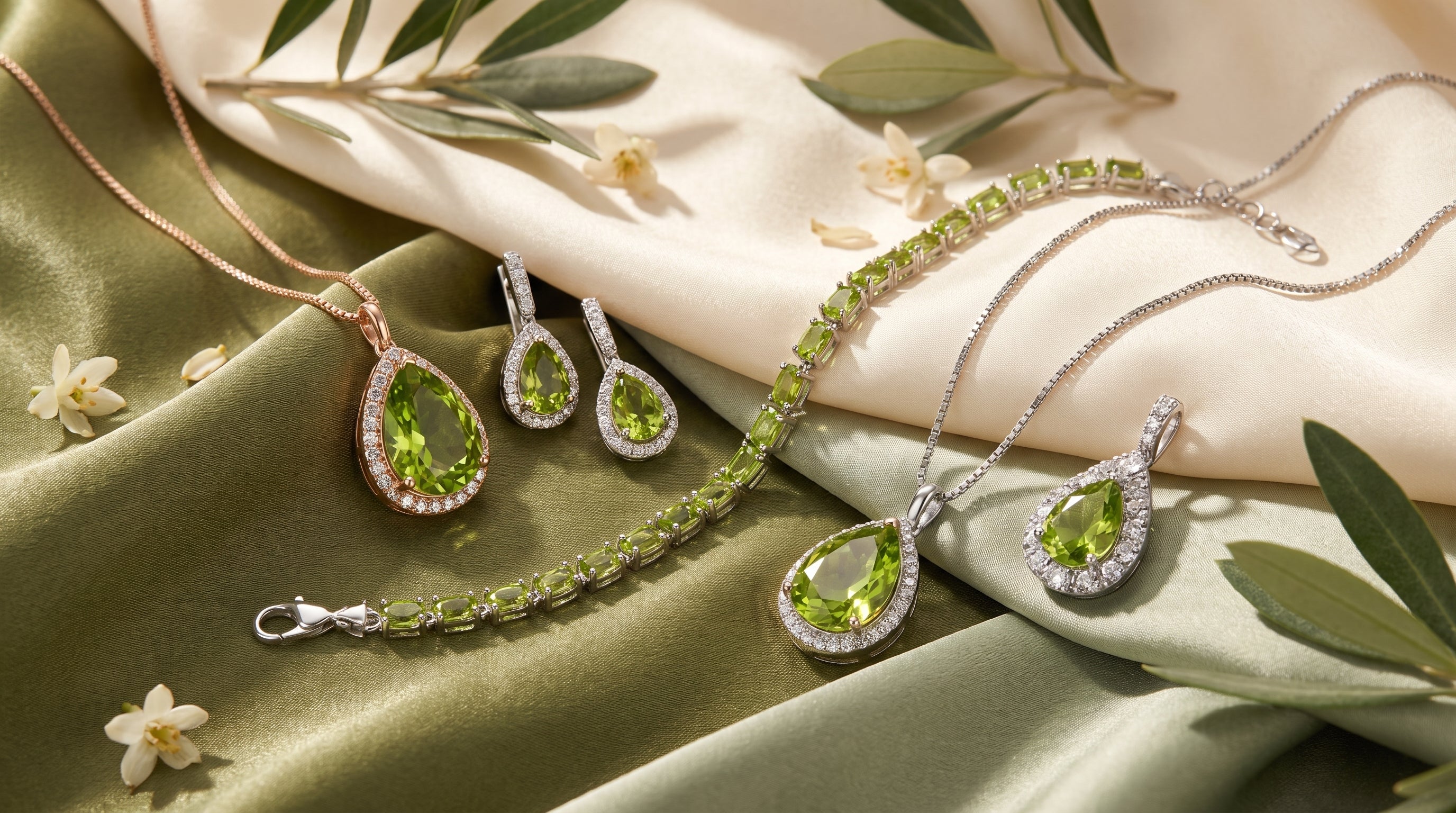
Search for an August birthstone jewelry set and you will notice something odd: most jewelers do not actually sell one. Rogers & Hollands, Cape Cod Jewelers, James Avery, and Peora all run dedicated August peridot pages, but they organize them by piece type — rings here, necklaces there, bracelets in a third bucket. Kendra Scott gets closest by framing its August pieces as "stacking jewelry" designed for layering, and Rogers & Hollands mentions giftable sets, but the coordination work still lands on you. Amazon is the main place where "set" appears as a literal product label, usually a peridot pendant paired with matching studs.
That gap matters, because a set that was assembled rather than manufactured can be better — you control the green, the metal, and the scale — but only if you understand what makes peridot pieces read as a matched group instead of three separate purchases that happen to share a color family. This guide covers the decisions that determine whether your set looks intentional: stone type, color consistency, metal tone, and piece hierarchy. It also handles the questions that surface alongside the main one, including August birthstone color, the two August birth flowers, and how August's green compares to May's and September's stones.
What Counts as an August Birthstone
Most shoppers assume August has one stone. It has three. The Gemological Institute of America lists peridot, spinel, and sardonyx as August birthstones. Jewelers of America, the trade association, lists peridot and spinel in its August row of the standard birthstone chart, illustrated with a gold peridot necklace.
Peridot is the one that dominates retail, and for good reason — nearly every August category page in the market is built around it. GIA describes peridot as the yellowish green to greenish yellow gem variety of the mineral olivine, with the preferred color being a pure grass green free of brown or yellow undertones. Cape Cod Jewelers calls it the "Gem of the Sun."
Spinel earned its place on modern August lists partly through its wide color range and a long history of being mistaken for other stones. Sardonyx is the traditional August stone, banded and opaque rather than transparent, and largely absent from contemporary birthstone jewelry lines. If you are building a set, peridot is the practical choice — it is what the market supplies, and it gives you enough pieces across necklaces, bracelets, and pendants to actually coordinate. But it is worth knowing why you might occasionally see a red or gray stone marketed as August: those retailers are drawing on spinel or sardonyx rather than making an error.
Why this affects set-building
Sticking to one stone type across a set is the single easiest way to make it look deliberate. Mixing a peridot necklace with a spinel bracelet gives you two technically correct August pieces that share nothing visually. Unless you are specifically after a multi-stone August concept, choose peridot — or a peridot-colored stone — and hold that decision across every piece.
August Birthstone Color: The Range You Are Actually Choosing From
Peridot is not one green. GIA's description spans yellowish green to greenish yellow. Kate Koel's peridot guide breaks the practical range down further: pale and almost transparent at one end, bright lime in the middle, deeper olive or grass green at the other. Iver Jewelry makes the same point, noting that green is the most famous August birthstone color specifically because of peridot, with subtle yellowish nuances running through it. Little Sky Stone describes August's stone as a soft green.
This variation is normal in natural peridot and it is the reason assembled sets sometimes fail. Two natural peridot pieces bought separately can sit noticeably apart on the yellow-to-olive spectrum, and side by side on a wrist and neckline, the mismatch reads as an error rather than a range.
Quality markers within the green
Frassanito Jewelers' peridot guide gives the clearest practical criteria: look for vibrant, evenly distributed green without visible brown or yellow undertones, and favor cleaner stones, since peridot typically has excellent transparency and fewer inclusions translate directly into more brilliance. Even color distribution is the marker most shoppers overlook — a stone can have a pleasant hue overall while being noticeably darker at one end, and that unevenness shows most in larger center stones.
How August green compares to May and September
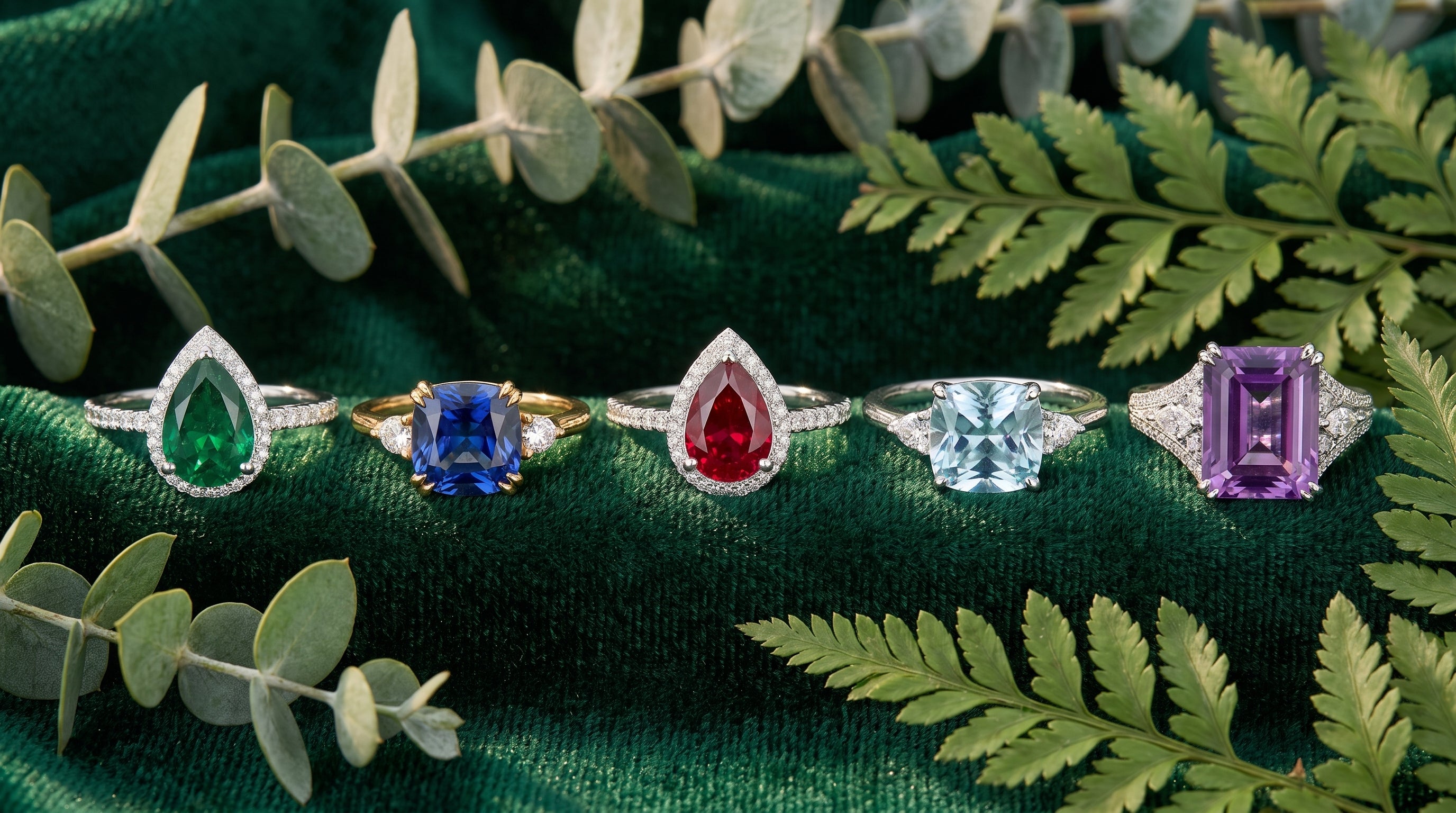
People building family sets or shopping for several birthdays run into this comparison constantly. Jewelers of America's chart lists emerald for May and sapphire for September. May birthstone color is, in practice, the deep green of emerald — a bluer, more saturated green than peridot's yellow-leaning tone, which is why the two rarely substitute for each other despite both being "green months." September birthstone color is best documented as blue: Gabriel & Co. describes sapphire as most commonly blue, ranging from deep royal to cornflower shades, with meanings tied to wisdom, loyalty, and protection.
The practical takeaway for multi-month gifting is that peridot's lighter, warmer green sits comfortably next to sapphire blue but can look washed out beside emerald. If you are pairing an August piece with a May piece, give the peridot its own real estate rather than stacking it directly against emerald. Our guides to sapphire birthstone rings and May birthstone rings cover those two stones in their own right.
Natural Peridot vs. Simulated Green Stones
This is the fork in the road that determines almost everything else about your set, and most category pages skip past it.
Natural peridot is mined olivine. Peora, for instance, builds its August collection specifically around natural peridot in sterling silver and 14K gold settings. Natural stones carry genuine gemological identity and the variation described above — no two are quite the same green.
Simulated and substitute stones represent August by color rather than mineral identity. FYB Jewelry's August bracelet uses cubic zirconia set in 18K gold plating over 925 sterling silver. Awareness Avenue's Belenis Hex in 18K gold vermeil states the logic plainly in its own copy — "Vibrant Saturation. Hexagonal Precision. Simulated Perfection" — with the note that nature rarely delivers the perfect shade of green. That is an honest description of the trade-off rather than a workaround.
A third path uses a different stone entirely for its optical qualities. The Azurise Eye is marketed as an August birthstone eye necklace and is engineered with moissanite for more fire than diamond, set in solid S925 sterling silver with rhodium plating. Its August connection runs through design and concept rather than through peridot itself.
Choosing between them for a set specifically
For a multi-piece set, the argument for simulated stones is stronger than it is for a single purchase. Because simulated green is manufactured to a target shade, pieces bought separately will match each other far more reliably than two natural peridots will. If your priority is that the necklace and bracelet look like they were made together, consistency of color favors the simulated route. Awareness Avenue's August simulated peridot collection and natural peridot collection are separated for exactly this reason — deciding which lane you are in before you shop saves you from a mismatched set.
If gemological authenticity is the point — the stone matters as much as the look, or the set is marking a milestone where "real peridot" carries meaning — go natural and accept that you may need to view pieces together, or build around a single natural centerpiece with simpler accompanying pieces.
Metals: The Decision That Makes or Breaks a Matched Set
Color coordination gets all the attention, but metal tone is what most obviously exposes an assembled set. Across the August market, three metal categories recur.
Sterling silver and rhodium-plated silver
Sterling silver is the workhorse of August birthstone jewelry — Cape Cod Jewelers highlights sterling silver peridot bezel necklaces and bracelets, and James Avery and Peora both offer sterling silver alongside gold. Silver's cool tone pushes peridot's yellow-green toward the cooler, fresher end of its range. Rhodium plating over sterling, as used on the Azurise Eye, adds a brighter white finish. Awareness Avenue's August Peridot Birthstone Necklace and August Peridot Birthstone Bracelet are both S925 sterling silver, which makes them the most direct pairing available for a matched two-piece set.
Gold vermeil
Gold vermeil is gold over a sterling silver base — the Belenis Hex and Peridina Teardrop both use 18K gold vermeil. Warm gold amplifies peridot's yellow undertones, producing a richer, more golden-green effect. If you want peridot to read as sunlit rather than crisp, gold vermeil is the setting that gets you there.
Solid gold
Solid gold appears at the top of most August ranges — James Avery and Peora both offer 14K gold peridot pieces, and the Amelienne Peridot Pendant is offered in S925 sterling silver and 10K white gold. Awareness Avenue's solid gold pieces sit in a separate collection. Solid gold is where a set's centerpiece often lives when the accompanying pieces are silver or vermeil — though be deliberate about that, since mixing metals is a style decision, not a default.
The practical rule
Match your metal across the set, or mix it so obviously and consistently that it reads as intentional. The failure mode is accidental near-matching: a rhodium-plated silver necklace next to a warmer, unplated silver bracelet, or gold vermeil against 10K white gold. If you are combining tones on purpose, repeat the combination in at least two pieces so the eye registers a pattern.
Building the Set: Piece Hierarchy and Specific Combinations
A functional set needs one piece doing the talking and the rest supporting it. Attempting three statement pieces produces competition, not coordination.
Start with the centerpiece
The necklace or pendant is almost always the anchor. It sits at eye level and it is where the peridot gets the most attention. Choose the largest or most distinctive stone here. Options in this role include the Amelienne Peridot Pendant, the Elyon Peridot Pendant, the Peridina Teardrop, the Belenis Hex, and the straightforward August Peridot Birthstone Necklace. The Belenis Hex's hexagonal cut is a distinct enough silhouette that it does the work of a statement piece on its own.
Add the wrist piece
Bracelets carry a set's rhythm. Three broad approaches show up in the peridot market. A tennis line — like the Electra Tennis Peridot Bracelet — delivers continuous stone coverage and reads as the dressiest option. A station design — the Clarisse Station Bracelet in S925 sterling silver — spaces stones out for a lighter, more everyday effect. A single-stone or oval-focused bracelet, like the Calianna Oval Peridot Bracelet, echoes a pendant's shape without repeating its scale.
The pairing logic is inverse: a bold pendant wants a station or single-stone bracelet; a simple bezel-set necklace can carry a tennis bracelet without the set feeling overloaded.
Three worked combinations
The matched silver two-piece. August Peridot Birthstone Necklace with the August Peridot Birthstone Bracelet, both S925 sterling silver. This is the closest thing to a purpose-built August birthstone jewelry set in the range — same metal, same naming convention, same design intent — and it is the lowest-risk option if you are buying as a gift and cannot see the pieces together first.
The elevated pendant plus line bracelet. The Amelienne Peridot Pendant in sterling silver with the Electra Tennis Peridot Bracelet. A defined pendant at the neckline, continuous sparkle at the wrist, unified by silver. Better suited to evening and occasion wear than to daily rotation.
The warm-gold combination. The Belenis Hex or Peridina Teardrop in 18K gold vermeil as the anchor, with the green tones warmed by the gold. This is the route to take if the recipient's existing jewelry skews gold, since a silver set will simply sit unused next to it.
Earrings and the fourth piece
Traditional four-piece sets include earrings, and pre-bundled Amazon listings typically pair a pendant with matching studs precisely because that combination is so easy to wear. If earrings are not available in a matching peridot design, a pair of plain studs in the same metal will complete the look without competing — this is one case where not matching the stone is the better call. A pendant, bracelet, and metal-matched studs reads as a full set; a pendant, bracelet, and mismatched green earrings reads as three unrelated pieces.
Durability and Everyday Wear
Peridot is softer than diamond or sapphire, which is why Frassanito Jewelers recommends protective settings — bezels or halo designs — for rings and pieces intended for everyday wear. That advice reshapes how you should think about a set that gets daily use.
The exposure ranking runs roughly: rings take the most impact, bracelets next, then necklaces and earrings, which sit relatively protected. So if your set includes a ring or a bracelet you plan to wear constantly, that is where a bezel setting earns its keep. Cape Cod Jewelers' emphasis on bezel-set peridot pieces reflects the same reasoning.
A useful strategy for sets: put the more delicate or elaborate stonework in the necklace, where it is least likely to catch, and choose a sturdier setting style at the wrist. That way the set survives real wear rather than living in a box. If daily wear is the goal, our guide to building an everyday jewelry set covers the same durability logic across piece types.
The August Birth Flowers: Gladiolus and Poppy
August has two recognized birth flowers, and they open a design direction most peridot-only pages ignore entirely.
Royer's Flowers identifies gladiolus (genus Gladiolus spp.) as August's birth flower, noting a blooming period from mid-spring through fall and a decorative life of six to ten days as a cut flower. Kate Koel names both gladiolus and poppy as August's flowers and suggests birth flower rings and necklaces as an alternative for anyone who wants an August connection without a gemstone. Little Sky Stone stocks a poppy birth flower necklace alongside its peridot pieces.
Working flowers into a stone-based set
Three approaches make sense. You can substitute entirely — a gladiolus or poppy piece stands in for peridot when the recipient prefers metalwork, engraving, or has no attachment to green. You can layer — a peridot pendant on one chain, a floral pendant on another, giving a two-necklace set both of August's symbols. Or you can accent — a floral charm on a peridot bracelet, or engraving on the reverse of a pendant, keeping the stone dominant while adding a second layer of meaning.
This is genuinely open territory. Floral August motifs show up mainly in small independent collections rather than mainstream peridot lines, which means a set combining both symbols is uncommon enough to feel considered. Our guide to the August birthstone and flower goes deeper on the symbolism behind both.
Peridot's Meaning and What to Say When You Give It
Gift-givers usually want a line to attach to the box. Peridot supplies several, all with real documented history behind them.
GIA records peridot's long use as a protective talisman, believed to shield its owner from evil spirits and "terrors of the night." Royer's adds the pirate folklore: peridot was said to glow near buried treasure and to offer protection from nightly terrors when set in gold — which incidentally makes a gold-set peridot piece a nicely specific story to tell. In modern practice, GIA associates peridot with courage, happiness, and clear communication that brings stability to marriage and partnerships, and notes that peridot is the gift for a 16th wedding anniversary. Little Sky Stone describes it as bringing peace, compassion, and healing to the wearer. Iver Jewelry and Kate Koel connect it to light, protection, prosperity, and renewal.
These are traditional and cultural meanings, not verified effects — present them as the stone's history rather than as a promise. That framing is more interesting anyway. "Sailors carried this because they thought it glowed near treasure" lands better than a wellness claim.
The 16th anniversary angle
Peridot's anniversary role is underused by shoppers. If you are buying for a couple at sixteen years, a peridot set is a documented traditional gift rather than an arbitrary green choice — and it works regardless of whether either partner was born in August.
Practical Checks Before You Buy
Confirm what the stone actually is
Product titles and category labels do not always distinguish natural peridot from simulated green stones or moissanite. Read the individual product page for stone description and material before purchase — Awareness Avenue separates its natural peridot and simulated peridot collections, but not every retailer draws that line clearly.
Check the recipient's existing metal
The most common gifting mistake is buying a beautiful set in the wrong metal tone. Look at what they already wear daily. Kate Koel makes the same point about scale — whether someone gravitates to small everyday necklaces or larger statement pieces should drive the centerpiece choice more than your own taste does.
Verify current specifications and pricing on the product page
Materials, stone details, and pricing change. Every product referenced here links to its own page; treat those pages as the authority on carat weight, chain length, stone type, and current price rather than relying on any guide, including this one.
Decide whether you are buying a set or a starting point
Two pieces bought together and worn together is a set. One good piece with room to add later is a foundation — and for a first August gift, that is often the smarter structure. Kendra Scott's stacking approach is built on exactly this logic: start with a base and expand. If you are shopping across multiple birthdays or family members, our complete birthstone jewelry guide covers how the months coordinate.
Quick Answers
What is the August birthstone?
Peridot is the primary and most widely used August birthstone. GIA also recognizes spinel and sardonyx as August stones, and Jewelers of America lists peridot and spinel for the month.
What color is the August birthstone?
Green — specifically peridot's yellowish green to greenish yellow range, running from pale and nearly transparent through lime to deeper olive. GIA identifies pure grass green with no brown or yellow undertone as the preferred color.
What is the August birth flower?
Gladiolus is identified as August's birth flower by Royer's Flowers, and poppy is also commonly associated with the month.
Can I buy a pre-made August birthstone jewelry set?
Marketplace listings, notably on Amazon, do bundle multi-piece August sets under single SKUs. Most independent and brand jewelers, including Awareness Avenue, sell August peridot pieces individually — which means you assemble the set yourself, with more control over metal, green tone, and piece scale.
Is peridot durable enough for daily wear?
Peridot is softer than diamond or sapphire. Frassanito Jewelers recommends protective settings such as bezel or halo designs for rings and pieces worn every day. Necklaces and earrings face less impact than rings and bracelets.
How does August green compare to May and September?
May's emerald is a deeper, bluer green than peridot's warmer yellow-green. September's sapphire is most commonly blue, from deep royal to cornflower. Peridot pairs more comfortably with sapphire blue than with emerald green.
Where to Start
If you want the simplest path to a coordinated August birthstone jewelry set: choose your lane first — natural or simulated, silver or gold — then pick one anchor piece and one supporting piece within that lane. The matched S925 sterling silver necklace and bracelet are the most straightforward pairing available. If gold suits the recipient better, build around a vermeil pendant. Browse the full August birthstone collection or the broader birthstone jewelry range to see how the pieces sit next to one another before committing.
The advantage of building your own set is that nothing in it is a compromise made by a packaging decision. Use it.

Leave a comment
This site is protected by hCaptcha and the hCaptcha Privacy Policy and Terms of Service apply.