


Turn a gold bracelet over and look inside the clasp. If it is genuinely 14k, you should find a small stamp reading 14K or 585 — the European shorthand for 58.5% gold — usually next to a maker's mark. That tiny engraving is the single most useful thing on the entire piece, because 14k gold contains roughly 58.3% pure gold with the remaining 41.7% made up of alloy metals, according to Jewelers of America and the American Gem Society. Everything else you are deciding — style, width, clasp, diamonds, price tier — sits on top of that one material fact.
If you are searching for a 14k gold bracelet womens style, this guide is built for someone who intends to buy, not browse. It covers what 14k actually gives you compared with 18k and 24k, how to tell solid gold from hollow and plated construction, which bracelet silhouettes are genuinely wearable day to day, how to size your wrist properly, and what to verify before you pay.
What "14k" Means on a Women's Bracelet — and Why It Dominates Daily Wear
Pure gold is 24 karat. Jewelers of America explains that 24k gold is generally too soft for use in most jewelry, which is why gold is alloyed with metals such as silver, copper, and zinc to increase hardness and to change color. The same guide notes that in the United States, 14k is the most common jewelry alloy, and warns that pieces below 10k contain relatively little gold and will not offer the longevity of higher-karat pieces.
That is the practical argument for 14k on a bracelet specifically. A bracelet lives on the most-abused part of the body: it knocks desks, drags across laptop edges, and gets caught in sleeves and handbag straps dozens of times a day. Retail buying guides such as USA Jewels describe 14k as the practical karat for everyday bracelet wear precisely because the alloy content makes it harder than higher-karat gold. Treat that as sound industry guidance rather than a laboratory measurement — the authoritative sources confirm the softness of near-pure gold and the hardening role of alloys, but none publish comparative bend or scratch testing for finished bracelets.
14k vs 18k vs 24k, in plain terms
- 14k (585): about 58.3% gold. The default for bracelets intended to be worn constantly.
- 18k (750): 75% gold, 25% alloy. Richer color, higher intrinsic gold content, and the metal that luxury houses favor — an 18k gold bracelet Cartier produces, for example, like the LOVE bracelet, uses a screw-and-hinge fastening system in 18k yellow gold.
- 24k: pure gold. Soft and heavy, and sold widely in some markets as a store of value as much as an ornament. A gold bracelet Costco Korea lists, for example, is described as 99.9% pure gold, and they offer both 24k gold bracelets for women and 24k gold bracelets for men, sold by gram weight, with chain lengths around 17.5 cm plus a 2 cm extension.
If you are weighing purity against practicality, our comparison of 24k gold bracelets for women's daily wear versus 14k and 18k goes deeper into where each karat earns its place, and the same logic applied to chains is covered in our guide to solid 18k gold chains.
Karat is not carat
This confusion costs shoppers real money. The GIA defines a carat as a metric unit of weight equal to 200 milligrams, or 0.20 grams, and "total carat weight" (tcw or ctw) as the combined weight of all the diamonds in a piece. Karat, spelled with a K, describes gold purity. So a "14K gold 4.00 ctw tennis bracelet" is telling you two unrelated things: the metal is 58.3% gold, and the stones together weigh four carats. A higher ctw does not make the gold purer, and a higher karat does not add stone weight.
Solid, Hollow, Gold-Filled, or Plated: The Distinction That Decides Longevity
Two bracelets can look identical in a photo and differ by an order of magnitude in what they are. This is the most consequential thing to verify after the hallmark.
- Solid 14k gold: When you buy a 14k solid gold bracelet, the piece is 14k alloy all the way through, inside and out, as USA Jewels defines it. Heaviest for its size, repairable by a jeweler, and the only version that retains meaningful metal value.
- Hollow: real 14k gold formed around an empty core. Lighter and cheaper for the same visual width, but retail guides such as Certified Jewelry NYC note hollow links are more prone to denting.
- Gold-filled / plated: a base metal body with gold bonded or deposited on the surface. Jewelers of America notes gold-plated pieces are often marked "GP" and carry only a thin gold layer, without the longevity of solid higher-karat gold. Markings such as GF or HGE signal the same category.
A reliable field test: compare weight to apparent size. A wide, chunky bracelet that feels light for its bulk is usually hollow or plated. Then read the listing language literally. "14k gold" and "14k gold plated" are one word apart and worlds apart in construction.
How to read the hallmark stack
The American Gem Society advises that gold jewelry should be marked with its karat quality, and that near the karat mark you should also see the name or registered trademark of the company standing behind that quality statement — and that you should consider another piece if no trademark accompanies the quality mark. So you are looking for two marks, not one: purity (14K or 585) and accountability (a maker's mark). On bracelets, these are typically on the clasp, on a small tag beside it, or on the inside of a bangle.
Choosing a Silhouette You Will Actually Wear
Scan the women's gold bracelet assortments at warehouse clubs, direct-to-consumer jewelers, and chain specialists, and the same handful of silhouettes recurs. Here is how they behave in real life.
Cuban link
A 14k gold bracelet cuban link style features tightly interlocking flat links that lie flush against the wrist. Because the links are substantial, Cuban bracelets carry more gold per inch than most chains, which is why they read as the boldest option and price accordingly. Specialist retailers sell them in 14k yellow, white, and rose gold, plain or pavé-set, and brands such as JAXXON offer women's widths around 3 mm, 5 mm, and 8 mm for stacking. Practical note: a 3 mm Cuban is office-neutral; 8 mm is an outfit decision.
Paperclip chain
Elongated, flat oval links. The minimalist counterpart to Cuban, offered in 14k and 18k across the market from warehouse-club assortments to italian gold bracelets featured in designer listings. Light paperclip chains layer well with a watch and sit comfortably under a cuff; very fine versions can kink if you sleep in them.
Tennis and diamond-station bracelets
A continuous line of stones (tennis) or spaced bezel-set stones (station). These are the pieces where ctw and clasp security matter most — you are wearing concentrated value on a hinge. Look for a safety catch in addition to the primary closure. Lab-grown diamond versions are now standard in mainstream assortments, which is why identical-looking carat weights can sit in very different price brackets.
Bangles, cuffs, and bolo styles
A rigid bangle or open cuff keeps a low profile and does not dangle into keyboards. Bolo bracelets use a sliding bead or mechanism so one piece adapts to different wrists, which also makes them a safer gift choice when you do not know a size. Awareness Avenue's Caelisse Bolo Bracelet is listed as a solid gold piece in that adjustable category; check the product page for its full metal specification before buying on karat alone.
Charm and motif link bracelets
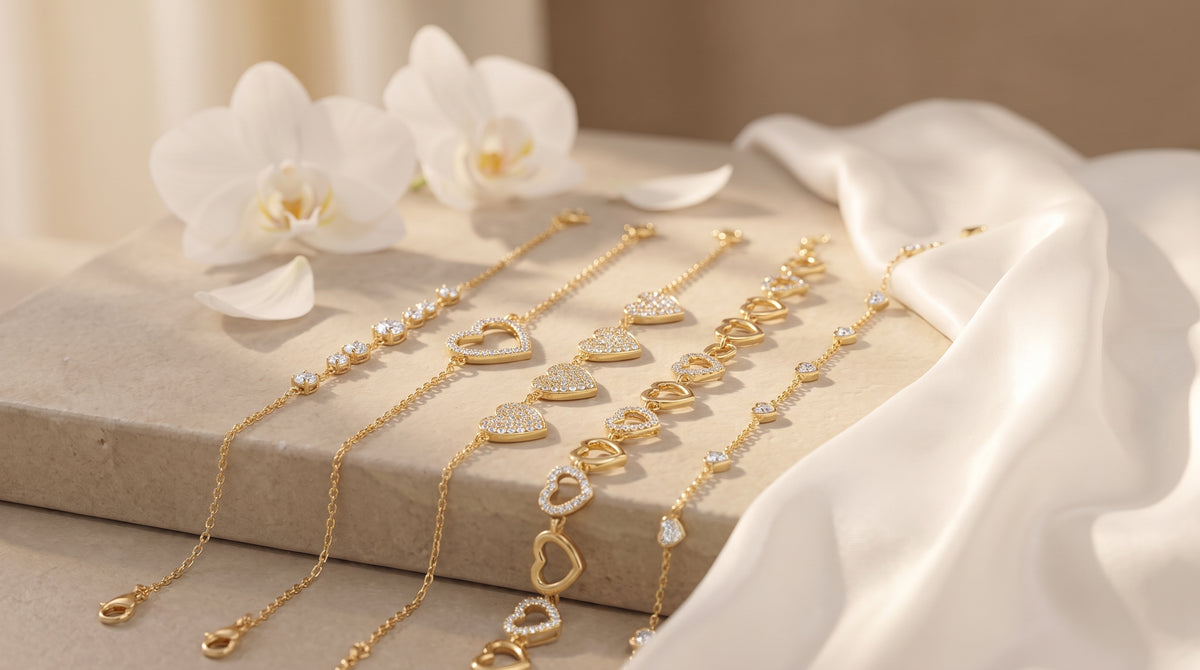
Heart links, charm stations, and engraved plaques carry sentiment that a plain chain does not, which is why they dominate gifting. In our own catalog these sit in the heart bracelets grouping — styles such as the Four Heart Charms Link Bracelet and the Petite Gold Heart Link Bracelet — alongside gemstone designs like the Amarella Moissanite Bracelet and the Aurelia Pearl Bracelet. Design intent differs from metal specification, so read each product page for the stated materials rather than assuming a karat. If you are shopping a personalized route instead, our 14k gold birthstone bracelet guide covers stone selection and setting choices.
Yellow, White, or Rose: What the Alloy Does to Color and Upkeep
Gold color is an alloy outcome, not a coating in every case — and that difference affects maintenance.
Yellow gold is the baseline: gold alloyed with silver and copper, with no surface treatment to wear away. Rose gold gets its warmth from copper; Jewelers of America notes that most rose gold jewelry is 14k, roughly 58.5% pure gold with copper added for color. Because the color comes from the alloy itself, it does not fade as the surface wears. White gold is the one with ongoing upkeep: the American Gem Society notes that some white gold is plated with rhodium to appear brighter and whiter, which means the brilliant finish is a surface layer that can thin over years of wear and be re-plated by a jeweler.
Which color flatters you is a style judgment, not a fact — treat skin-tone pairing advice from any retailer, including us, as opinion. The defensible guidance is narrower: white gold involves periodic re-plating to keep its brightest finish, rose and yellow do not, and if you own a lot of one tone already, matching it is the easiest way to guarantee the bracelet gets worn.
Sizing: The Step Most Online Buyers Get Wrong
USA Jewels' sizing guidance is the most specific in the current market, and it is worth following step by step.
- Wrap a flexible tape measure or a strip of paper around your wrist at the wrist bone and record the measurement.
- Add about three-quarters of an inch for a standard, comfortable fit. Add half an inch for a closer fit, or a full inch for a looser drape.
- Compare to standard lengths: most women's bracelets fall between 7 and 7.5 inches, while most men's run 8 to 8.5 inches. (If you are buying for a man, our 14k gold men's bracelet guide uses the same method with the larger range.)
Bangles size differently. Because a bangle has to pass over your hand, measure across the widest point of your knuckles with your hand squeezed as narrow as possible; that figure determines the diameter you need, not your wrist circumference.
Fit also depends on what your hands do all day. USA Jewels suggests a slim link bracelet or low-profile bangle if you work at a desk or with your hands, since it is less likely to catch, and reserves wider Cuban links and stacked bangles for going out. A bracelet that is too tight restricts movement; one that is too loose can slide over the hand or snag. Adjustability is a legitimate workaround — Cartier's LOVE bracelet on chain is offered with adjustable chain lengths of 16 and 18 cm, and the 24k bracelets listed by Costco Korea include extension links for the same reason.
Clasps, ranked by how much security they add
On a lightweight chain, a well-made lobster clasp is fine. On anything heavy, wide, or stone-set, prefer a box clasp with a fold-over safety latch or a push-button closure with a figure-eight safety: the weight of a substantial 14k bracelet works against a single spring-loaded gate all day. Check that the jump rings connecting clasp to chain are soldered closed, not open loops, and if you have known metal sensitivities, ask the seller what alloy metals the piece contains before ordering.
What Actually Drives the Price of a 14k Bracelet
Gold prices move constantly, and retailer price ranges go stale quickly, so rather than quoting figures, understand the levers. Within the same karat, price scales with:
- Gram weight. The dominant factor. A wide, solid Cuban link holds several times the gold of a fine paperclip chain of identical length, and solid versions weigh far more than hollow ones.
- Diamond or gemstone total carat weight and quality. Using GIA's definition, ctw is cumulative stone weight; clarity, color, and whether stones are natural or lab-grown then separate pieces of equal ctw.
- Construction and finish. Hand-finishing, pavé setting, textured or hammered surfaces, and made-to-order production all add labor. Italian jewelers selling solid 14k and 18k bracelets commonly quote production lead times of a couple of weeks on made-to-order cuffs and chains. If you specifically want a 14k gold bracelet italy produced, look for origin information stated in the product description alongside the karat hallmark rather than inferring it from styling.
- Brand and origin. A signed luxury 18k bangle and an unbranded solid 14k bangle of similar weight are not priced on metal alone.
Two bracelets at the same price can therefore be radically different buys: one heavy and plain, one light and stone-set. Decide which you want before you compare price tags.
Verifying Authenticity Before and After You Buy
Combining the guidance from the American Gem Society, Jewelers of America, and mainstream retail guides, a sensible pre-purchase check looks like this:
- Find the karat mark. 14K or 585 on the clasp, tag, or inner bangle surface. No mark is a reason to ask questions.
- Find the maker's mark or trademark near it, so there is an identifiable party standing behind the quality claim.
- Check the listing wording for "solid," "hollow," "gold-filled," or "plated," and for GP/GF/HGE abbreviations.
- Use a magnet as a screen, not a verdict. Gold is not magnetic, so attraction points to ferrous base metal — but a non-magnetic result alone does not prove karat.
- Weigh it against its size, then get acid or XRF testing from a reputable jeweler if the value justifies certainty. Hallmarks can be faked; professional testing is the only strong assurance.
- Buy where returns are clear, so an unexpected fit or finish is not a permanent problem.
Keeping a 14k Bracelet Looking New
Bracelets accumulate hand cream, soap residue, and skin oils in a way necklaces do not, and that film is what makes gold look dull rather than any flaw in the metal. USA Jewels' routine is easy to follow:
- Soak the bracelet for 10–15 minutes in warm water with a drop of mild dish soap to loosen oils and buildup.
- Brush each link gently with a soft-bristle toothbrush, paying attention to the clasp and the gaps between links.
- Rinse under clean running water with the clasp closed so the bracelet cannot slip down the drain.
- Pat dry with a lint-free cloth and make sure no moisture stays trapped between links.
Every two to four weeks is a reasonable cadence for a bracelet worn daily, with professional ultrasonic cleaning once or twice a year — which also gives a jeweler the chance to check the clasp and solder points for wear. For anything set with stones, the American Gem Society's advice applies: ask your jeweler which at-home products are safe for your particular metal and gemstones, since not all stones tolerate the same cleaners. Remove bracelets before swimming, gym sessions, and applying lotion, and store pieces separately so links do not abrade one another.
A Short Decision Framework
If you want one bracelet to wear every day, buy solid 14k, in the color you already own most of, in a slim-to-medium link, with a clasp that has a secondary safety, sized at wrist measurement plus roughly three-quarters of an inch. If you want a statement piece, go wider or stone-set and accept that it is an occasion item. If you want maximum gold content and cultural or investment value, look at 18k or 24k and plan to wear it more carefully. And if you are gifting without knowing a wrist size, an adjustable bolo or extension-chain design removes the guesswork.
You can browse the full bracelet collection or narrow directly to the solid gold pieces grouping, and read each product page for the stated metal, length, and closure details before you order. The hallmark, the construction, and the fit are what you will still care about in five years — everything else is styling.


Leave a comment
This site is protected by hCaptcha and the hCaptcha Privacy Policy and Terms of Service apply.