


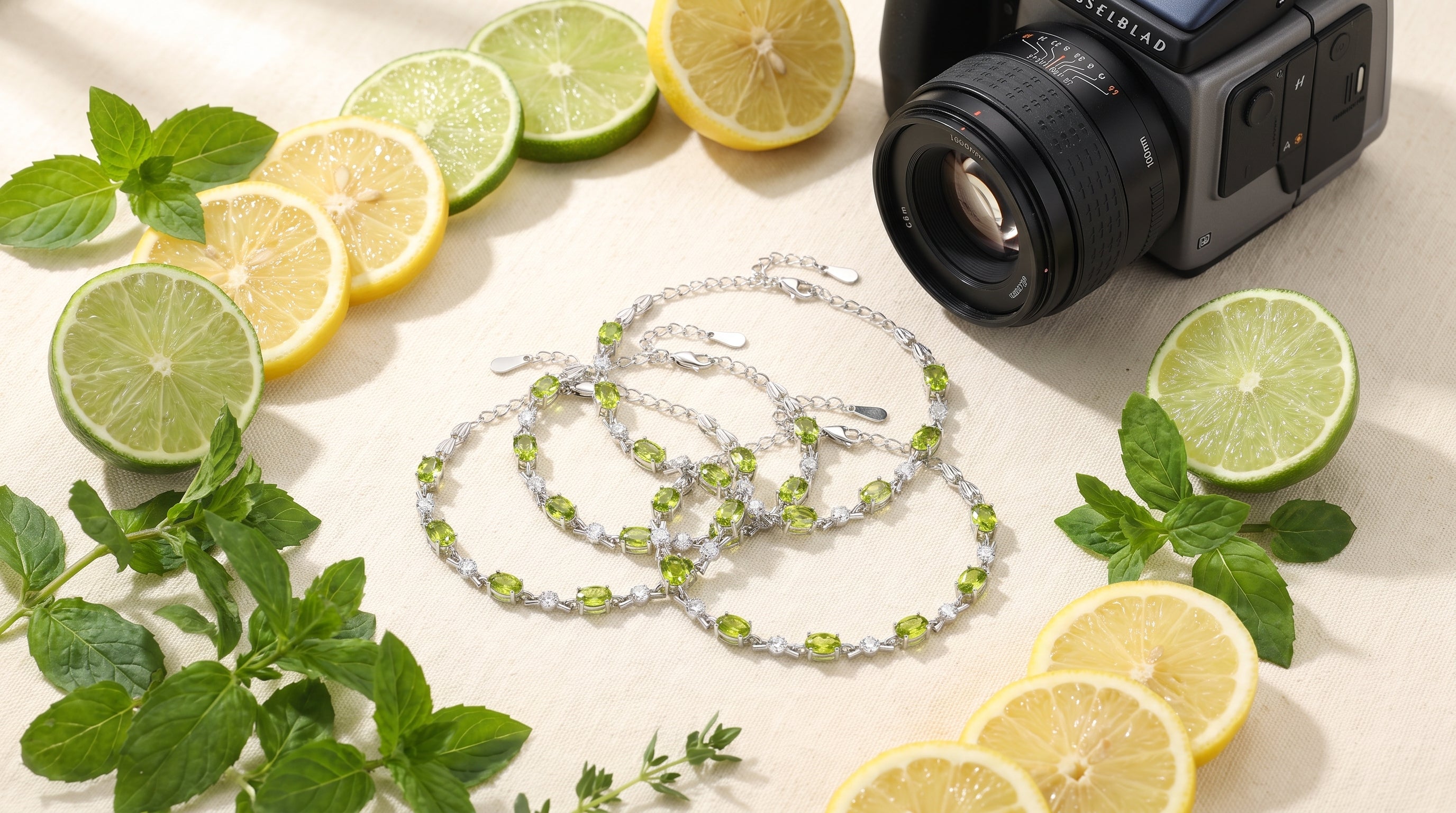
A wrist is the most punishing place on the body to wear a medium-hardness gemstone. It meets desk edges, door frames, steering wheels, gym equipment and grocery bags in a way that earrings and pendants simply never do. And peridot — August's primary modern birthstone — sits at roughly 6.5 to 7 on the Mohs hardness scale with fair to good toughness, according to the Gemological Institute of America. That single pair of numbers should shape almost every decision you make about an August birthstone bracelet: the setting profile, the stone spacing, the metal, and how you clean it.
This guide works through those decisions in order, separates what is gemologically established from what is cultural tradition, and points to the bracelet formats that suit different lifestyles rather than simply listing green jewelry.
August Has Three Birthstones — So Why Is Every Bracelet Green?
August is one of only two months with three officially recognized birthstones. Peridot is the primary modern birthstone, sardonyx is the original traditional choice, and spinel is the newest official addition, formally recognized in 2016. Despite that, the overwhelming majority of bracelets marketed under the August birthstone label feature peridot, which is why the category reads as uniformly green.
Peridot is the gem variety of the mineral olivine, a magnesium-iron silicate. Its color range runs from vivid lime green through yellow-green to deeper olive tones. Unlike stones such as sapphire or tourmaline, peridot does not occur in a wide palette — green is essentially the whole story, which is part of why it reads so instantly as "August" in a jewelry case.
When Spinel or Sardonyx Makes More Sense
If the recipient is hard on jewelry, spinel deserves a look. It sits at approximately 8 on the Mohs scale, meaningfully more scratch-resistant than peridot, and it spans red, pink, blue, purple and orange. Its name comes from the Latin spina, meaning thorn, a reference to its pointed crystal habit. Historically, vivid red spinel was frequently mistaken for ruby.
Sardonyx is the heritage option: a layered chalcedony made up of sard and onyx, ranging from reddish-brown to dark orange with white or black banding. It was used for Roman seals and Renaissance cameos, and its traditional symbolism centers on courage, happiness, clear communication and marital stability. It is far less common in bracelet form than peridot, so expect a narrower selection.
For most buyers, peridot remains the right call — it is the stone the recipient will recognize as "their" August stone. But if you are shopping for someone who works with their hands or dislikes green, knowing that spinel and sardonyx are equally official gives you a legitimate alternative rather than an off-brief substitution.
What Peridot's Hardness Actually Means on a Wrist
Hardness and toughness are different properties, and both matter here. Hardness describes resistance to scratching; toughness describes resistance to chipping and breaking under impact. GIA places peridot at 6.5–7 Mohs with fair to good toughness. Practically, that means peridot is durable enough for regular wear — including bracelets — but it is not in the same category as sapphire or diamond, and it does not forgive careless treatment.
Two Specific Risks Bracelets Face
The first is abrasion. Ordinary sand is largely quartz, which sits at about 7 on the Mohs scale — equal to or above peridot. That makes the beach and the garden genuinely risky environments for a peridot bracelet, not just a generic caution. The second is impact. Because a bracelet rides on the outside of the wrist, exposed stones knock against desks, countertops and door handles routinely. Station bracelets, where individual stones sit proud along a chain, are especially exposed for this reason.
The third risk is thermal. Peridot is sensitive to sudden temperature change, which is why ultrasonic and steam cleaning are both off the table — more on that below.
Design Choices That Reduce Risk
None of this rules out daily wear; it simply argues for matching the design to the day. Lower-profile stones and settings that shield the girdle of the stone sit closer to the wrist and catch less. A single-stone or oval design concentrates the value in one protected point rather than distributing exposure along the whole bracelet. Continuous-stone tennis designs are the most visually generous and, correspondingly, the format that benefits most from being treated as an occasion piece rather than a gardening companion.
The Four August Birthstone Bracelet Formats, Compared
Almost every peridot bracelet on the market falls into one of four structures. They differ far more in wear behavior than in price positioning.
| Format | What it looks like | Exposure level | Best suited to |
|---|---|---|---|
| Tennis | A continuous line of matched stones around the full circumference | High — stones on all sides | Occasion wear, evening, gifting impact |
| Station | Individual stones spaced along a fine chain | Moderate to high — stones sit proud | Semi-formal wear, layering with other chains |
| Single-stone / oval | One focal stone, often oval-cut, on a plain chain | Lower — one protected focal point | Everyday wear, minimalist taste |
| Chain or motif | Chain-led design with a charm or motif accent | Lower — metal-dominant | Casual daily wear, stacking |
Within Awareness Avenue's August birthstone collection, the mapping is straightforward. The Electra Tennis Peridot Bracelet is the continuous-line option. The station family includes The Peridelle Station and The Clarisse Station Bracelet in S925 sterling silver, with The Lucerelle Station in 18K gold vermeil and The Lucerelle Station in solid gold covering the warmer metal tones. For single-stone wear there is The Elianise Oval Bracelet in sterling silver, the same design in solid gold, and The Calianna Oval Peridot Bracelet. The motif route is covered by The Lucerise Clover Bracelet, and the plainly named August Peridot Birthstone Bracelet is the most literal gift-boxed interpretation of the brief.

Length and Clasp
Bracelet fit is the detail most often skipped and most often regretted. Adjustable chains with extender links are common in this category — Alex and Ani's peridot curb chain bracelet, for example, is offered with a 6.5 to 8 inch range — and an adjustable design is the safer choice when you are buying as a gift and cannot measure the wrist. If the bracelet is fixed-length, measure the recipient's wrist with a strip of paper and add roughly a finger's width of ease so the piece rotates rather than binds. A bracelet that sits too tight puts the stones in constant contact with the wrist bone and any surface the arm rests on.
Sterling Silver, Gold Vermeil, or Solid Gold?
Metal choice affects appearance, maintenance and how the bracelet ages — and bracelets abrade more than any other jewelry format, which changes the calculus compared with a pendant.
S925 Sterling Silver
Sterling silver is 92.5% silver alloyed with other metals for strength, which is what the 925 stamp denotes. It gives peridot a cool, high-contrast setting that emphasizes the stone's green rather than warming it. Silver tarnishes over time through contact with air, humidity and skin chemistry; this is surface oxidation, not damage, and it responds to gentle polishing. If you want the brightest possible green at the lowest metal cost, silver is the logical pick.
18K Gold Vermeil
Vermeil is a layer of gold over a sterling silver base. It delivers a warm gold look with a precious-metal core rather than base metal. The honest caveat is friction: because a bracelet rubs against sleeves, desks and other stacked pieces far more than a necklace does, plated and vermeil surfaces show wear at high-contact points sooner on the wrist than elsewhere. Treat vermeil bracelets as pieces to rotate rather than never remove.
Solid Gold
Solid gold has no surface layer to wear through, which is precisely why it makes sense for a bracelet destined for genuinely constant wear or for keeping long-term. It carries the highest material cost of the three, and the warm metal shifts peridot's green slightly toward its yellow-green range rather than its cool lime end. If you are weighing karat and construction questions in more depth, our 14k gold birthstone bracelet guide covers gold-specific considerations, and the solid gold collection shows the pieces available in that construction.

Read the Stone Description Before You Read Anything Else
"August birthstone" is a marketing label, not a gemological one, and brands apply it with varying strictness. Some retailers broaden the category on stylistic grounds — HAVERHILL, for instance, groups Lemon Verbena Quartz alongside peridot as August's yellow-green birthstones. That is a legitimate design decision, but it means a green or yellow-green stone in an August listing is not automatically peridot.
Before buying, confirm four things on the product page:
- The stone's actual name. Does the description say peridot, or only "August birthstone" and a color?
- Natural, lab-created, or simulated. These are three different things. A simulated stone imitates peridot's appearance without sharing its composition; a lab-created stone shares the composition but is grown rather than mined. Awareness Avenue's August range is listed under simulated peridot, and that is worth knowing up front rather than discovering later.
- The metal specification. S925, vermeil, plated and solid gold behave differently over years of wear.
- Length and adjustability, as covered above.
If a listing is vague on any of these, treat that as information in itself. For a broader look at how the same stone reads across pendants, studs and rings, see our August birthstone jewelry guide by format, color and durability.
Cleaning and Care: The Rules That Are Actually Evidence-Based
Peridot care is unusually well documented, and the guidance is consistent across GIA, Brilliant Earth and specialist jewelry sources. It comes down to a short list of do's and a firm list of don'ts.
The Safe Method
Clean with lukewarm or warm water, a small amount of mild dish soap, and a soft-bristle brush — a baby-soft toothbrush works well. Let the bracelet soak briefly to loosen accumulated oils, brush gently around the settings where film collects, rinse thoroughly (over a fine-mesh strainer if you are working at a sink), and dry completely. A microfiber cloth restores surface sparkle without scratching.
For a bracelet worn regularly, a light wipe after each wear plus a proper soap-and-water clean every two to four weeks is a reasonable rhythm. Periodic professional inspection of settings, links and clasps is worthwhile because bracelets take more mechanical stress than any other format.
The Don'ts
Do not use ultrasonic or steam cleaners — peridot is sensitive to thermal shock, and both methods risk fracturing the stone. Avoid sudden temperature changes and high heat generally. Keep the bracelet away from harsh chemicals including bleach, chlorine, acetone and strong acidic solutions. Avoid hard blows. Store the piece separately in a soft compartment so harder gemstones and metal edges cannot scratch it.
A useful behavioral rule is "last on, first off": put the bracelet on after lotion, perfume and sunscreen, and take it off before cleaning, cooking, swimming or exercising. Most complaints that a peridot bracelet has "gone dull" trace back to a film of soap, lotion or conditioner sitting on the stone rather than any structural change — which means the fix is a five-minute clean, not a repair.
Meaning and Folklore — Clearly Labeled as Such
Peridot carries a long and genuinely interesting cultural history. The ancient Egyptians valued it and called it the "gem of the sun." Its name is commonly traced to the Arabic faridat, meaning gem, though some sources propose an older Greek root, peridona, meaning "give enough" — an etymology often used to connect the stone to welfare and happiness.
In traditional symbolism, peridot is associated with strength, good fortune and happiness; with balance, peace and creativity; and with protection — including, in older folklore, protection from nightmares and evil spirits. Some sources also link it to good health and restful sleep. Sardonyx traditionally signals courage and clear communication, and both stones appear in gift narratives for that reason.
It is worth stating plainly what these claims are and are not. They are cultural traditions and brand storytelling, not verified physical effects. You will encounter retail copy attributing metabolic, organ-level or psychological benefits to peridot; those assertions come from alternative-medicine traditions and are not supported by clinical evidence. Buy the stone because the meaning resonates with the person receiving it, not because you expect it to do something measurable.
Gifting Occasions
The obvious occasion is an August birthday, which is what drives most of this category. Beyond that, peridot is traditionally associated with the 16th wedding anniversary, and it also appears in some traditions as a stone linked to Libra. If you are building toward a coordinated gift rather than a single piece, our guide to building a peridot set that actually matches covers how to keep stone tone and metal finish consistent across pieces.
How to Choose: Four Real Scenarios
She wants to wear it every single day
Choose a single-stone or oval design in a lower profile, and choose solid gold if the budget allows, because there is no plating layer to wear through at friction points. The oval formats keep one protected focal stone rather than exposing a full line of them.
It's a milestone gift and you want visual impact
Tennis is the format that photographs and presents best, with a continuous line of matched green stones. Set expectations that it is a piece to wear out rather than to garden in, and pair it with the care routine above.
She already wears three bracelets and stacks everything
A station design or a chain-led motif bracelet layers better than a tennis line, which tends to dominate a stack and rub against neighboring pieces. If stacking, be aware that station stones sit proud and will contact adjacent metal — a reason to give the bracelet its own soft compartment when stored.
You want the gold look without the solid gold cost
18K gold vermeil is the honest middle path, with the caveat that wrists are high-friction. Rotate it rather than wearing it around the clock, and follow last-on, first-off discipline. Broader trade-offs across metals and stones are covered in our birthstone bracelet guide by month, metal and stone type.
Common Questions
Can a peridot bracelet be worn every day?
Yes, with care. At 6.5–7 Mohs and fair to good toughness, peridot handles regular wear, but it scratches more readily than sapphire or diamond and chips under hard impact. Choose a lower-profile design for daily rotation and remove it for the gym, the beach, gardening and cleaning.
Can I shower or swim in it?
Take it off. Chlorine and harsh cleaning chemicals should be avoided entirely, and soap film is the main cause of dulled sparkle. Hot water also introduces the temperature swings peridot does not tolerate well.
Is peridot the only official August birthstone?
No. Peridot, spinel and sardonyx are all recognized, with peridot as the primary modern stone, sardonyx as the traditional original, and spinel added in 2016. Bracelets are dominated by peridot simply because that is what the market produces.
How often should I clean it?
A quick wipe after each wear, plus a mild soap-and-water clean every two to four weeks for a regularly worn piece. Never ultrasonic, never steam.
Are there August birthstone bracelets designed for men?
The bracelet category skews toward finer chains and smaller stones, but peridot itself is not gendered — men's peridot rings with customizable band widths are widely offered, which shows the stone works in heavier settings. For a masculine bracelet, prioritize wider chain gauge, a single bezel-style stone rather than a continuous line, and a substantial clasp.
What if I want a necklace, ring or earrings instead?
The same stone behaves differently in each format — earrings and pendants face far less abrasion than bracelets, which widens your design options considerably. Our format-by-format August birthstone guide compares those trade-offs, and the full birthstone jewelry collection spans every month.
The Short Version
Peridot is August's primary modern birthstone, green in every meaningful variation, and durable enough for a bracelet you actually wear — provided you match the design to your habits and skip ultrasonic cleaning entirely. Decide on exposure level first (tennis, station, oval or chain), then metal, then confirm exactly what the stone is described as on the product page. Browse the full bracelet collection once you know which of those four formats you are actually shopping for; it makes the choice considerably faster.

Leave a comment
This site is protected by hCaptcha and the hCaptcha Privacy Policy and Terms of Service apply.