


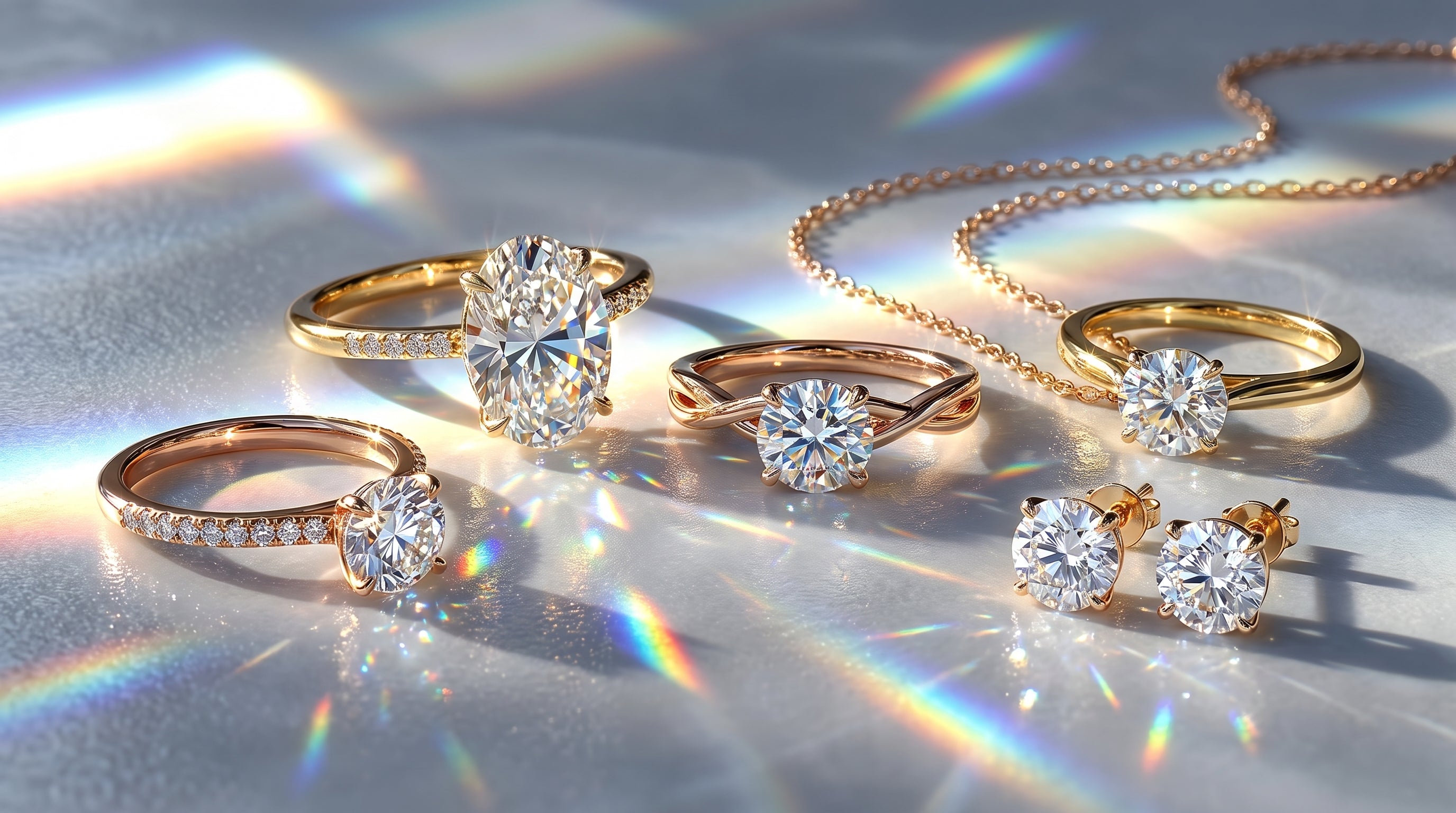
Put a lab grown diamond, a moissanite and a cubic zirconia on a white cloth and the differences look cosmetic. Under a spectrometer they are not even the same family of material: one is pure carbon in a diamond crystal lattice, one is silicon carbide, and one is zirconium dioxide grown in a cubic crystalline form. That single fact explains almost every argument you will read online about which stone is "real," which one scratches, which one throws rainbows, and which one holds any value at all. The rest of this comparison translates those three chemistries into things you can actually see and feel on a hand over ten years of wear.
The distinction that resolves most of the confusion: diamond vs. simulant
The word "lab grown" causes more misunderstanding in this category than any other term. Being made in a laboratory does not make a stone a diamond. A diamond is defined by what it is made of and how those atoms are arranged, not by where it crystallized. Moissanite and cubic zirconia are both produced in laboratories, and neither is a diamond. Lab grown diamonds are produced in laboratories, and they are diamonds. Once you hold that line, the three-way comparison becomes straightforward.
Lab grown diamond: a real diamond with a different origin story
Lab grown diamonds are pure carbon arranged in the cubic diamond crystal structure — the same chemical composition, crystal structure and physical properties as diamonds pulled out of the ground. Major retailers and gemological educators are consistent on this point: lab grown stones are graded on the same four Cs (cut, color, clarity, carat) using the same standards applied to mined diamonds, and they are visually indistinguishable from natural diamonds to the untrained eye. They are typically produced by one of two methods: High Pressure High Temperature (HPHT), which recreates mantle-like conditions, or Chemical Vapor Deposition (CVD), which builds diamond layer by layer from carbon-bearing gas onto a substrate. A mined diamond forms over geological timescales; a lab grown diamond forms in weeks.
When comparing a lab grown vs natural diamond, separating the two is a specialist job. GIA and other institutes run dedicated training and identification programs for laboratory-grown diamonds precisely because the distinction relies on subtle growth features, inclusion patterns and spectroscopic signatures rather than anything you could spot across a dinner table. Practically speaking: if you want a diamond, a lab grown diamond is a diamond.
Moissanite: silicon carbide, and its own gemstone
Moissanite is silicon carbide (SiC). It was identified in 1893 by Henri Moissan in material from a meteorite crater, and natural terrestrial occurrences are so rare that essentially every moissanite in jewelry today is grown under controlled high-temperature conditions. It is not a diamond, and it is not a lab grown diamond. It is a separate gem species that happens to be hard, bright and near-colorless — a combination that makes it an excellent stand-in for diamond without pretending to be one.
Two numbers define its behavior. Its Mohs hardness sits around 9.25 (some sources cite up to 9.5), which places it second only to diamond among stones commonly used in jewelry and above sapphire and ruby. Its refractive index of roughly 2.65 to 2.69 exceeds diamond's, and its dispersion of about 0.104 is more than double diamond's 0.044. That dispersion figure is the technical origin of moissanite's signature rainbow flash.
Cubic zirconia: an engineered diamond simulant
Cubic zirconia is zirconium dioxide (ZrO₂) stabilized into a cubic crystalline form. There is no gem-grade natural CZ on the market; all of it is manufactured, and it was engineered from the outset to look like diamond at a very low cost. It typically comes out of production optically flawless with bright, obvious sparkle, which is why it dominated the "faux diamond" category for decades.
Its numbers are lower across the board: Mohs hardness of about 8 to 8.5, refractive index roughly 2.15 to 2.22, and dispersion in the region of 0.058 to 0.066. It is also singly refractive, whereas moissanite is doubly refractive — a difference gemologists use for quick identification under magnification, since doubling of facet junctions is visible in moissanite and not in CZ or diamond.
Side-by-side: the specifications that actually matter
These values are drawn from convergent jeweler and gemological education sources. Treat them as reliable consumer-level reference points rather than laboratory measurements of your specific stone, since cut quality and material grade shift real-world results.
| Property | Lab grown diamond | Moissanite | Cubic zirconia |
|---|---|---|---|
| Composition | Carbon (C), diamond lattice | Silicon carbide (SiC) | Zirconium dioxide (ZrO₂) |
| Category | Real diamond, lab origin | Distinct gemstone | Diamond simulant |
| Mohs hardness | 10 | ~9.25 (cited up to 9.5) | 8–8.5 |
| Refractive index | ~2.417–2.419 | ~2.65–2.69 | ~2.15–2.22 |
| Dispersion (fire) | ~0.044 | ~0.104 | ~0.058–0.066 |
| Refraction | Single | Double | Single |
| Sparkle character | White-light brilliance, classic diamond look | Very high brilliance with strong rainbow flash | Bright, pronounced rainbow that can read as glassy |
| Typical use | Fine jewelry, engagement, heirloom | Fine jewelry, engagement, everyday wear | Fashion jewelry, temporary or budget pieces |
| Origin | HPHT or CVD | Lab-grown (natural material is vanishingly rare) | Entirely manufactured |
How each stone actually looks on a hand
Fire and brilliance, in plain English
Brilliance is the white light a stone returns to your eye. Fire is the way it splits that light into spectral colors. Refractive index drives the first; dispersion drives the second. A lab grown diamond, with an RI near 2.42 and dispersion near 0.044, gives you the familiar diamond signature: crisp white flashes with restrained bursts of color. Moissanite, with a higher RI and roughly two and a half times the dispersion, returns more light and considerably more color. Cubic zirconia sits lowest on refractive index, so it returns less white light, but its dispersion is high enough to throw noticeable rainbows — the combination that trained eyes describe as glassy or slightly artificial.
Carat weight changes the verdict
Below roughly a carat, the three stones are hard to separate in normal indoor lighting, which is exactly why cubic zirconia works so well in small accent settings and pavé. Above a carat, differences amplify. Moissanite's fire becomes the talking point — the effect frequently described as "disco ball" flashes in direct sunlight or under bright spotlights. Some buyers want precisely that; others find it reads less like a traditional diamond. A large cubic zirconia is where the lower brilliance becomes most visible, because the stone's face-up presence depends more on returned white light as the table grows.
Color behavior
Premium moissanite is cut to present near-colorless in the D–F range on the diamond scale, but guides consistently note that larger moissanites can show a subtle warm or grayish undertone in certain lighting. Lab grown diamonds are graded on the standard color scale, so you select color directly. Cubic zirconia is generally produced colorless and eye-clean by default, which is one of its genuine strengths — you rarely pay extra for clarity in CZ because the material is manufactured that way.
Will anyone notice?
In everyday social contexts, no. Jewelers repeatedly report that untrained observers cannot reliably distinguish a well-cut moissanite from a diamond without tools. A gemologist can, quickly, using double refraction, thermal conductivity and electrical conductivity. Notably, both diamond and moissanite conduct heat well, which is why older thermal-only diamond testers can read moissanite as diamond; cubic zirconia is a poor thermal conductor and is easy to flag with the same instrument. If you want a deeper visual breakdown of the two simulants, our side-by-side look at moissanite and cubic zirconia covers what changes under different lighting.
Durability: how each stone ages over a decade of daily wear
Hardness translated into real-world consequences
The Mohs scale measures scratch resistance, and it is not linear — the gap between 8.5 and 10 is far wider than the numbers suggest. In practice, a ring worn daily meets quartz-based dust constantly (Mohs 7), plus metal, stone countertops and grit. A diamond at 10 and a moissanite at around 9.25 shrug that off; facet edges stay crisp and the polish stays mirror-bright for years. Cubic zirconia at 8 to 8.5 accumulates fine surface abrasion faster, and because sparkle depends on flat, sharply meeting facets, micro-scratching gradually softens the light return. That is the single most important practical difference between CZ and the other two stones.
Why cubic zirconia goes cloudy — and what actually fixes it
Cloudy CZ is one of the most searched objections in this category, and the explanation is more nuanced than "cheap stones die." Specialist coverage of CZ behavior notes that early generations of the material were more porous and could absorb body oils, leading to clouding and, with heat or strong UV exposure, color shifts. Modern high-grade CZ — often marketed with 5A or 6A designations — is significantly less porous and more stable. In current pieces, dullness usually comes from two removable or cumulative causes: residue buildup from soap, lotion, sunscreen, hairspray and skin oils sitting on the pavilion facets, and accumulated surface scratching.
The residue portion is reversible. Warm water, a mild soap solution, a soft toothbrush worked gently behind the stone, then a careful rinse and dry will restore most of the original brightness. The scratching portion is not reversible without repolishing. It is also worth correcting a persistent myth: cubic zirconia does not tarnish or rust. Zirconium dioxide is already in a stable oxidized state and does not oxidize further under normal conditions. If a CZ ring is discoloring, the metal setting is the culprit, not the stone.
Moissanite and lab grown diamond over the long haul
Moissanite's optical performance comes from its crystal structure, not from any coating or surface treatment, so its fire cannot wear off. Moissanite specialists also emphasize the material's thermal stability and report that it tolerates the temperatures encountered in jewelry work and everyday life without cracking, which supports the case for treating it as a genuinely long-term stone rather than a stopgap. Lab grown diamonds, being diamonds, carry the durability record diamonds have always had.
For both, any loss of sparkle over time is almost always dirt on the underside of the stone or a settling issue in the mounting, not degradation of the gem. A twice-monthly soak-and-brush plus an annual prong check from a jeweler is genuinely all the maintenance either stone requires. That check matters more than the cleaning: a hard stone in a loose setting is still a lost stone.
Cost patterns and what "value" means for each stone
The shape of the pricing, not the numbers
Pricing across this category is reported almost entirely by brands rather than by independent surveys, and it varies by cut, quality grade, metal, region and retailer. What can be stated confidently is the ordering, which is consistent across every source in this space: cubic zirconia is the least expensive by a wide margin, moissanite sits well below diamonds of comparable size, lab grown diamonds sit below natural diamonds, and natural diamonds sit at the top. The multiples between those tiers are large enough that stone choice, not carat weight, is usually the biggest lever on a ring budget.
What drives cost within each tier differs too. With lab grown diamonds you are buying the four Cs, and price climbs steeply with color, clarity and carat. With moissanite, material clarity is high and consistent by production standard, so cut quality, size and setting metal do most of the work on price. With cubic zirconia, the stone is close to a rounding error and you are effectively paying for the mounting. If you want concrete figures for the moissanite versus lab diamond comparison specifically, see our dedicated moissanite vs lab diamond price breakdown, which goes deeper on cost specifics than a general stone comparison can.
Resale: set expectations honestly
Jeweler guides generally place lab grown diamonds above moissanite for resale, and moissanite above cubic zirconia, with CZ described as carrying essentially aesthetic value only. Those rankings are qualitative and are not supported by published valuation data in this category, and the same guides frequently caution that lab grown diamond values may behave differently from natural diamond values because supply is not constrained in the same way. The honest conclusion: none of these three stones should be bought as a financial asset. Buy on how it looks, how it wears and what it costs you today.
Origin, ethics and symbolism
All three stones are made rather than mined, which removes the sourcing questions that attach to mined material. That is where the similarity ends, because the three occupy very different symbolic positions.
Lab grown diamonds carry the full cultural weight of diamond. For a buyer who wants the tradition, the grading report and the word "diamond" without mined origin, they are the direct answer, and nothing else in this comparison substitutes for that. Moissanite carries a different appeal: it is openly its own gemstone, chosen for what it does optically and for how far a budget stretches, and increasingly chosen by couples who find the "my stone isn't a diamond" answer more interesting than awkward. Cubic zirconia, though equally mining-free, is rarely framed as an ethical statement — it is positioned as a fashion material, and jewelers do not generally recommend it for a ring meant to be worn for decades.
Be skeptical of precise environmental numbers in this space. Broad claims that lab-created stones avoid mining impacts are reasonable and widely accepted; specific carbon-footprint figures and certification claims are frequently repeated without any traceable life-cycle study behind them.
Which stone fits you? Four honest scenarios
Choose a lab grown diamond if…
Diamond symbolism matters to you or to the person wearing it; you want a graded report against the same four Cs used for mined stones; you prefer the restrained white-light sparkle of diamond over intense rainbow fire; and you are comfortable with the highest price of the three options. A lab grown diamond is the only choice here that is, technically and socially, a diamond.
Choose moissanite if…
You want maximum size and sparkle per dollar with durability that stands up to daily wear indefinitely; you actively like the extra fire, or you plan to stay near or under a carat where the difference is subtle; you are relaxed about the stone not being a diamond; and you would rather put the difference in cost toward a better setting, a wedding, or literally anything else. If you are weighing a moissanite vs diamond ring, our broader comparison goes deeper on the diamond-side trade-offs if that is the branch you are exploring.
Choose cubic zirconia if…
The piece is fashion jewelry, a travel ring, a placeholder while you save, a costume or event piece, or a stone you expect to replace. Modern high-grade CZ is genuinely bright, eye-clean and non-tarnishing, and it does that job well. It is a poor fit for a ring you intend to wear every day for decades, because the softer surface will lose crispness and require far more upkeep than moissanite or diamond.
A note on men's rings
When evaluating moissanite rings men can wear daily, keep in mind that bands and signet-style rings take more direct abuse than most engagement rings — tools, gym bars, steering wheels, doorframes. That amplifies the hardness gap. Moissanite and lab grown diamonds both handle that environment; cubic zirconia in a wide, exposed men's setting will show wear fastest, particularly on a high-set center stone. If you are pricing out a men's piece, our guide to a 1 carat men's ring in diamond versus moissanite walks through setting choices that protect the stone.
If moissanite is your answer, here is what to look for
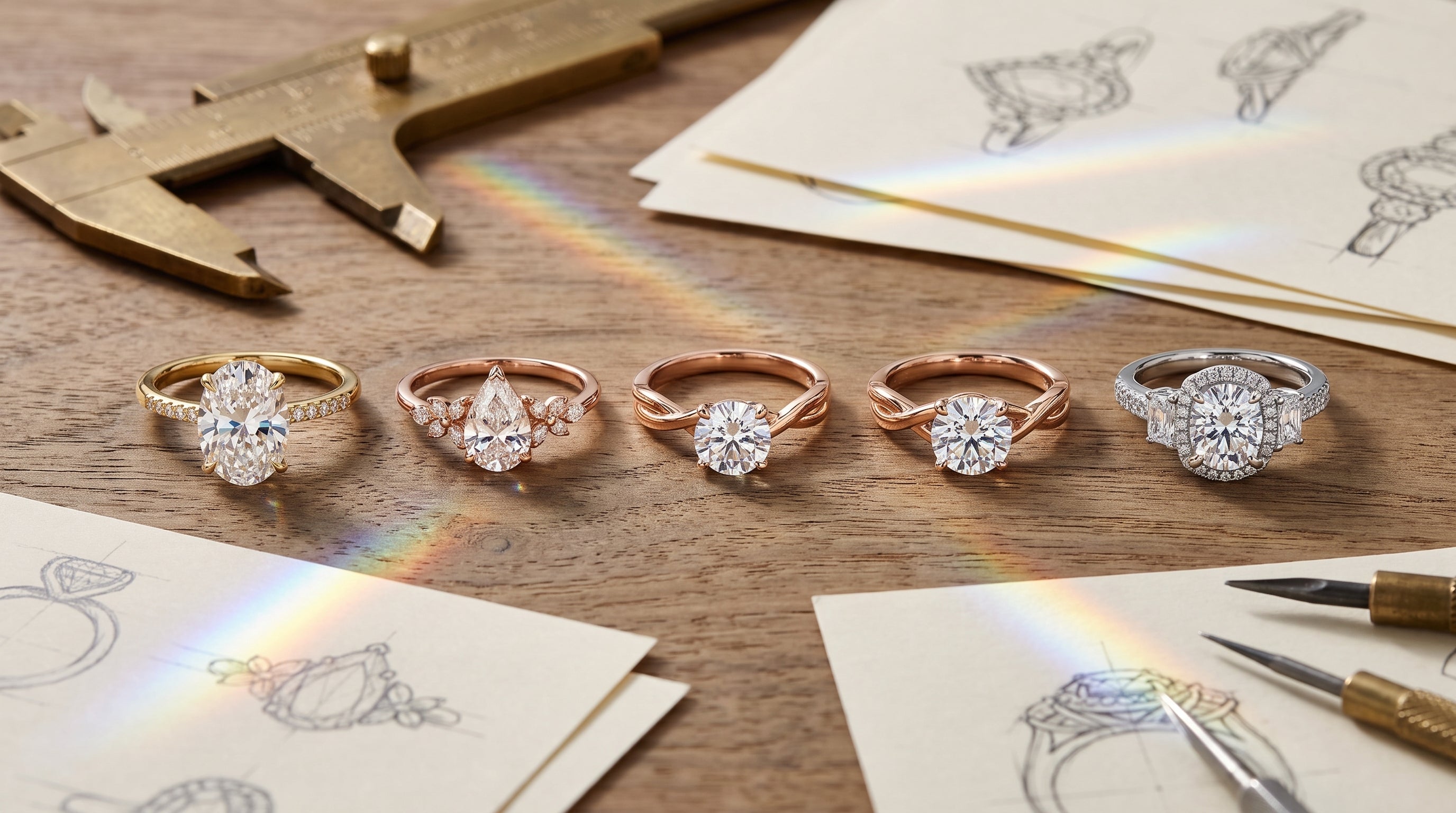
Assuming the comparison above landed you on moissanite, the variables that matter most are cut quality, shape and how much fire you actually want on display. Step cuts such as emerald and Asscher use long, broad facets that produce a hall-of-mirrors effect and mute dispersion, so they read closest to a traditional diamond look — the Adelina Rae 2ct emerald cut is that approach in practice. Brilliant cuts do the opposite: round and oval faceting maximizes light return and lets moissanite's dispersion show, as in the Opaline oval cut solitaire. Twisted and pavé-accented bands add scintillation around the center stone without adding carat weight to the middle, which is a useful way to gain presence at a smaller center size.
Colored moissanite is a separate route worth knowing about, since the same material can be produced in tones that no colorless stone offers — a pink emerald cut or a blue round changes the conversation from "is that a diamond?" to something else entirely. You can browse the full range of engagement moissanite rings in our moissanite engagement ring collection once you have settled on shape and setting.
Frequently asked questions
Is moissanite a lab grown diamond?
No. Moissanite is silicon carbide; a lab grown diamond is carbon in a diamond crystal structure. Both are grown in laboratories, but only one of them is a diamond. This is the most common point of confusion in the category, and jeweler guides answer it the same way consistently.
Is a lab grown diamond the same as cubic zirconia?
No. Cubic zirconia is zirconium dioxide, a simulant engineered to resemble diamond. A lab grown diamond is chemically and structurally identical to a mined diamond and is graded by the same standards. They differ in hardness, refractive index, thermal conductivity and price by a very large margin.
Which sparkles more, moissanite or cubic zirconia?
Moissanite, on both measures. Its refractive index (about 2.65–2.69 versus roughly 2.15–2.22) returns more white light, and its dispersion (about 0.104 versus roughly 0.058–0.066) produces stronger color flashes. CZ still sparkles noticeably, but with less brilliance behind the rainbow.
Does moissanite pass a diamond tester?
Older testers that rely only on thermal conductivity can read moissanite as diamond, because both conduct heat well. Combination testers that also measure electrical conductivity separate them reliably. Cubic zirconia fails a basic thermal tester immediately.
Can moissanite be an heirloom stone?
Physically, yes. At around 9.25 on the Mohs scale with fire produced by its crystal structure rather than a coating, moissanite is built to survive generations of normal wear with basic cleaning and periodic setting checks. Whether it carries heirloom meaning is a question about your family and your values, not about the material.
Why do jewelers steer people away from cubic zirconia for engagement rings?
Because of how it ages, not how it looks on day one. Its lower hardness means surface abrasion accumulates on a ring worn daily, and once facet edges soften, the sparkle cannot be cleaned back. For occasional wear, that trade-off is fine; for a lifetime piece, most jewelers point buyers toward moissanite or diamond instead.
The short version
Lab grown diamonds are real diamonds with a laboratory origin, and they are the choice when diamond identity and traditional sparkle matter most. Moissanite is a distinct silicon carbide gemstone with hardness close to diamond, more fire than diamond, and dramatically more size per dollar, making it the strongest all-round value for a ring worn every day. Cubic zirconia is an inexpensive, bright, mining-free simulant that earns its place in fashion jewelry but is not engineered for decades of daily contact. Rank your own priorities — diamond identity, sparkle character, longevity, budget — and one of these three will separate itself quickly.

Leave a comment
This site is protected by hCaptcha and the hCaptcha Privacy Policy and Terms of Service apply.