


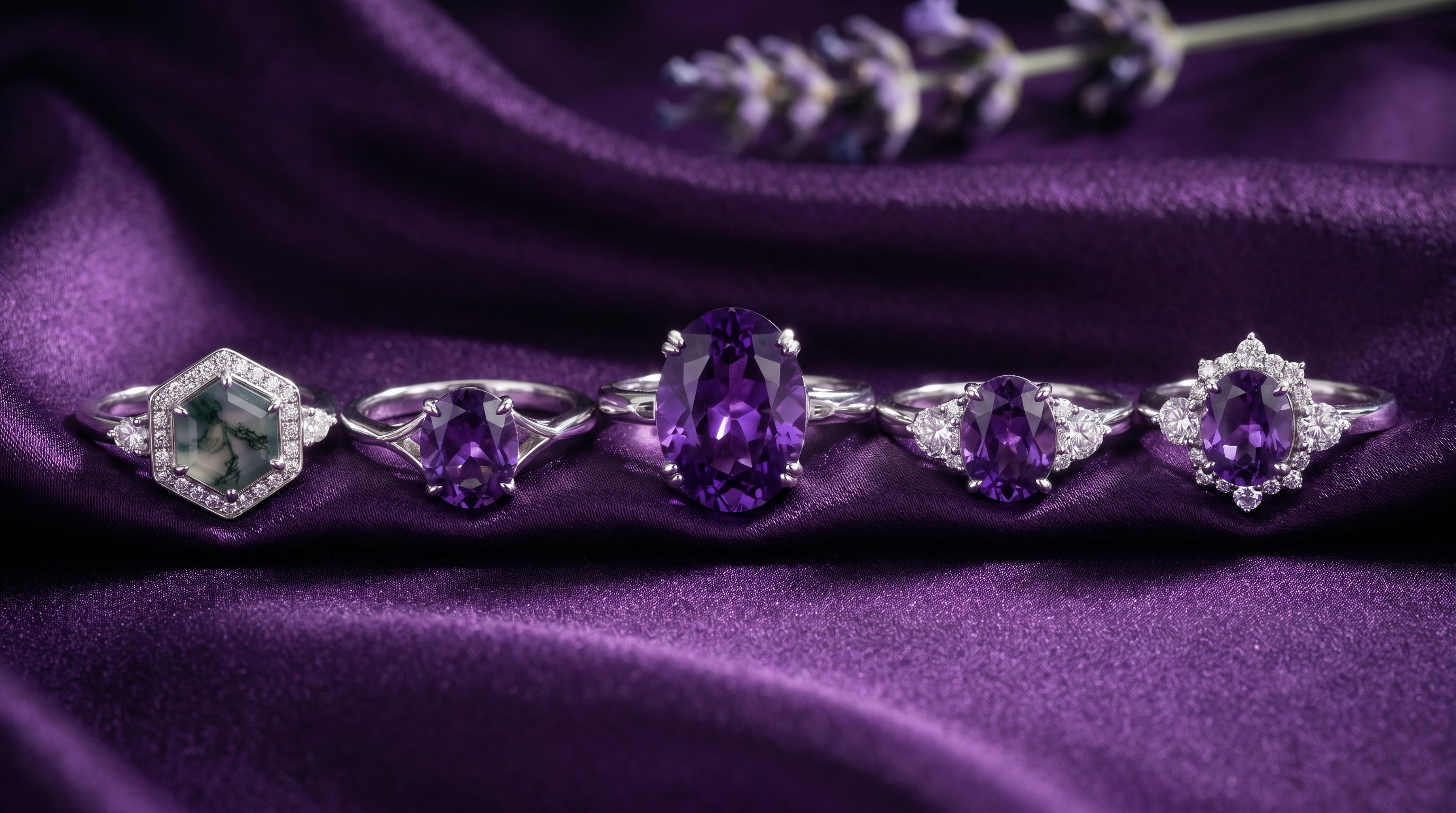
The word doing the heavy lifting in real alexandrite engagement ring is not "alexandrite" — it's "real." In a gem lab, that word has a narrow, testable meaning: a stone is real alexandrite if it is chrysoberyl (beryllium aluminum oxide) colored by trace chromium, with a refractive index in the region of 1.746 to 1.755, double refraction, and a genuine color shift between daylight and incandescent light. By that definition, a chrysoberyl grown in a laboratory is just as real as one pulled out of the Ural Mountains. In a shopper's mind, though, "real" usually means something else entirely: not a fake, not overpriced, and ideally mined rather than made. Those two definitions collide constantly in the alexandrite market, and the gap between them is where people lose money.
This guide keeps the two apart. It covers what alexandrite is, the three material tiers you will encounter, how color-change quality is described and priced, which tests actually settle authenticity, and how to translate all of that into a ring you'll wear every day. It also explains, plainly, where we decline to give you a number because the publicly available evidence isn't good enough to quote.
What "Real" Means in Gemology vs. What Buyers Usually Mean
There are three distinct materials sold under the alexandrite name, and only two of them are alexandrite at all.
1. Natural alexandrite
Mined chrysoberyl that formed in the ground. It is exceptionally rare because it requires beryllium and chromium — two elements that almost never occur in the same geological environment — to meet. Deposits have been documented historically in Russia's Ural Mountains and later in Brazil, Sri Lanka, India, and East Africa, but fine material with a strong, complete color change remains extremely scarce. Tiffany & Co. lists alexandrite among its "legacy gemstones," a category the house reserves for stones prized for rarity and beauty — a useful signal of how the high-jewelry world ranks it.
2. Lab-grown alexandrite
Chrysoberyl produced in controlled conditions using methods such as Czochralski pulling, flux growth, and hydrothermal synthesis. It shares the natural stone's chemical composition, crystal structure, chromium coloring mechanism, hardness, and color-change behavior. In gemological terminology, "synthetic" simply means lab-created material with the same composition as its natural counterpart — it is not a synonym for fake. Calling lab-grown alexandrite an imitation is factually wrong, and any seller who does so is either confused or hoping you are.
3. Alexandrite simulants
Different materials engineered to mimic the color-change effect — color-change corundum (often sold as "synthetic alexandrite-like" sapphire) and glass are the classic examples. These are genuinely imitations: different chemistry, different optical properties, different value. Much of the inexpensive "alexandrite" circulating in mass-market jewelry falls into this tier, and it is the specific thing most people are trying to avoid when they type "real" into a search bar.
So the honest answer to "is it real?" is a two-part answer: is it chrysoberyl at all, and was it grown in the earth or in a furnace. Those are separate questions requiring separate evidence. If you already know you want mined material specifically, our companion guide on the natural alexandrite engagement ring goes deeper on provenance; if the color-change phenomenon matters more to you than geological origin, start with lab-grown alexandrite engagement rings instead.
The Gemology Behind the Color Change
Alexandrite's party trick is not a coating, a treatment, or a lighting gimmick. Chromium sitting in the chrysoberyl crystal lattice absorbs light in a narrow band of the yellow region of the spectrum, leaving the eye to resolve either the green transmission window or the red one depending on which wavelengths dominate the light source. Under daylight or fluorescent light, which is comparatively rich in blue and green, the stone reads green to bluish green. Under incandescent light or candlelight, which is rich in red, it reads red to purplish red. That is the origin of the "emerald by day, ruby by night" description you'll see on nearly every alexandrite page online — a phrase that is romantic shorthand for a real optical effect, not marketing invention.
How color change is described and graded
Trade practice describes the shift in percentage terms. A "100% color change" refers to a complete transition between two clearly distinct hues; a stone described as 60–70% shows a strong but partial transition, retaining some of its daylight character under incandescent light. This percentage convention is a practitioner's descriptive tool rather than a formal, standardized scientific scale, so treat it as a common language between dealers rather than a certified grade. At the low end, one retailer buying guide takes the position that anything above roughly 30% change is acceptable and that stones below that threshold are not worth buying as alexandrite — a defensible rule of thumb, though again, a retailer heuristic and not a laboratory standard.
What matters practically is that color-change strength, completeness, and the saturation of both colors are the dominant drivers of alexandrite's value, more so than raw carat weight. A large stone with a lazy, muddy shift is worth far less per carat than a small one that flips cleanly from bluish green to purplish red. When you evaluate a ring, do it under at least two light sources: north-facing daylight and a warm incandescent bulb. LED bulbs vary wildly in spectrum and can flatten the effect, which is why a stone can look magical in a jeweler's showroom and dull in your kitchen.
Durability for daily wear
Alexandrite sits at 8.5 on the Mohs scale, which makes it one of the most wearable colored stones in fine jewelry — harder than most gems and behind only corundum (sapphire and ruby) and diamond in everyday practical terms. That hardness applies equally to natural and lab-grown chrysoberyl, because the crystal structure is identical. Alexandrite is therefore a genuinely realistic engagement stone rather than a fragile novelty, provided you treat it sensibly: hardness resists scratching, but it does not make a stone immune to a sharp knock against a door frame or to chemical exposure.
How to Verify a Real Alexandrite Engagement Ring Before You Pay
This is the section that actually protects your money.
What you can judge yourself
You can assess whether a stone shows a convincing color change, and how complete and saturated that change is, using two light sources as described above. You can also read the seller's language carefully. A page that says "alexandrite" with no qualifier — no mention of natural, lab-grown, or created — is withholding the single most important fact about the stone. Ask directly, in writing, before ordering. That request is reasonable to make of any jeweler.
What you cannot judge yourself
You cannot reliably tell natural from lab-grown alexandrite by eye. A well-cut lab-grown stone and a natural stone of comparable quality show the same color change, brilliance, and fire to the unaided eye. Anyone who tells you there is a simple at-home test to distinguish them is overstating what is possible. Separation is done under magnification and with instruments.
The tests gemologists actually run
- Refractive index. Alexandrite reads roughly 1.746–1.755 on a refractometer and is doubly refractive, showing measurable birefringence. This test quickly separates alexandrite from many simulants.
- Specific gravity. Density measurement using Archimedes' principle with distilled, deionized water provides another identification data point.
- Inclusion analysis. Natural alexandrite carries a fingerprint of inclusions — fluorite, apatite, mica platelets, rutile, multi-phase inclusions, negative crystals, liquid inclusions, and fingerprint inclusions among them. Crucially, natural stones do not show the curved growth lines characteristic of certain synthetic growth processes, which is one of the differentiators gemologists rely on.
- Ultraviolet response. Alexandrite may show fluorescence or phosphorescence under long- and short-wave UV, adding supporting evidence.
The only definitive answer: an independent lab report
Every credible source in this category converges on the same conclusion: the reliable way to confirm both identity and origin is an independent report from a recognized gemological laboratory such as GIA, AGL, or IGI. Such a report states whether the stone is natural or laboratory-grown and details any treatments. A seller's own certificate, a "certificate of authenticity" printed in-house, or an appraisal that merely repeats the seller's description is not the same thing. If you are paying natural-alexandrite money, insist on independent paperwork; if you are buying lab-grown or an alexandrite-style color-change stone at a modest price, a lab report may be disproportionate to the purchase, but the disclosure still should be explicit.
Why We Won't Quote You a Price Per Carat
You will find plenty of per-carat figures for natural alexandrite online. Nearly all of them come from retailers selling the stone, and the ones that carry a date are more than a decade old. Numbers stated without a date, a quality grade, an origin, and a carat weight are close to meaningless for a gemstone whose value swings enormously on color-change strength alone. We would rather give you the relationships, which are well supported and stable:
- Fine natural alexandrite is among the most expensive colored stones on the market, and per-carat prices rise steeply with size because larger fine crystals are so scarce.
- Lab-grown alexandrite is consistently and substantially less expensive than natural material of comparable appearance, because supply is predictable rather than accidental.
- A simulant priced like alexandrite is the failure mode to avoid, and the entire purpose of documentation is to prevent it.
Set your budget first, decide which tier that budget realistically buys, and then shop within it. A modest budget spent on a clearly disclosed lab-grown stone buys a better-looking ring than the same budget stretched toward a small, weakly changing natural stone — and it avoids the worst outcome, which is paying natural prices for something that was never chrysoberyl. If you want to see how this plays out across a working inventory rather than in theory, our guide to real alexandrite rings for sale walks through the same decision with specific ring formats.
Choosing the Ring: Cut, Setting, and Metal
Once the material question is settled, the design question is about showing the color change to its best advantage.
Cut and shape
Elongated shapes — oval, pear, and kite — spread the stone's face-up area across the finger and give the color shift more surface to perform on. Round and hexagon cuts concentrate brilliance and read as more compact and modern. Step cuts such as emerald give you broad, mirror-like facets that display color as flat planes rather than sparkle, which suits a stone with a strong, saturated shift and looks softer with a weaker one. Awareness Avenue's alexandrite designs span these formats: The Alexandria is a 2-carat oval cut, The Aerina pairs a 1.5-carat pear cut with a classic halo, and The Chiara is a two-piece set built around a 2-carat kite cut.
Setting style
A solitaire keeps the light path to the stone as open as possible, which is exactly what a color-change gem wants. A halo of small accent stones increases apparent size and adds sparkle in low light, where alexandrite's red phase appears; it also frames a stone whose hue is shifting, giving the eye a fixed reference point. Three-stone settings work well when the side stones are colorless, letting the center stone's transformation stand out by contrast. Vintage-inspired settings with milgrain and filigree suit alexandrite historically — the stone's fame dates from an era of ornate goldwork — and remain one of the most popular treatments in the category.
Metal
White metals (platinum, white gold, sterling silver) keep the daylight green cool and unmuddied and read as neutral against both phases of the color change. Yellow gold warms the stone and tends to flatter the red evening phase while slightly dulling the green. Rose gold leans hardest into the red side and creates a deliberately romantic, monochrome effect after dark. There is no correct answer here, only a preference for which half of the color change you want emphasized. Many designs, including The Martha at 0.8 carats in a round cut, are offered across gold, rose gold, and silver so you can choose that emphasis.
A note on our own listings, in the spirit of the rest of this guide: we describe our color-changing rings by cut, carat, setting, and metal, and those are the specifications we stand behind here. If the natural-versus-lab-grown distinction is decisive for you, ask us — or any seller — to state the material in writing before you order, and confirm exactly what documentation accompanies the specific piece. That standard should apply to every jeweler you consider, including this one. You can browse the full range in the alexandrite rings collection.
Vintage and Antique Natural Alexandrite Rings
Buyers searching for vintage alexandrite engagement rings are usually after two things at once: period design and documented natural origin. The antique trade does supply both, though almost always at collector prices and in single, non-repeatable pieces. Specialist dealers list items such as an early-1900s 14K gold ring set with a 0.81-carat Russian alexandrite described as showing 90–100% color change, and an Edwardian ring circa 1910 in 18KT yellow gold and palladium centered on a 2.70-carat cushion-cut natural alexandrite with a diamond halo. These are dealer descriptions rather than independently audited claims, which is precisely why an independent lab report matters most in this corner of the market — the higher the asking price and the older the piece, the more valuable third-party verification becomes.
Antique buying also brings practical considerations: century-old prongs wear thin, shanks thin out from decades of wear, and resizing an ornate period mounting can be difficult or inadvisable. Budget for a jeweler's inspection and possible restoration before daily wear. If you love the aesthetic but want a new mounting and a stone you can specify, a vintage-inspired contemporary setting delivers the look without the structural unknowns — a trade-off we examine in our comparison of vintage versus modern engagement rings.
Caring for an Alexandrite Engagement Ring
At 8.5 Mohs, alexandrite handles daily wear better than most colored stones. Routine cleaning with mild soap, warm water, and a soft toothbrush is sufficient, and alexandrite is generally considered safe in ultrasonic and steam cleaners — though that guidance assumes an untreated stone in sound mountings, so have any older or accent-set ring checked first, and avoid ultrasonics entirely if the piece is antique or the setting is loose. Remove the ring before swimming, exercising, heavy cleaning, or any activity involving harsh chemicals. The stone is durable, not indestructible, and the setting is almost always the weaker element.
A Practical Buying Sequence
Working in this order prevents most expensive mistakes:
- Decide what "real" means to you. Mined origin, or genuine chrysoberyl with a real color change regardless of how it formed? This single decision sets your budget bracket.
- Set the budget before you shop. Then match the tier to it rather than stretching across tiers.
- Demand explicit disclosure. Natural, lab-grown, or simulant — in writing, on the invoice.
- Require independent certification for natural purchases. GIA, AGL, or IGI. Seller-issued paperwork is not a substitute.
- Judge the color change under two light sources. Daylight and incandescent, not showroom LED alone.
- Choose cut, setting, and metal last. Design is the easiest variable to change; the stone is not.
- Confirm returns and resizing terms before payment, particularly for antique or made-to-order pieces.
Frequently Asked Questions
Is lab-grown alexandrite fake?
No. Lab-grown alexandrite is chrysoberyl with the same composition, crystal structure, 8.5 Mohs hardness, and chromium-driven color change as mined alexandrite. It differs in origin and rarity, not in identity. Fake alexandrite means a different material altogether, such as color-change corundum or glass.
Can I tell if my alexandrite is natural just by looking at it?
Not reliably. Natural and well-cut lab-grown alexandrite look the same to the naked eye. Separation requires magnification and instrument testing, and confirmation requires an independent laboratory report.
Does a stronger color change always mean higher value?
Color-change strength, completeness, and the saturation of both hues are the leading value drivers for alexandrite, so a stronger, cleaner shift generally commands a premium — but origin, size, and clarity all factor in too, which is why two stones of the same weight can be priced very differently.
Is alexandrite tough enough for an everyday engagement ring?
Yes. Its 8.5 Mohs hardness places it among the most wearable stones used in fine jewelry, behind corundum and diamond. Normal precautions — removing it for chemicals, sport, and heavy cleaning — are enough.
What should I ask a seller before buying?
Four questions: Is the stone natural chrysoberyl, lab-grown chrysoberyl, or a simulant? What independent lab report, if any, accompanies it? How is the color change described, and under which light sources? What are the return, resizing, and repair terms? A seller who answers all four clearly is one you can buy from.
Alexandrite rewards buyers who slow down for one extra step. The stone itself is unusually forgiving — hard, wearable, and visually unlike anything else on a hand. The market around it is not. Settle the material question with documentation, judge the color change with your own eyes under two lights, and the design decisions that follow become the enjoyable part. For a deeper dive on identification and red flags specifically, see our guide on how to buy a real natural alexandrite ring and spot a fake.

Leave a comment
This site is protected by hCaptcha and the hCaptcha Privacy Policy and Terms of Service apply.