


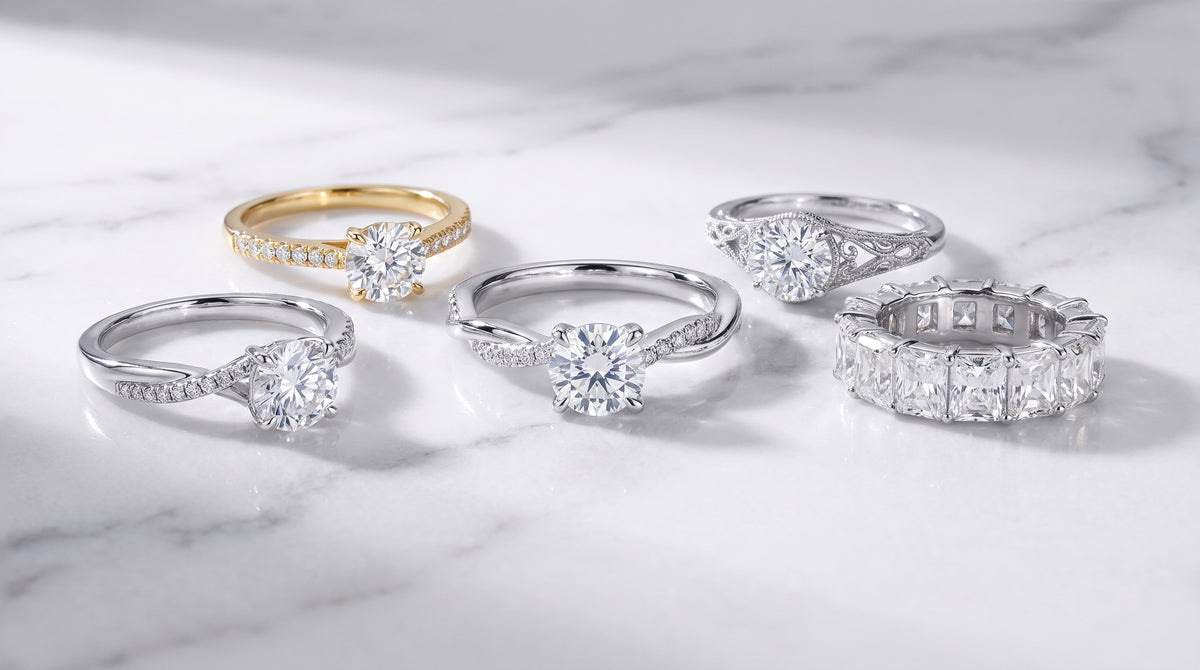
A sterling silver moissanite ring is a study in contrasts. The stone sits at roughly 9.25 to 9.5 on the Mohs hardness scale, close behind diamond at 10 and comfortably above sapphire. The metal holding it sits at about 2.5 to 3. That single gap — six to seven points of hardness between the gem and its setting — explains almost everything shoppers eventually notice about these rings: why the sparkle still looks flawless after years, why the band picks up hairline scratches within months, and why a prong can loosen long before the moissanite shows any sign of wear.
Most buying guides skate past that. This one starts there, because once you understand that the metal, not the stone, is the limiting factor, every other decision gets easier: which designs to shortlist, how thick the band should be, how often you will realistically be cleaning it, and whether sterling silver is the right choice for the role you have in mind — a fashion ring, a promise ring, a first engagement ring, or something meant to outlast a mortgage.
What a sterling silver moissanite ring actually is
The 925 half of the equation
Sterling silver is defined by alloy standards such as ISO 8517 and ASTM B208 as 92.5% pure silver combined with 7.5% other metals — most commonly copper. That copper content is not a compromise; it is what makes the metal hard enough to hold a prong, take a polish, and survive being shaped into a band. Fine silver at .999 purity is too soft for ring shanks and settings that face daily mechanical stress.
Genuine sterling is usually stamped 925, .925, S925, or Ster on the inside of the band. Descriptions that say only "silver," "silver-tone," "silver-plated," or "nickel silver" are not the same thing — nickel silver in particular typically contains no silver at all. The copper in the alloy also has a second consequence: it is the component that reacts with sulfur in the air, which is why tarnish is part of the deal (more on that below).
The moissanite half
Moissanite is a lab-created gemstone with a hardness of approximately 9.25 to 9.5 on the Mohs scale. In practical terms, almost nothing you encounter day to day is hard enough to scratch it — only a diamond or another material of equal or greater hardness. Hardness is only one axis of durability, though. Toughness, the resistance to chipping and fracture, matters just as much for a ring worn on a hand that opens car doors and carries grocery bags. Diamond is harder, but it has cleavage planes that can chip under a bad impact angle; moissanite lacks those strong cleavage planes, which gives it a modest toughness advantage in some scenarios. For the moissanite rings versus diamond question, the honest answer is that both are more than durable enough for a human lifetime of normal wear, and the differences only surface in extreme or highly abrasive conditions.
Moissanite also holds its optical performance. Comparative jewelry reporting places its brilliance retention in daily wear at roughly five to seven times that of cubic zirconia, which tends to dull and abrade. If you have previously been disappointed by a CZ ring clouding over, that is not what happens with moissanite.
The hardness gap: what it means for real-world wear
Put a near-indestructible stone in a soft metal and the failure modes all migrate to the metal. Jewelry industry guidance on sterling silver engagement rings reports that continuous daily wear typically produces visible change — fine scratching, dulling, some band thinning — within three to six months. The same reporting places the realistic service life of a sterling silver engagement ring at around three to seven years, stretching to five to eight with meticulous care, versus 30-plus years for a well-maintained 14K white gold or platinum ring that receives occasional prong retipping.
Wholesale material guidance is blunter still, rating 925 settings as "moderate" durability: prone to tarnish, able to bend under stress, and best matched to fashion jewelry, occasional wear, travel rings, and gifts rather than a ring that never leaves the finger. Stones can loosen over time in silver settings, particularly where band profiles are thin and prongs are fine.
None of this makes sterling silver a bad material. It makes it a material with a job description. A silver moissanite ring worn a few times a week, taken off for the gym and the washing-up, and cleaned properly will look excellent for years. The same ring worn continuously through manual work will look tired quickly, and no amount of marketing language changes that.
Tarnish: predictable, reversible, and worth planning for
Why it happens
One jewelry-care publisher reports that roughly 87% of consumers believe sterling silver should not tarnish at all. Every sterling silver piece will. Tarnish is not rust and not deep corrosion — it is a surface film of silver sulfide and copper sulfide, on the order of 0.0001 mm thick, formed when the alloy meets airborne sulfur compounds and moisture. Functionally it behaves like the patina on bronze: a thin passivation layer sitting on top of intact metal, which is precisely why it polishes off rather than needing to be repaired.
How fast it happens
Speed depends almost entirely on environment, not on quality. Published timelines from jewelry-care testing and materials reporting give a useful mental model:
- Airtight, low-exposure storage: visible change may take 6 to 12 months; silver stored in zip-top bags with the air excluded has shown no tarnish after 18 months in lab conditions.
- Regular daily wear: dullness within about 2 to 6 weeks, noticeable darkening at 3 to 6 months.
- High humidity or high-sulfur environments: initial tarnish in as little as 1 to 3 weeks, and within hours near concentrated sulfur sources such as hot springs.
- Controlled sulfur vapor testing (ASTM B809-95 protocol): uncoated sterling darkens after roughly 200 hours of exposure.
Accelerants include hydrogen sulfide in the air, humidity, chlorinated pool water, rubber, wool, perfumes and cosmetics, and individual skin chemistry — which is why two people can buy the identical ring and report completely different experiences.
How to slow it down
Store the ring dry, in a low-humidity spot away from the bathroom, in its own compartment so it cannot scratch or be scratched. Anti-tarnish strips absorb hydrogen sulfide for up to about six months; silica gel packs handle moisture. Take the ring off before swimming, before applying perfume or hairspray, and before anything involving rubber gloves. A rhodium-plated finish, used on many silver moissanite rings, adds a barrier layer that delays tarnish — but plating is a wear layer, not a permanent coating, and it thins with abrasion and harsh chemicals.
How to verify a genuine 925 setting and a genuine graded stone
Metal checks before you buy
- Look for an explicit 925 / S925 / .925 hallmark and a listing that states solid sterling silver rather than plated over base metal.
- Treat vague wording — "silver color," "silver finish," "nickel silver" — as a red flag rather than an abbreviation.
- If you have metal sensitivities, ask whether the alloy is nickel-free; the 7.5% portion is usually copper, but formulations vary.
- Sterling silver is not magnetic. A strong pull toward a magnet indicates a base-metal core.
- Ask whether the piece is rhodium-plated or platinum-layered, and treat that as a finish detail rather than a change in the underlying metal's hardness.
Stone checks before you buy
- Look for stated color and clarity grades. D–F color with VVS clarity is the benchmark quality tier for moissanite center stones.
- Ask whether a grading certificate is available — independent laboratories such as GCAL and EGL USA are referenced in moissanite buying guidance.
- Check that measurements are given in millimeters as well as "carat equivalent." Moissanite is less dense than diamond, so a stone sold as a 1CT equivalent is described by its face-up diameter, commonly around 6.5 mm for a round.
- Confirm the setting type (prong, bezel, halo, pavé) and the number of accent stones, which affects how much maintenance the piece will need.
Why price alone is a poor quality test
Here is a genuine contradiction in the published advice worth knowing about. Several buying guides publish minimum-price heuristics — the idea that a one-carat-equivalent moissanite ring below a certain figure must be plated or uncertified. Yet live retail listings routinely undercut those thresholds by an order of magnitude while still describing the piece as rhodium-plated 925 sterling silver. Both statements cannot function as a universal rule. The practical takeaway is that a price floor is a weak proxy for quality: it tells you about a seller's pricing strategy, not about hallmark authenticity, stone grading, prong thickness, or finishing. Judge the ring on documented specifications and construction, and use price only as a sanity check afterward.
Choosing the design: stone, cut, setting, and band
Color and clarity
Colorless D–F moissanite is the natural partner for sterling silver. The metal is bright and neutral, so it reinforces a stone's icy, diamond-like look rather than warming it. Near-colorless stones in the G–I range are more often paired with yellow or rose gold, where the metal's warmth masks any tint. If you want a colorless stone to read as colorless, a white metal setting is the easier route.
Carat and proportion
Because moissanite delivers a large visual footprint for its cost, silver settings are where many shoppers size up. That is a legitimate strategy, with one caveat: the heavier the center stone, the more work the prongs and shank have to do, and silver is the softest part of the system. If you want a large center stone in silver, prioritize a substantial shank and robust prongs over the thinnest, most delicate profile on the page.
Setting style and band thickness
Halo and pavé designs multiply sparkle and disguise the surface scratching that silver inevitably picks up, because a busy, faceted surface hides fine marks better than a wide plain band. The trade-off is more small stones and more small prongs to inspect. Bezel and half-bezel settings protect the girdle of the stone best. Whatever the style, a knife-edge or hair-thin band in sterling silver is the profile most likely to distort over time — err toward a fuller shank if the ring will be worn often. For a deeper side-by-side on silhouettes, our comparison of solitaire versus twisted band moissanite rings covers how each style handles light and daily contact.
Sterling silver vs gold vs platinum: matching the metal to the job
| Consideration | Sterling silver (925) | 14K/18K gold | Platinum |
|---|---|---|---|
| Approx. Mohs hardness | 2.5–3 | Harder than sterling silver | Harder than sterling silver |
| Tarnish | Inevitable; surface-level and reversible | High corrosion resistance | High corrosion resistance |
| Typical reported lifespan in daily wear | About 3–7 years; 5–8 with excellent care | 30+ years with periodic servicing | 30+ years with periodic servicing |
| Maintenance load | Highest: regular polishing, anti-tarnish storage | Lower; rhodium refresh for white gold | Lowest routine upkeep |
| Best suited to | Fashion, promise, travel and occasional-wear rings | Daily-wear engagement and wedding rings | Long-horizon heirloom pieces |
When sterling silver is the right call
Silver earns its place when the ring's job is style, symbolism on a shorter horizon, or trying a look before committing. Promise rings, stacking bands, statement cocktail rings, travel rings you would rather not risk losing in gold, and gift pieces all suit the metal well. It is also the sensible way to test a shape or carat size before ordering the same design in gold — a genuinely useful function that no other metal performs as cheaply.
When to step up to gold
If the ring is intended as a daily-wear engagement ring meant to last decades without replacement, the published durability evidence favors 14K gold or platinum. That is not a sales line; it is the consistent conclusion across independent buying guides and wholesale material guidance. If you are weighing the two, our detailed breakdown of moissanite in gold versus silver settings and the guide on choosing between sterling silver and white gold moissanite rings walk through the decision with the same evidence base used here.
The care routine that keeps a silver moissanite ring looking new
The short home clean
A method consistent with jewelry-care lab guidance takes under ten minutes: rinse in lukewarm water (never hot — avoid thermal shock to the stone), soak briefly in lukewarm water with a few drops of mild dish soap, brush gently with an ultra-soft brush paying attention to the underside of the stone where oils and product residue collect, rinse with distilled water to avoid mineral spotting, dry fully with a microfiber cloth, then use a dedicated silver polishing cloth on the metal only. Recommended frequency is roughly every 7 to 10 days for a ring in daily rotation, and every 2 to 3 weeks for occasional wear.
What not to use
- No bleach or ammonia — both attack silver and can damage settings.
- No toothpaste or baking soda scrubs — abrasive enough to scratch a 2.5–3 hardness metal.
- No alcohol wipes or hand sanitizer — these degrade rhodium plating and leave films.
- No hot water, and never store the ring while damp.
- Ultrasonic cleaners: moissanite itself tolerates ultrasonic cleaning well, but the silver setting and any plating are the vulnerable parts — leave that to a jeweler who can judge the piece.
Storage and servicing
Individual pouches or compartments, an anti-tarnish strip, a silica gel pack, and a drawer away from bathroom humidity will do more for a silver ring's appearance than any polishing product. Book a prong inspection roughly every six months if you wear the ring frequently; in a soft metal, catching a lifted prong early is the difference between a five-minute tightening and a lost stone.
Sterling silver moissanite rings worth shortlisting
Awareness Avenue's silver-set designs cover the main silhouettes people look for in moissanite rings for women, and the collection of adjustable sterling silver moissanite rings is a useful starting point if sizing is uncertain — adjustable bands also sidestep the resizing question that comes with soft metals.
Three-stone silhouettes
The Lily is a triple-stone design with a pear-cut moissanite center flanked by two triangular accent stones, set on a premium S925 sterling silver band layered four times with platinum. Its stones are specified as D color with flawless to internally flawless clarity, with center sizes offered from 1 to 5 carats — a straightforward example of colorless moissanite in a bright white setting, which is exactly the pairing that maximizes perceived brilliance. If you like the three-stone silhouette in a different cut, the Vintage 3-Stone Round Cut Moissanite Ring applies the same three-stone logic to a rounder, more traditional shape — check the product page for that piece's specific metal and stone details before ordering.
More styles to compare
Beyond three-stone designs, the Twist Pavé 1CT Round Cut Moissanite Ring is worth a look if you are drawn to the eternity-band silhouette, the Camilla is another design to consider for everyday rotation, and the Eveline offers another distinct design to explore. As with any purchase, confirm the exact metal composition and stone grading listed on each product page before you buy. Browse the wider moissanite rings range to compare shapes side by side.
If you decide the ring needs to be gold
Should the durability evidence push you toward a lifetime metal, the Twisted Band 1CT Round Cut Moissanite Ring is offered in solid gold with a 1-carat D color, VVS clarity center and moissanite accents along the twist, in white, rose, and yellow gold options. It is the same visual language as a silver twisted band, built in a metal that is better suited to continuous daily wear. The moissanite engagement rings collection groups the pieces designed for that role.
Frequently asked questions
Will a sterling silver moissanite ring tarnish?
Yes, eventually — all sterling silver does, because the copper in the alloy reacts with sulfur compounds in the air. The important part is that tarnish is a surface film, not damage: it polishes off, and airtight storage, anti-tarnish strips, and removing the ring before swimming or applying cosmetics push the onset out substantially.
Is sterling silver acceptable for an engagement ring?
It is acceptable, but it is a shorter-horizon choice. Published guidance places the realistic lifespan of a sterling silver engagement ring at around three to seven years of daily wear, with visible scratching and dulling appearing within the first three to six months, against 30-plus years for gold or platinum. Silver works well as a promise ring, a proposal ring you plan to upgrade later, or an engagement ring for someone who will wear it selectively. For a full treatment of that scenario, see our guide to 925 sterling silver moissanite engagement rings.
How do moissanite rings compare with diamond rings?
On hardness, diamond leads at 10 against moissanite's 9.25 to 9.5, though both sit far above anything they will meet in normal use. On toughness, moissanite's lack of pronounced cleavage planes gives it a small edge against chipping from awkward impacts. In everyday terms, the practical difference in durability over a human lifetime is minimal; the meaningful differences are optical character and cost.
Do moissanite rings for men work in sterling silver?
Men's bands tend to be wider and heavier, which helps, but they also take more abrasion from tools, steering wheels, and gym equipment — precisely the conditions that a 2.5–3 hardness metal handles worst. If a silver moissanite band is going onto a hand that works, choose a thick shank with bezel-set or flush-set stones rather than raised prongs, and expect to polish more often. For a hardwearing everyday men's piece, gold is the more forgiving setting metal.
What about matching sterling silver moissanite earrings?
Earrings are the easiest place for sterling silver to perform well. They take almost none of the knocking, scraping, and hand-washing a ring endures, so the metal's softness is far less relevant and the main variable is storage-related tarnish. If you love the look of silver but need durability in the ring, pairing gold moissanite rings with sterling silver moissanite earrings is a perfectly sensible split.
Should I search for moissanite rings near me or buy online?
Either route works; the verification checklist does not change. In person, you can inspect the hallmark, feel the shank thickness, and check prong finishing. Online, insist on the same information in writing: stated solid 925 construction, hallmark confirmation, stone color and clarity grades, millimeter measurements, and setting details. The one thing local buying genuinely adds is easier access to sizing and future prong servicing — worth factoring in for a metal that needs inspection every six months.
Can a sterling silver moissanite ring be resized?
Silver is workable, so resizing is generally possible, but every resize means heat and metal removal on an already soft band. If you are between sizes or buying as a surprise, an adjustable band or a design with a fuller shank gives you more room to maneuver than a thin, heavily stone-set eternity-style ring.
The bottom line
A sterling silver moissanite ring gives you a gemstone that is functionally permanent in a setting that is not. Treat that as a feature rather than a flaw and the category makes complete sense: it is the most accessible way to wear a large, colorless, high-grade moissanite, to test a silhouette before committing to gold, or to mark a moment without a lifetime budget. Verify the 925 hallmark, insist on stated stone grades, choose a shank substantial enough for the stone it carries, keep an anti-tarnish strip in the box, and book a prong check twice a year. Do those five things and the ring will look far better, far longer, than the metal's reputation suggests. Want the version that never needs that level of vigilance? That is what gold is for.

Leave a comment
This site is protected by hCaptcha and the hCaptcha Privacy Policy and Terms of Service apply.