


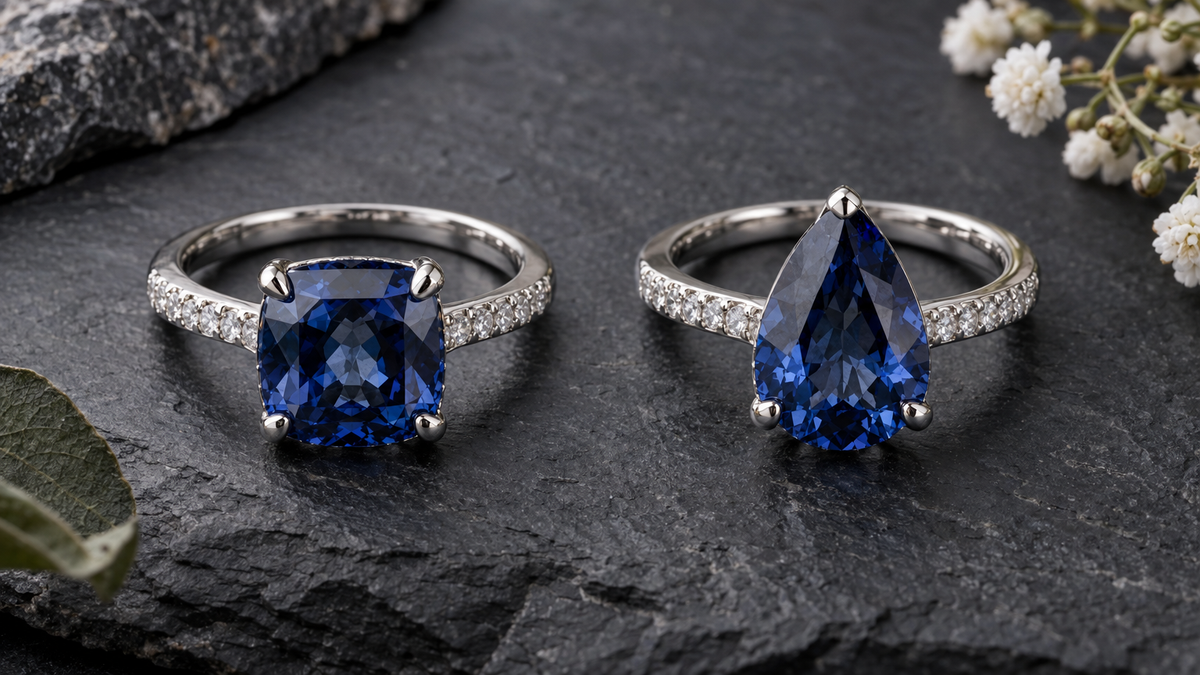
Much of the vividly blue topaz in a jewelry case began life as near-colorless material. The Gemological Institute of America is explicit about this: in nature topaz is most commonly colorless, naturally strong blue gems are extremely rare, and strong blue shades are plentiful in the marketplace because of treatment (GIA, Topaz Quality Factors). That single fact reshapes how you should read a blue topaz ring listing — because a page can accurately say "natural topaz" while the blue you are paying for was created in a treatment facility. Both statements can be true at once, and the honest listings disclose both. This guide shows you how to separate stone identity from color origin, how to judge the parts of the ring that genuinely vary in quality, and which questions to send to a seller before you check out.
Natural stone versus natural color: two claims that are easy to conflate
Topaz is a mineral that occurs in a range of colors in nature. The strong, saturated blues that dominate retail are a different matter. GIA states that treaters use a combination of radiation and heat to produce blue hues in topaz, and that since the 1970s treatment has brought blue topaz to a broad market (GIA); its general treatments primer explains that treatment disclosure is both necessary and legally required of anyone selling a gem (GIA, An Introduction to Gem Treatments). So when a product page says "natural topaz," read it as a claim about where the mineral came from — the earth rather than a laboratory crystal-growing run — not as a claim that the color arrived that way.
This is not a reason to avoid treated blue topaz. GIA describes blue topaz today as essentially a mass-market gem whose uniform color makes it highly suitable for standard jewelry sizes (GIA). It is a reason to be precise in your own expectations: do not pay a "rare natural color" premium for a stone whose color category GIA describes as plentiful because of treatment.
What US naming and disclosure rules require
Federal Trade Commission guidance for jewelry marketing holds that the unqualified name of a precious or semi-precious stone — topaz included — should describe a mined stone of that type, and that imitation, simulated and laboratory-created products must be qualified clearly and conspicuously immediately before the stone name; it also addresses disclosure of treatments that are not permanent, that create special care requirements, or that significantly affect value (FTC, Loupe advertising guidance). The same guidance says treatment information should be disclosed at the point of sale and in any online advertisement where a consumer can buy the treated gemstone without viewing the item in person — which is to say, on the product page itself, not buried in a help center.
Practical test when you compare listings: can you tell, from the page alone, (1) whether the center stone is mined topaz, laboratory-grown topaz, or a simulant, and (2) what was done to it? If either answer requires guesswork, ask before ordering.
Reading treatment wording on a specific page
Wording varies between sellers. As an example of what disclosure looks like in practice, the current descriptions for Awareness Avenue's Cyanis Natural Topaz Ring and Aquadine Natural Topaz Ring each state that the blue color is produced by permanent irradiation. Those are seller statements about their own stock, not independent verification. GIA's description of the trade process pairs radiation with heat (GIA), so if the exact treatment sequence matters to you — for an appraisal, for example — ask the seller to confirm it for the specific stone rather than assuming the category description applies.
On the regulatory side, GIA states that national regulations around the world control the release of gems from irradiation facilities to ensure they meet safety standards, and that in the United States the standard for release and import of topaz is a small fraction of the background radiation everyone is exposed to every day (GIA, Topaz Buyer's Guide). That is GIA's statement of the standard, which is the level of sourcing worth insisting on for any claim of this kind rather than a retailer's paraphrase.
Sky, Swiss, and London Blue are trade shade names, not grades
Browse the large retail categories and you will see assortments sorted by shade name — Sky, Swiss, and London Blue all appear in current listings at Zales and Kay. Treat those labels as a shared retail vocabulary for appearance. GIA states that it evaluates topaz but does not grade it (GIA), so a shade name on a product page is a seller's description rather than a laboratory grade. The category pages that use these names do not publish a definition of where one shade ends and the next begins, which means two sellers can apply the same word to visibly different stones.
Because color is the most important quality factor for topaz (GIA), judge the actual stone rather than the label: look at multiple photos and video, in daylight and indoor light if possible, and remember that a stone's appearance can vary between photographs, screens, and lighting conditions.
Quality factors that actually change how the ring looks
Color
Evaluate evenness as well as depth. A stone can be richly colored face-up but show a pale window in the center. Depth itself is a preference, not a ranking: a darker blue and a brighter one behave differently under low indoor light than under daylight, so look at the exact stone in more than one lighting condition before deciding which you prefer.
Clarity
Here is a useful reality check: GIA notes that faceted blue topaz is almost always free of eye-visible inclusions (GIA). "Eye-clean" is therefore the expected baseline for this material rather than a scarce upgrade, so it should not carry a premium on its own. What does matter is condition: look for chips at corners or along the girdle, abraded facet junctions, and surface-reaching fractures, especially on pre-owned or clearance stock.
Cut
GIA identifies cut as one of the most important factors in a gem's appearance (GIA). In practice, check three things in photos taken straight-on: symmetry of the outline, even brightness across the face, and crisp meeting points between facets. A well-proportioned smaller stone can look better at conversational distance than a poorly cut larger one.
Size, and why it should not drive your budget
Blue topaz is widely available in large sizes, and GIA states that it rises very little in per-carat price as size increases (GIA). That has a direct budgeting consequence: on a blue topaz ring you are paying for more than the center stone — the metal, the weight and construction of the mounting, the accent stones, and the workmanship are all part of what the price covers, and none of them is visible in a millimeter measurement. Compare the whole ring, not just the stone size.
Note also that millimeter dimensions and carat weight answer different questions. Millimeters tell you how the stone will look on the hand; weight is what appraisers and insurers typically want. If a listing gives one and you need the other, ask for the missing figure in writing for the exact variant you plan to order.
Durability: Mohs 8 is about scratching, not impact
This is where a lot of marketing copy quietly overreaches. Topaz ranks 8 on the Mohs hardness scale, but GIA also states that its toughness rating is poor because of its cleavage, that a hard blow might split it, and that extreme pressure or sharp temperature changes might cause it to break (GIA, Topaz Care and Cleaning). Hardness and toughness are two separate properties: the first concerns resistance to scratching, the second resistance to chipping and cleaving. A blue topaz ring can stay bright and unscuffed for years and still be vulnerable to one solid knock against a door frame.
Settings that reduce the risk
Because of that cleavage, GIA notes that jewelers prefer to set valuable topaz gems in protective mountings, or use topaz in pieces that are not exposed to too much wear, such as pendants and pins (GIA). Translate that into things you can actually check on a product page:
- Corner coverage. Square and rectangular outlines have corners sitting at the edge of the stone. Ask whether prongs or a bezel edge cover them.
- Prong count and thickness. Ask how many prongs secure the stone and how substantial they are; many listings do not state either.
- Profile height. Ask for a side view so you can see how far the stone stands off the finger, which a top-down photograph will not tell you.
- Metal around the girdle. Bezels and partial bezels cover the stone's edge; open baskets leave more of it visible and more of it exposed.
If a listing does not show the ring from the side, ask for a profile photo before ordering.
Match the ring to the way you live
Blue topaz can suit occasional wear, office wear, and dressing up when worn with care. For daily wear through manual work, the gym, climbing, or hands-on childcare, plan on removing it — or choose a lower, more enclosed setting. No setting makes a cleavable gem impact-proof.
Metal and accent stones: read the specification, not the color
What "sterling silver" and "925" do and do not tell you
The words silver, sterling and sterling silver describe products containing 92.5% pure silver, and the 925 mark means 925 parts per thousand are pure silver; US law also requires silver items to show the name or registered trademark of the company standing behind the mark (FTC consumer guidance; see also the FTC's Jewelry Guides notice). That is a fineness standard for the silver content — it does not identify the remaining alloy, any plating or coating applied over it, or the solder used at a sizing joint. So "925" on its own is not evidence about skin sensitivity, tarnish behavior, or nickel content. If you react to certain metals, ask the seller for the specific alloy and plating details before ordering, and treat any blanket comfort claim as something to verify rather than assume. Our guide to sterling silver rings and stone-set designs covers the same metal questions in more depth.
Gold options: confirm which stone you actually receive
Metal variants sometimes change more than the metal. On both Awareness Avenue topaz rings, the current descriptions state that 10K, 14K, and 18K gold orders include an automatic upgrade to VVS moissanite for the center and accent stones. If your goal is specifically a topaz center stone, that matters a great deal: select the sterling silver option, or contact the seller to confirm in writing which stone a given gold variant ships with. This is a good general habit — wherever a listing offers a materials upgrade, re-read the stone specification for that exact variant rather than the headline description.
Accent stones: "zircon" and "cubic zirconia" are not interchangeable words
Accent terminology repays careful reading. FTC guidance expects gemstone identity to be represented accurately, requires imitation and laboratory-created stones to be qualified clearly and conspicuously immediately before the stone name, and separately notes that moissanite is a laboratory-created gemstone that resembles a diamond and can defeat thermal testers designed to separate diamond from cubic zirconia (FTC). As an illustration of how much accent naming can vary between two rings in the same collection, the Cyanis description lists A5 cubic zirconia accents while the Aquadine description lists brilliant-cut zircon accents. If accent identity affects your decision — for resale, insurance, or personal preference — ask the seller to confirm the material, the stone count, and the total accent size for your variant in writing.
Documentation: what a certificate proves, and what it doesn't
There is a hierarchy here, and conflating its levels is how buyers end up disappointed:
- Product description. The seller's own statement of identity, treatment, dimensions, and metal. Useful, and binding on the seller, but self-reported.
- Seller-issued certificate. A document produced by or for the retailer. Its value depends entirely on who performed the testing and what was tested.
- Independent laboratory report. Issued by a named gemological laboratory, with a report number you can check against the issuer's own records.
GIA states that it evaluates topaz but does not grade it, and that a GIA Colored Stone Identification Report assesses characteristics such as weight, measurements, shape, cutting style and color, identifies whether material is natural or laboratory-grown, and names any detectable treatments (GIA). That means a phrase like "GIA-graded topaz" should raise an eyebrow immediately. Both Awareness Avenue listings reference an included certificate of authenticity; as with any seller, the useful follow-up questions are the same three: who issues it, what tests does it record, and is there a report number tied to this specific stone?
Comparing two blue topaz rings on their listed specifications
The table below reproduces only what the current product descriptions and variant options state for the two topaz rings in the natural topaz jewelry collection. It is first-party seller information, not independent verification, and specifications and availability can change — confirm against the live product page for the exact variant before ordering.
| Listed specification | The Cyanis Natural Topaz Ring | The Aquadine Natural Topaz Ring |
|---|---|---|
| Center stone as listed | Natural topaz, Swiss Blue | Natural topaz, Swiss Blue |
| Cut and dimensions as listed | Cushion cut, 7 x 7 mm | Princess cut, 8 x 8 mm |
| Color treatment as listed | Permanent irradiation | Permanent irradiation |
| Mounting as described | Prong-set center | Bypass band design |
| Accent stones as listed | A5 cubic zirconia | Brilliant-cut zircon |
| Band width as listed | 1.7 mm | 1.7 mm |
| Metal option compared | S925 sterling silver | S925 sterling silver |
| Gold variants | Withheld pending stone-identity clarification (listing states gold orders upgrade to moissanite) | Withheld pending stone-identity clarification (listing states gold orders upgrade to moissanite) |
| Ring sizes offered | US 3 to US 13, including half sizes | US 3 to US 13, including half sizes |
Which outline suits you
On the listed facts, the choice between them is mostly a shape-and-scale decision. The Cyanis cushion outline is rounded at the corners and is listed at 7 x 7 mm. The Aquadine princess outline at 8 x 8 mm is more geometric and covers more finger surface, and square outlines have corners whose coverage is worth confirming with the seller before you decide. Neither listing specifies prong count, corner coverage, or setting height, so neither mounting can be described as the more protective one on the published facts. Both are listed with the same 1.7 mm band width.
What to confirm for either ring
- Center-stone carat weight for your chosen variant, if you need it for insurance or appraisal.
- Prong count and corner coverage, plus a side-profile photo showing setting height.
- Finished ring weight in the metal you select, if you are comparing value against another seller.
- Accent stone identity, count, and total size, confirmed in writing.
- Which stone ships with the gold variants, if you are not ordering sterling silver.
- The issuer and scope of any included certificate.
- Current availability for your size and metal, confirmed before you pay.
Sizing, returns, and warranty: settle these before you pay
Both listings offer US 3 through US 13 including half sizes, with UK/AU and EU equivalents shown in the size selector, which is a wider span than many gemstone rings — helpful if you are between sizes or buying for a smaller or larger finger. Still, getting the size right prevents unnecessary returns, so measure the actual finger the ring will live on, and measure it more than once, at different times of day, before deciding.
Because eligibility for returns, exchanges, resizing, and repair varies by item type, destination, and condition, read the current terms rather than a summary of them: the refund policy and the warranty terms are the documents that govern your order. If a detail you are relying on is not spelled out there — resizing range for a particular setting, for instance — ask support to confirm it in writing before you order rather than after.
Gift timing: birthstone and anniversary conventions differ
Blue topaz gets pulled into several gift occasions, and the conventions genuinely differ, so it pays to know which list you are citing. Jewelers of America's US birthstone list pairs citrine and topaz with November, and lists turquoise, blue topaz, and tanzanite for December (Jewelers of America) — so blue topaz appears on that December list alongside two other stones, while GIA's topaz material describes topaz as a November birthstone (GIA). Describing blue topaz as "the" official December stone overstates the case; naming it as one of December's listed stones is accurate.
For anniversaries, Jewelers of America lists blue topaz for the fourth year (Jewelers of America), and GIA notes that there is no single authoritative wedding anniversary gemstone list (GIA). "A fourth-anniversary gemstone" is the safe phrasing on a gift card. If you are shopping by month rather than by stone, our birthstone ring buying guide and the birthstone jewelry collection are the better starting points.
Care that actually protects a topaz ring
GIA's guidance is specific and easy to follow: warm, soapy water works best for topaz, and it is important to avoid steam or ultrasound; extreme pressure and sharp temperature changes might cause the stone to break (GIA). Build a short routine around that:
- Clean the stone with warm soapy water.
- Avoid steam cleaning and ultrasonic cleaners entirely.
- Avoid extreme pressure and sharp temperature changes, which can break the stone.
- Because GIA states a hard blow might split topaz, remove the ring before activities that put your hands at risk of impact.
If you want blue but need a tougher stone
If your honest answer to "how will I wear this?" involves constant impact risk, it is worth comparing blue topaz against other blue options before committing, rather than hoping a setting will compensate for cleavage. We cover the trade-offs between blue gem choices in our comparison of aquamarine and blue moissanite rings, and run through more options in ten alternatives to aquamarine rings. For blue topaz specifically, the trade-off is clear: saturation and face-up size for the money, best enjoyed with a little care rather than total indifference.
The pre-purchase checklist
- Identity: Is the center stone mined topaz, laboratory-grown, or a simulant, and does the page say so plainly?
- Treatment: Is the color treatment disclosed on the product page, and does it apply to the variant you are buying?
- Color: Have you seen the stone in more than one lighting condition, in video if possible?
- Cut: Is the face evenly bright, with a symmetrical outline and no large dull window?
- Condition: Any chips at corners or girdle, or surface-reaching fractures?
- Dimensions and weight: Do you have both the millimeter size and, if you need it, the carat weight?
- Setting: Prong count, corner coverage, profile height, and a side-view photo.
- Metal: Fineness, whether solid or plated, and the alloy details if sensitivity matters.
- Accents: Exact material, count, and size, confirmed in writing.
- Variant check: Does changing the metal change the stone?
- Documentation: Issuer, scope, and report number of any certificate.
- Policies: Current return, exchange, resizing, and warranty terms for your item and destination.
Frequently asked questions
Is blue topaz real topaz?
If a listing says natural or mined topaz without qualification, that is a claim that the mineral is genuine topaz from the earth. FTC guidance holds that the unqualified name of a stone such as topaz should describe a mined stone, and that imitation and laboratory-created stones must be qualified (FTC). Genuine topaz with treated color is still genuine topaz.
Is blue topaz naturally blue?
Rarely. GIA states that naturally strong blue topaz is extremely rare and that strong blue shades are plentiful in the market because of treatment (GIA). Unless an independent report specifically documents untreated natural color, assume the blue was created by treatment.
Which is better, Swiss Blue or London Blue?
Neither is objectively better. They are trade descriptions of shade used to sort assortments at retailers such as Jared, not laboratory grades — GIA states it evaluates topaz but does not grade it (GIA). Choose by how the stone looks on your hand and in the lighting you live in.
Can a blue topaz ring be worn every day?
It can be worn regularly with care. Topaz is Mohs 8, which concerns scratch resistance, but GIA describes its toughness as poor because of cleavage, with a hard blow capable of splitting the stone (GIA). Lower settings, more corner coverage, and taking the ring off for rough tasks matter more than the hardness number alone.
Is blue topaz suitable for an engagement ring?
It is an option for someone who accepts the limitations and is willing to remove the ring for high-impact activity. A protective mounting is the main design lever, since GIA notes that jewelers prefer to set valuable topaz gems in protective mountings because of its cleavage (GIA). If the wearer will never take the ring off, consider a tougher stone instead.
Should I buy the largest stone I can afford?
Not automatically. GIA states that blue topaz rises very little in per-carat price as size increases, and that it is widely available in large sizes (GIA), so a bigger stone is not by itself evidence of a better ring. Weigh cut quality, mounting construction, and the metal you are happy to wear long term alongside size.
How do I clean it at home?
Warm water and mild soap. Skip steam and ultrasonic machines entirely, and avoid sudden temperature shifts (GIA).
What should I ask a seller before ordering?
Six questions cover most risk: stone identity for your exact variant, disclosed treatment, millimeter size and carat weight, accent stone identity and count, setting details with a profile image, and the issuer and scope of any certificate. A seller who answers all six in writing has told you more than any marketing paragraph can.

Leave a comment
This site is protected by hCaptcha and the hCaptcha Privacy Policy and Terms of Service apply.