


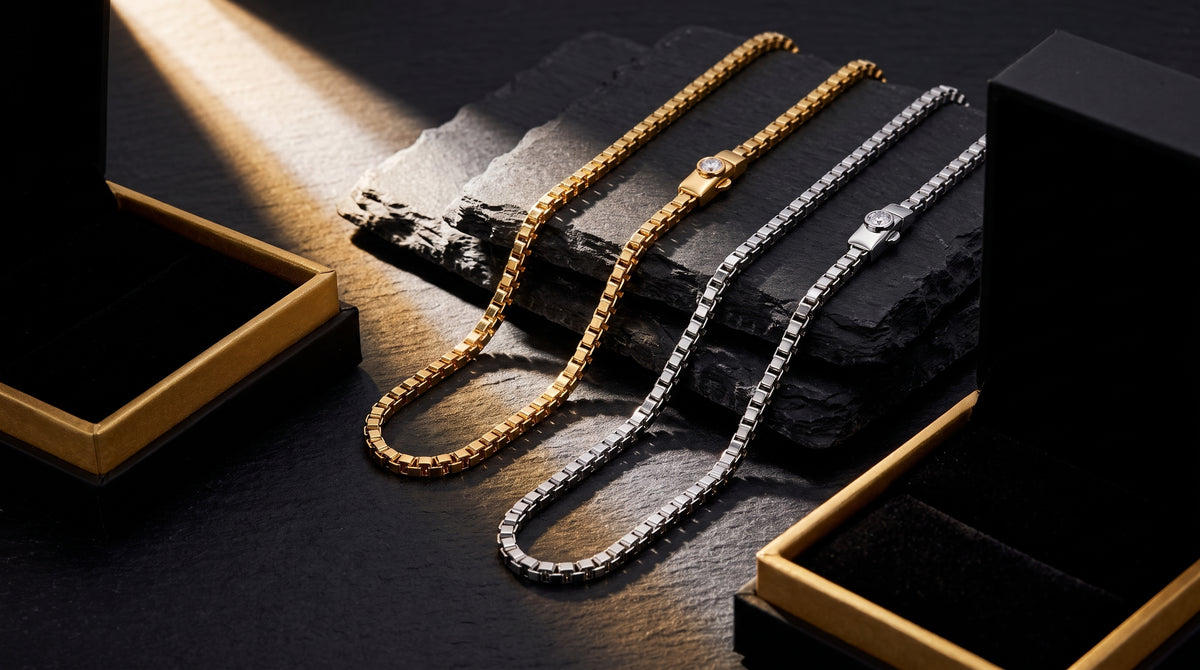
Search for a diamond men's chain necklace and you get two completely different kinds of page stacked on top of each other. The first is retail: specialist jewelers listing men's diamond tennis necklaces in real sterling silver, 14k white gold four-prong tennis chains, iced-out Cuban links advertised with VVS clarity, and sculpted curb or box link chains from fine-jewelry houses. The second is defensive: guides on how to spot a fake diamond chain, how to tell whether a Cuban link is solid gold, and which at-home test proves a stone is a diamond. Nobody writes the page in between — the one that explains why those two layers exist, which claims on a product page are verifiable and which are just marketing language, and what you should actually ask before you send money.
That is what this page does. It works through the objections buyers raise in the order they usually raise them, and it is honest about one thing up front: Awareness Avenue does not sell natural-diamond tennis chains or certified VVS Cuban links. Our chains and pendants sit in the simulated-stone and everyday-wear category, and there is a specific kind of buyer that suits. If you want a certified natural diamond chain, this guide will still help you buy one competently from someone who sells them.
What "Diamond Men's Chain Necklace" Actually Means on a Product Page
The phrase covers at least three structurally different products, and confusing them is the single most common reason a purchase disappoints.
The diamond tennis chain
A tennis chain is a continuous line of evenly spaced stones, usually prong-set, with the metal doing almost nothing decorative — it exists to hold stones in a straight line. Retailers describe the look as sleek and minimalist rather than loud, which is why it reads as dressy even when it is fully set. Real examples in the market include two-row sterling silver versions around 6 mm wide and slim 14k gold four-prong chains in the region of 2.3 mm. The narrow width matters: a tennis chain's presence comes from light, not bulk, so a 2 mm tennis chain can look more expensive than a 6 mm plain chain while weighing far less.
The iced-out Cuban link
Here the links themselves are pavé-set, so you are buying two expensive things at once: a heavy interlocking chain and a large number of stones. Genuine Cuban links are substantial by nature — thick, tightly spaced links, real heft in the hand, and a robust clasp that latches with a positive, engineered feel. A chain that looks Cuban but feels light is usually hollow, plated, or both. Iced-out 12 mm Cuban links marketed with VVS diamonds sit at the top of this category; they are statement pieces, not quiet ones.
The plain chain with a diamond pendant
Fine-jewelry men's "diamond necklace" sections frequently mean a bold gauge link, curb, or box chain in sterling silver or 18k gold carrying a diamond-set pendant, not a stone-set chain. This is a very different price and maintenance profile. If a listing is vague about whether stones are in the chain or only in the pendant, assume pendant-only until the seller confirms otherwise.
What "real" and "VVS" are doing in the copy
"Real," "genuine," and "VVS" appear constantly in this category, and on their own they are retailer assertions, not verified facts. VVS (very, very slightly included) is a legitimate clarity grade near the top of laboratory clarity scales, but a grade only means something when it comes from a grading report tied to the stones you are buying — and on a chain with dozens or hundreds of small stones, that report usually does not exist in the form buyers imagine. If clarity language is central to a listing, ask what documentation accompanies it. Our companion piece on what you're really paying for in a VVS diamond chain goes deeper on how that grade is used in men's chain marketing, and the VVS diamond Cuban link buying guide covers the Cuban-specific version of the same problem.
Objection 1: "How Do I Know the Diamonds Are Real?"
This is the dominant anxiety in the category, and it deserves a precise answer rather than reassurance.
Start with the setting, not the stones
Authenticity guides consistently advise inspecting the mounting first, because it is easier to read than a 1.5 mm stone. On a well-made diamond chain, prongs are secure, evenly spaced, and consistent in size, and the metal is a recognized precious alloy. Irregular prong spacing, visibly soft or cheap-looking metal, and sloppy solder joints are warning signs. The reasoning is simple: nobody sets valuable stones in a setting that will lose them.
Then check the stamps
Hallmarks are the cheapest information available to you. "10K," "14K," "18K," "585" (14k), and "750" (18k) indicate gold purity; "PT" or "PLAT" indicates platinum; "925" indicates sterling silver; and a "CZ" stamp indicates cubic zirconia rather than diamond. Stamps can be faked or generically engraved, so they are a filter rather than proof — but a chain sold as solid gold with no purity mark anywhere on the links or clasp is a conversation you should have with the seller before checkout.
Understand what home tests can and cannot tell you
The popular tests all have a real physical basis and a real limit:
- Fog test. Diamond disperses heat quickly, so condensation from your breath clears almost instantly. Useful against glass, unreliable against moissanite, which also conducts heat well.
- Newspaper / readability test. A well-cut diamond scrambles light enough that text underneath becomes unreadable. Works on loose or open-back stones; largely useless on a chain with closed settings.
- Water test. Diamond is dense and sinks quickly, but the metal in a chain dominates the result. Treat this as supplementary at best.
- UV / blacklight. Many diamonds fluoresce blue, but plenty of genuine diamonds do not fluoresce at all, and some simulants glow in other colors. Never conclusive either way.
- Loupe examination. The most informative option. Real diamonds show sharp, crisp facet junctions and natural inclusions rather than gas bubbles. Bubbles and curved growth lines point toward glass or cubic zirconia.
- Heat test. Guides mention it and then tell readers not to do it. Follow the second half of that advice.
The one thing that is actually conclusive
Professional appraisal by a qualified gemologist, or laboratory grading documentation, is the only high-confidence verification. Standard pocket diamond testers measure thermal conductivity — diamond conducts heat roughly five times faster than moissanite — which is why cheap testers can misread moissanite, and why dual-mode testers that also read electrical conductivity exist. Under magnification, moissanite is doubly refractive and shows doubled facet edges, while diamond does not; that is a definitive tell, but it takes a trained eye to see reliably. Bottom line: if authenticity is the deciding factor in your purchase, buy from a seller who supplies documentation and a return window, and have the piece appraised independently.
Objection 2: "Why Is One Chain a Fraction of the Price of Another?"
Two chains can look nearly identical in a product photo and differ enormously in cost. Four variables explain almost all of it.
Stone type
Natural diamond, lab-grown diamond, moissanite, and cubic zirconia are four different materials with four different cost structures. Moissanite is silicon carbide, now essentially always lab-created, and it costs a small fraction of a comparable diamond per carat. Cubic zirconia costs less again. On a fully iced chain, where stone count is high, that per-stone difference compounds dramatically — which is exactly why a "diamond look" chain can be affordable while a genuinely diamond-set one cannot.
Metal and construction
Solid 14k or 18k gold, gold-filled, gold-plated base metal, sterling silver, and stainless steel are not interchangeable. Solid gold carries a raw material cost that scales with weight, which is why heavy Cuban links in solid gold are expensive before a single stone is set. Hollow construction cuts weight and price and reduces durability. Plating adds gold color at a tiny fraction of the cost, with the trade-off that it wears at friction points over time.
Weight, width, and length
Price scales with material volume. A 22-inch chain uses meaningfully more metal than an 18-inch chain in the same style and width, and width increases weight faster than it increases visual size. If you are comparing quotes, compare width, length, and stated weight together or you are not comparing anything.
Labor and setting
Prong-setting hundreds of small stones and finishing links to a consistent polish is skilled work. Uniform links, smooth finishing, and a clasp that operates cleanly are all signs that labor was paid for. Visible irregularities, rough edges, and a flimsy clasp usually mean it was not.
One useful sanity check from the authenticity literature: the price has to be plausible against the material cost. A heavy solid-gold diamond Cuban link offered at a price that would barely cover the gold is not a bargain, it is a different product than advertised.
Objection 3: "Won't a Simulated or Moissanite Chain Look Obviously Fake?"
This is the fear that keeps people from considering alternatives, and the technical answer is more interesting than "no."
Moissanite has a refractive index of roughly 2.65–2.69 against diamond's 2.42, so it bends light more strongly, and its dispersion value of about 0.104 versus diamond's 0.044 means it throws roughly 2.4 times more spectral "fire." In practice that means a moissanite chain is not a dimmer version of a diamond chain — it is a brighter, more rainbow-flashing one. Most people cannot tell the difference by eye, but a trained observer may notice the extra fire, particularly in strong directional light. If you want restraint, that extra fire is something to design around: narrower stones and lower-profile settings read more like diamond than large, wide-open ones.
Cubic zirconia and other simulants behave differently again. They can sparkle convincingly when new, but their lower hardness means surface wear accumulates and the sparkle dulls faster, and under a loupe they often reveal internal bubbles. Guides on spotting fakes note that lower-quality simulants tend to produce an uncontrolled rainbow light show rather than diamond's mix of white brilliance with restrained colored flashes.
The honest limitation is value, not looks. Moissanite and simulants have negligible resale value and no established secondary market, while natural diamonds retain a share of retail on resale. If you are buying a chain partly as a store of value, alternatives are the wrong tool. If you are buying it to wear, the calculus flips: you get the visual effect without the loss anxiety. Our real diamond necklace for men objection guide works through that trade-off in more detail.
Objection 4: "Will It Survive Daily Wear?"
Durability splits into stone durability and chain durability, and buyers usually only think about the first one.
Stones
Diamond sits at 10 on the Mohs scale — the hardest natural material and effectively immune to scratching, though still brittle enough to chip on a hard impact. Moissanite is around 9.25–9.5, which makes it one of the hardest gemstones used in jewelry and entirely suitable for everyday wear. Cubic zirconia is softer, roughly 8–8.5, and that gap is where "it looked great for three months" complaints come from: soft stones abrade against clothing, desks, and each other over time.
Chains and clasps
A chain fails at its weakest joint, usually the clasp or the link next to it. Look for a clasp that closes with a definite click and does not flex under gentle pressure. Stainless steel resists corrosion and takes mechanical abuse well, which is why it is a sensible choice for a chain that will be worn constantly rather than kept for occasions. Plated finishes need more care: skip perfume, chlorine, and abrasive polishing cloths, wipe the piece after wear, and store it separately so harder pieces cannot scratch it.
Setting maintenance
On any stone-set chain, the maintenance item is prongs, not stones. Check them under good light every few months and have loose ones tightened by a jeweler. This applies equally to a five-figure diamond tennis chain and an affordable simulated-stone one; the difference is only what a lost stone costs to replace.
Objection 5: "What Length and Width Should I Actually Order?"
Returns in this category are driven as much by fit as by authenticity. A practical starting method: wrap a soft tailor's tape around the base of your throat, read the measurement, then add 2–4 inches for a comfortable minimum length. That gives you a floor, not a final answer — where the chain sits also depends on build, neck width, and what you plan to wear it with.
Useful rules of thumb from how these styles are actually worn:
- Tennis chains tend to look right sitting close to the collarbone, where the line of stones stays visible against skin rather than disappearing under a shirt.
- Iced-out Cuban links are usually worn shorter and higher so the link structure reads clearly; a heavy chain hung too long swings and catches.
- Pendant chains need extra length, since the pendant hangs below the chain's resting point. If you want a pendant centered on the chest, plan for a longer chain than you would choose for a bare chain.
- Width should be scaled to frame. Narrow widths read refined and layer easily; wider widths make a statement and need neck and shoulder width to balance them.
For exact length-to-fit mapping and how millimeter widths translate to visual weight, see our men's chain necklace size chart.
Objection 6: "I Want the Look as a Gift, Not an Investment"
This is where Awareness Avenue fits, and where we would rather be specific than aspirational. Our catalog is built around wearable, giftable pieces — including moissanite rings, simulated-stone necklaces, and chains — not certified natural-diamond chains. If you came here for a graded VVS Cuban link, we do not have one, and no amount of clever wording changes that.
What we do have suits a recognizable buyer: someone who wants a chain a teenager or young man can wear every day without being a target, or a milestone gift for a son or grandson where the message matters more than the carat weight.
- The Boxer Chain in stainless steel is a straightforward everyday chain in a metal chosen for toughness rather than intrinsic value — a sensible base for a pendant or a standalone piece for constant wear.
- The Boxed In Chain in gold covers the warm-tone option; check the product page for the current material and dimension details before ordering.
- The Adelaide is, as its name states, a 1 ct round simulated diamond pendant necklace — a single-stone look rather than a stone-set chain, and labeled as a simulant rather than described as diamond.
- Gift-first buyers usually end up in the bundles, such as the To My Son Enduring Faith bundle or the To My Grandson Golden Legacy bundle, where the presentation and message are the point. The full range sits in son and grandson gifts and gift bundles.
If you want to browse by category instead, necklaces and affordable pieces under $100 are the fastest routes in. And if a darker, less conventional iced look appeals, our guide to choosing a black moissanite chain in tennis versus Cuban link styles covers that decision.
Questions Buyers Ask Before Checkout
Is a sterling silver diamond chain "real"?
It can be. Retailers do set genuine diamonds in sterling silver to keep the price of a tennis-style chain accessible, so a 925 stamp does not by itself indicate fake stones. It does mean you should ask separately about the stones, since the metal tells you nothing about them.
Can a jeweler tell moissanite from diamond?
Yes. A gemologist with magnification can look for moissanite's double refraction, and a dual-mode tester distinguishes it using electrical as well as thermal conductivity. Basic thermal-only testers can misread moissanite, which is why single-test claims should never be your only evidence.
Should I be suspicious of a heavy discount?
Be suspicious of a price that cannot cover the materials described. Discounts are normal in jewelry retail; a solid-gold, fully diamond-set chain priced like costume jewelry is not a discount, it is a specification mismatch.
What should I ask a seller before I buy?
Four questions settle most disputes: What is the metal and its purity, and where is it stamped? Are the stones natural diamond, lab-grown diamond, moissanite, or a simulant? What documentation comes with the piece? And what is the return window if an independent appraisal disagrees with the listing? A seller who answers all four clearly is a safer purchase than one with better photography.
How to Decide
Work backward from why you want the chain. If it needs to hold value, insist on natural diamonds with documentation and solid precious metal, accept the price, and plan on insuring it. If it needs to look excellent and be worn daily without anxiety, a moissanite or simulated-stone chain in a durable metal gets you most of the visual effect for a small share of the outlay, provided the seller labels it honestly. If it is a gift carrying a message, prioritize presentation, fit, and durability over stone pedigree — the recipient will remember the occasion, not the clarity grade.
The failure mode to avoid is buying a piece sold as one category while quietly expecting another. Clear labeling, a plausible price, a stamped and well-finished setting, and a real return policy protect you far better than any breath-on-the-stone test. Choose the category deliberately, and the rest of the decision gets easy.

Leave a comment
This site is protected by hCaptcha and the hCaptcha Privacy Policy and Terms of Service apply.