


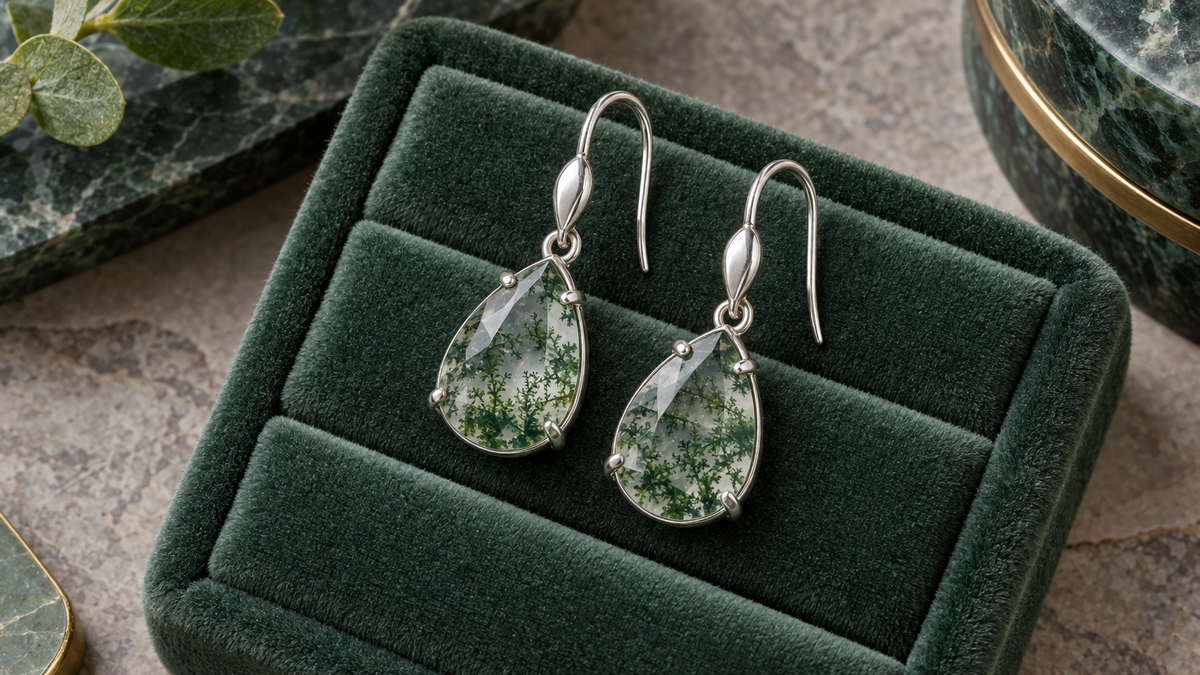
Open an Awareness Avenue moss agate earring listing and the first decision is not the cut — it is a dropdown labeled “Jewelry Material.” On the coffin cut studs, kite cut drops, barrel cut dangles, vine wrap studs and teardrop leverbacks, that selector lists three options: S925 Sterling Silver, 14K White Gold and 18K White Gold. If you searched for moss agate earrings in silver, the sterling option is the one you want — but the word “silver” carries a legal fineness definition, a specific maintenance profile, and a set of component-level questions that a product title never answers on its own.
Moss agate adds a second layer of uncertainty. It is a variety of chalcedony whose green and brown-to-black dendritic inclusions can vary from stone to stone, as documented in the mineral record at Mindat. That means two earrings cut from the same rough can look related rather than identical, and it means a photograph is a sample of a material, not a specification. This guide is written for that problem: what a silver moss agate earring listing actually proves, what it only asserts, and which details to confirm before you commit to a pair. If you want to browse the range itself first, the moss agate earring collection is the shoppable starting point.
What “silver” has to mean before anyone calls it sterling
In the United States, jewelry represented as sterling silver is held to a fineness standard: products marked or described as sterling are expected to contain at least 925 parts per thousand of silver, as set out in the Federal Trade Commission's jewelry guides at 16 CFR § 23.5 and in the national silver stamping statute reproduced at 15 U.S.C. § 296. The FTC's consumer explainer on buying platinum, gold and silver jewelry puts it plainly: a “925” mark means 925 parts per thousand are silver.
Two things follow that most shoppers miss. First, the standard describes the silver content, not the remaining alloy — “925” by itself does not establish what the other 75 parts per thousand are, which matters if you react to specific metals. Second, a legal definition is a rule for sellers, not an audit of any individual pair. A listing that says S925 is making a composition claim; independent confirmation would come from an assay or a supplier material declaration covering the body, the post, the ear back and the solder, not from the description alone. The FTC's own advertising substantiation policy is the reason that distinction is worth holding onto: objective product claims are supposed to rest on evidence, so it is reasonable for you to ask what the evidence is.
Finish is not the same as metal
Some sterling earrings are rhodium plated; specialist retailers such as Juwelo state plating alongside alloy and metal weight on the product page itself. Rhodium plating is a surface finish applied over silver — it changes the look and the care routine, and like any coating it is a layer rather than the underlying metal. If a finish is not named on the listing you are reading, treat the finish as unstated rather than assuming polished sterling, and ask.
The silver moss agate earring styles in Awareness Avenue's range
Five sterling silver designs cover studs, drops, dangles and a leverback closure. The details below are taken from the text of the live listings themselves; where a specification is not given in that description, this guide flags it as something to confirm on the full product page or with the seller rather than filling it in.
Coffin cut studs
The coffin cut stud listing describes a geometric, angular stone held by prongs positioned to protect the cut's corners. Pointed and corner-heavy cuts are the ones that most reward a close look at the setting, a point echoed in CustomMade's guidance on choosing moss agate, where cut shape and setting protection are treated as linked decisions. The description does not carry a stone measurement or a backing type, so check the specification panel on the page and, if they are not there, request both before ordering.
Vine wrap studs
The vine wrap studs set the stone inside a botanical silver frame. Because the metalwork surrounds the gem, the visible moss pattern is smaller than the overall earring footprint — a reason to ask for the stone size separately from the earring size rather than judging scale from a close-up photograph.
Barrel cut dangles
The barrel cut dangle listing publishes a stone measurement in its description: 5 x 10 mm. That is a useful anchor. Sketch those dimensions on paper, cut them out and hold them to your earlobe in a mirror; it is a more reliable scale test than adjectives such as “dainty” or “statement.” Total length from the ear wire to the lowest point, and the weight of the pair, are not given in that description, so ask for both if drop length and comfort matter to you.
Kite cut drops
The kite cut drops use a sharply geometric silhouette. The description names the cut and the metal but not the ear-wire or closure type, so do not infer a hook, a leverback or a post from product photography angles alone — confirm it in writing.
Teardrop leverbacks
The teardrop leverback listing names its closure in the description: a leverback. A leverback is a hinged mechanism that closes behind the lobe, which is a mechanical description rather than a guarantee of security or comfort for every wearer. Closure mechanism is still one of the most useful facts a drop earring listing can give you, because it determines how the earring is put on, how it sits and what can snag it.
Gift-framed versions of the same cuts
Three further listings present closely related silver designs through gift-oriented pages: a teardrop leverback pair with a cubic zirconia halo and pavé detailing, a coffin stud listing that states a 7 x 9 mm coffin cut stone, and a vine design stud listing. Two useful notes. First, a gift-framed title is merchandising, not a different product category — these pages still describe sterling silver moss agate earrings, and nothing in the construction limits who can wear them. Second, these are separate listings with their own descriptions: the coffin stud dimension stated on that page belongs to that page, so compare each listing on its own terms rather than assuming the specifications transfer. On the teardrop gift version, the cubic zirconia accents are a man-made material surrounding the moss agate centre, which is relevant to how you value the piece and how you clean it.
Studs, drops, dangles and leverbacks: matching the format to the wear
Format is the decision that survives changing taste. Studs sit flat against the lobe and keep the stone in one plane, so the earring projects very little from the ear. Drops and dangles move, catch light from more angles and display more of the stone's interior pattern, because translucent material reads differently when it is lit from behind rather than against skin. Leverbacks sit between the two: the drop still moves, but the hinge closes the loop behind the lobe.
Resist turning any of this into a performance promise. Unless the seller gives you a pair weight, you cannot predict how a given drop will feel after eight hours, and unless the backing type is stated you cannot judge how securely a stud will hold. Ask for the numbers, then judge. If you are comparing across sellers, note that listing depth varies widely: Juwelo's silver moss agate earring pages publish dimensions, stone counts, carat weight and metal weight, while large marketplace categories such as Etsy's moss agate earring market and curated collections such as Aquamarise, Jewelhalo and Rosery Poetry present product grids, style options and prices alongside their own FAQs or policies. Those are seller presentations, not independent verification — but a page that volunteers measurements is a page you can actually compare.
The gold question: white gold variants, vermeil, plating and solid gold
Shoppers searching for moss agate earrings in gold are usually asking one of four different questions, because “gold” describes four different constructions. The FTC's consumer guidance on gold and silver jewelry separates solid karat gold from gold-filled, gold overlay and gold-plated work, and notes that plating is a surface layer that can wear with use. Gold vermeil is narrower still: under 16 CFR § 23.4, the term is tied to gold of a stated minimum fineness applied over a sterling silver base at a minimum thickness on significant surfaces. Those are not interchangeable words, and the price gap between them is the gap between a coating and a metal.
On the sterling silver listings above that offer a metal upgrade, the gold choices presented in the material selector are labeled 14K White Gold and 18K White Gold. White gold is a color as well as a construction, so if you specifically want yellow or rose, do not assume it from the word “gold” in a title — ask which colors can be made. Awareness Avenue also publishes separate solid gold earring pages, such as the solid gold kite cut drop listing; read the karat and color stated on that page rather than inferring them from the handle. Some listings also reference moissanite accents on gold options “where applicable,” which is a phrase that leaves the question open: confirm, for the exact variant you are buying, whether accent stones are included and what they are, because the stone identity can differ between the sterling silver option and a gold option on the same page. Our tanzanite earrings buying guide works through the same natural-versus-simulated and solid-versus-plated distinctions if you want a second worked example.
The specification checklist to complete before you order
Before you order, try to collect the following in writing. Any seller can answer these; the answers are what make two similar-looking pairs genuinely comparable.
- Sold as a pair or a single earring. Single-earring listings exist in this category, particularly for cartilage and flat-back styles, so do not infer from plural wording.
- Stone dimensions and overall earring dimensions. These are different numbers. Ask for stone length and width, then total height or drop and maximum width of the finished earring.
- Weight. Per earring or per pair, stated as a number rather than as “lightweight.”
- Closure and post details. Stud backing type, post length and gauge where relevant, leverback or hook construction, and whether spare backs are supplied.
- Component metals. Body, post, ear back and solder, plus any plating and its thickness.
- Setting. Prong, bezel or halo, and how exposed the corners or points of the cut are.
- Treatment disclosure. The FTC's gemstone advertising resource, “All That Glitters”, sets out when gemstone treatments should be disclosed — including treatments that are not permanent, that create special care requirements, or that significantly affect value. Ask for the treatment status in writing rather than reading “natural” as a complete answer.
- Photography basis. Whether the images show the exact pair you will receive or a representative sample of the design.
Natural variation: what your pair will and won't look like
Because the inclusions in moss agate are mineral growths rather than a repeatable pattern, no two cut stones are obliged to match. Buying guidance from GemSelect frames pairing in terms of harmony — comparable size, tone, translucency and pattern density — rather than mirror-image identity, which is a realistic standard for natural material.
This is also where authenticity anxiety lives. Community threads such as this “real or fake” discussion and this moss agate thread show that buyers do raise concerns about dyed or composite material. Those are anecdotal user opinions, not identification evidence — but they explain why a seller's willingness to document identity and treatment is worth more than a reassuring adjective. The same reading discipline applies across the category; we broke it down for chains in our guide on how to read a moss agate necklace listing.
Sensitive ears and the metals that touch your skin
Mayo Clinic describes nickel allergy as a common cause of allergic contact dermatitis, typically producing an itchy rash where the metal touches skin, and the American Academy of Dermatology specifically identifies earrings and earring backs among the everyday items that can be a source of nickel exposure. Sensitivity is individual, which is why no metal can be presented as universally reaction-free.
The practical step is component-level: ask what the post, the butterfly or leverback hinge and the solder are made from, not just the body of the earring, and ask whether any nickel-release or composition testing exists for those parts. If you have a known sensitivity, that documentation — not a marketing adjective — is the thing to request before purchase.
Care, tarnish and realistic daily wear
Moss agate is commonly placed at 6.5 to 7 on the Mohs scale, as described by the International Gem Society and in Stuller's bench guidance for working with moss agate. Hardness measures resistance to scratching; it does not mean a stone cannot chip, and surface-reaching inclusions can affect how material responds to knocks. Earrings generally take less abuse than rings simply because of where they sit, but that is a practical observation about placement rather than a durability rating for any particular pair.
For cleaning, Stuller's guidance points to warm water, mild soap and a soft brush — after you have confirmed that the piece contains no adhesive, coating or treatment that water or detergent could affect. On the metal side, Jewelers Mutual and the Canadian Conservation Institute both explain that silver tarnishes through reaction with sulfur-bearing compounds in the air, which is why dry, separate, low-exposure storage is standard advice. No finish should be described to you as permanently tarnish-proof. If you own other sterling pieces with natural stones, the routine in our guide to moss agate rings in silver transfers directly.
Policies and paperwork to confirm before you order
Natural-pattern jewelry raises the value of a clean returns path, because you are judging a specific pair of stones in person for the first time. Before ordering, read the current refund policy as it stands on the day you buy, check whether the item you want is a stock piece or made to order, and read the terms on the warranty page in full rather than relying on a summary phrase in a product description. FTC guidance on warranty advertising exists for exactly this reason: the complete written terms, including exclusions, should be available to you before the sale, not after it.
Also confirm, in the same message, whether the photographs represent your pair, what the return window and return shipping arrangement are for your item type, and what packaging is included. Those four answers resolve most of the risk in buying a naturally variable stone online.
Frequently asked questions
Does “S925” guarantee the whole earring is sterling silver?
It is a claim about silver fineness — 925 parts per thousand, per 16 CFR § 23.5 — and it does not automatically describe every component. Posts, backs and solder can differ, so ask for the composition of each part.
Which moss agate earring style shows the pattern best?
Larger, flatter stone faces give the inclusions more room to read, and translucent stones show more depth when light passes through them, which is why a larger drop can display more of a pattern than a very small stud. Beyond that it depends on the individual stone, so compare photographs of the actual cut rather than relying on a rule.
Can I get these earrings in yellow or rose gold?
The gold options presented in the material selector on these listings are 14K and 18K white gold, and separate solid gold earring pages state their own karat and color. If you want yellow or rose, ask directly which colors can be produced and in which construction — solid gold, vermeil or plated are three different products.
Will my pair look exactly like the photo?
Only if the seller confirms the images are of the exact pair. Otherwise treat photographs as representative of the design and expect individual variation in pattern, density and translucency, with pairing judged on harmony rather than identical inclusions.
Are moss agate earrings suitable for everyday wear?
At 6.5 to 7 on the Mohs scale, moss agate is wearable with sensible care but is not impact-proof. Remove earrings before activities that risk knocks, store them dry and separate to limit tarnish on the silver, and clean them only in a way consistent with the setting and any disclosed treatment.
What should I ask before buying any moss agate earrings in silver?
Six things: pair or single, stone and overall dimensions, pair weight, closure and post details, component metals including the backs, and the treatment and photography basis for the stones. If a seller answers all six, you can compare their pair to anyone else's. You can see how the sterling styles sit alongside the wider range in the moss agate jewelry collection.


Leave a comment
This site is protected by hCaptcha and the hCaptcha Privacy Policy and Terms of Service apply.